-
-
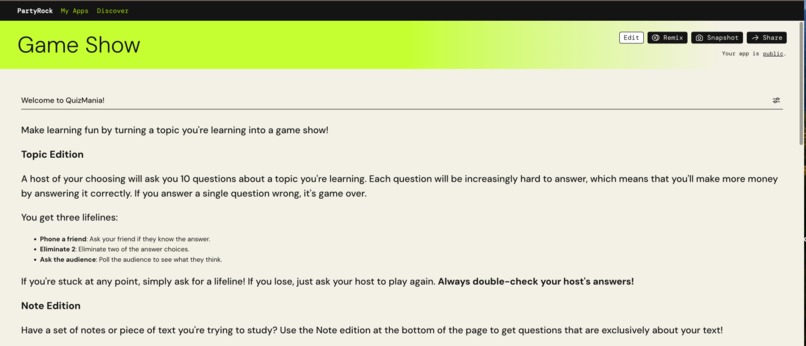
Synopsis of QuizMania
Inspiration
Everyone has been a student before, meaning that everyone knows that some subjects simply aren't the most fun to learn about. As a student myself, I've tried different studying processes to incentivize studying things I personally don't find very engaging. I have always loved watching shows like Who Wants to be a Millionaire and Jeopardy, with a recognition that, by the end of an episode, I learn something new. Combining these two ideas (that learning can sometimes be boring and that game shows are a fun way to learn) inspired me to create QuizMania, a PartyRock app that gamifies the studying process.
What it does
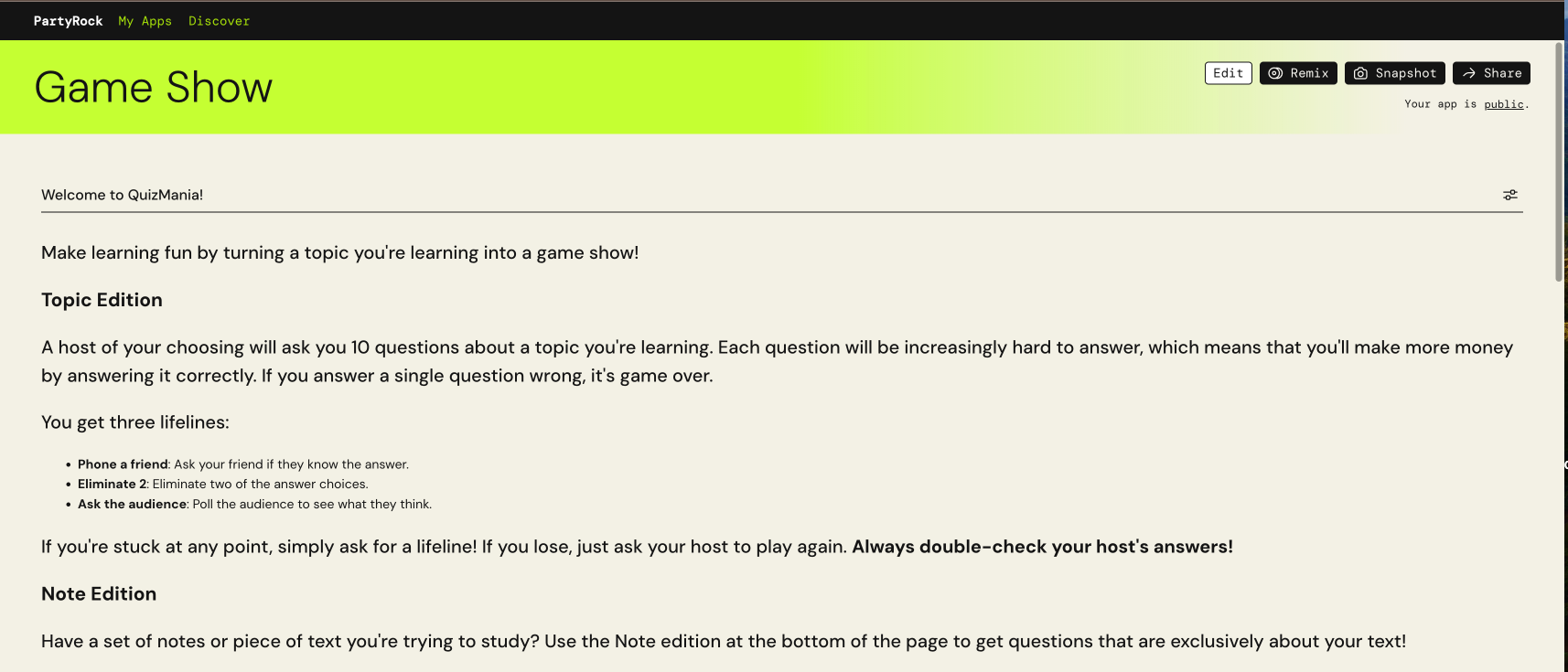
QuizMania is an LLM-powered game show where the questions can be about anything and everything. A game show host (via a chatbot) asks you 10 progressively harder questions about a topic you're studying, with each question being worth more and more money. You get three lifelines that can each be used once, and answering a question wrong ends the game. A couple of aspects of the game were engineered to make the game more engaging. For one, the player chooses the who the host is, which makes the game feel more personal and, at many times, much funnier. Second, the player chooses their friend, which makes the game better for the same reasons a custom host makes it better. This friend gives the player a pre-game speech encouraging them and acts as a lifeline when the player doesn't know an answer.
How we built it
Preliminary information (name, host, and friend) is entered using 'User Input' widgets. A Claude Instant LLM then generates a pump up speech for the user, and the image model generates a photographic style image of the host. Then, the user chooses between the Topic edition and the Notes edition of the game. The difference between the two editions is that, in the topic edition, the questions are based on a topic of the player's choosing and the Claude chatbot uses information it's learned during training to generate the questions. In the Notes edition, the player inputs some piece of text or notes they've taken, and the Cluade chatbot makes questions based on that text. The prompts for each chatbot are similar. They both detail the rules of the game and direct the LLM to make jokes and not reveal any answers. The main difference is that the Notes edition LLM is directed to cite the piece of text it used to generate an answer and is told not to give the player lifelines in order to encourage the player to read the text to get the answer.
Challenges we ran into
One of the main challenges in creating the game was preventing the LLMs from answering the questions that were asked. Initially, instead of a pump up speech, there was a commentator LLM that would comment on what was going on in the game by taking in the game show chat as input. However, it was too difficult to prevent this LLM from answering the questions, so I abandoned this idea and created a pre-game speech LLM instead. For the chatbots, I put the directive to never provide the answer until the player has answered toward the end of the prompt, as the LLMs seem to follow the directions given towards the end of a prompt better than those given in the beginning. The second major challenge was making the prompt as short as possible. It was difficult to create a prompt that the LLM would follow to a tee, as long prompts would cause the LLM to forget certain directions. Making sure each sentence was absolutely essential, and restating directives that were imperative to the functioning of the game, took lots of experimentation. Finally, ensuring every answer was correct turned out to be impossible. While most answers in the game show were correct, every now and then the chatbot would deem an incorrect answer as the correct one. Instead of abandoning the game show completely, I put a bold disclaimer in the directions that tells users to double check every answer. While unideal, this accounts for the few times the chatbot goes wrong and, if followed, may further solidify the learning process by forcing the player to seek out the information on their own.
Accomplishments that I'm proud of
The things I'm most proud of are the app's personalization capacity and how well it functions. As far as personalization goes, being able to choose your game show host and friend makes the game feel much more engaging. For example, I have just finished watching the Sopranos, so making Tony Soprano my host made it hard to stop playing the game, as his mafia-themed jokes throughout the game show made it extra entertaining. Choosing a character like Elmer Fudd as a friend and reading his trademark accent scattered throughout a pump-up speech was so enjoyable. And of course, I'm proud that the game (usually) works how it's supposed to. Getting the LLM to follow several sentences of directions without forgetting any took lots of iterations, and I'm proud that the game now works fairly well.
What I learned
I learned that the main strength of LLMs for game applications is also, at times, its biggest weakness. LLMs, unlike many other tools, allow you to create games that are dynamic and unpredictable. Even if all the inputs are the same, you never get the same game twice, which is great because it makes the game more engaging and fun to play. The downside of this unpredictability is that much experimentation with the prompts must be done to tame this variation such that the game can still function how it is supposed to. For example, on some runs the chatbot, after a few questions, may start answering questions on its own or start making up different lifelines than the ones outlined in the prompt, which ruins the game. Engineering a prompt that roped in the LLM while still allowing for healthy variation in each game was challenging, and even then the chatbot may still make some mistakes. However, even with its flaws, the game still more than accomplishes its purpose, which makes me excited for the future of these tools.
What's next for QuizMania
Games breed competition, and I believe that the obvious next step for a game like QuizMania is having a leaderboard or a keeping track of personal accomplishments when a player plays the game. This allows players to compete with others or themselves, which would further drive engagement and motivate players to use QuizMania as part of a their studying routine. The game as it is right now is obviously far from perfect, so I will continue making small improvements on the prompts to see if I can extract any more entertainment value and accuracy from the LLMs.
Built With
- partyrock

Log in or sign up for Devpost to join the conversation.