-
-
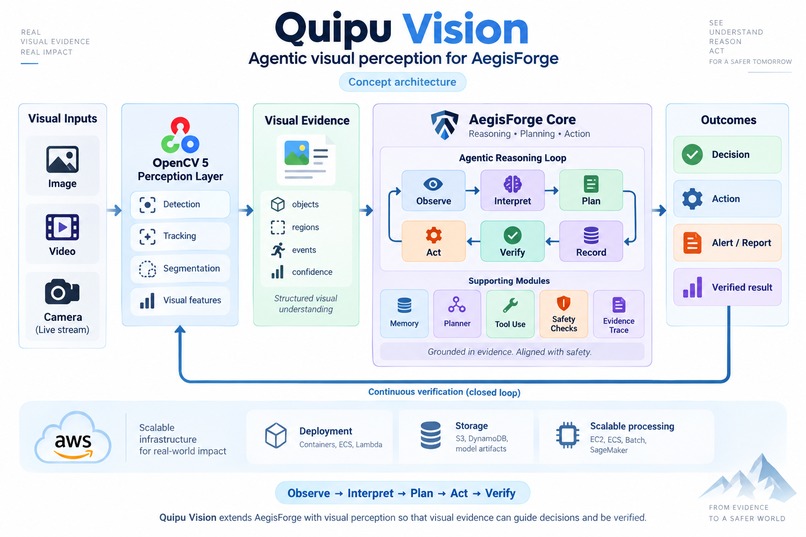
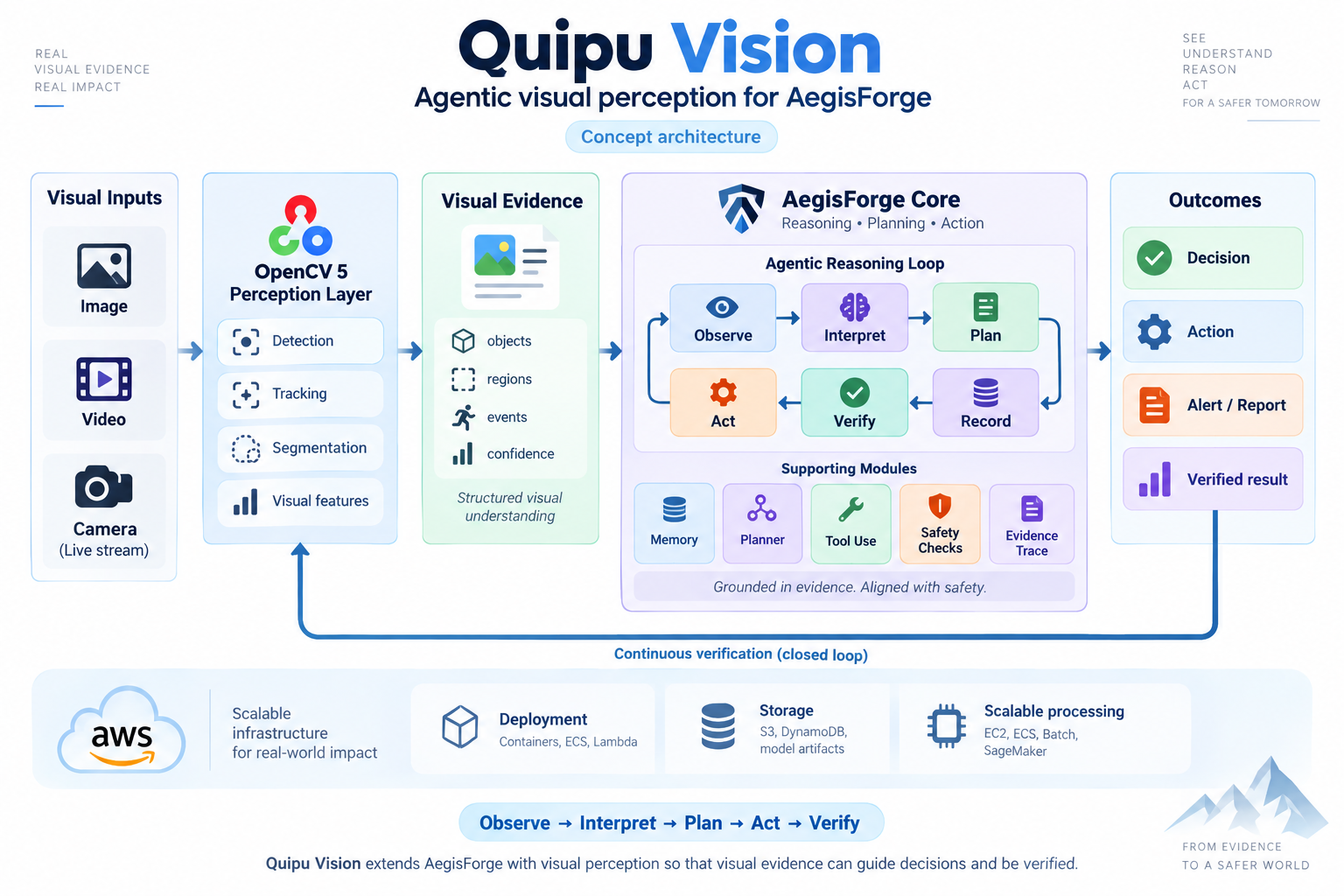
Concept architecture of Quipu Vision: OpenCV 5 perception integrated with AegisForge for reasoning, action, and verification.
Inspiration
Inspiration
Quipu Vision was inspired by the idea that an AI agent should not only process text, but also perceive visual information, reason about what it sees, make decisions, and verify outcomes.
It extends AegisForge by adding visual perception as a new capability.
What it does
Quipu Vision is an agentic computer vision system designed to connect OpenCV-based perception with AegisForge's reasoning and decision-making architecture.
The goal is to create a loop where the system can:
Observe → Interpret → Plan → Act → Verify
Instead of only describing an image, Quipu Vision is designed to use visual evidence to influence decisions and subsequent actions.
How we built it
The project is being developed in Python.
AegisForge provides the reasoning, planning, evidence tracking, verification, and agent workflow, while OpenCV 5 is being integrated as the visual perception layer.
AWS will support deployment, storage, and scalable processing components where needed.
The architecture is designed to remain modular so visual capabilities can be expanded without rebuilding the entire agent.
Challenges we ran into
One of the main challenges is transforming raw visual information into structured evidence that an AI agent can reliably use.
Another challenge is connecting perception with decision-making while keeping the process traceable and avoiding unnecessary or unsupported actions.
We also need to balance local processing with cloud infrastructure while keeping the system efficient.
Accomplishments that we're proud of
We already have AegisForge as a working foundation for planning, verification, evidence handling, safety checks, and multiple task domains.
Quipu Vision builds on that architecture instead of starting from scratch.
We have also defined a modular vision-agent pipeline that allows OpenCV perception to become part of the agent's reasoning and verification cycle.
What we learned
We learned that computer vision becomes much more useful for agents when visual outputs are treated as evidence rather than as simple descriptions.
We also learned that verification is especially important in agentic vision: the system should not only make a decision based on what it sees, but also check whether the result of that decision matches expectations.
What's next for Quipu Vision
The next steps are to complete the OpenCV 5 integration, connect visual observations directly to AegisForge's planning loop, deploy the required components on AWS, and evaluate the system on real visual tasks.
We also plan to add visual memory, stronger verification, and more specialized vision capabilities over time.

Log in or sign up for Devpost to join the conversation.