-
-
architecture
-

sample edit
-
benchmark

Inspiration
Generic writing tools fix grammar. They do not understand that your shorthands & habits, your teammate's name, or the paragraph open beside your draft may change what you meant.
Quip is our attempt at the next step: a Mac writing util backed by a local model that learns from the corrections you accept and uses nearby context.
What it does
- Select Quip Native as a Mac input source and type normally in a real text field.
- Quip reads a bounded typing burst plus optional local context, then asks a local model for up to five suggestions.
- The candidate bar appears near the caret; accepting replaces only the tracked burst.
- Accepted and dismissed suggestions become local learning signals for personal shorthand and future per-user adapters.
How we made it
We replaced the fragile Accessibility-first typing path with a Swift InputMethodKit source. Quip Native passes literal typing through, tracks the verified UTF-16 range and caret, and only applies a replacement after explicit selection.
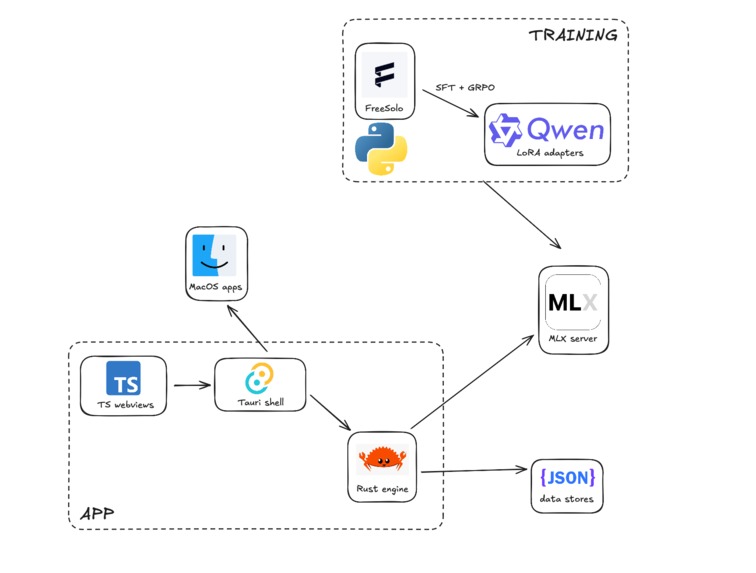
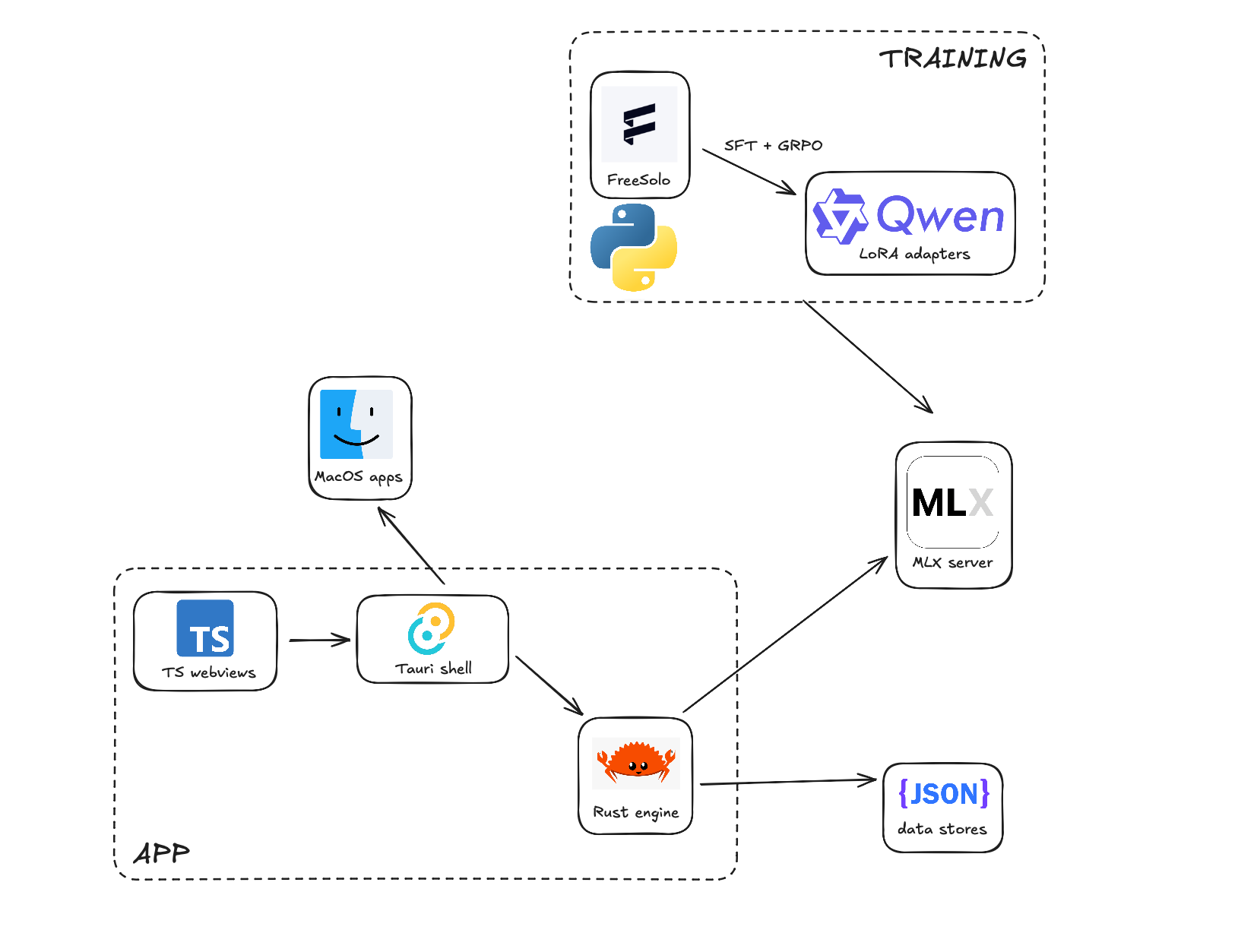
The app itself is Tauri with a Rust composition engine. A loopback bridge connects the input method to the engine, and a persistent Rust sidecar calls local MLX model servers running Qwen3.5-2B plus the Freesolo-trained Global LoRA adapter.
For the model, we trained Quip-specific adapters with Freesolo Flash instead of relying on a generic base model. The training data teaches the model the behavior Quip needs: expand shorthand, fix messy typing, use context when it helps, and leave the user's text alone when there is nothing useful to change.
Challenges we ran into
- macOS app coverage was the wall. Accessibility could inspect some fields, but not reliably enough across modern apps. We switched the main live-typing path to InputMethodKit and kept Accessibility for bounded window context and existing-text fallback.
- The model had to be useful without being pushy. We made every completion return one full-text JSON suggestion, then filtered exact matches and ranked deduplicated candidates instead of auto-editing text.
- Local inference had to be demoable. We moved to MLX loopback model servers, added health checks and latency tooling, and kept fixture mode as a fallback when model artifacts or startup time are risky.
- Personalization can become creepy or noisy. Quip records accepted corrections and stable dismissals as compact local examples; it does not treat every keystroke as a training label.
Accomplishments that we're proud of
- We built a real macOS input-method path instead of faking typing inside a web demo.
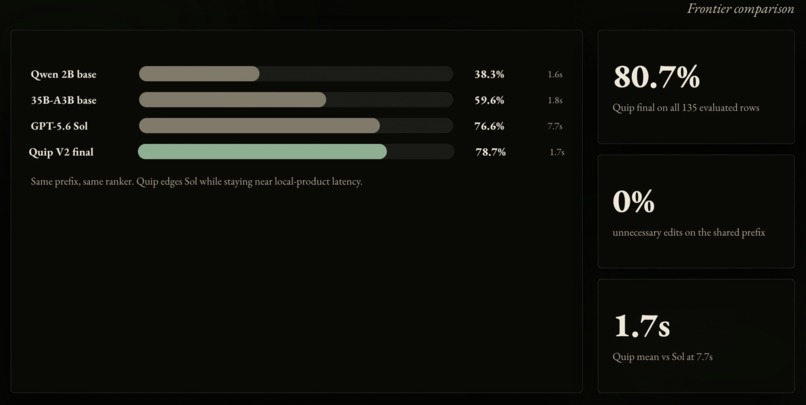
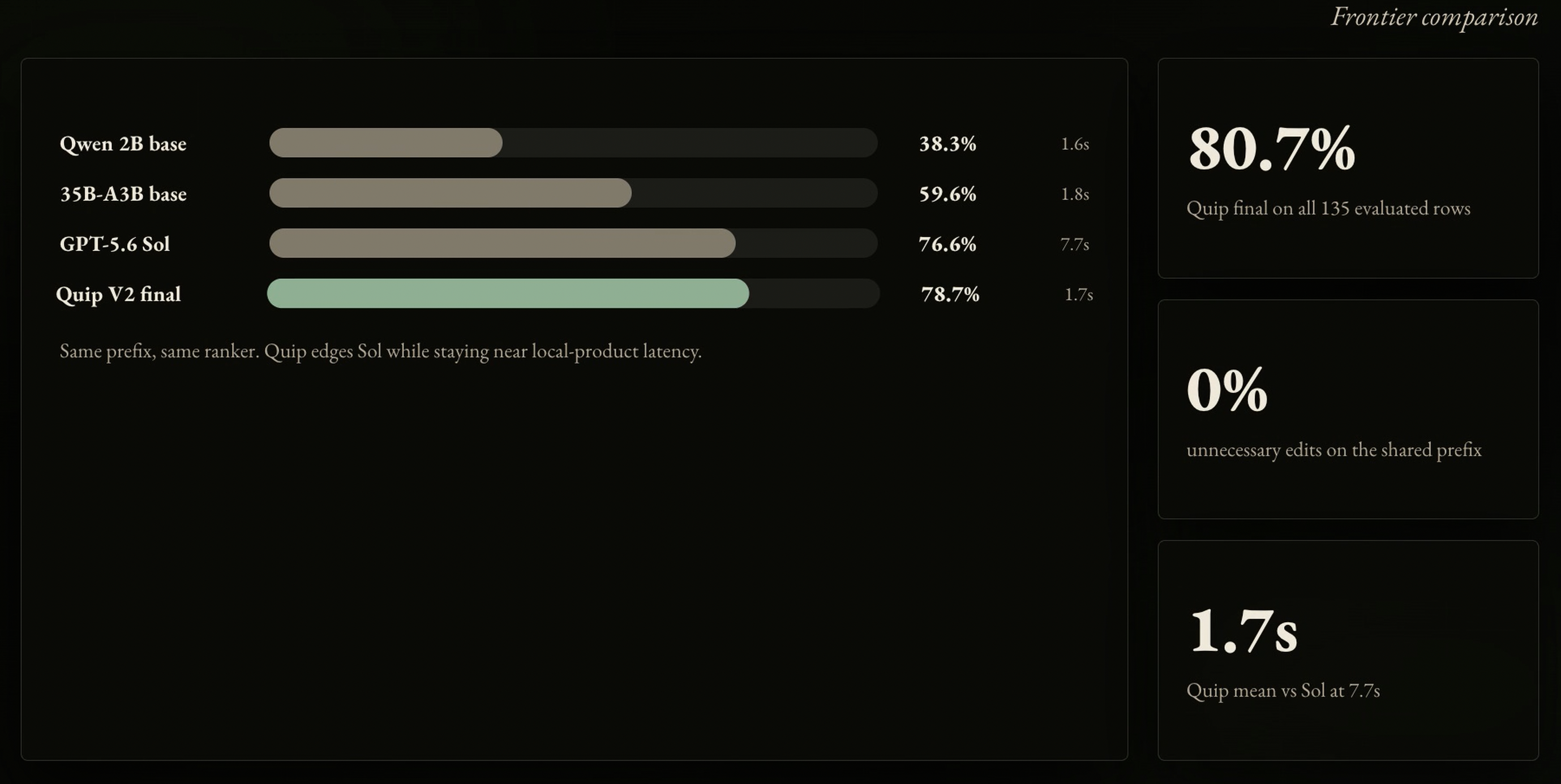
- We trained and evaluated Freesolo LoRA adapters instead of wrapping a generic cloud autocomplete API.
- We made the model contract strict: five schema-valid completions, exact-match filtering, deduplication, vote ranking, and explicit user selection.
- We connected the product story end to end: local typing, local inference, bounded context, learning signals, and a credible per-user adapter path.
What we learned
- On macOS, "works while typing" is an input-method problem, not just an Accessibility problem.
- Correction quality is not only about fixing more text. A good writing model also needs to know when to leave the user's words alone.
- Personalization is strongest when it comes from confirmed user choices, not passive scraping.
What's next for Quip
- Harden Quip Native across TextEdit, Notes, Chrome, Safari, and common browser fields.
- Finish the per-user adapter loop: package confirmed local examples, train a private Freesolo profile adapter, and load it next to the global adapter.
- Improve local latency with more caching, better model warmup, and tighter prompt construction.
- Polish installation so Quip feels like a normal Mac input source, not a hackathon setup script.
Built With
- fine-tuning
- freesolo
- lora
- python
- rust
- swift
- tauri
- typescript


Log in or sign up for Devpost to join the conversation.