-
-
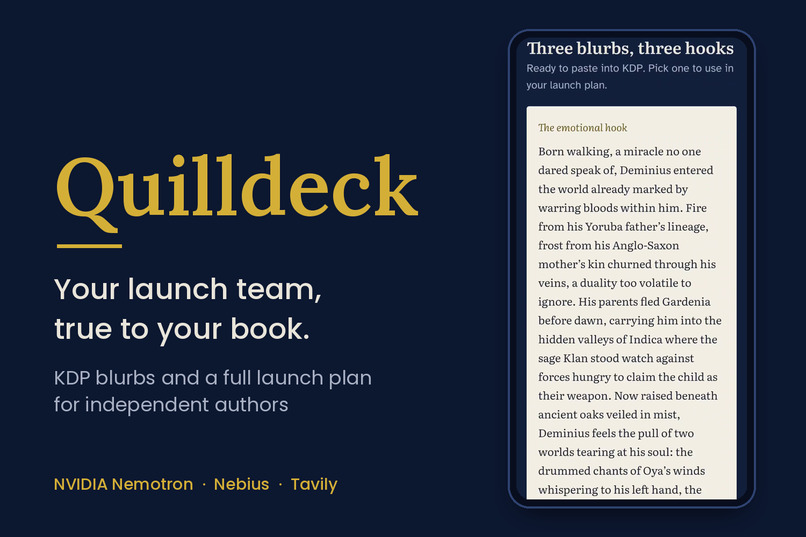
Quilldeck: KDP blurbs and a full launch plan, true to your book
-
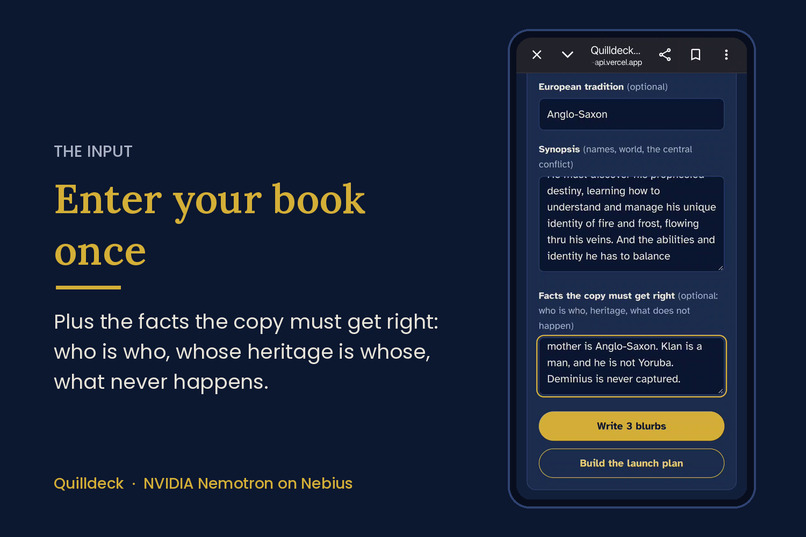
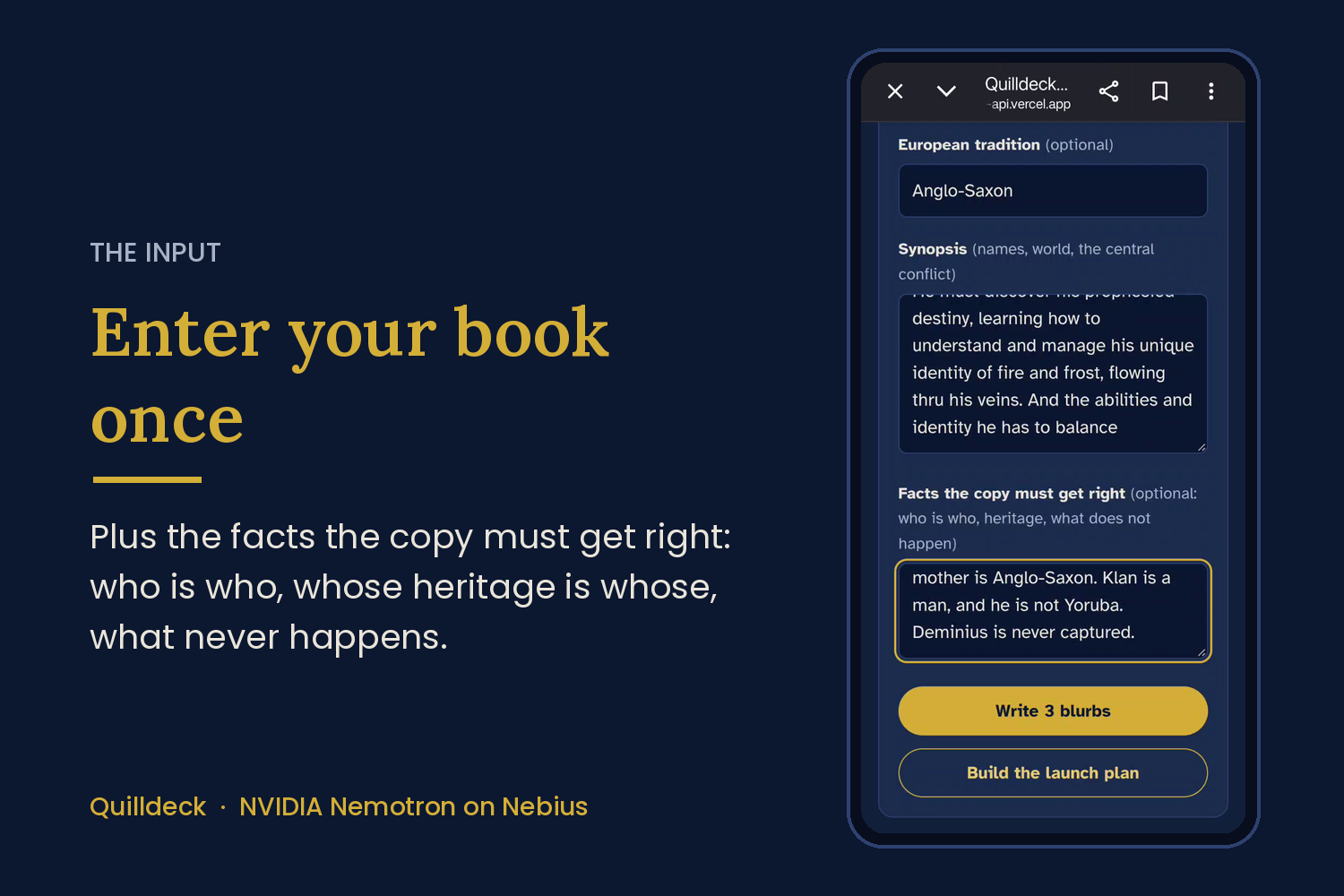
Enter your book once, with the facts the copy must get right
-
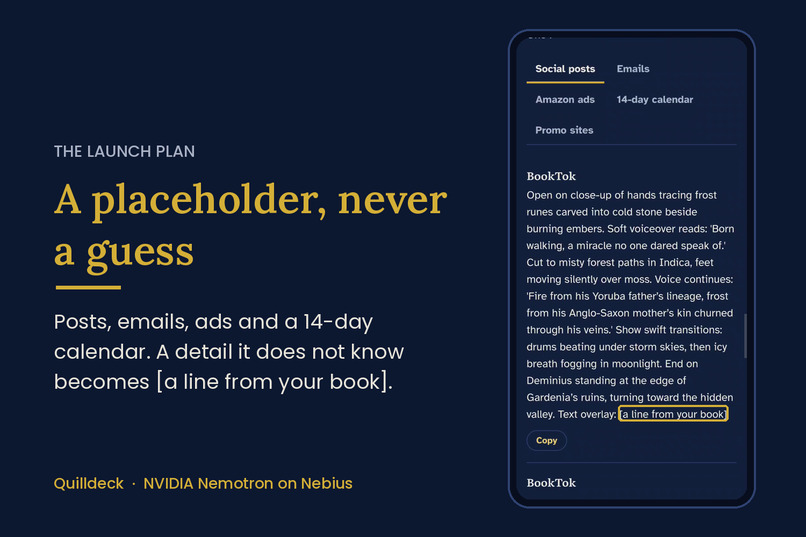
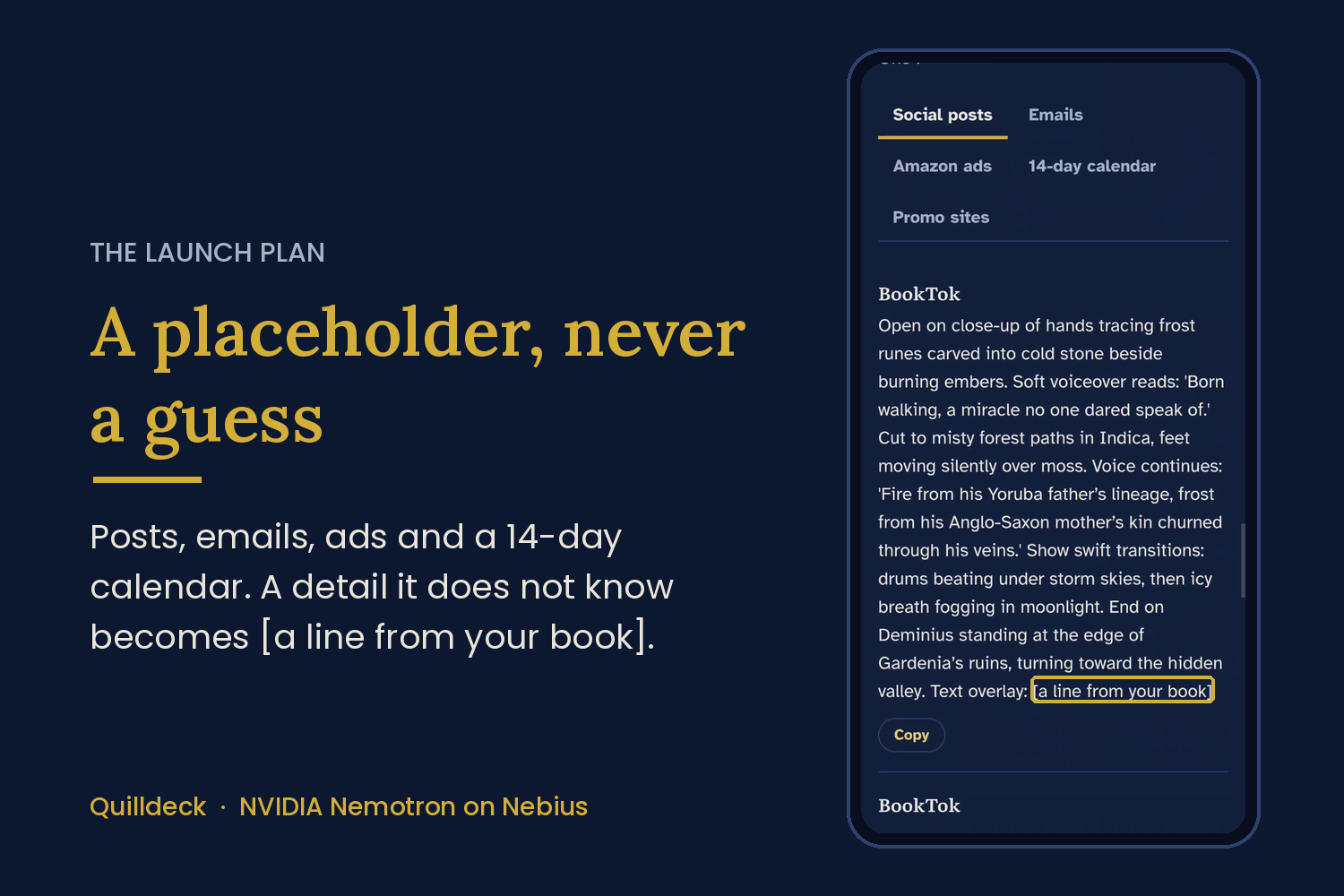
Where a detail is missing, it leaves a placeholder instead of inventing one
-
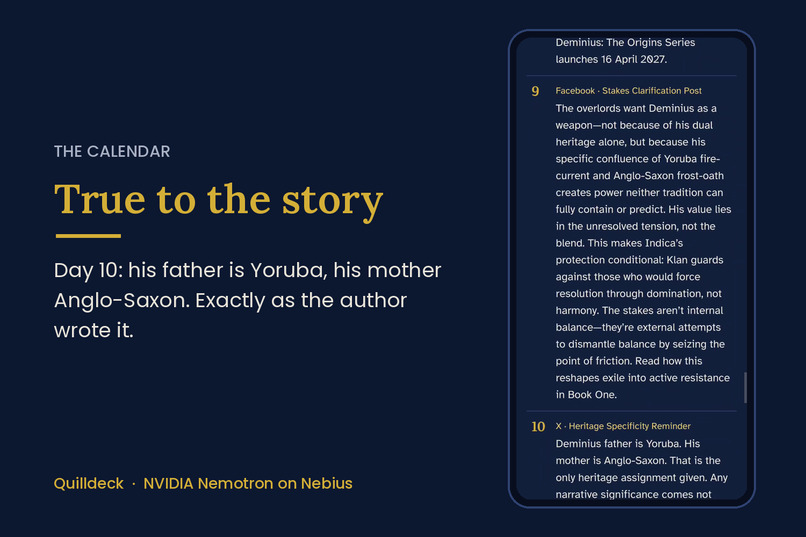
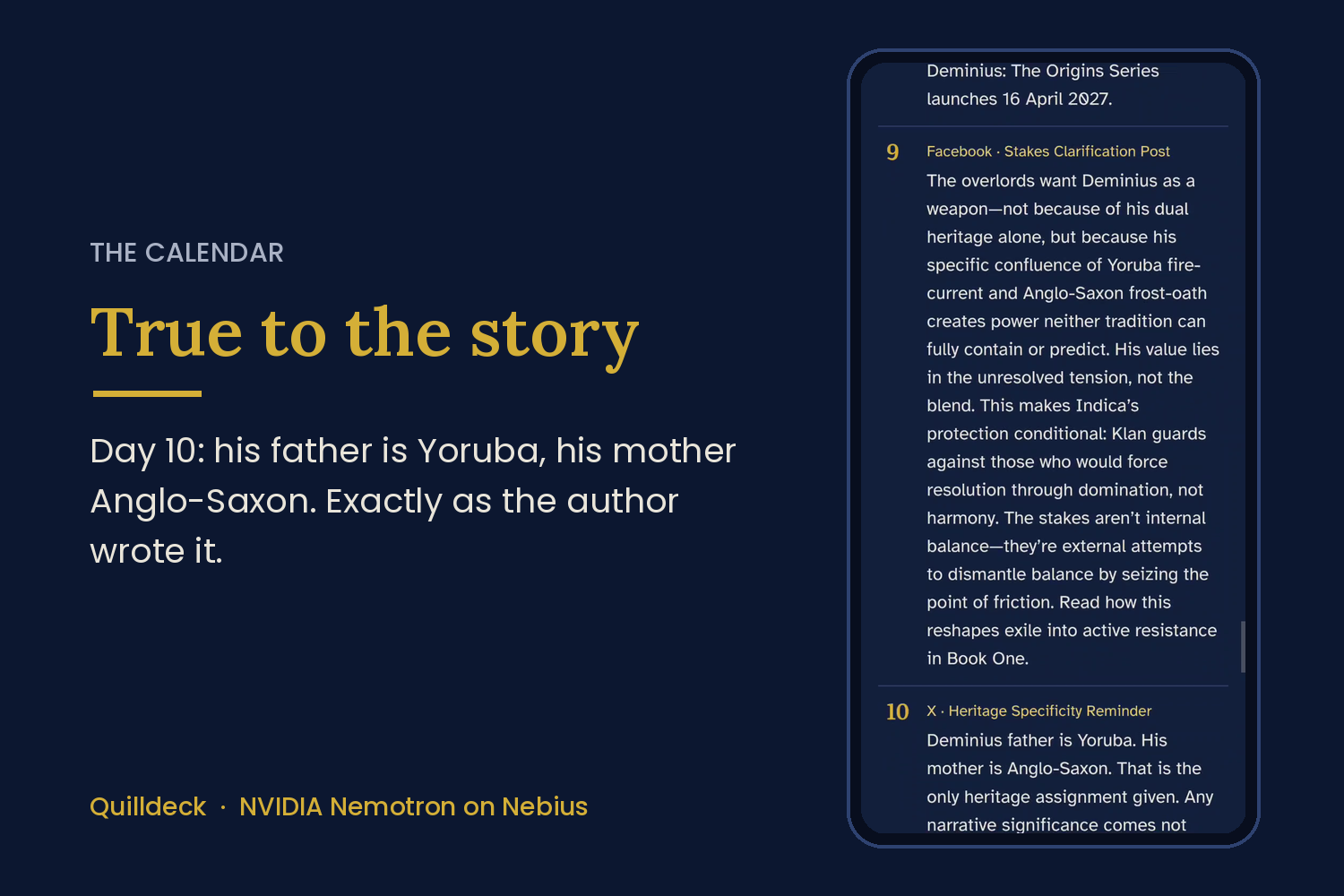
Day 10 of the calendar keeps the hero's heritage exactly as the author wrote it
-
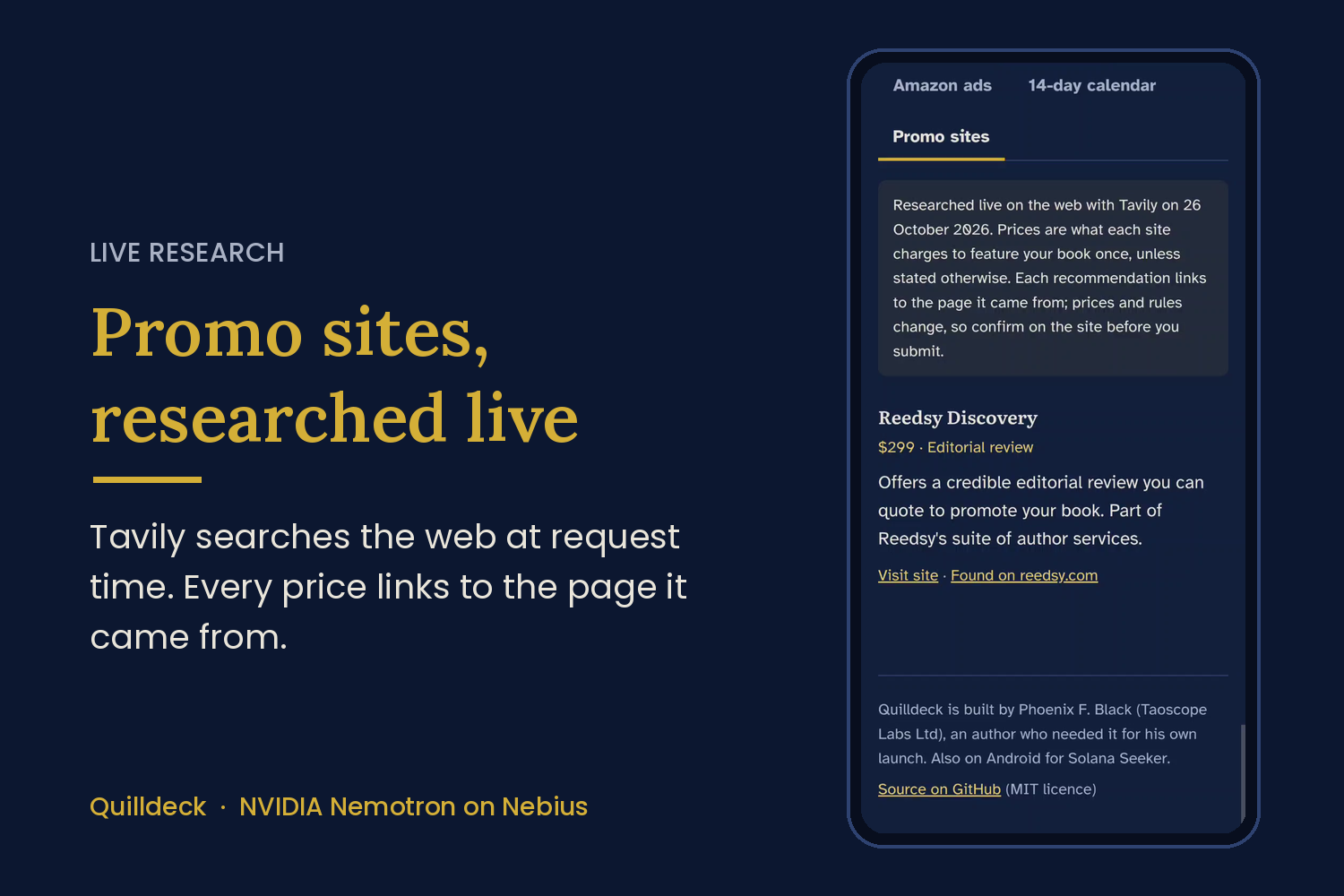
Promo sites researched live with Tavily, each price linked to its source
Inspiration
I am an author. When I finished my novel, The Silent One, I found the writing was only half the job. An independent author then has to become a copywriter, an ad buyer and a social media manager, alone and usually with no budget. I tried general AI tools for my launch copy and hit a worse problem than blank pages: they filled every gap in my synopsis with things I never wrote. One swapped which parent my hero's heritage comes from. Another invented an abduction that never happens in the book. Copy that misrepresents your book is worse than no copy at all. So I built the launch team I never had, and made it stick to the book.
What it does
Quilldeck is a free web app. The author enters their book once: title, series, launch date, genre, synopsis, and the facts the copy must get right (who is who, whose heritage is whose, what never happens).
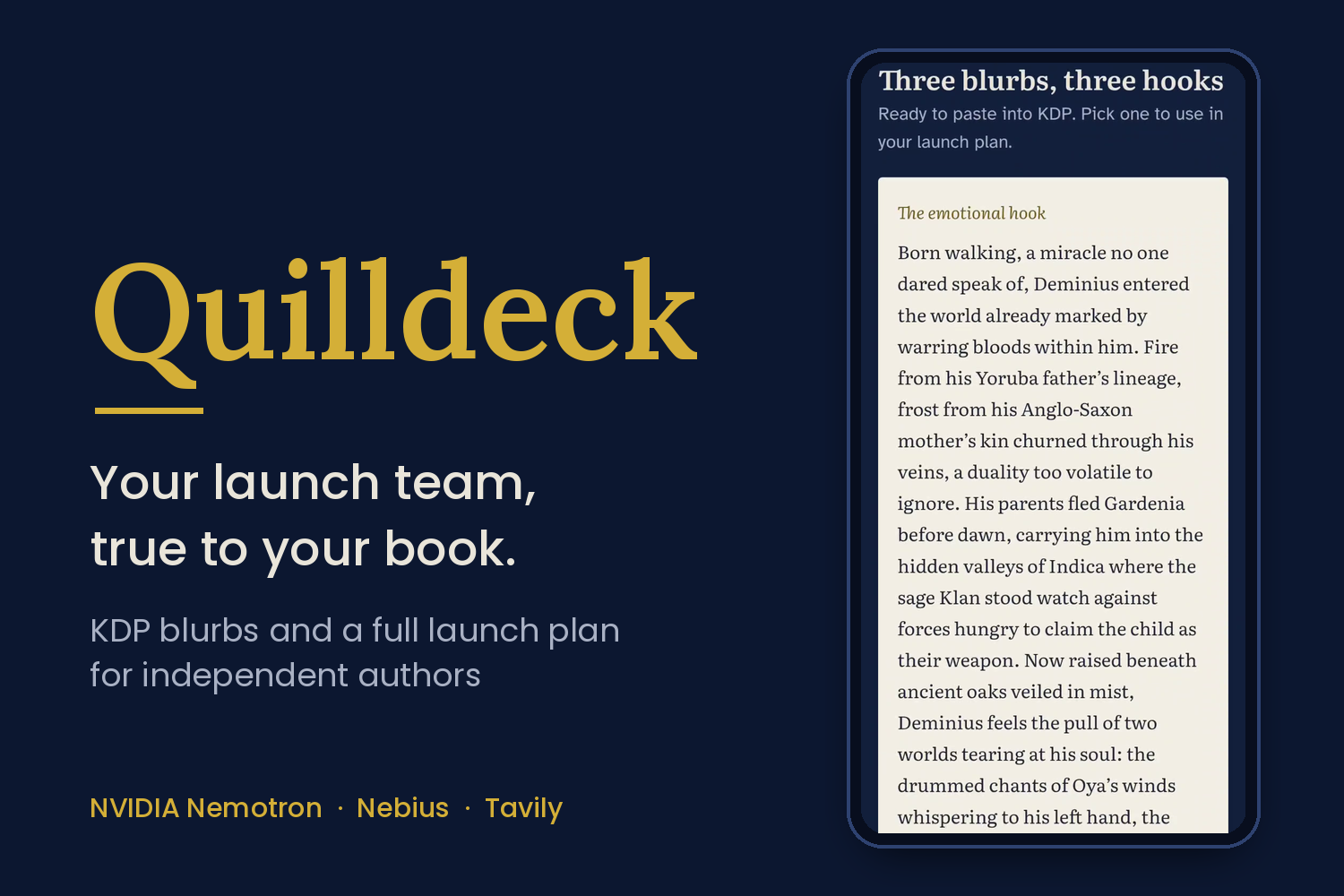
- Three blurbs in seconds. KDP-ready, 150 to 200 words, each with a different hook: emotional, action and mystery. The author picks one to carry forward.
- A launch plan in one tap. Platform-specific social posts (BookTok, Bookstagram, X, Facebook), launch emails signed by the author, Amazon ad variants with keywords, and a 14-day posting calendar.
- A placeholder, never a guess. Where a detail is missing, such as a pre-order link or a line from the book, Quilldeck leaves a clear placeholder like [a line from your book] instead of inventing one.
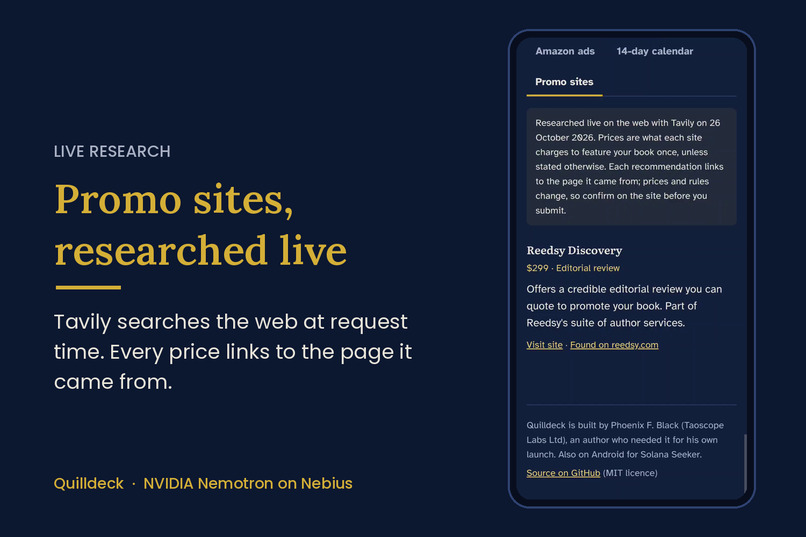
- Promo sites researched live. Tavily searches the web at request time for promotion services that suit the book's genre. Nemotron picks the best using only those pages, and every recommendation links to the page its price came from.
- House style built in. British spelling, no em dashes, character names corrected to the author's exact spelling.
How we built it
The agent workflow: plan, write, check, repair, research
Quilldeck does not send one prompt and hope. Each request runs as a small agent workflow on Nemotron:
- Plan. The book is entered once. The app turns it into separate jobs (blurbs; posts and emails; Amazon ads; a 14-day calendar; promo research), each carrying the author's facts and an exact-spelling list of the book's names.
- Write. Nemotron drafts each part, in parallel where it can.
- Check its own output. The server inspects every result for missing sections, echoed templates, and blurbs that are too short, unpunctuated or in the first person. It keeps what passes and asks again only for what failed.
- Fact-check and repair. A second Nemotron pass acts as a continuity editor. It reads the blurbs against the author's synopsis and facts, flags any sentence that contradicts them, invents a specific event, name or quotation, or misspells a name, and makes the smallest fix. A repair is accepted only if it still passes every quality check, and the author sees exactly what was corrected and why.
- Research and verify. For promotion, Tavily searches the live web, Nemotron chooses only from what was found, every recommendation must cite a source, and every website link is checked before it is shown.
Under the hood:
- Model: every word comes from a live call to
nvidia/nemotron-3-super-120b-a12bthrough the Nebius Token Factory OpenAI-compatible API. - Backend: Vercel serverless functions in TypeScript, one per job (blurbs, launch plan, promo research), with no other dependencies.
- Speed: reasoning is switched off with
chat_template_kwargs: {"enable_thinking": false}, which took blurbs from 30 to 90 seconds down to roughly 4 to 18, with no visible loss in quality. It falls back automatically if an endpoint rejects the setting. - Reliability: the launch plan runs as four parallel requests. The server checks every expected section and retries only what is missing. Blurbs that echo the JSON template, run short, lack punctuation or slip into first person are rejected and regenerated.
- Story accuracy: every prompt treats the synopsis and the author's facts as the only source of truth, carries an exact-spelling list of the book's names, and forbids invented events, giveaways, prices, handles and quotes. The page then checks the output again: it corrects near-miss names and replaces any "quote from the book" that is not actually in the author's text.
- Research: three Tavily searches in parallel, recent pages first. Any recommendation that does not cite a URL Tavily returned is dropped, and a "Visit site" link only appears when the address is real, carries the service's name and is not a parked domain.
Challenges we ran into
- Invented story facts. Given a synopsis, Nemotron confidently filled the gaps: swapped heritage between parents, assigned a character the wrong gender and culture, invented events. The fix was the facts field, explicit fidelity rules in every prompt, and checks after generation.
- Name drift. Invented names drifted between runs (Gardenia, Gardena, Gardinia). We now pass an exact-spelling list and correct near misses automatically.
- Missing sections. A single five-part JSON request sometimes came back with whole sections missing. Splitting it into parallel requests with per-section validation fixed it.
- Wrong links. The model gave wrong or non-existent official addresses for well-known services, and search results were often list articles. Every link is now checked before it is shown.
Accomplishments that we're proud of
- A fact-check that runs before the author sees anything: a second Nemotron pass checks every blurb against the author's own facts, repairs contradictions and invented details, and shows exactly what it changed.
- I put my own book launch on hold to rebuild Quilldeck for this hackathon. With this version I am now confident enough in the copy to resume launching The Silent One with it. The demo video is that real launch, not a mock-up.
- It is truly "enter your book once". The old app made authors retype their details at every stage; now one entry feeds the blurbs and the whole launch plan.
- It respects an author's world. The Afroeurofantasy support lets the named African and European traditions shape the copy without guessing who carries which heritage.
- Blurbs in seconds, a full launch plan in about 15, and promo prices you can trace back to their source.
What we learned
- Reasoning is not always worth the wait. For creative copy, Nemotron 3 Super with thinking off was several times faster with no loss we could see.
- Accuracy needs to be designed in, not hoped for. The model writes well, but it will fill silence with invention unless the author's facts are treated as the boundary.
- Live search beats model memory for anything with a price on it, but it still needs checking: search results are not the same as official sources.
What's next for Quilldeck
- Collecting feedback from authors through the app, on usefulness, accuracy and what they would pay.
- A story bible that keeps names, places and facts consistent across a whole series.
- Bringing these improvements to the Quilldeck Android app.
Built With
- css
- html
- javascript
- nebius-token-factory
- nvidia-nemotron
- tavily
- typescript
- vercel

Log in or sign up for Devpost to join the conversation.