-
-
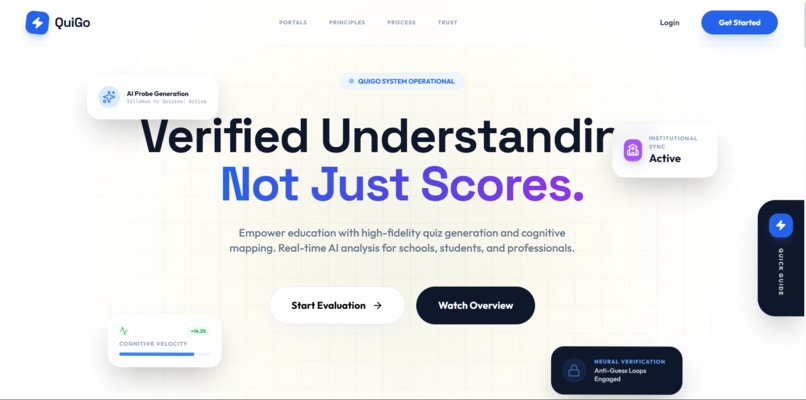
the hero page
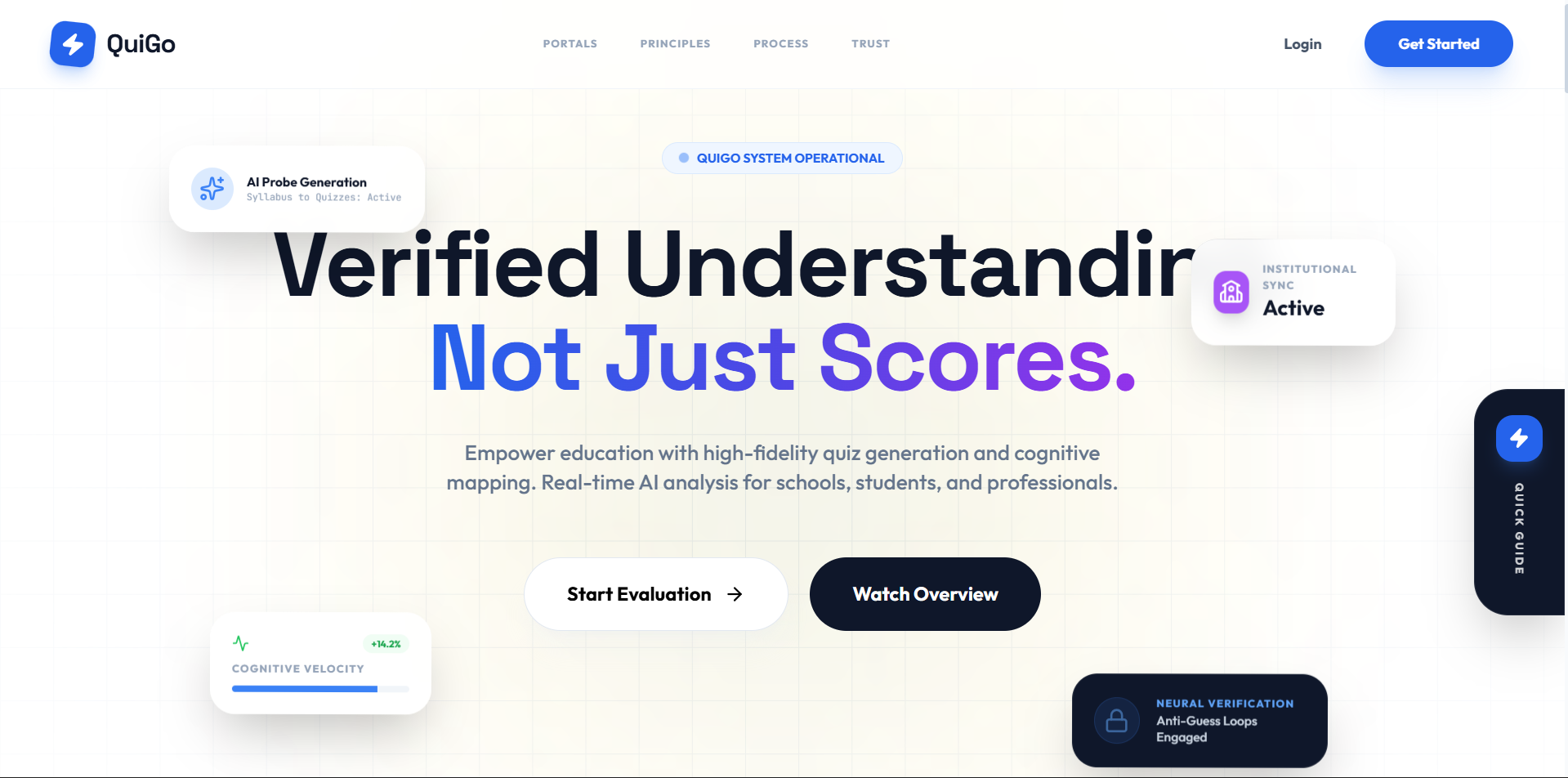
Inspiration
The inspiration for Quigo came from notebooklm, I was like “can’t schools use ai to set quizzes or test”, because after using notebooklm to do some research and learning why can’t schools use this format as well.
I was also thinking of the immense load on educators in our current system. Teachers often spend a disproportionate amount of time marking assessments and setting tests for large numbers of students. I asked myself: “Why can't AI handle the heavy lifting of test creation, scoring, and feedback?” Quigo was born to automate the assessment lifecycle generating tests, scoring students, and providing deep insights into strengths, weaknesses, and personalized recommendations. Additionally, by generating dynamic questions, it helps curb the issue of leaked examination papers.
What it does
Quigo is an advanced, AI-powered Learning Management System (LMS) designed to streamline the creation, administration, and evaluation of educational assessments. It bridges the gap between raw Generative AI and a structured terminal for modern education.
How we built it
The creation of Quigo represents a sophisticated fusion of modern web development and cutting-edge artificial intelligence. At its foundation, the project was built using a high-performance, full-stack architecture that prioritizes scalability, security, and the fluid integration of large language models.
The technical backbone of Quigo is programmed primarily in Python and TypeScript. For the backend, FastAPI was chosen for its asynchronous capabilities and speed, allowing the system to handle intensive AI processing without blocking user interactions. This backend acts as the "brain," managing a relational database structured with SQLAlchemy and SQLite. This database was meticulously designed to handle a complex hierarchy ranging from administrative school profiles to individual student testing credentials ensuring data integrity across thousands of potential users.
On the frontend, the project utilizes React paired with Vite and TypeScript, creating a fast, type-safe environment. This layer provides the interface for Quigo’s most innovative features: a dynamic "Quiz Architect" for teachers and a secure, timed "Student Terminal" for test-takers. The decision to use TypeScript ensures that the complex data structures moving between the AI and the user remain robust and error-free.
However, the true centerpiece of Quigo is its AI orchestration. By integrating the Google Gemini SDK, you built a system that doesn't just display information, but generates it. Through sophisticated prompt engineering, the backend sends structured requests to Gemini, which are fed context by LlamaParse a tool used to transform complex PDFs into clean, searchable Markdown. This enables the "Retrieval-Augmented Generation" (RAG) that allows Quigo to create highly accurate assessments from any source document.
Ultimately, Quigo was built by layers: starting with a rigid database foundation, moving into a flexible API layer, and finally crowning it with an AI-driven interface that automates the traditionally manual tasks of quiz creation and subjective grading.
Challenges we ran into
The major challenge i faced was when my token limit was reached when i was still trying to get and test the quizzes that were generated
Accomplishments that we're proud of
When I was finally able to get the rest from the generated quiz, especially how the reasoning works in the theory test format, i was really surprised at the result of it looking at the student thought and comparing it to the question
What we learned
Building Quigo was a deep dive into the practicalities of modern AI engineering. Key technical areas I mastered include:
- Advanced Prompt Engineering: Implementing negative constraints, structured outputs, and context management to ensure high-quality, reliable results.
- JSON Sanitization & Data Processing: Developing robust logic to handle occasionally "brittle" LLM responses and stripping away markdown artifacts.
- RAG (Retrieval-Augmented Generation): Utilizing LlamaParse to professionally ingest complex PDFs, converting them into LLM-friendly Markdown for accurate context injection.
- Automated Subjective Grading: Engineering AI as a judge to evaluate open-ended theory answers—a task traditionally impossible for standard program logic.
- Multi-Model Orchestration: Coordinating different models for specialized tasks like content generation versus performance evaluation. ## What's next for Quigo I wish for quigo to be added as part of the Google Ai software and agent which allows schools to set test and quizzes for their students since almost everyone has a Google account. I would also want add more features to it like diagram drawings test, debate sections and monitoring of student while taking the test
Built With
- fastapi
- postgresql
- pydantic
- python
- react
- sqlalchemy
- sqlite
- typescript
- uv
- uvicorn

Log in or sign up for Devpost to join the conversation.