Inspiration
Grand Theft Auto VI comes out on November 19, 2026, and the indie release calendar is reshuffling around it. GamesBeat reports that smaller studios are moving their launches, "particularly for mid-core and hardcore titles that share overlapping audiences with GTA" (GamesBeat, April 20, 2026). Others keep the same day on purpose: two indies launch on November 19 because, their studios say, their players are different (GameDev.net, September 29, 2026).
It happened last year too. When Hollow Knight: Silksong was dated with two weeks' notice, at least eight games moved their release (Game Developer, August 28, 2025).
Both camps are betting on the same unknown: does that big release share my players? Release calendars count games per week. None of them says whose players a big launch will take. An indie studio usually gets one launch week, and today it guesses. That question is about taste, which is exactly what Qloo measures.
What it does
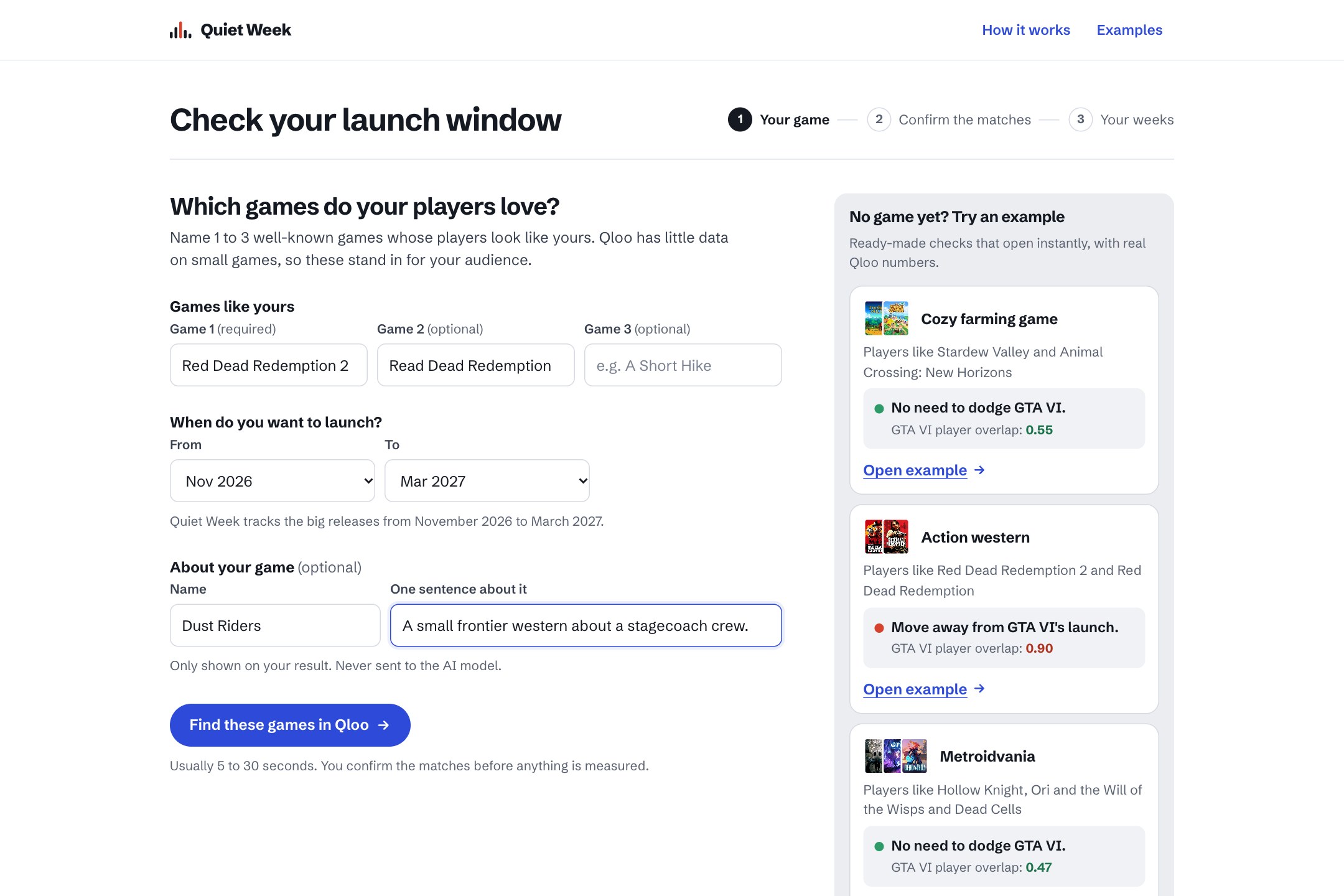
You name 1 to 3 well-known games whose players look like yours, and your launch window. Quiet Week tells you whether to move, and which weeks are quiet for you.
- Your game. Type the games, typos included. No game yet? Open one of three ready-made examples from the same screen.
- Confirm the matches. An AI agent finds each game in Qloo, fixes the typo, checks that Qloo has audience data for it and suggests a better-known game when it does not. You confirm each pick, with its cover, before anything is measured.
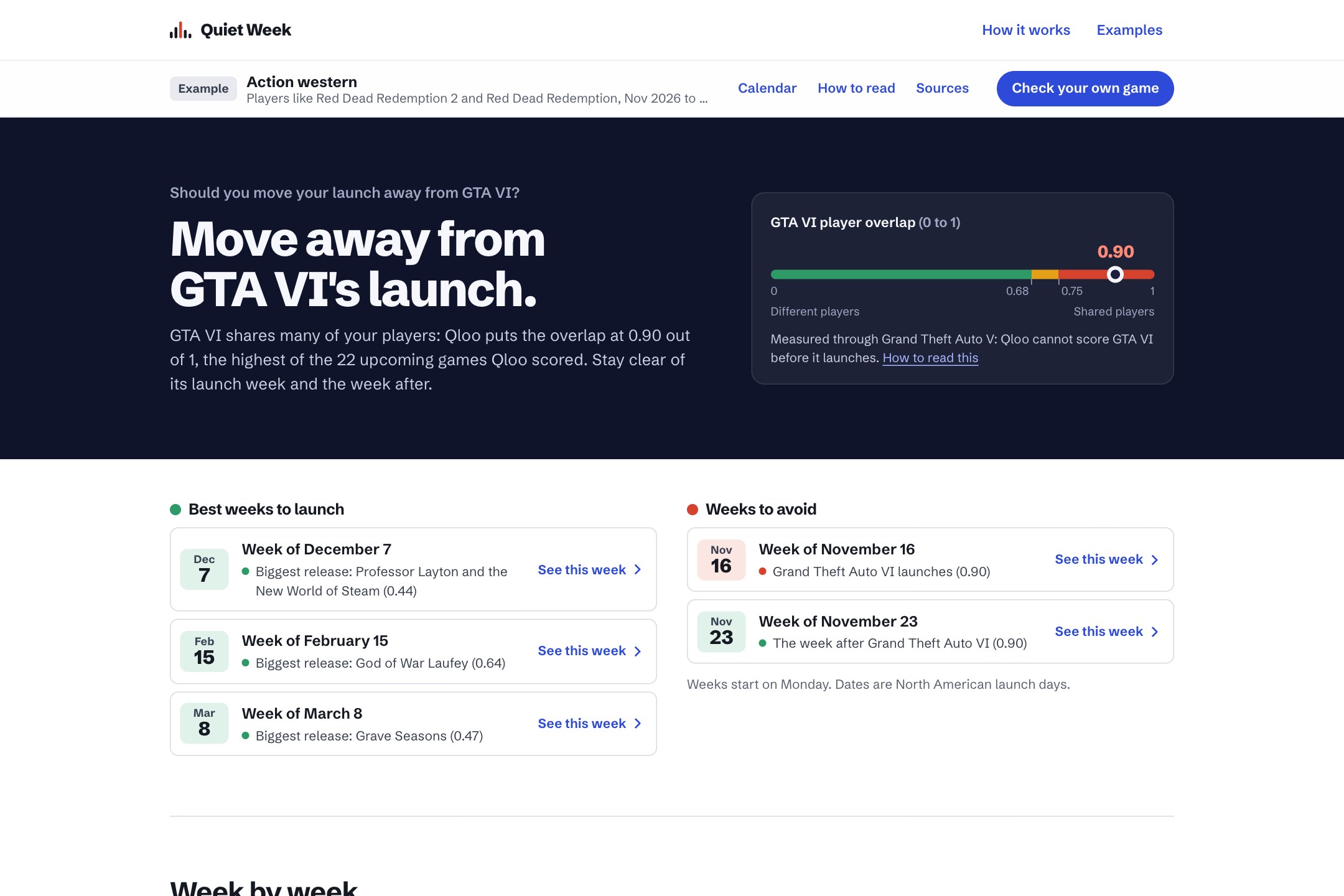
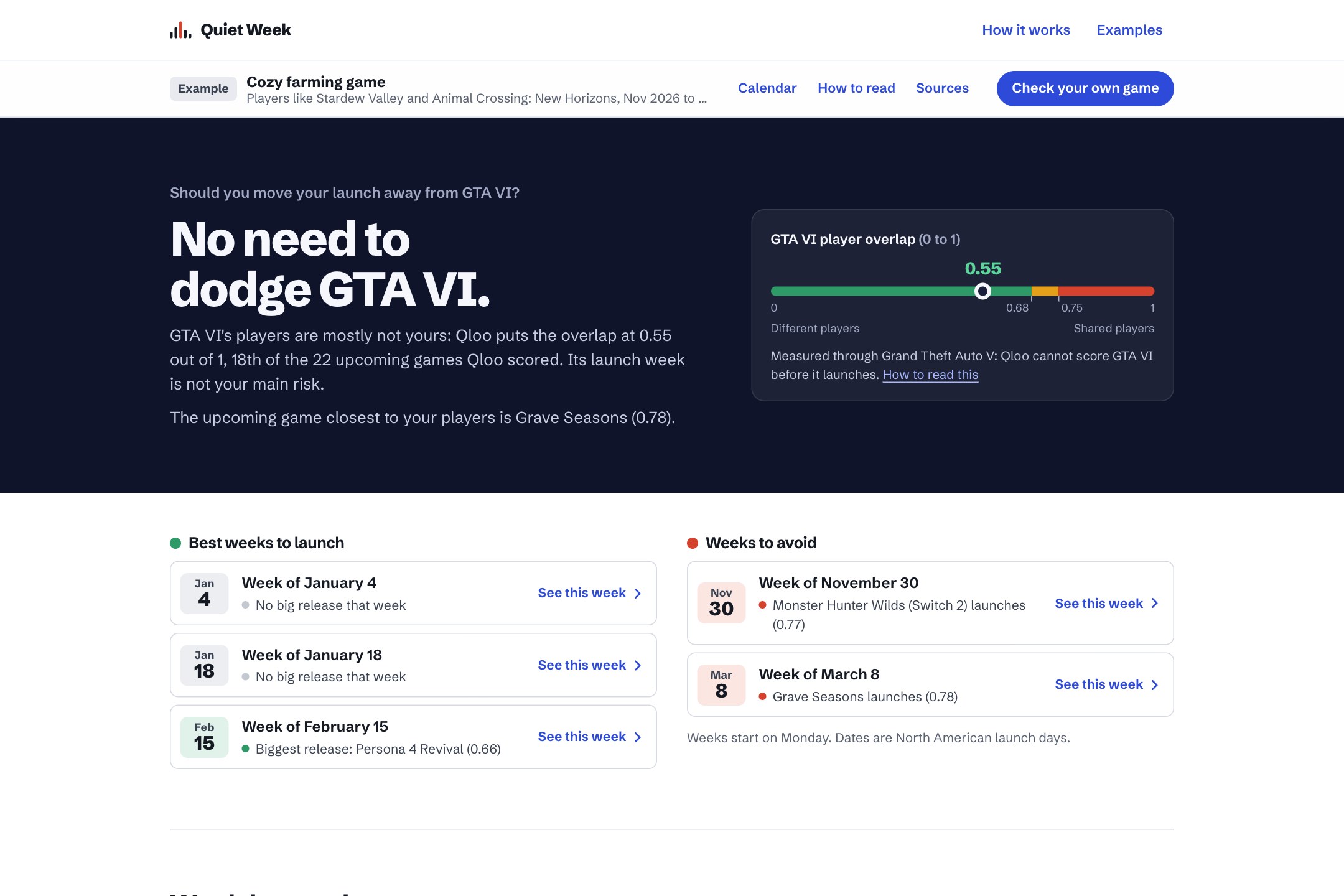
- Your weeks. The answer comes first: one sentence ("Move away from GTA VI's launch" or "No need to dodge GTA VI"), the GTA VI player overlap on a 0 to 1 scale, the three best weeks and the two to avoid. Below it:
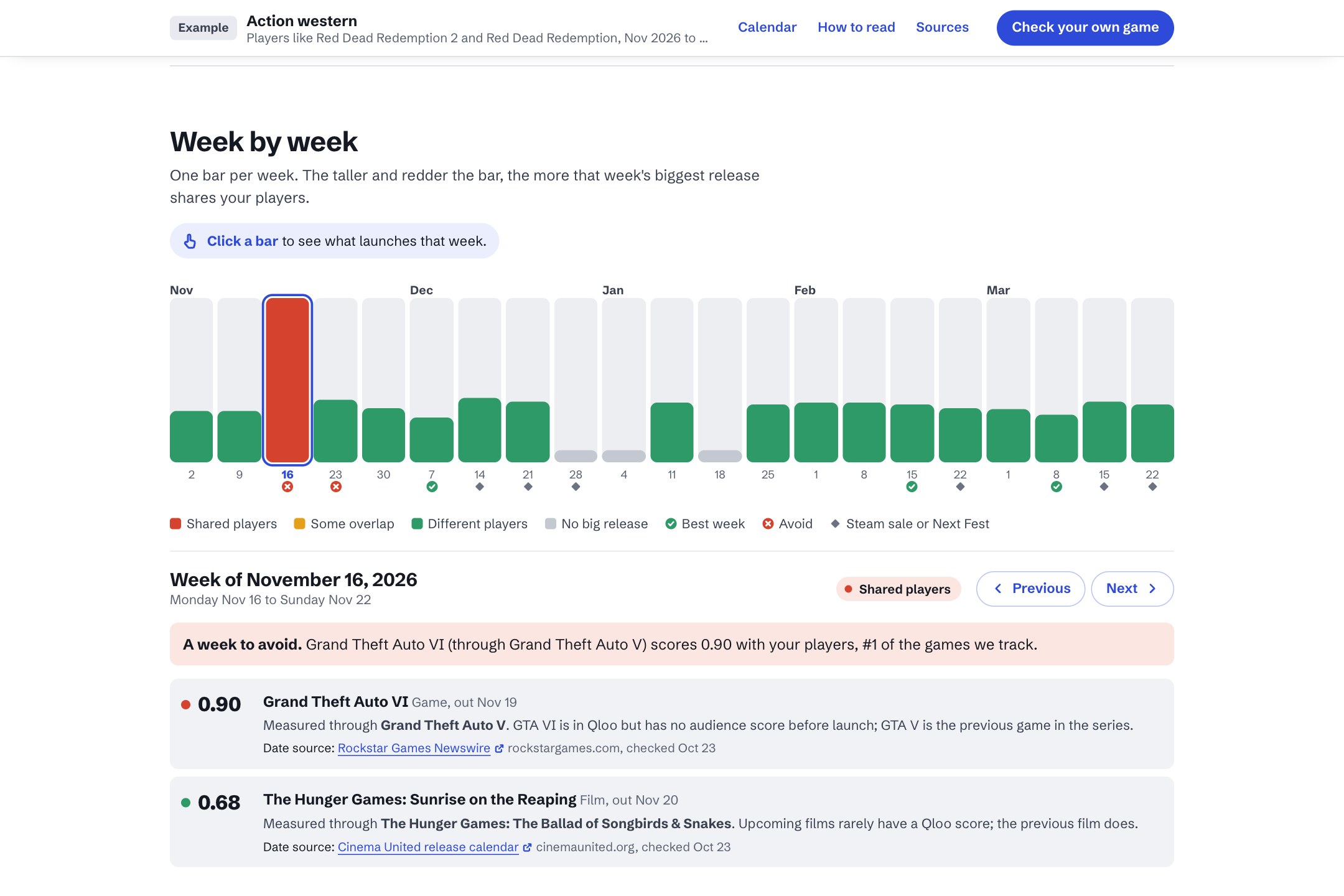
- Week by week: 21 weeks from November 2026 to March 2027, one bar each. Height and colour show how much that week's big releases share your players. Click a bar to see every release that week, its Qloo score, what it was measured through and the source of its date.
- How to read this: the score, the colour rule and the limits, explained once.
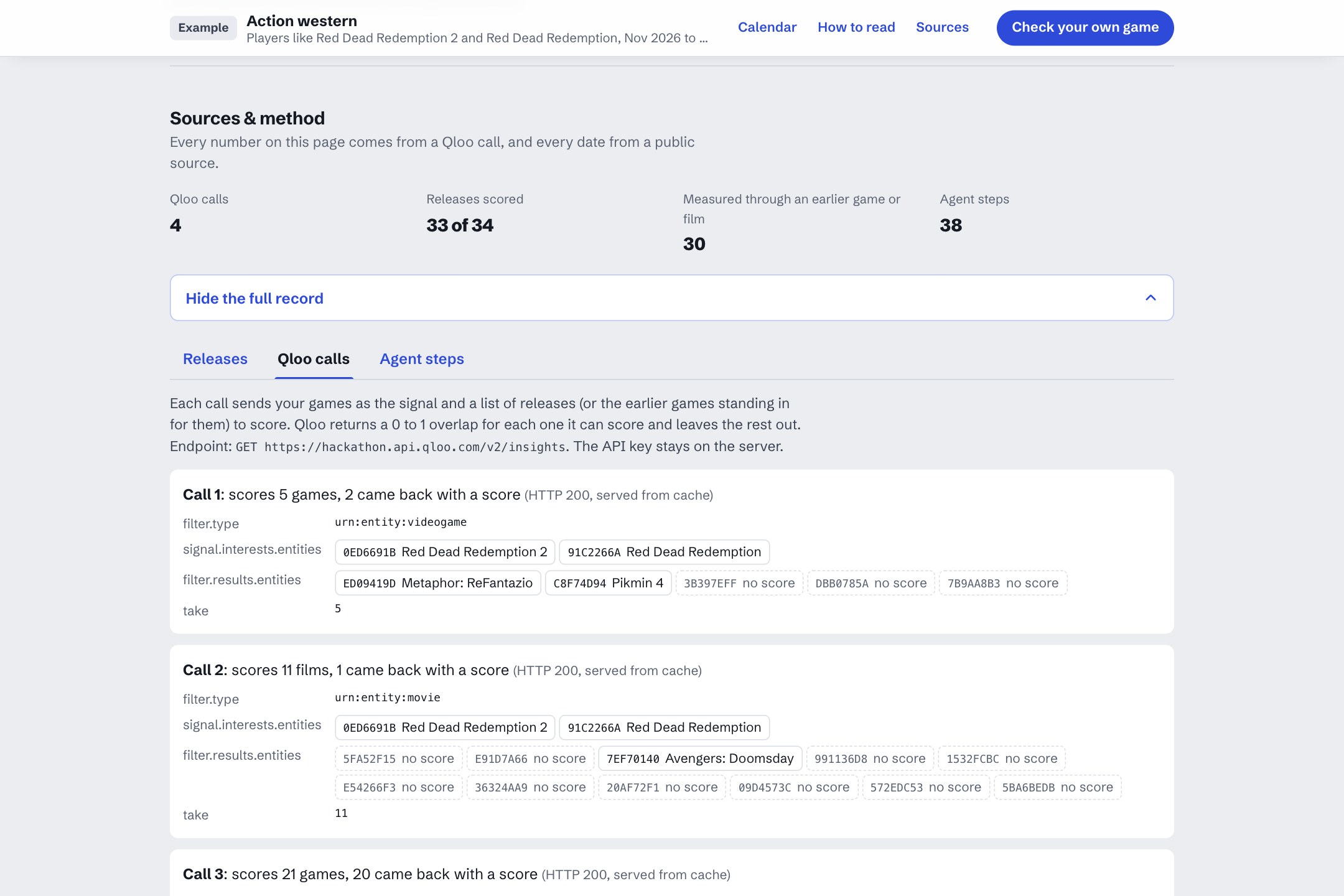
- Sources & method: every release with its score, the exact Qloo calls (entity ids and parameters) and every step the agent took.
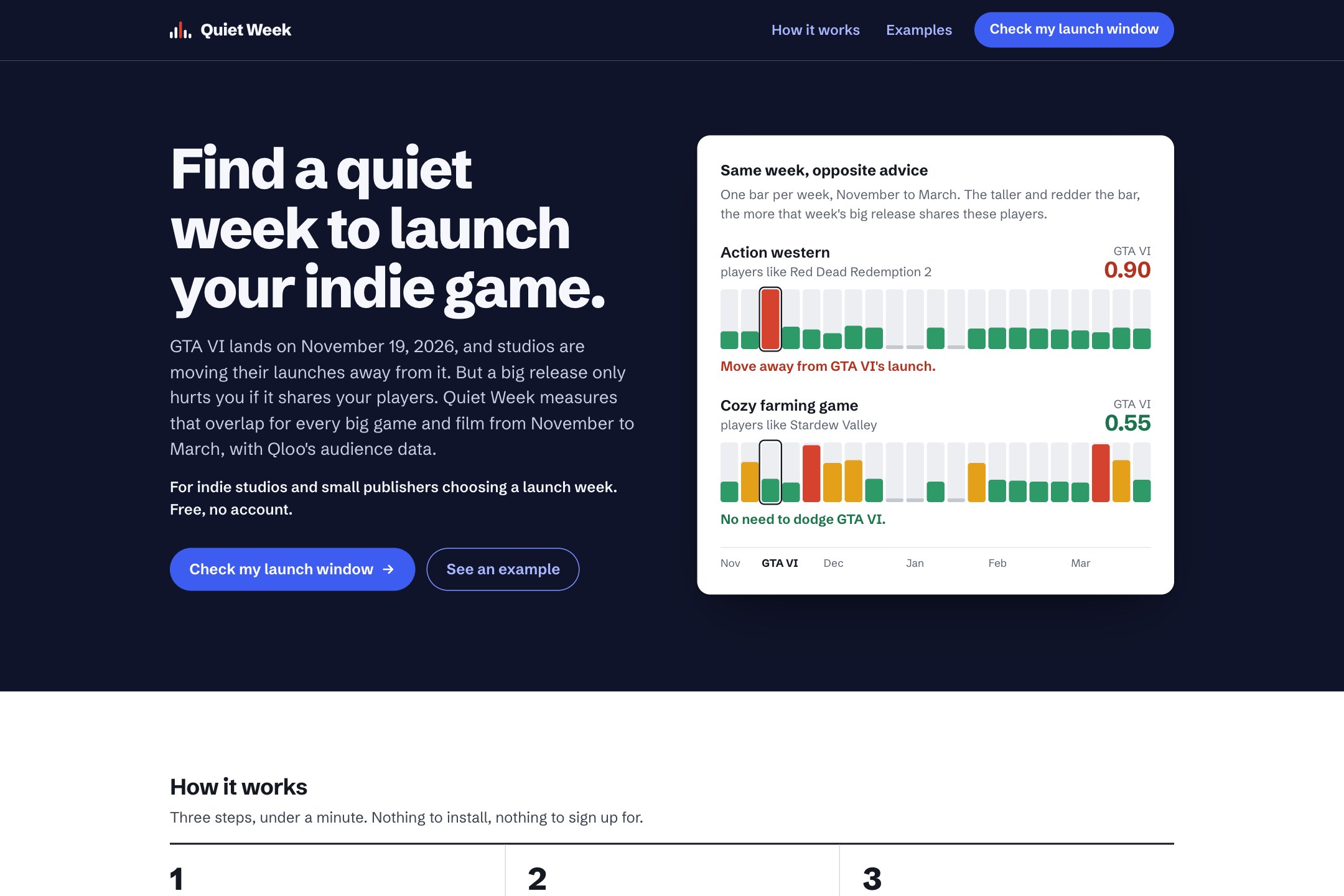
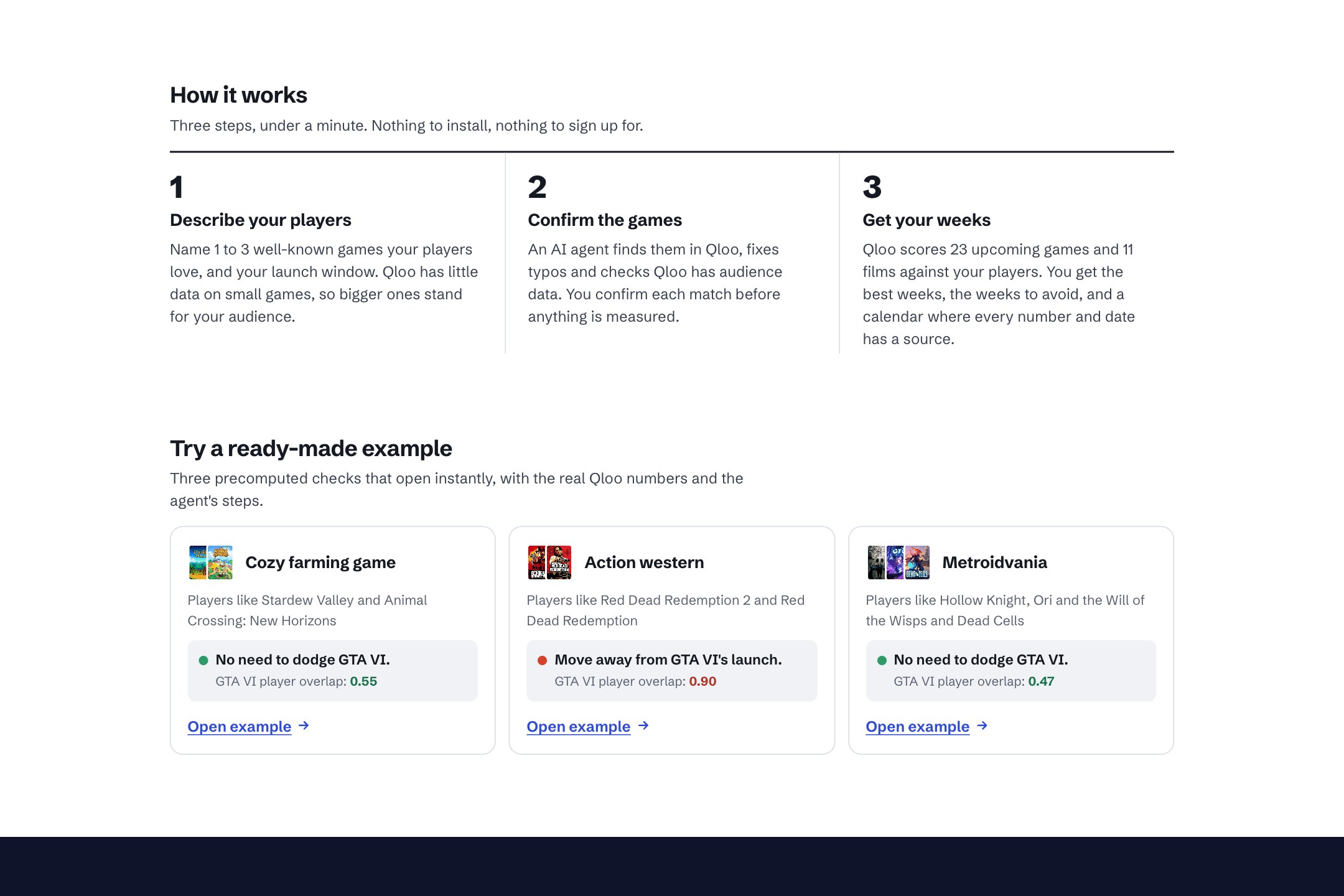
Same week, opposite advice. For an action western (players like Red Dead Redemption 2), GTA VI's overlap is 0.90: move. For a cozy farming game (players like Stardew Valley and Animal Crossing), it is 0.55: GTA VI is not your problem, and the release that matters is Grave Seasons, a farming life sim coming in March (0.78).
How Qloo is used
Qloo is the whole engine. Without it there is no answer, only a release calendar.
- Search (
/search,types=urn:entity:videogame) turns typed titles into Qloo entities. - Audience check (
/v2/insightswith the candidate as the signal against four well-known games) tells the agent whether Qloo can describe that game's players at all. - Scoring (
/v2/insightswithsignal.interests.entities= your 1 to 3 games andfilter.results.entities= up to 25 upcoming releases) returns one affinity per release, for games and, in a second call, for films. A full analysis is four insights calls. - Stand-ins. Qloo does not score titles before they launch: GTA VI has an entity but no affinity. Each upcoming release in the calendar declares a stand-in, usually the previous entry of the series (GTA V for GTA VI, Metroid Dread for Metroid Ravenous, Dune: Part Two for Dune: Part Three). The release's own score always wins when Qloo has one, and the stand-in is named next to every number it produces.
- Films count too. A blockbuster competes for your players' evenings, so films can turn a week yellow, never red.
The agent
A Gemini model drives the work through function calling: search_games, check_audience_data and propose_matches to resolve your games, then get_release_calendar, measure_overlap, get_stand_ins, measure_stand_ins, build_calendar and submit_verdict to measure them. Each step streams to the screen as it happens.
It may only quote Qloo's numbers. submit_verdict rejects any decimal Qloo did not return, any week or date the tools did not return, and any word about sales, revenue, wishlists, percentages or forecasts. The agent then rewrites; if it still fails, the page shows a verdict assembled from the numbers. The colours and the week picks are plain, tested code, not model output.
How I built it
- Next.js (App Router) and TypeScript, on Vercel. Keys stay on the server; Qloo answers are cached.
data/releases.json: 34 releases (23 games, 11 films) from November 2026 to March 2027, plus Steam's Winter Sale, February Next Fest and Spring Sale. Every entry was typed by hand from a public source (publisher, platform store, press, a cinema release calendar), with its link and the date I checked it. Nothing is scraped.- The colour rule: a week turns red when a game that week scores 0.75 or more with your players, yellow from 0.68 (or a film from 0.78). I chose the thresholds from the real score spread, not from a guess.
- 57 unit tests (colour rule, calendar, week picks, stand-ins, the agent's number check, the wording of the result).
Challenges I ran into
Qloo leaves your own games out of its answers. I found this while testing the app on 40 genre audiences. If you name Metro Exodus, Qloo returns no score for Metro Exodus, which is fair. But Metro 2039 is measured through Metro Exodus, so for Metro fans the sequel silently dropped out of the calendar. Worse, a GTA V fan was told Qloo had no score for GTA VI, with an almost all-green calendar. Now a release that continues one of your games counts as red, with no invented number, and the page says why: "Metro 2039 continues a game you named, so it shares your players."
Small games have little Qloo data. That is why you describe your players with well-known games, and why the agent checks each one before measuring.
Free-tier AI is slow and sometimes busy. The three examples are precomputed, so judges never wait on it, and every error is turned into one plain sentence with a retry.
Accomplishments that I'm proud of
I checked the results against what a games person would expect, on 40 audiences. For 30 of them I wrote down, before running, the upcoming release that should come out on top: Forza Horizon 6 for racing fans, Path of Exile 2 for Diablo players, Fable for Skyrim players, Dawn of War IV for RTS players. Quiet Week put that release first for 26 of the 30, and in the top three for 29. The miss is honest data: for Qloo, Resident Evil players and Until Dawn players are two different horror crowds.
The advice changes with the audience: only the open-world crime and GTA audiences are told to move, racing and battle royale fans are told to avoid GTA's launch week if they can, and the other 35 are told GTA VI is not their main risk.
What I learned
The number that matters is not how big a release is but whose players it takes. A blockbuster film can matter more to a cozy game than GTA VI does.
What's next
- More releases, and a way for studios to add the ones they track themselves.
- Steam tags and wishlist counts as a second signal next to Qloo's audiences.
- Alerts when a big release moves its date, since dates move all the time.
A note on the numbers
An affinity is Qloo's 0 to 1 score of how much two audiences like the same things. It is not a share of players, and Quiet Week makes no sales forecast. Release dates were checked by hand on October 23, 2026, and can move.
Built With
- gemini
- next.js
- node.js
- qloo
- react
- typescript
- vercel
- vitest

Log in or sign up for Devpost to join the conversation.