-
-
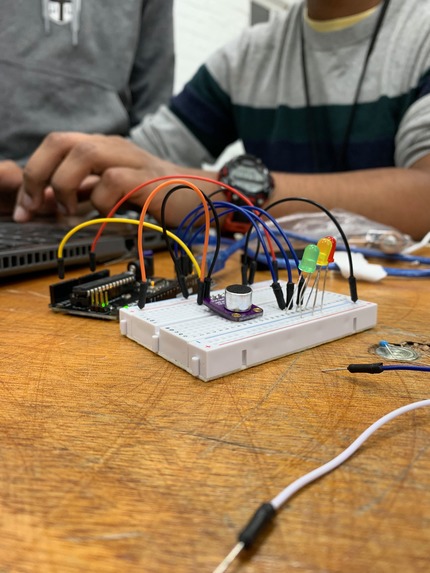
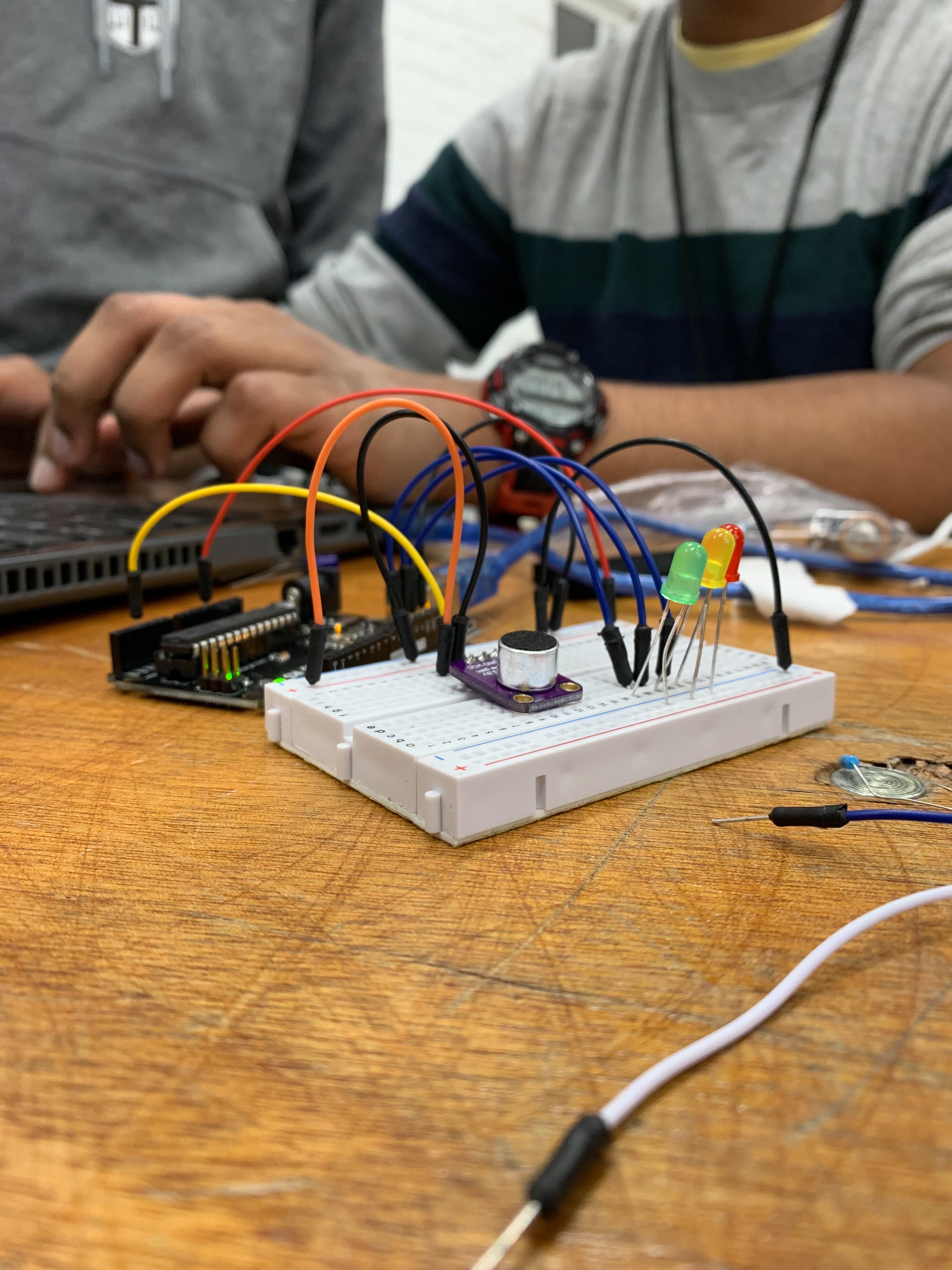
Completed circuit with green (acceptable), yellow (borderline), and red (too loud) LED lights
College is the most exciting time of our lives, so it's understandable that we forget to use our inside voices from time to time. But preserving the peace and quiet oftentimes comes at a price-- confronting your dorm-mates, getting the RA's involved, or filing a report to DPS all threaten to undermine the sense of community within the dorm.
To that end, we proudly present After Hours. When installed in a common area, After Hours monitors the noise level in the room and, when it gets too loud, displays a light as a friendly reminder to lower one's volume.
We began by listing out possible areas of improvement here at Brown University and how we could hack a solution to them. After some deliberation, we chose to pursue the After Hours noise level monitor because it seemed to be challenging, interesting, and realistic. We simultaneously developed the code and constructed the hardware according to an overall plan which would come together at the end. For the hardware, we built a circuit with the materials available at the Hardware Room and soldered together a sound sensor, amplifier, and terminal pins. The code was written in C++ using a series of variable declarations, an array to identify the maximum volume detected by the sensor, and experimentally-verified noise thresholds.
On the onset, we encountered difficulties in gathering materials for the hardware. While motion detectors and thermometers were available at the Hardware Room, our microphone had to be built from scratch. We attempted several times to build an amplifier circuit for the sound sensor provided to us, but this configuration only returned values of 0 and 1 rather than the desired volume measurements. Finally, we sought help from the Brown Design Workshop, where we acquired a microphone amplifier. Regarding the code, because the microphone was somewhat low quality, we had to design the algorithm to distinguish between outliers caused by static spikes and true loud noises. Furthermore, minor changes in volume were causing sporadic light flashing, which required several trial-and-error additions to the code.
Despite being a team of all first-time hackers with no experience, we were proud to be able to see our project through, from the planning phase to the final product. The difficulties we faced along the way, though frustrating in the moment, only served to compound the satisfaction of having overcome all the obstacles to achieve our goal.
All of our team members were completely new to Arduinos and breadboards, but by the end of the project, we had taught ourselves enough to interpret pinout and circuit diagrams and use them to wire our own microphone amplifier circuit. We also learned the importance of preparation and having the correct materials, else being able to improvise and build around missing parts. Finally, we were surprised to discover that inexperienced hackers like us could come up with a handy device to improve quality of life in the dorm communities.
With more time and resources, there are many additions we would like to implement to After Hours. If we had access to the Arduino WiFi Shield, we could send an alert to the RA's if the noise level has been too high for an extended amount of time. Another compatible function would be to set designated quiet hours when the volume thresholds would be lower or during exam season. In addition to the warning light, users could easily attach their own systems such as flickering the lights or playing a beeping sound. Further applications of After Hours could include tracking noise level throughout the day to provide data regarding dorm activity for purposes such as sustainable use of air conditioning or planning social events.


Log in or sign up for Devpost to join the conversation.