-
-
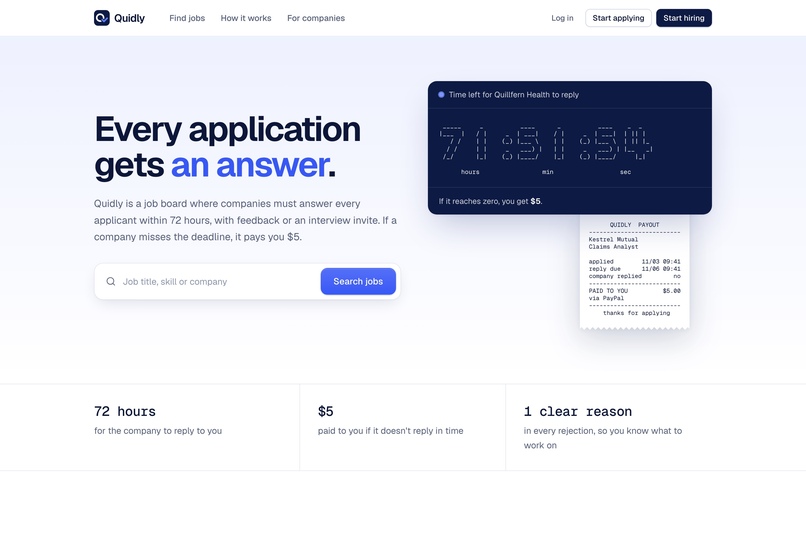
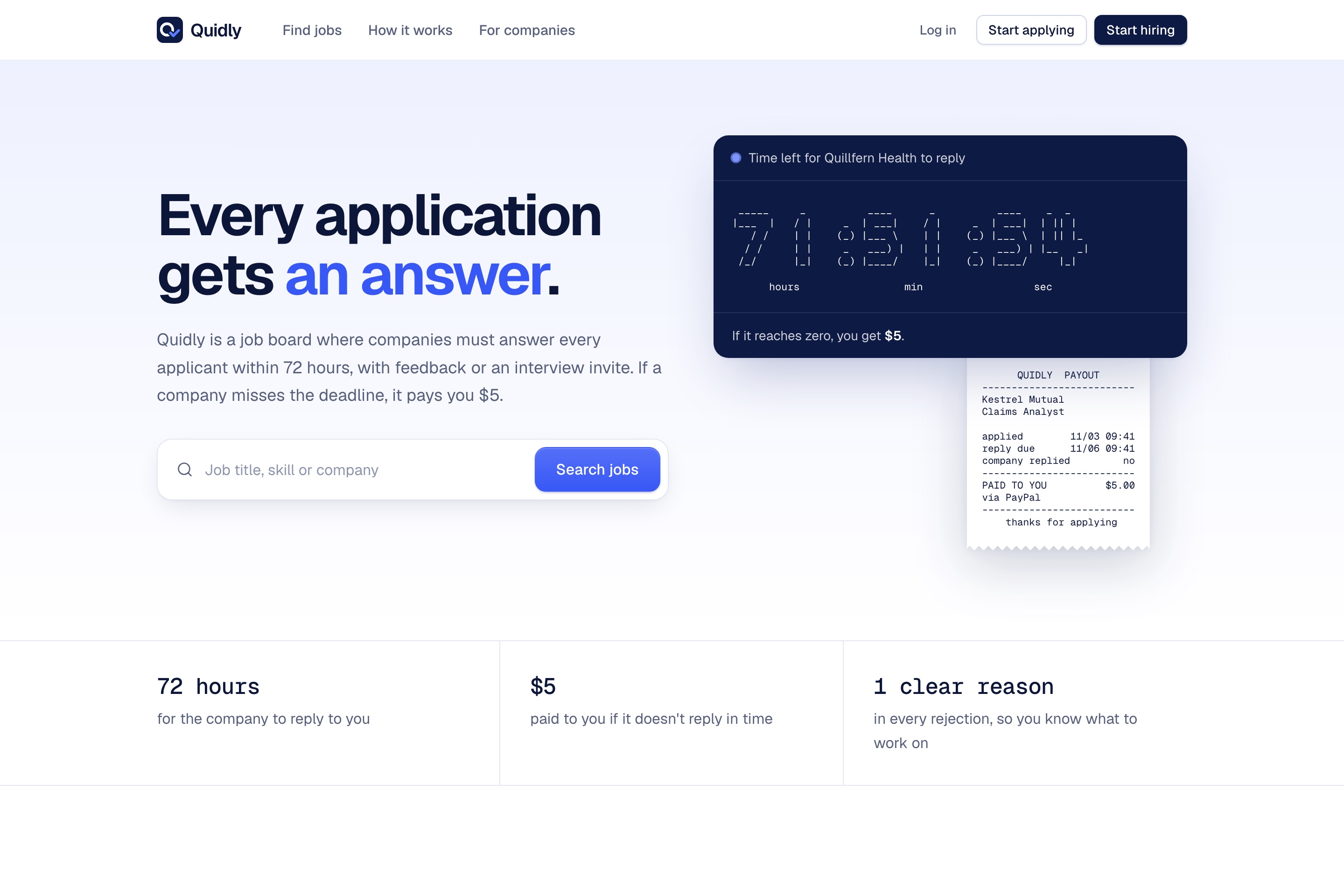
Every application gets an answer, or $5.
-
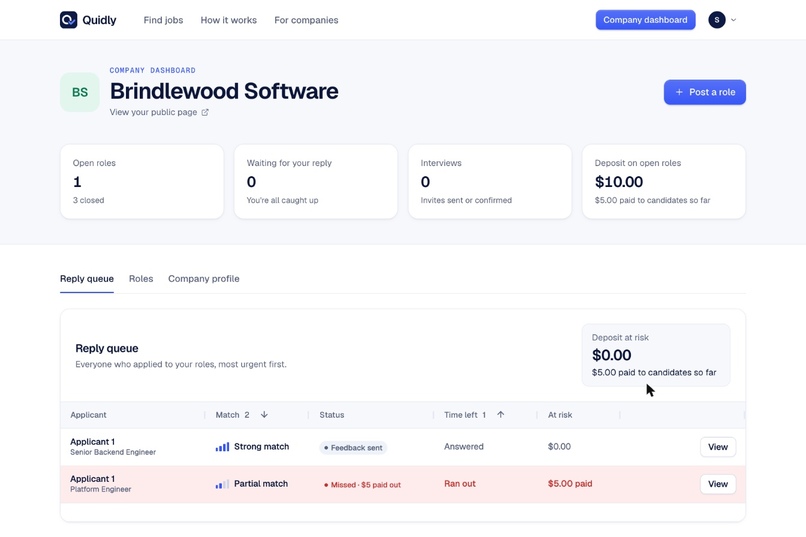
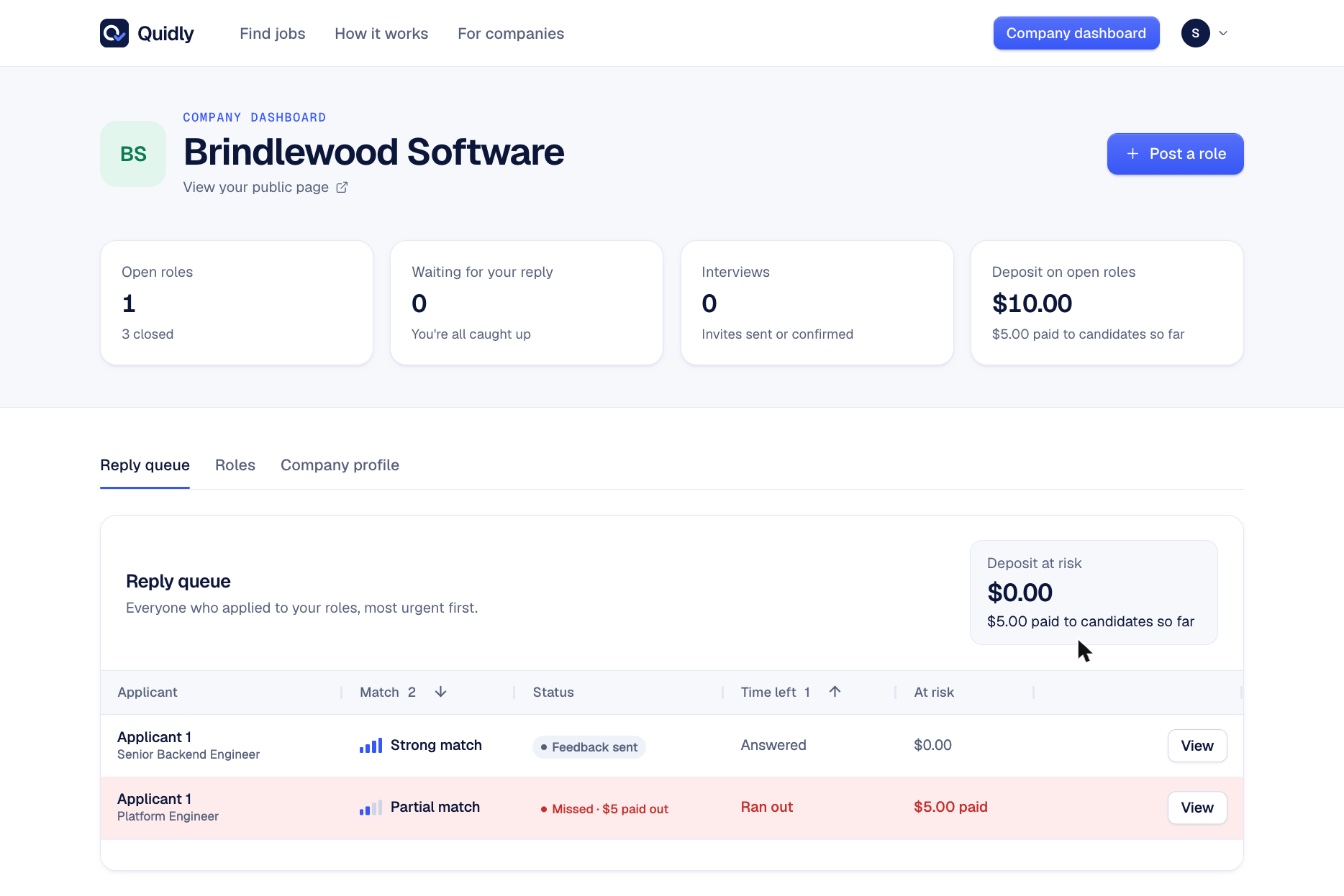
The company's AG Grid reply queue: match scores, deadlines, and a $5 payout when one is missed.
-
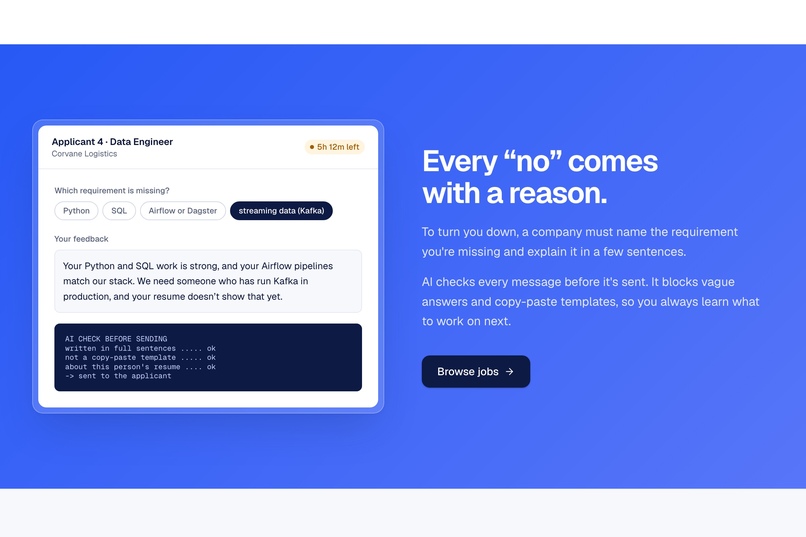
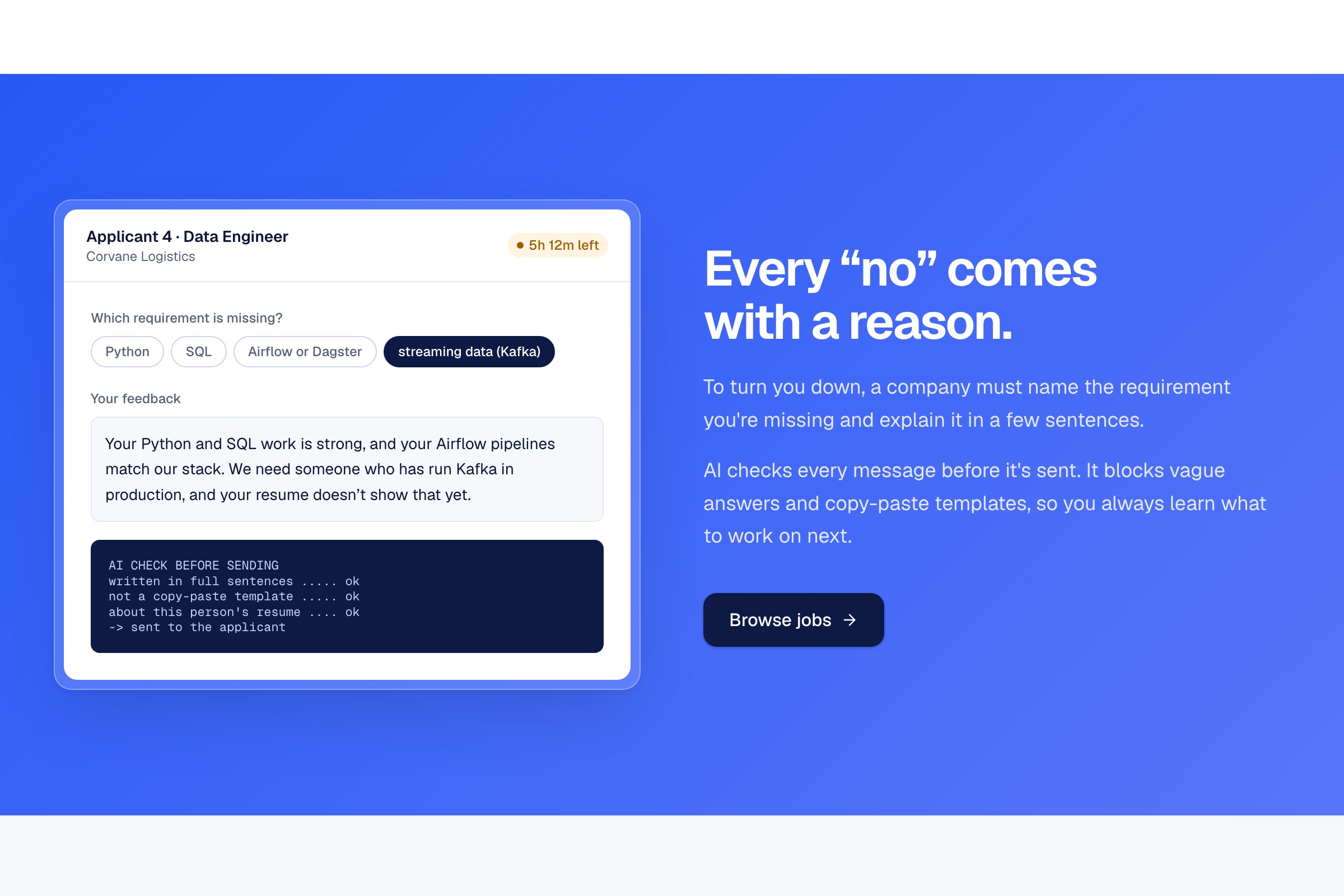
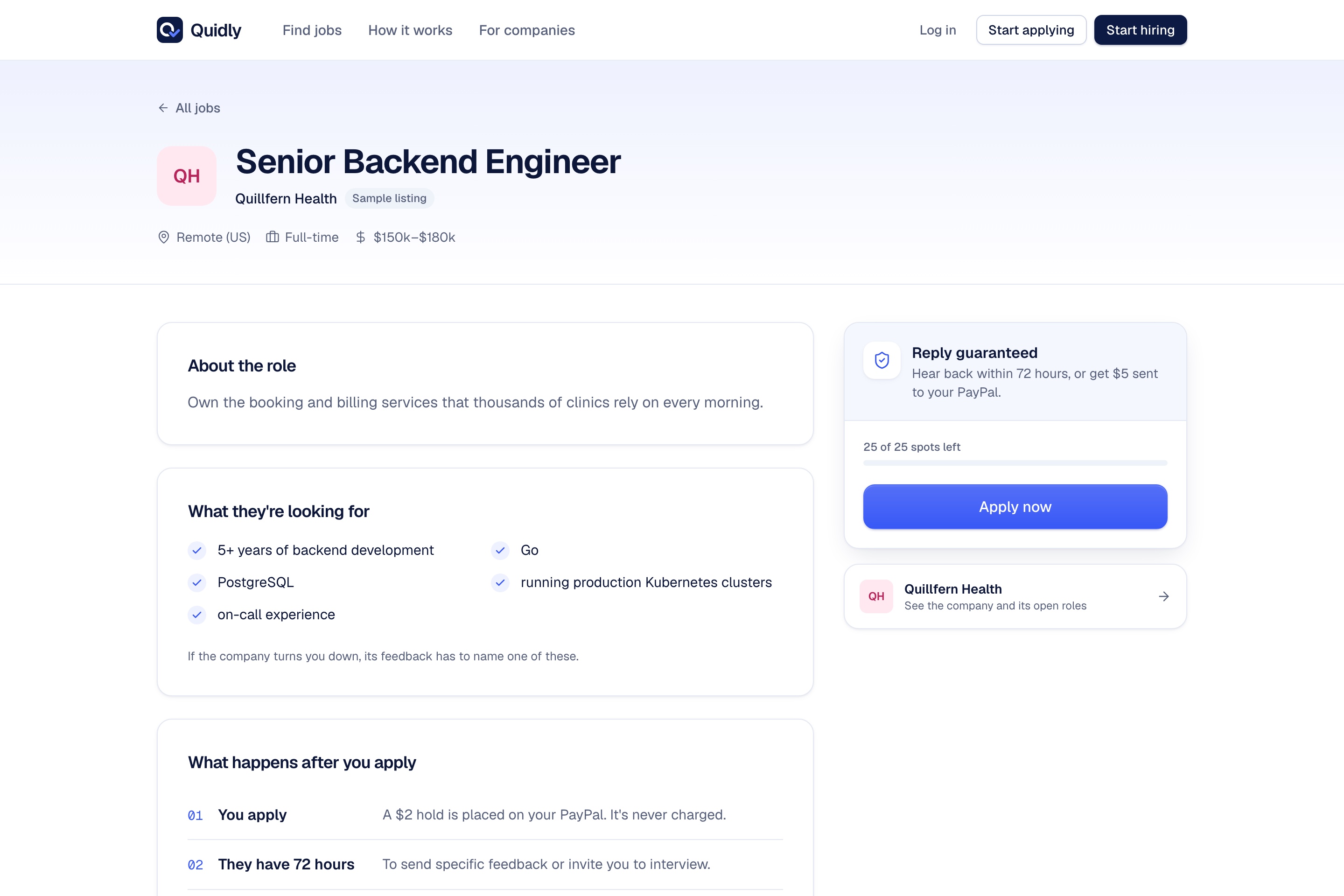
Every rejection has to name a missing requirement. Elastic checks it before it's sent.
-
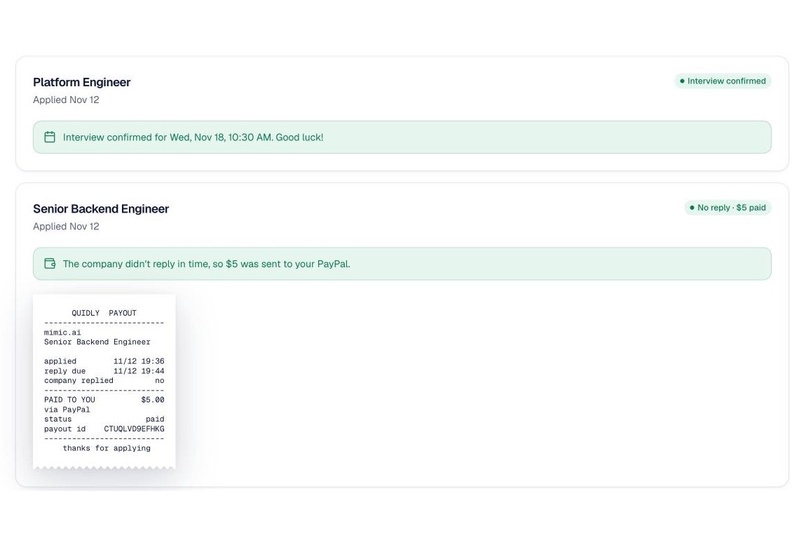
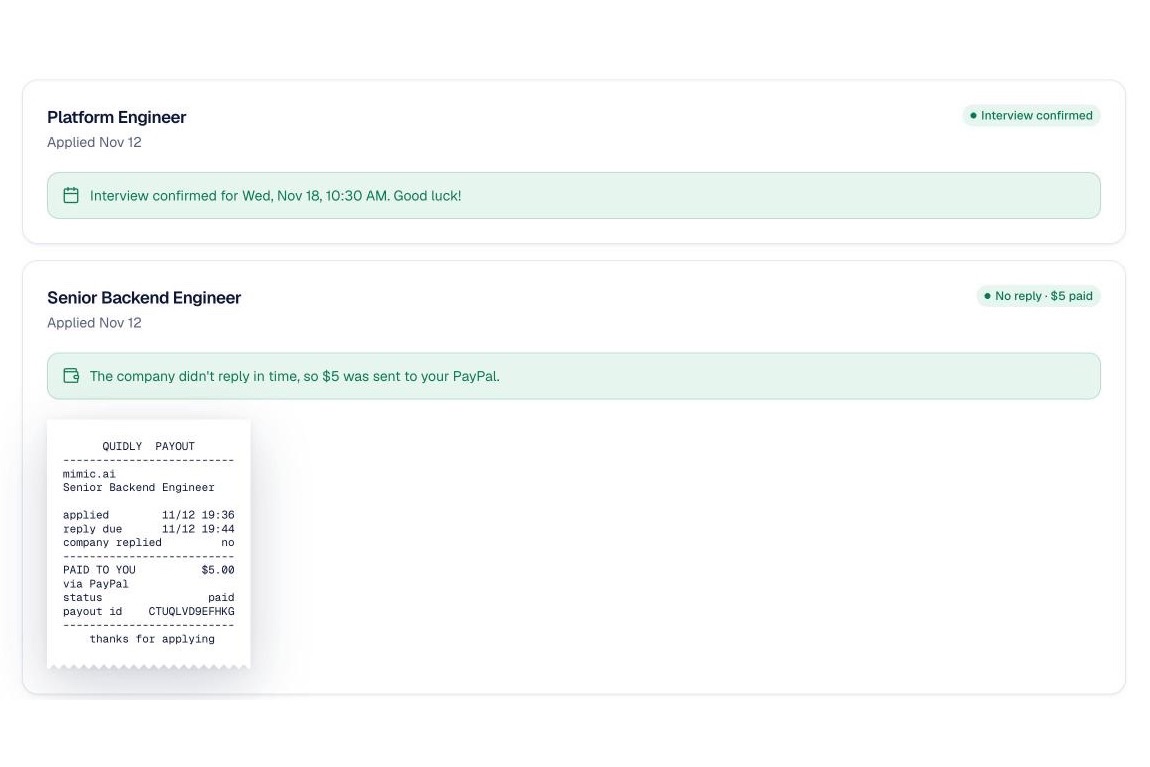
A job seeker's answers: a confirmed interview, and a $5 PayPal payout receipt.
-
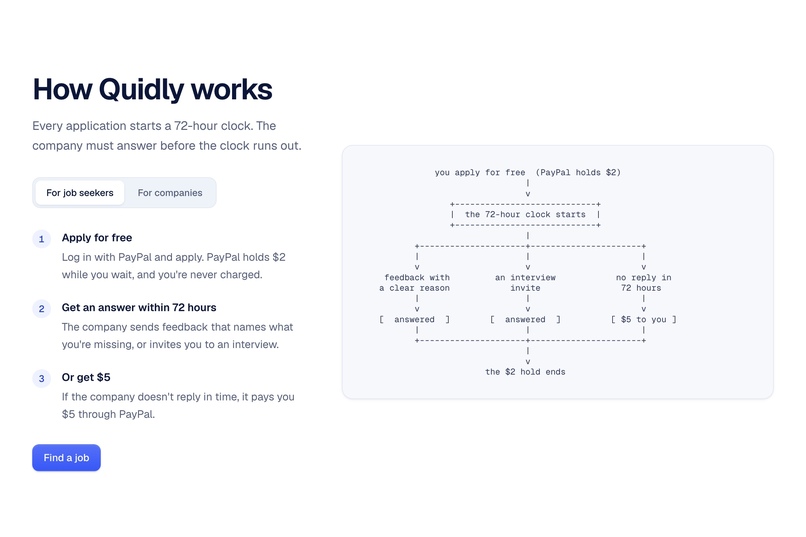
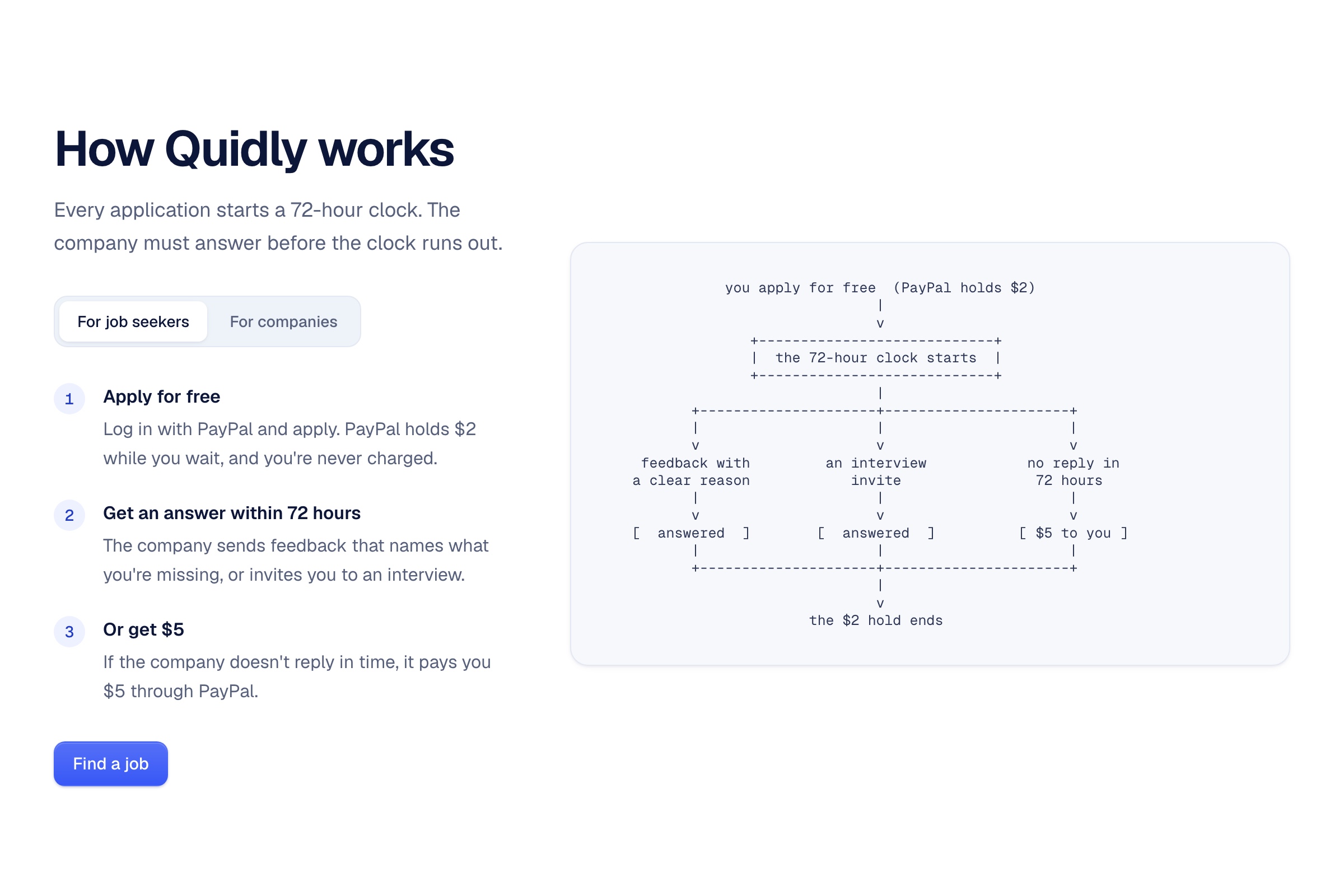
Every application starts a 72-hour clock.
-
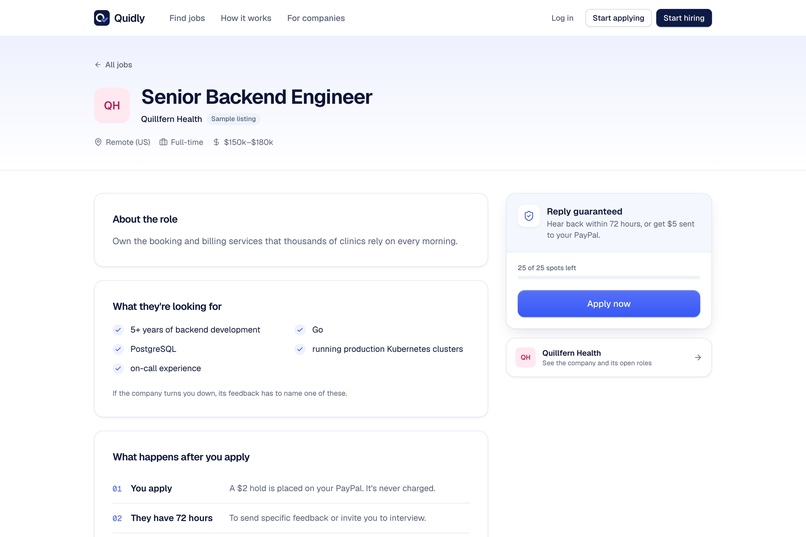
Each role shows the reply guarantee and the requirements that feedback must name.
-
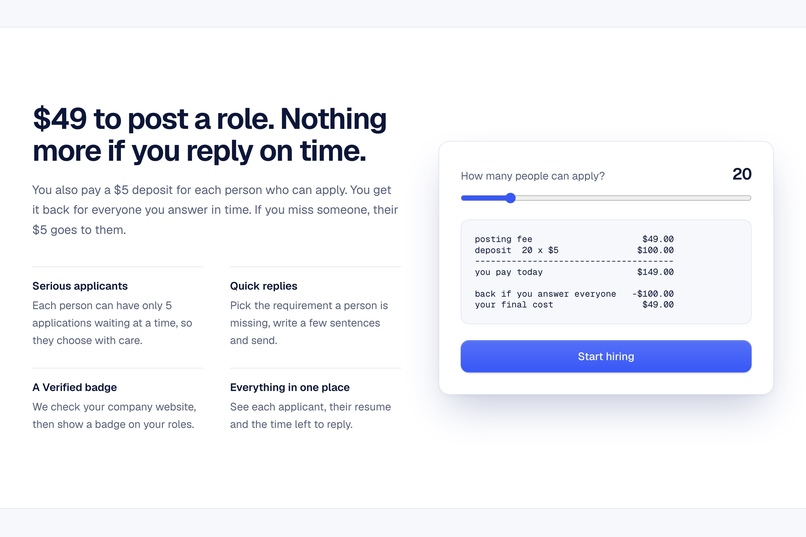
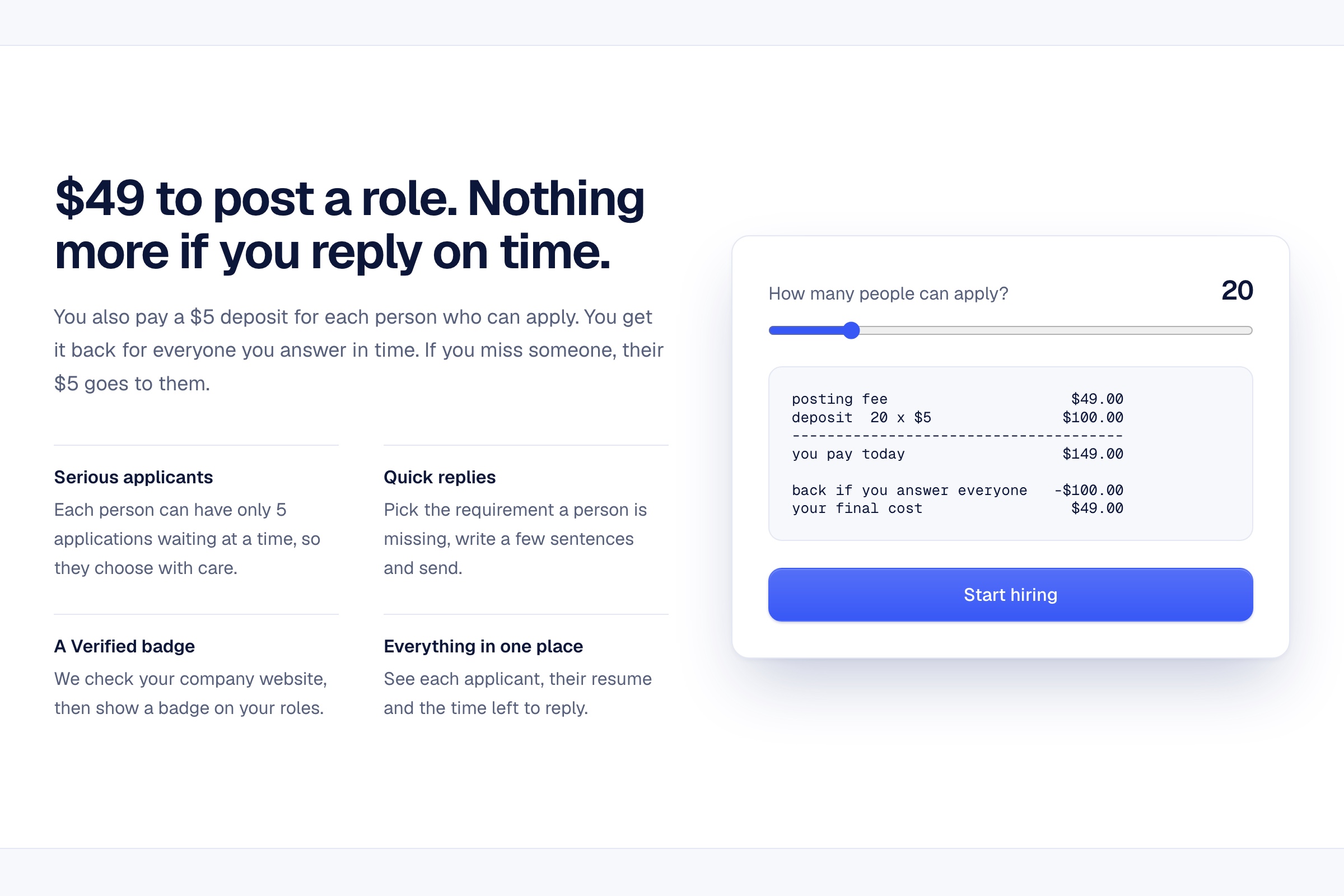
$49 to post a role, plus a $5 deposit per spot that comes back if you reply on time.
-
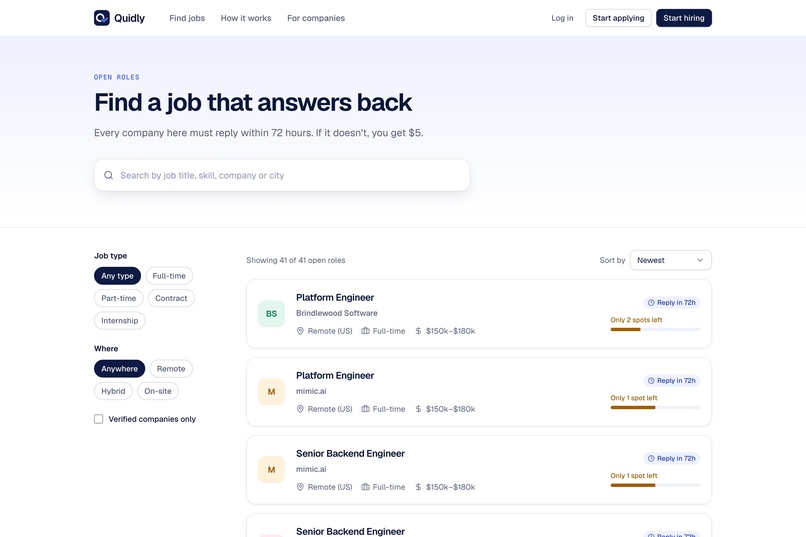
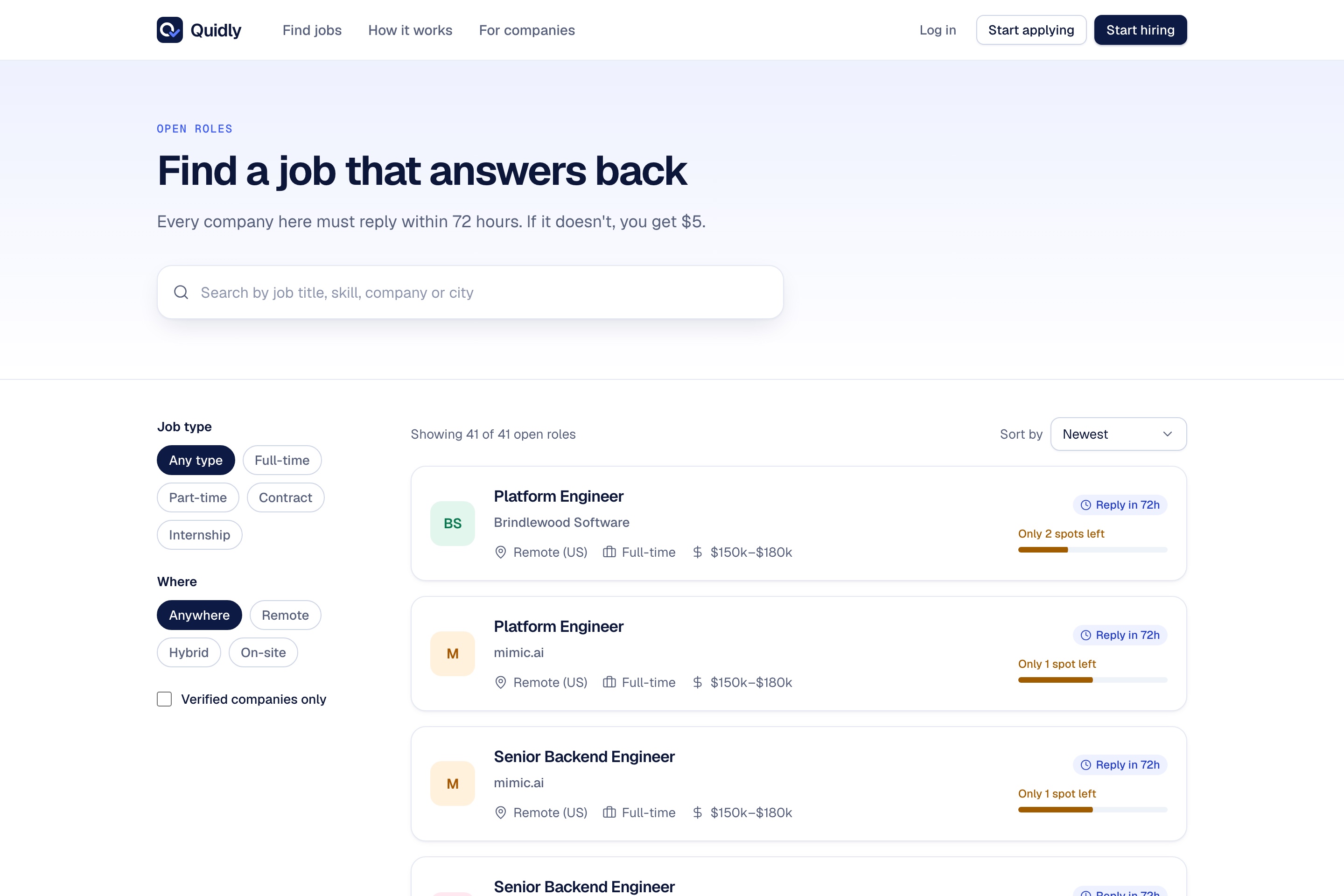
The job board: every company here must reply within 72 hours.
Inspiration
Applying for a job takes hours. Ignoring an applicant costs a company nothing, so most applications never get a reply. I wanted to put a small, fixed price on that silence and give the money to the person who was left waiting.
What it does
Quidly is a job board where every application gets an answer, or $5.
- Companies pay a $49 listing fee plus a refundable $5 deposit for every applicant spot.
- Job seekers log in with PayPal and apply with a $2 PayPal hold. The hold is never charged, and each person can have 5 applications open at once.
The company then has 72 hours to answer each applicant:
| What happens | Job seeker's $2 hold | Company's $5 |
|---|---|---|
| Feedback that passes the AI checks | Released | Kept for the refund |
| Interview invite, confirmed by the job seeker | Released | Kept for the refund |
| Invite reported as not genuine | Stays on hold | Stays locked |
| No reply in 72 hours | Released | Paid to the job seeker |
A copy-paste line like "Sorry, we went with someone else" doesn't count as an answer, and Elastic blocks it. When the role closes, the unused deposit goes back to the company. A company that answers everyone only pays the listing fee.
Companies work from a live reply queue. It ranks applicants by deadline and by how well each resume matches the role, and it shows how much deposit is at risk right now.
How I built it
PayPal (sandbox): 5 parts of the platform carry the whole money flow.
- Log In with PayPal: every account is a PayPal identity, which makes fake sign-ups harder.
- Orders v2, capture: the company's fee and deposit, in one payment.
- Orders v2, authorize and void: the job seeker's $2 hold, released as soon as the company answers.
- Payouts: the $5 to a job seeker whose deadline ran out, sent automatically.
- Refunds: the unused deposit when a role closes.
Elastic: the AI inside the product. Every embedding comes from Elastic's hosted inference endpoint (.openai-text-embedding-3-small). Feedback must pass 3 checks:
- Not a template: known form rejections are indexed as
semantic_text. A reply that scores 0.73 or higher against any of them is blocked. - Real sentences: at least 12 words, written as sentences rather than a list of keywords.
- About this person: the feedback is compared with this resume and this role. Below 0.40, it's blocked as off-topic.
The same embeddings give every applicant a match score: Strong, Good, Partial or Weak.
AG Grid: the reply queue.
- Multi-column sorting, with the most urgent first and then the best match.
- Custom cell renderers.
- Rows that turn amber, then red, as deadlines approach.
- Cells that flash when a status changes.
- Countdowns that update every second.
- A live "Deposit at risk" counter.
Stack: Next.js on Vercel, and a Fastify API in TypeScript on Render with Postgres and Drizzle. A deadline checker runs every 2 seconds inside the API.
Challenges I ran into
- Money that's safe to retry. Every payment step has to survive being run twice.
- Payouts use a fixed batch ID per application, so a retry can't pay twice.
- Releasing a hold that PayPal already released counts as done.
- When a deadline passes, the outcome is saved before any money moves. The update only claims applications that are still waiting, so a late reply and a payout can never both win.
- Telling a lazy rejection from a short, real one. Generic rejections and honest feedback share a lot of words. I tuned the thresholds on a hand-written set of good and bad replies. The "about this person" check lets specific feedback pass and stops template text.
- Showing a 72-hour deadline in a 3-minute demo. Demo mode lets a job seeker apply with a 90-second window. "Skip to 45s" moves any waiting application to its last 45 seconds, so you can watch a real PayPal payout happen.
Accomplishments that I'm proud of
- Every outcome, including the automatic $5 payout, runs end to end on real PayPal sandbox payments, not mock data.
- It's a self-serve product, not a scripted demo. Anyone can log in with PayPal and use both sides.
- 77 tests cover the money flows, the feedback checks and the API routes.
What I learned
- A $2 authorization hold signals commitment better than a fee does, and nobody gets charged.
- A PayPal authorization is only guaranteed for about 3 days, which is where the 72-hour deadline comes from.
- Semantic search is a cheap, explainable way to catch template text. Every block comes with a score I can show.
What's next for Quidly
- Settling disputed interview invites.
- Penalties for job seekers who skip an interview.
- Removing the badge from companies that keep missing deadlines.
Try it
Live site: https://quidly-theta.vercel.app. PayPal runs in sandbox mode, and the logins are in the testing instructions.
Built With
- ag-grid
- drizzle
- elastic
- elasticsearch
- fastify
- next.js
- node.js
- paypal
- postgresql
- react
- render
- tailwindcss
- typescript
- vercel
- vitest

