-
-
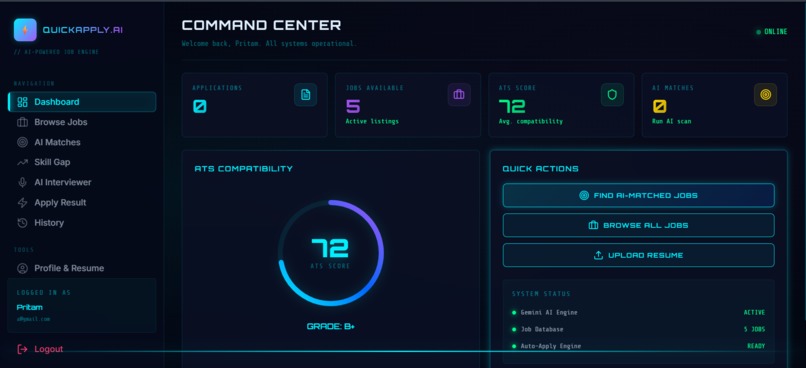
Your Autonomous AI Career Command Center
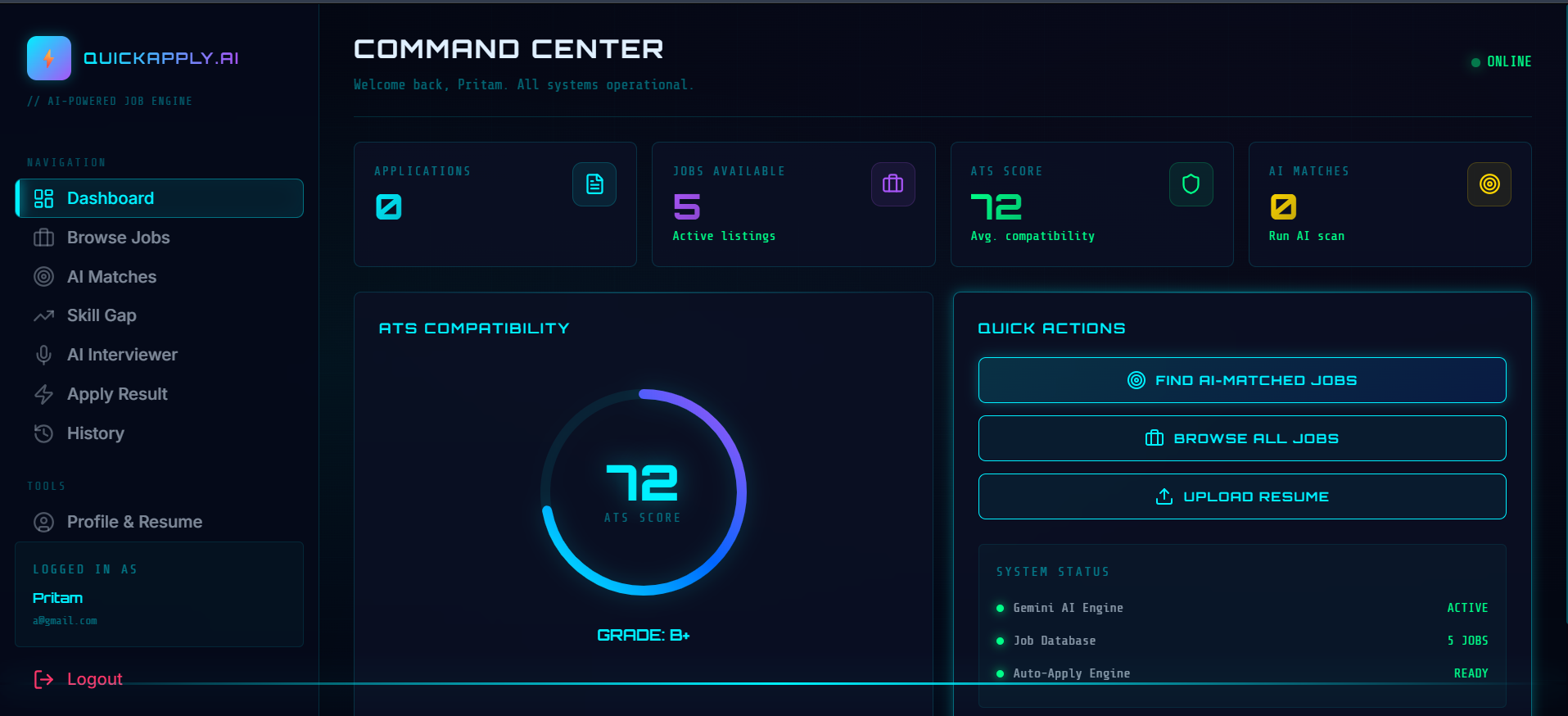
🚀 QuickApply.AI
Inspiration
Applying for jobs today is frustrating, repetitive, and extremely time-consuming. Students and job seekers spend hours filling out the same forms repeatedly, only to get rejected silently by ATS systems before a human recruiter even sees their resume.
We wanted to solve this pain point by building an intelligent platform that could automate the entire process — from resume optimization to job applications and interview preparation — all inside one futuristic dashboard.
That idea became QuickApply.AI.
What it does
QuickApply.AI is an AI-powered autonomous job application platform that helps users:
- Upload and parse resumes instantly
- Calculate ATS compatibility scores
- Auto-fill profile information using AI
- Edit resumes live inside a preview window
- Auto-apply to jobs using Puppeteer automation
- Stream real-time browser activity logs using SSE
- Generate application proof screenshots
- Practice AI-powered mock technical interviews
Our goal was simple:
“Stop Filling Forms. Start Getting Interviews.”
How we built it
Frontend
We built the frontend using:
- React + Vite
- Tailwind CSS / Custom CSS
- Framer Motion for animations
- Glassmorphism + cyberpunk inspired UI
The interface was designed like a futuristic HUD dashboard to make the platform feel modern and immersive.
Backend
The backend stack includes:
- Node.js
- Express.js
- MongoDB Atlas
- Puppeteer
- Google Gemini API
Core Workflow
- User uploads a PDF resume
- Backend extracts text from the PDF
- Gemini AI converts it into structured JSON
- ATS score + strengths + weaknesses are generated
- User edits resume live inside preview mode
- Puppeteer launches Chromium and auto-fills job forms
- Live logs are streamed using Server-Sent Events (SSE)
- Screenshot proof is generated after successful submission
- AI interviewer conducts mock interviews and returns a scorecard
Challenges we faced
⚡ Real-time Streaming
Implementing live terminal-style logs with SSE was challenging because we needed smooth low-latency updates between the Puppeteer automation process and the frontend UI.
📄 Resume Parsing
Resumes come in many different formats, so extracting clean structured data consistently from PDFs required multiple parsing strategies and AI prompt tuning.
🤖 Browser Automation
Automating dynamic forms using Puppeteer was difficult because different websites have different layouts, validations, and upload behaviors.
🎨 UI/UX Design
We designed QuickApply.AI as a futuristic AI command center inspired by cyberpunk HUD interfaces rather than traditional job portals. Building the neon-glow dashboard while keeping the experience responsive, readable, and user-friendly required multiple frontend iterations and animation optimizations.
What we learned
During this project we learned:
- Advanced Puppeteer browser automation
- Real-time communication using SSE
- AI prompt engineering with Gemini
- Resume parsing and ATS optimization logic
- Building scalable React dashboards
- Managing complex frontend-backend workflows
Most importantly, we learned how AI can genuinely reduce repetitive work and improve the job search experience.
Future Plans
We plan to expand QuickApply.AI with:
- LinkedIn and Naukri integrations
- Smart job recommendation engine
- AI-generated personalized cover letters
- Multi-company application pipelines
- Voice-based AI interviews
- Real company portal automation
Tech Stack
Frontend:
React + Vite + Tailwind CSS + Framer Motion

Backend:
Node.js + Express.js + MongoDB Atlas

AI & Automation:
Google Gemini API + Puppeteer + SSE
⚡ QuickApply.AI
“Your Autonomous AI Career Copilot”
Built With
- css3
- express.js
- framer-motion
- github
- google-gemini-api
- html5
- javascript
- mongodb-atlas
- node.js
- puppeteer
- react.js
- server-sent-events-(sse)
- tailwind-css
- vercel
- vite


Log in or sign up for Devpost to join the conversation.