Inspiration
Emergency response delays are a major problem in many countries, especially in places like Nigeria, where bystanders often hesitate to act during accidents due to fear of being blamed or involved legally. This hesitation can cost valuable minutes—and sometimes lives.
QuickAlert AI was inspired by the need to remove hesitation, speed up reporting, and connect emergencies to help instantly using technology and AI.
What it does
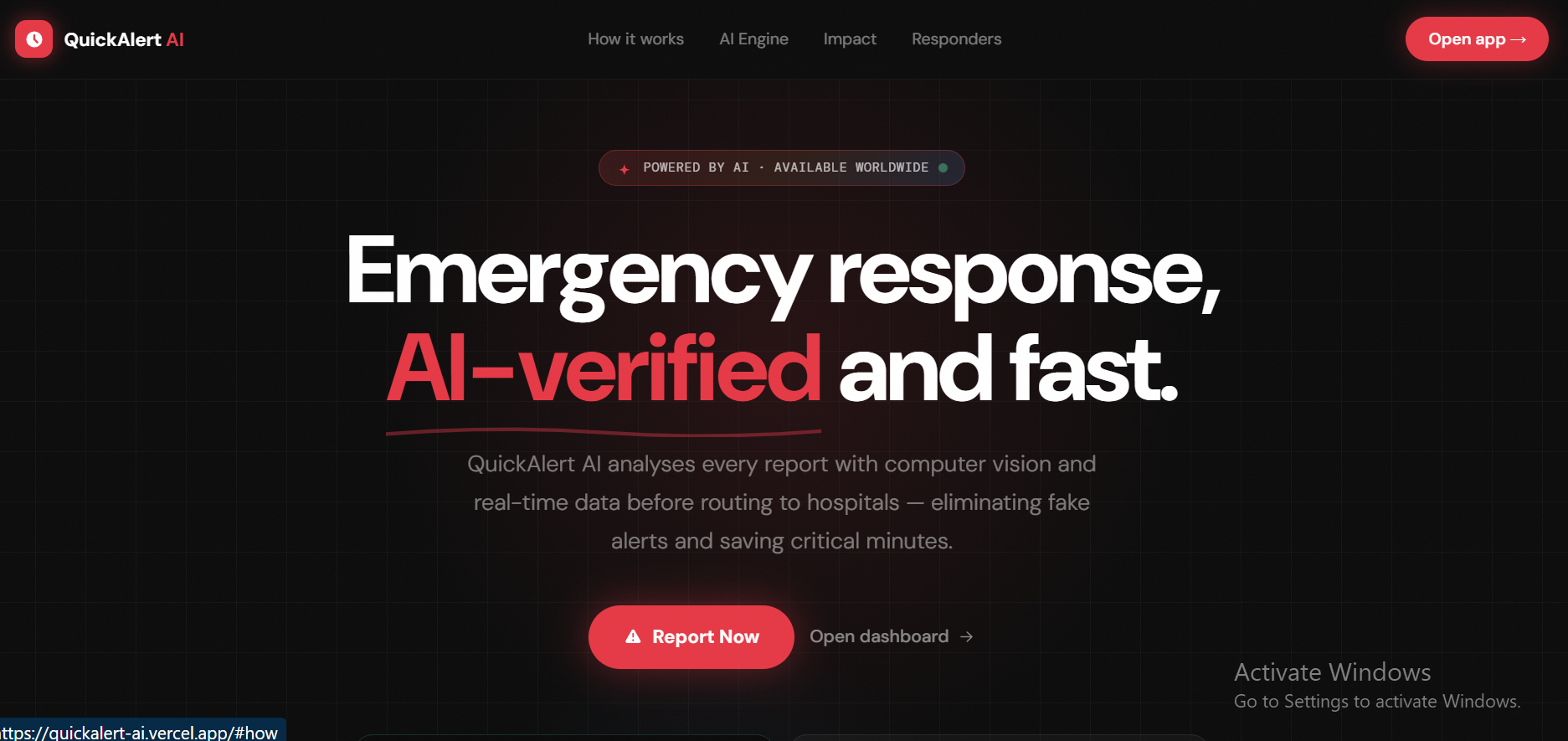
QuickAlert AI is an AI-powered emergency response system that allows anyone to report an accident or emergency in seconds.
Users report incidents using a 10-second live camera capture The system automatically captures real-time location AI analyzes the footage to estimate severity and validity of the emergency Verified incidents are sent to a live incident map dashboard Nearby registered hospitals or responders are alerted instantly If multiple reports come from the same location, urgency is increased automatically
How we built it
We built QuickAlert AI as a full-stack web application with multiple integrated systems:
Frontend: Landing page, user reporting interface, responder dashboard, and interactive map view Geolocation system: Automatically captures user coordinates during reporting Live camera integration: Enables short emergency video capture during incident reporting Real-time mapping: Displays active incidents and responder movement on a live map Backend system: Handles incident storage, updates, and dispatch logic AI module (prototype stage): Processes video input to estimate emergency likelihood and severity score
The system is designed as an end-to-end pipeline:
User Report → AI Analysis → Incident Verification → Map Display → Hospital/Responder Notification
Challenges we ran into
Integrating real-time camera capture smoothly across devices Handling geolocation accuracy in different environments Designing a reliable incident flow that feels fast but still structured Making the AI module meaningful without requiring a large labeled dataset Ensuring the system remains stable while updating live map data in real time
Accomplishments that we're proud of
Built a fully working end-to-end emergency reporting system Implemented a live incident map with real-time updates Successfully integrated camera + geolocation capture in one flow Designed a scalable architecture that could realistically support real-world deployment Created a system that simulates a real emergency response pipeline
What we learned
How to design real-time systems that handle urgent user actions The importance of simplifying user flow in critical applications How AI can be used as a decision-support layer, not just a feature The challenges of building systems that combine frontend, backend, and real-time data sync How impactful technology can be when focused on real human problems
What's next for QuickAlert AI
mprove AI accuracy using real emergency image/video datasets Add a hospital dashboard for live emergency tracking and response assignment Build a reputation system to prevent fake or malicious reports Expand to other emergency types like fire, robbery, and disaster alerts Introduce offline/SMS emergency reporting for low-connectivity regions Partner simulation: integrate with mock or real emergency response networks


Log in or sign up for Devpost to join the conversation.