✨ Inspiration
Life's unexpected turns can thrust us into pivotal moments where we hold the power to save lives. Recognizing first-hand the profound impact of First Aid knowledge, we delved into an extensive research. Our research revealed that shockingly, only 18% of Canadians are certified in first aid source. This revelation served as our inspiration. We decided to ensure that everyone possess the skills to administer First-Aid when needed, as well as expedite emergency response times. The Product? QuickAid – a way of bridging the gap between crucial moments and swift assistance, ultimately saving more lives.
🌎 What it does
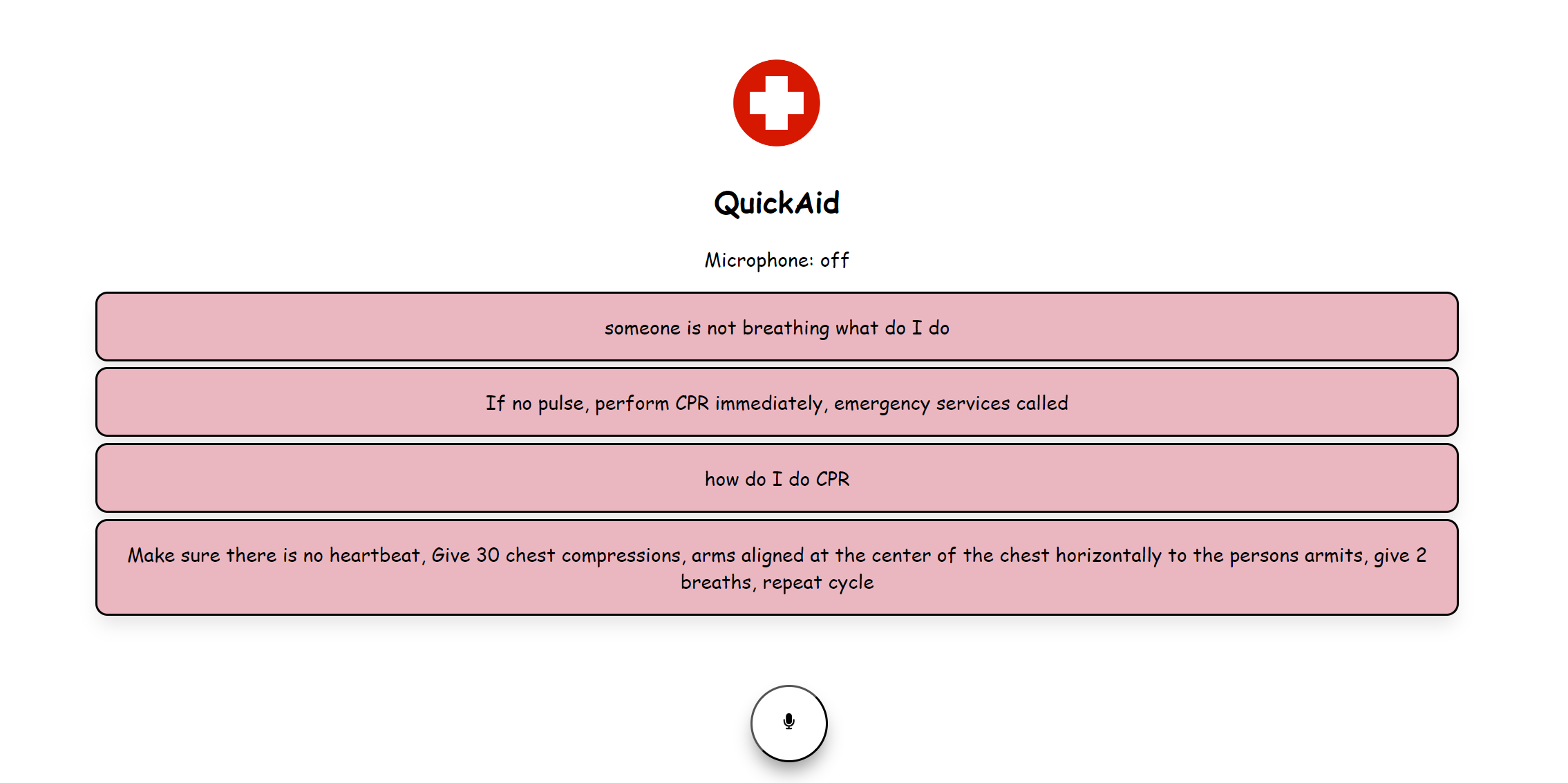
QuickAid has two main functions, both of which serve to help save lives. The first major part is called "Quick". Quick is an autonomous system that quickly and efficiently communicates vital incident information to Emergency-Service via phone call, when it deems necessary. The second major component of QuickAid is Aid, "Artificial Intelligence Doctor" our model that communicates vital First-Aid knowledge in times of dire need. This bot is responsible for providing people with the First-Aid knowledge necessary to potentially save other lives as well as their own. Together these two components help fulfill QuickAid's core mission: To save as many lives as possible.
⚙️ How we built it
 Our Frontend is build with flutter, because we envision QuickAid as a mobile application, making it more accessible and usable in emergency situations. It is hosted on Vercel and uses a .tech domain (thank you sponsors). The frontend implements speech to text to allow the user to communicate with AiD with minimum use of hands as they would be needed to help with the first aid the user is performing. It also tracks the users location, which would easily be passed on directly to EMS. The backend is build upon a Node.Js server which manages the functions of the application. It calls upon our custom contextual algorithm that can pinpoint what the problem is, and returns the response to the front end. It also makes autonomous phone calls to EMS through Twilio's free API in the cases of emergencies.
🚧Challenges we ran into
We ran into many challenges along the way.
- We initially trained our own custom model, however due to its size, we couldn't push it to GitHub or host it
- We build another more advanced model but didn't have sufficient computing resources to train it
- We eventually settled on Amazon Lex, which took a lot of time and help (Thank you Sean) to figure out and implement -A big challenge was figuring out how to navigate Twilio's api and make autonomous phone calls
😁Accomplishments that we're proud of
- We're extremely proud of building a functioning proof of concept application, in the short amount of time that was given to us.
- None of us knew each other previous to the hackathon and we are proud of learning how to function well as a team
- We are proud that our application has the potential to save many lives ## What we learned
- We learned/became familiar with fairly new technologies such as AWS, Twilio, Flutter and Node.JS
- We learned how to split roles and plan efficiently
- We learned how to develop and train a QA model from scratch
## What's next for QuickAid
- Increase the range of first-aid assistance our model can handle
- Improve autonomous phone calls to be faster and more reliable (custom AI agent? )
- Add more accessibility settings for wider range of support
- Create partnerships with EMS in order to improve our applications functioning


Log in or sign up for Devpost to join the conversation.