Inspiration
The inspiration behind the Quick Sort project came from my fascination with efficient sorting algorithms. I aimed to delve into the intricacies of Quick Sort and explore its potential for optimizing data organization.
What it does
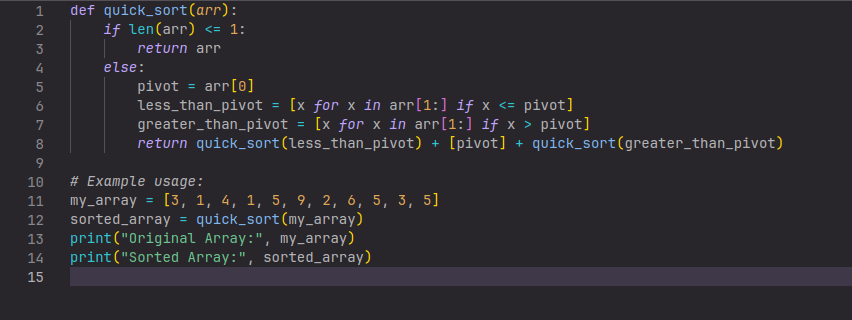
Quick Sort is designed to efficiently sort data by employing a divide-and-conquer strategy. It recursively divides the array, sorts individual elements, and then combines them for a sorted result.
How we built it
I implemented Quick Sort in Python, leveraging its concise syntax and readability. The algorithm efficiently organizes data by selecting a pivot, partitioning the array, and sorting the partitions recursively.
Challenges we ran into
Accomplishments that we're proud of
I take pride in successfully implementing Quick Sort and achieving an efficient sorting algorithm. The streamlined and organized code, along with the algorithm's effectiveness, is something I find personally rewarding.
What we learned
The development of Quick Sort provided valuable insights into Sorting Technique. These learnings contribute to my continuous growth as a developer.
What's next for Quick Sort
Looking ahead, I plan to practice other sorting searching algorithms. Exploring potential improvements will keep Quick Sort relevant and effective for various data sorting scenarios.

Log in or sign up for Devpost to join the conversation.