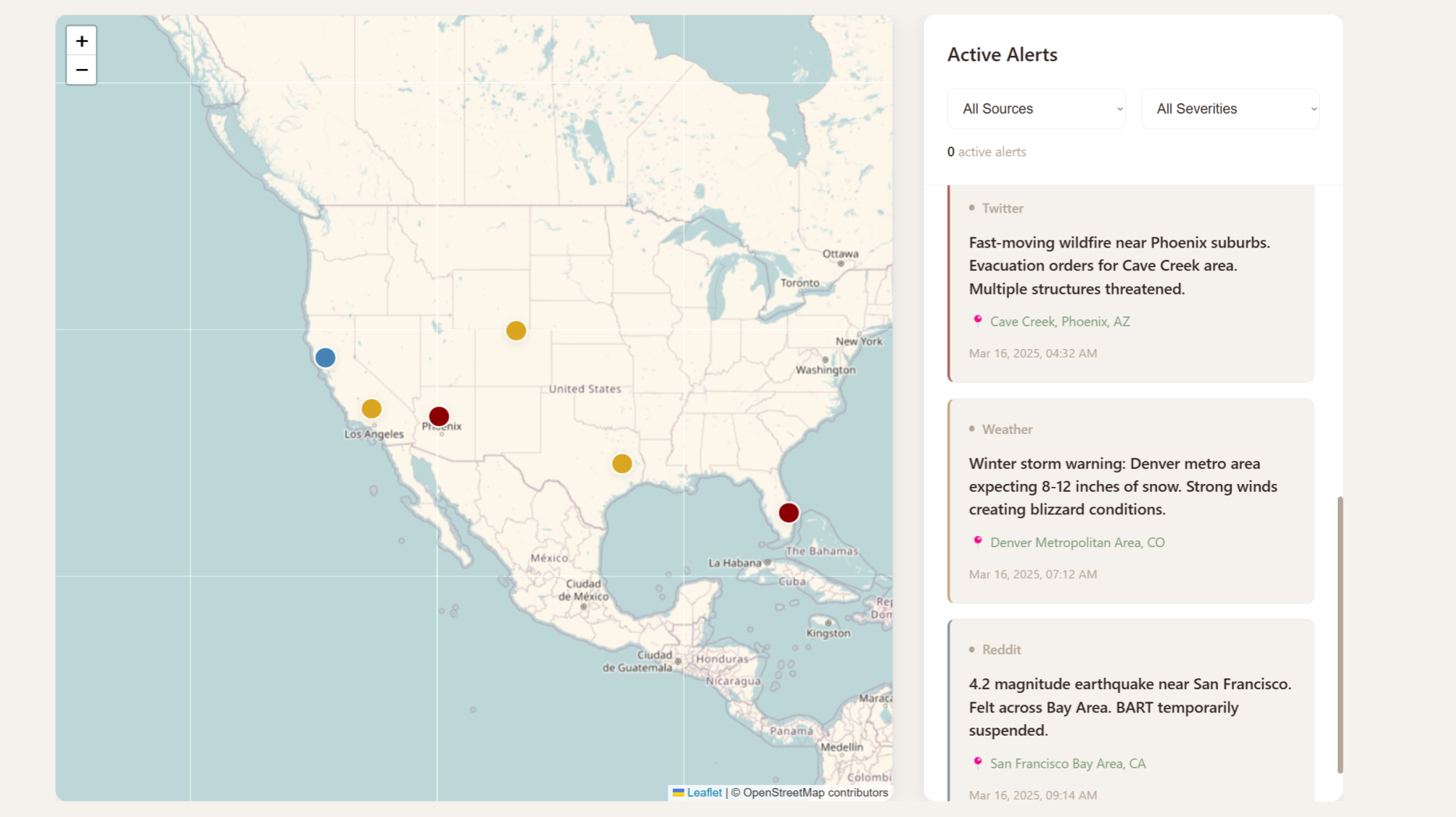
Disasters can strike at any moment, and timely alerts can be the difference between safety and danger. With social media platforms like Twitter and Reddit often being the first sources of real-time disaster information, we saw an opportunity to combine these with official national weather databases to create a reliable and rapid disaster alert system. Our goal was to provide users with instant notifications about potential dangers in their area, ensuring they have the necessary time to take action.
Quick Alert is an intelligent disaster alert system that aggregates data from Twitter, Reddit, and national weather databases, to provide real-time notifications of potential disasters. The app analyzes and filters relevant information to ensure that users receive accurate and timely alerts. Quick Alert categorizes alerts based on severity, type of disaster, and location, enabling users to make informed decisions quickly.
We developed it completely using Perplexity and CursorAI.
One of the major challenges we faced was filtering out misinformation from social media. To tackle this, we implemented machine learning models that assess the credibility of sources and cross-check information with official databases. Another challenge was optimizing the alert system to avoid overwhelming users with false positives while ensuring they receive crucial alerts in a timely manner. Additionally, integrating multiple data sources while maintaining performance efficiency required careful backend optimization.
We are proud to have developed an efficient disaster alert system that can potentially save lives. Our ability to integrate multiple data sources and provide accurate real-time alerts is a significant achievement. The website is also simple, down to only necessities for quick access.
Throughout the development of Quick Alert, we learned the importance of balancing real-time data processing with accuracy and reliability. We gained valuable experience in working with social media APIs, implementing NLP for data filtering, and designing scalable cloud-based architectures.
Moving forward, we plan to enhance Quick Alert by incorporating more data sources, including local news reports and emergency services. We aim to improve our machine learning models to further reduce false positives and enhance the accuracy of alerts.

Log in or sign up for Devpost to join the conversation.