-
-
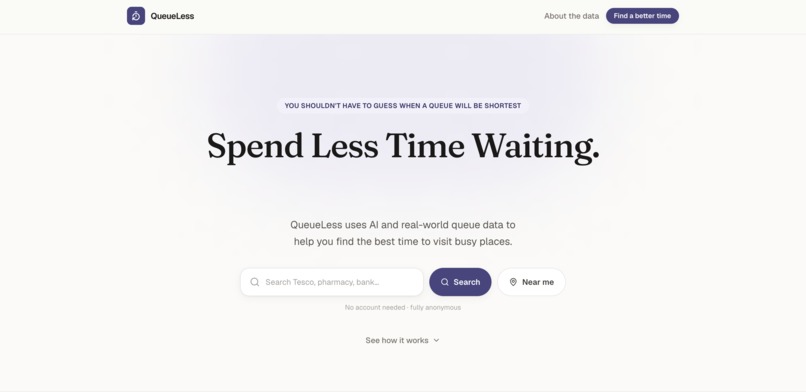
Front page
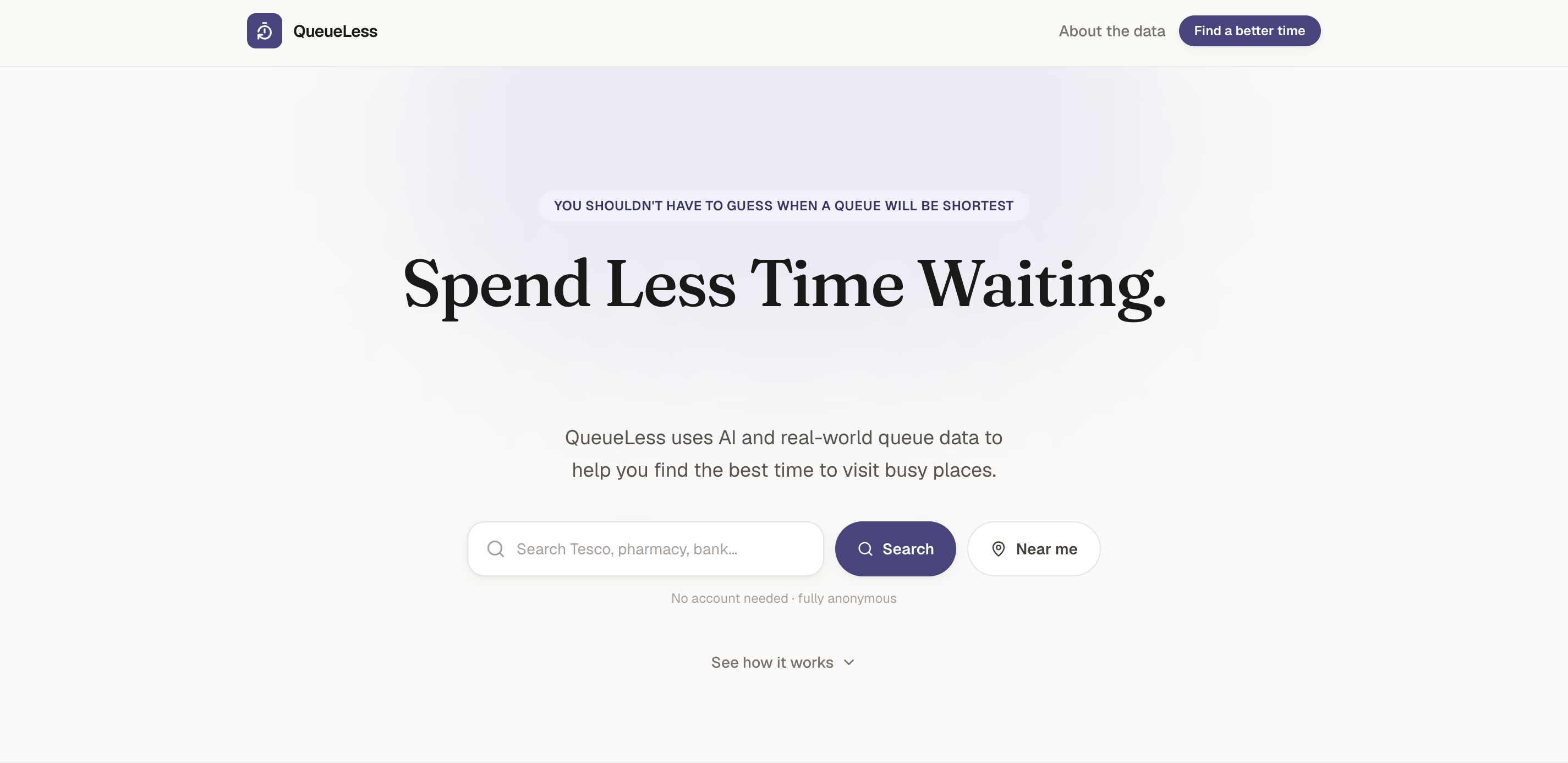
Inspiration
QueueLess was inspired by Waze. Waze transformed driving by using information from an entire community to help people make better decisions before they encounter traffic. We wanted to bring that same concept to queues.
We realized that while we can often see how busy roads are, we usually have no idea how busy a supermarket, pharmacy, bank, clinic, or coffee shop will be. People are forced to guess — potentially wasting 20, 30, or even 60 minutes.
What if waiting could be predicted instead of endured?
What it does
QueueLess is Waze for queues.
Users can search for real-world locations and see available queue information from:
🔴 Live community reports 🔵 Historical visits 🟣 Typical patterns
Users can also tell QueueLess what they need in natural language, such as:
“I need to be finished by 5 and can leave after 3.”
AI understands the user's constraints, while our deterministic prediction engine analyzes the available data and recommends the best time to visit.
Every prediction clearly shows its data provenance, so QueueLess never pretends that estimated or synthetic data is real.
How we built it
QueueLess is built with Next.js, TypeScript, Tailwind CSS, Supabase/PostgreSQL, and AI APIs.
We designed the prediction system so that AI doesn't invent the wait time. Instead, the prediction engine calculates the result from available observations, while AI handles natural-language constraints and explains the reasoning in a human-friendly way.
We also built a community reporting system where users can submit live or post-visit wait times. These reports feed back into the prediction system, creating a cycle where one person's experience can help the next person.
For real-world locations, QueueLess integrates with OpenStreetMap/Nominatim to help users find actual places rather than being limited to our demo locations.
Challenges we ran into
One of our biggest challenges was making predictions useful without fabricating data.
A traditional AI model could simply make up a convincing wait time when there isn't enough information. We deliberately avoided this. QueueLess separates real observations from synthetic demo data and displays their provenance to the user.
We also had to design a system that could start with limited data and become more useful as the community grows.
Another challenge was making the AI genuinely useful rather than adding AI just because it is a hackathon requirement. We decided that AI should understand messy human requests and explain complex prediction factors, while the actual numerical prediction remains deterministic and auditable.
Accomplishments we're proud of
We're especially proud of building a complete feedback loop:
Search → Predict → Report → Improve the prediction → Help the next person.
We also built:
Real-world location discovery Live and post-visit reporting Deterministic queue prediction AI natural-language understanding AI-generated explanations Transparent confidence scores Data provenance for every wait-time source Anonymous community participation Demo data that is clearly separated from real data
Most importantly, we created something that isn't just an AI demo — it's a product designed around a real everyday problem.
What we learned
We learned that adding AI isn't necessarily about letting an AI model make every decision.
Sometimes the strongest architecture is AI + deterministic systems.
AI is excellent at understanding people and communicating complex information, while deterministic systems are better when users need reliable, explainable numbers.
We also learned how important data provenance and trust are when building products that make predictions about the real world.
What's next for QueueLess
Our long-term vision is to make QueueLess a real-time global layer for physical queues.
As the community grows, QueueLess can build increasingly accurate location-specific patterns. We also want to explore integrations with external data sources, smarter anomaly detection, improved personalization, and eventually partnerships with businesses.
The ultimate goal is simple:
Make waiting predictable, avoidable, and eventually something people rarely have to think about.
QueueLess — Know When to Go.
Built With
- and-ai-apis-(anthropic/openai)
- for
- location
- next.js
- openstreetmap/nominatim
- react
- real-world
- supabase/postgresql
- tailwind-css
- typescript
- with
