
Inspiration
Moderators often have to make fast decisions with limited context. A reported post or comment may look bad at first glance, but the real decision depends on evidence, subreddit rules, surrounding context, user history, and whether the content clearly violates a rule. Existing moderation flows can force mods to jump between posts, profiles, rules, and reports before they can make a fair call.
QueueLens was inspired by that gap. We wanted to build a tool that does not replace moderators, but helps them review content with more clarity, evidence, and caution.
What it does
QueueLens turns a Reddit post or comment into an evidence-backed moderation review brief.
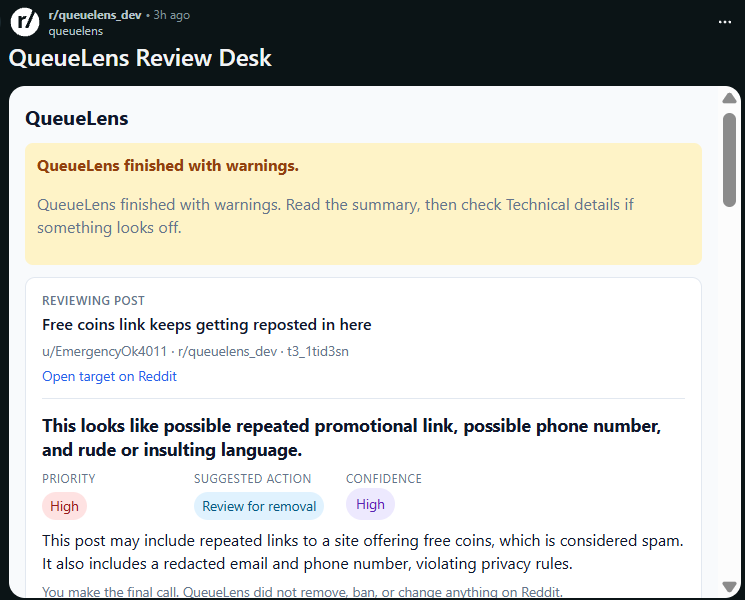
A moderator can click Analyze with QueueLens from the Reddit moderation menu. QueueLens opens a reusable Review Desk and shows:
- What content is being reviewed
- A plain-English review brief
- Suggested action, priority, and confidence
- Exact evidence snippets
- Reasons to be cautious before acting
- A suggested moderator note
- Investigation trace showing what QueueLens checked
- Context snapshot with available rules, target metadata, and user activity count
- Deterministic signals such as redacted email, phone, spam, or missing-context indicators
- Raw context for verification
QueueLens does not remove, approve, ban, message users, or change Reddit state. It only provides review assistance. The final decision stays with the moderator.
How we built it
We built QueueLens as a Reddit Devvit app with a moderator-only menu action.
The core flow is:
- A moderator selects Analyze with QueueLens on a post or comment.
- QueueLens creates a short-lived analysis session.
- The app opens a reusable QueueLens Review Desk custom post.
- The Review Desk loads the selected analysis through a postData bridge.
- QueueLens gathers bounded Reddit context, redacts sensitive details, extracts deterministic signals, calls the analysis pipeline, validates the result, and renders a review card.
The app uses a few important guardrails:
- Personal contact details are redacted before analysis.
- Evidence must be grounded in exact snippets.
- Invalid or unsupported evidence is removed.
- QueueLens analysis posts and the Review Desk cannot be recursively analyzed.
- The tool is advisory only and takes no automatic moderation action.
- Raw context remains available so moderators can verify the brief.
We also moved from creating a new analysis post for every review to using one reusable Review Desk per subreddit. That made the experience cleaner and avoided cluttering the subreddit feed with repeated analysis posts.
Challenges we ran into
The hardest challenge was working within Reddit and Devvit’s platform constraints.
At first, each analysis opened as a separate QueueLens analysis post. That worked, but it cluttered the subreddit and created stale analysis posts. We redesigned the flow around a reusable Review Desk.
Then we ran into session-passing issues. Passing analysisSessionId through the URL looked good in tests, but live Reddit preserved the parameter only on the top-level page. The embedded Devvit webview did not receive it. QueueLens correctly failed closed, but the Review Desk could not load the selected analysis.
To fix that, we switched to a Devvit postData bridge keyed by moderator user id. That made the Review Desk session handoff work without returning to a shared last-write-wins session key.
We also had to manage information overload. As QueueLens gained evidence, caution reasons, notes, context, deterministic signals, and investigation trace, the UI started feeling like a full audit dump. We refined the structure so the main decision brief stays visible first, while deeper technical details remain available for verification.
Accomplishments that we're proud of
We are proud that QueueLens became more than a basic AI moderation classifier.
It includes:
- A reusable Review Desk instead of one analysis post per click
- Per-analysis session handling
- Redaction for sensitive details
- Evidence validation
- Deterministic signal detection
- Reasons to be cautious
- Suggested moderator notes
- Investigation trace
- Context snapshot
- Raw context drawer
- Recursive-analysis protection
- Static guardrail tests
- Automated tests covering the core flow
We are especially proud that QueueLens is designed around moderator control. It helps moderators decide faster, but it does not pretend to be the final authority.
What we learned
We learned that moderation tools need trust more than automation.
A useful moderation assistant cannot just say “remove this.” It needs to show what it checked, what evidence supports the recommendation, what context was unavailable, and why a moderator should be careful before acting.
We also learned that platform constraints matter. Some things that are easy in a normal web app, such as passing session state through URLs or hiding menu items dynamically, behave differently inside Reddit and Devvit. Building QueueLens required adapting to those limits without weakening the safety model.
Most importantly, we learned that the best AI moderation tools should not replace human judgment. They should compress context, surface evidence, and make uncertainty visible.
What's next for QueueLens
Next, we want to keep improving QueueLens as a serious moderation review tool.
Planned improvements include:
- Better layout for dense review cards
- More compact default view with expandable audit details
- Stronger live E2E verification across multiple moderation scenarios
- More accurate context summaries for comments and parent threads
- Optional review history without storing unnecessary sensitive data
- Better handling for concurrent moderator workflows
- More polished demo fixtures and onboarding for moderators
Long term, QueueLens could become a full evidence-first moderation workspace: fast enough for daily modqueue review, cautious enough for sensitive decisions, and transparent enough for moderators to trust.

Log in or sign up for Devpost to join the conversation.