-
-
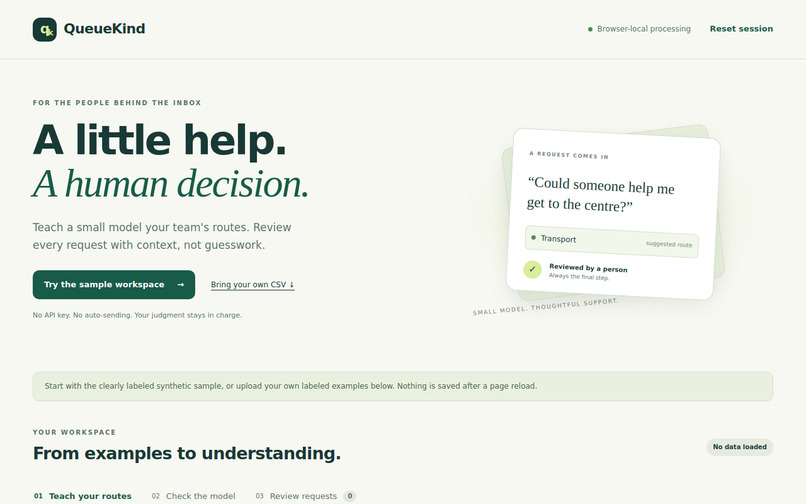
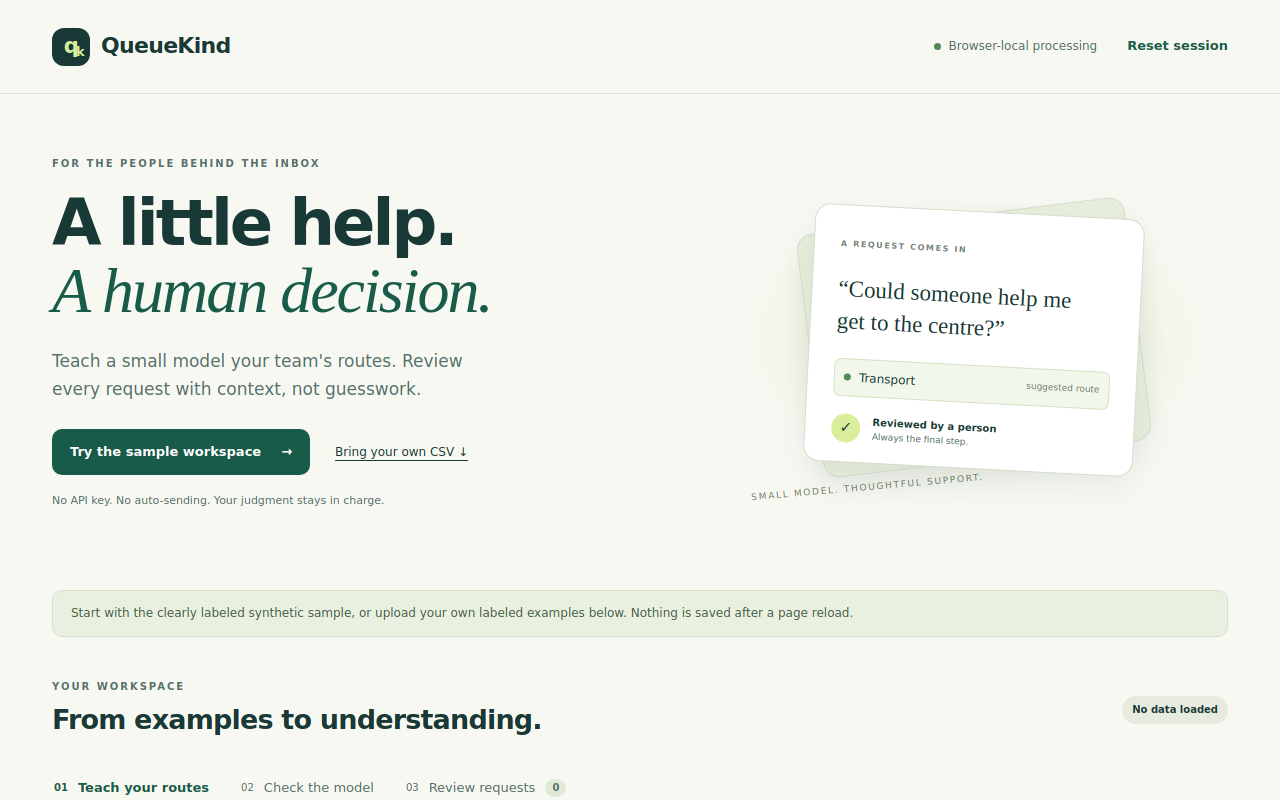
Actual app: start with labeled fictional examples or bring non-sensitive CSV data; processing stays in the page.
-
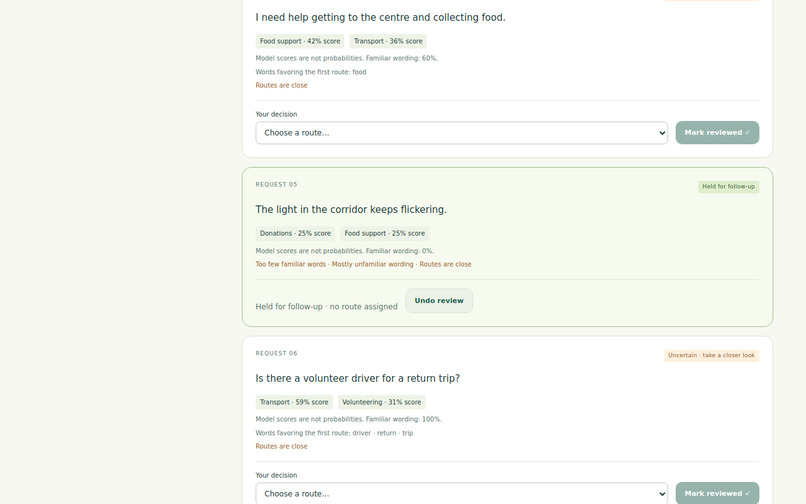
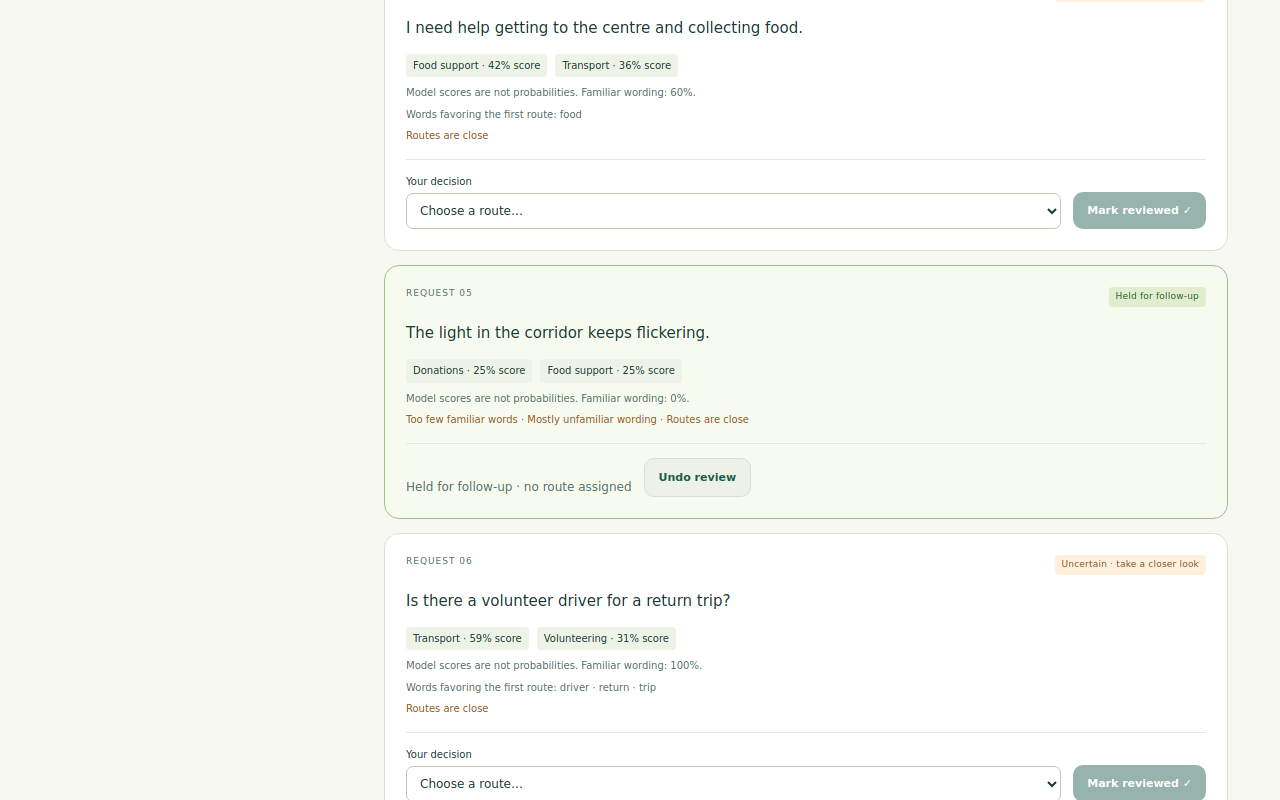
Actual review: an unsupported fictional request is held for follow-up with no route assigned; it is not learned as a route.
-
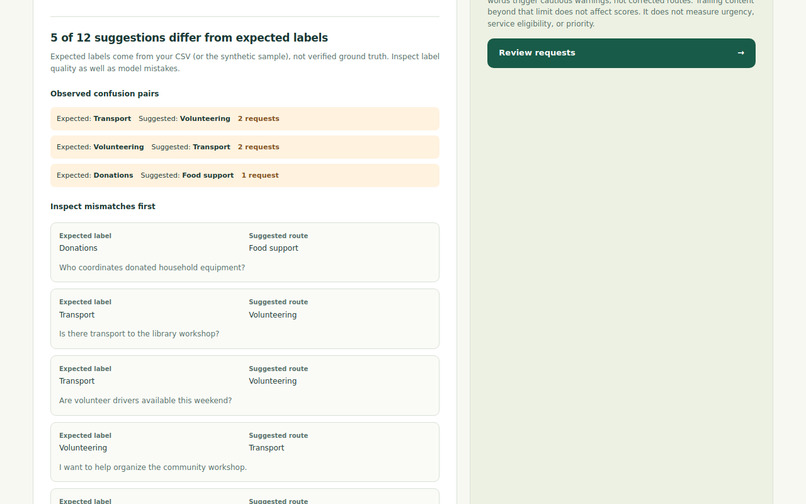
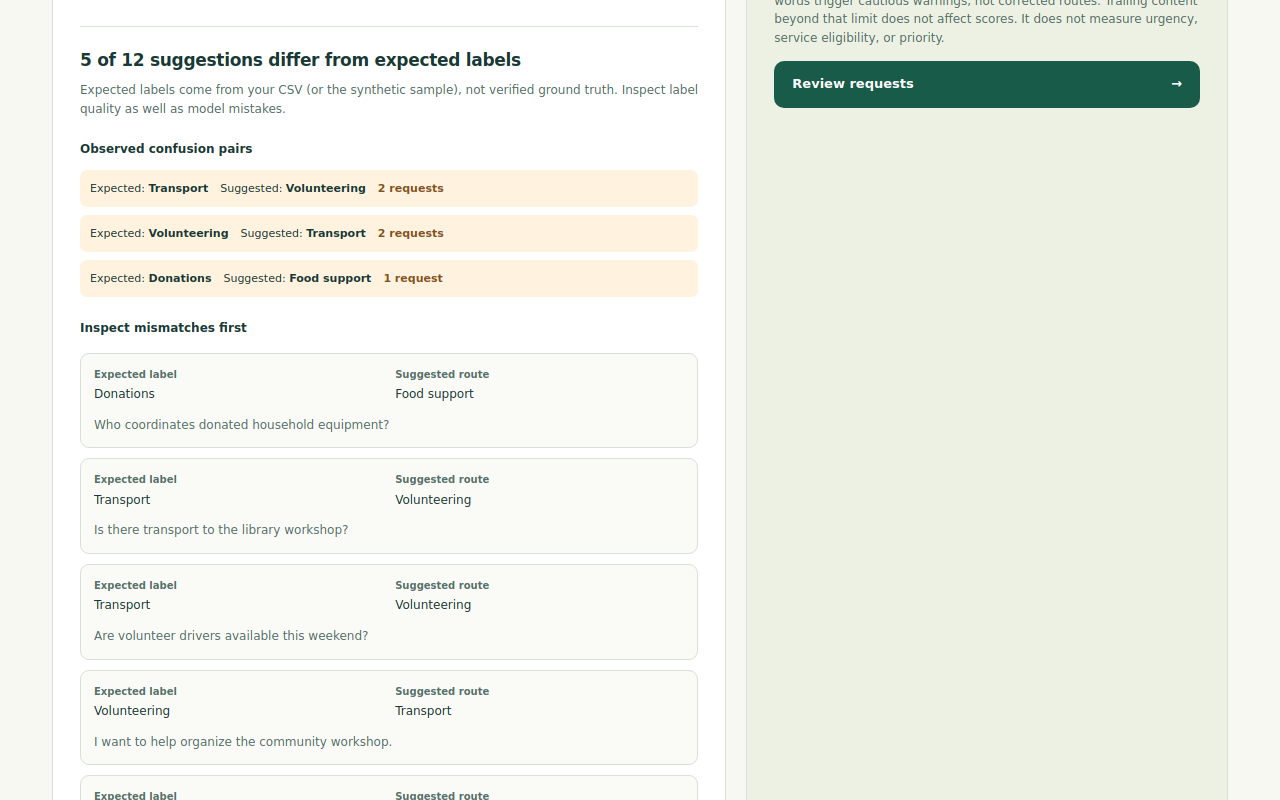
Actual sample check: five of twelve suggestions disagree with supplied labels. Inspect mistakes before trusting a score.
Problem
Volunteer teams can receive administrative requests for food support, transport, donations and volunteering through a shared queue. A text classifier can suggest a destination, but an impressive-looking score can hide a wrong interpretation. Ambiguous requests and requests outside the available routes need a human response—not a forced classification.
QueueKind explores how a lightweight routing aid can make those limitations visible. This is a proposed use case, not a claim of adoption by an organization or measured time savings.
Solution
QueueKind turns labeled examples into a small local machine-learning model, then puts error inspection and human decisions ahead of export. A reviewer can see held-out mismatches with the supplied label and suggested route side by side, inspect recurring confusion pairs, and choose a destination or explicitly hold a request for follow-up.
The app never sends a message or automatically routes work. It is an experimental administrative aid; it does not assess urgency, service eligibility or priority and is not an emergency-response or clinical tool.
Key features
- Teach the team's routes: CSV examples with
text,label, at least two routes and six unique examples per route. Conflicting labels for identical word-count features are rejected. - Inspect failure before trust: a deterministic held-out check, per-route precision/recall/F1, mismatch-first examples and confusion counts. Supplied labels are annotations, not verified ground truth.
- Review with context: the full request, two suggested routes, relative scores, familiar-word coverage and words favoring the leading route. Scores are not calibrated probabilities.
- Keep an honest escape route: hold an unsupported request for follow-up without assigning a route. Held requests do not become training examples.
- Correct without contaminating the check: learn from reviewed routes while excluding held-out word-count fingerprints. Semantic paraphrases can still leak; repeated tuning against the same check is not independent validation.
- Export deliberately: only reviewed requests are exported, including held requests with no assigned route. Review-time model version and per-request origin are retained. Spreadsheet formula prefixes are neutralized.
- Small, self-contained runtime: no model service, API key, external dependency or automatic persistence. Hosted assets load over the network; request processing stays in the page. Export work before closing or reloading.
Technologies
Vanilla JavaScript ES modules, HTML and CSS; an in-browser multinomial Naive Bayes classifier with Unicode tokenization, stop-word filtering and Laplace smoothing; deterministic stratified holdout; browser CSV import/export; Node.js automated tests; static GitHub Pages hosting. The classifier is not a generative model. Source is MIT-licensed.
Target users
Volunteer coordinators and small community teams exploring human-reviewed administrative request routing with non-sensitive, de-identified examples. No real-user study has yet established suitability or usefulness in operation.
What works—and what the evidence does not establish
The starter workspace contains 48 fictional labeled examples and six fictional requests. Its 36-training/12-check split produces 7/12 supplied-label matches and approximately 58% macro F1. Five mismatches are exposed first rather than hidden behind an aggregate score.
A separately prepared 60-case synthetic evaluation produces 23/32 matches on clear-intent cases and 8/12 on negation/contrast cases. Eight mixed-intent and eight out-of-scope cases have no single expected route and are not scored for routing accuracy. Warning rates are 22/32 clear, 12/12 negation, 6/8 mixed and 8/8 out-of-scope. These warnings are uncalibrated heuristics: they can over-warn and miss difficult cases, and all requests still require review.
The evaluation was engineer-blind when frozen, not fully double-blind: its author inherited earlier failure context. The corpus, provenance, results and reproduction runner are in the repository. Public cases are not a fresh blind test for later tuning. None of these synthetic results establishes real-world reliability, safety, time savings or impact.
The model cannot resolve word order, negation scope or multiple intentions. Conservative warnings do not correct its predictions. Only the first 500 content tokens affect scores. The product's contribution is the inspect–review–correct workflow and its safeguards, not a novel classifier or a claim of high accuracy.
Team and attribution
Solo entrant: Sharon Basovich. Project owner and entrant. QueueKind was developed with AI-assisted implementation, test generation, documentation and independent AI-assisted review. AI assistants are development tools, not additional human team members. This project does not claim that Sharon personally hand-wrote each component or conducted a real-user study.
QueueKind is an original project developed beginning November 2, 2026; it is not a reuse of the previously submitted Clever Hans Lab project.
Links
- Source: https://github.com/sharonbasovich/queuekind
- Unlisted demonstration video: https://youtu.be/j4XVJLKH5mA
- Live experimental demo: https://sharonbasovich.github.io/queuekind/
- Verification notes: https://github.com/sharonbasovich/queuekind/blob/main/QA.md
- Evaluation provenance: https://github.com/sharonbasovich/queuekind/blob/main/qa/evaluation/PROVENANCE.md
- Event: https://ml-build-challenge-4.devpost.com/
Suggested judge walkthrough
- Open the demo and choose Try the sample workspace.
- Open Check the model. Inspect the five failures and confusion pairs, not only 7/12 and 58%.
- Open Review requests. The flickering-corridor-light request is outside the sample routes; choose Hold for follow-up / no suitable route, then Mark reviewed.
- Review a routed request deliberately. Retrain from that routed decision, understanding that the reused check is not new independent evidence.
- Export reviewed requests; unreviewed requests stay excluded.
What we learned and what comes next
The most useful improvement was not a more confident score: it was exposing mistakes and making an unsupported route easy to hold. During development, independent synthetic challenges exposed word-order and negation failures. A bounded feature experiment did not justify replacing the transparent baseline. Review workflow, correction integrity and honest feedback were prioritized instead. Next would be a small consented usability study with non-sensitive examples, followed by fresh held-out evaluation—not repeated tuning on the published check.
