Inspiration
Healthcare should begin with care—not with waiting in long, uncertain queues. During our research, we observed that patients often spend hours waiting without knowing when they will be called. This leads to overcrowded waiting areas, increased stress, reduced patient satisfaction, and inefficient hospital operations.
We wanted to solve a simple yet impactful problem: How can we make hospital waiting smarter, more transparent, and more efficient?
This idea led to the creation of QUEUE CURE AI, an intelligent queue management system that combines Artificial Intelligence with real-time hospital operations to improve the patient experience.
What it does
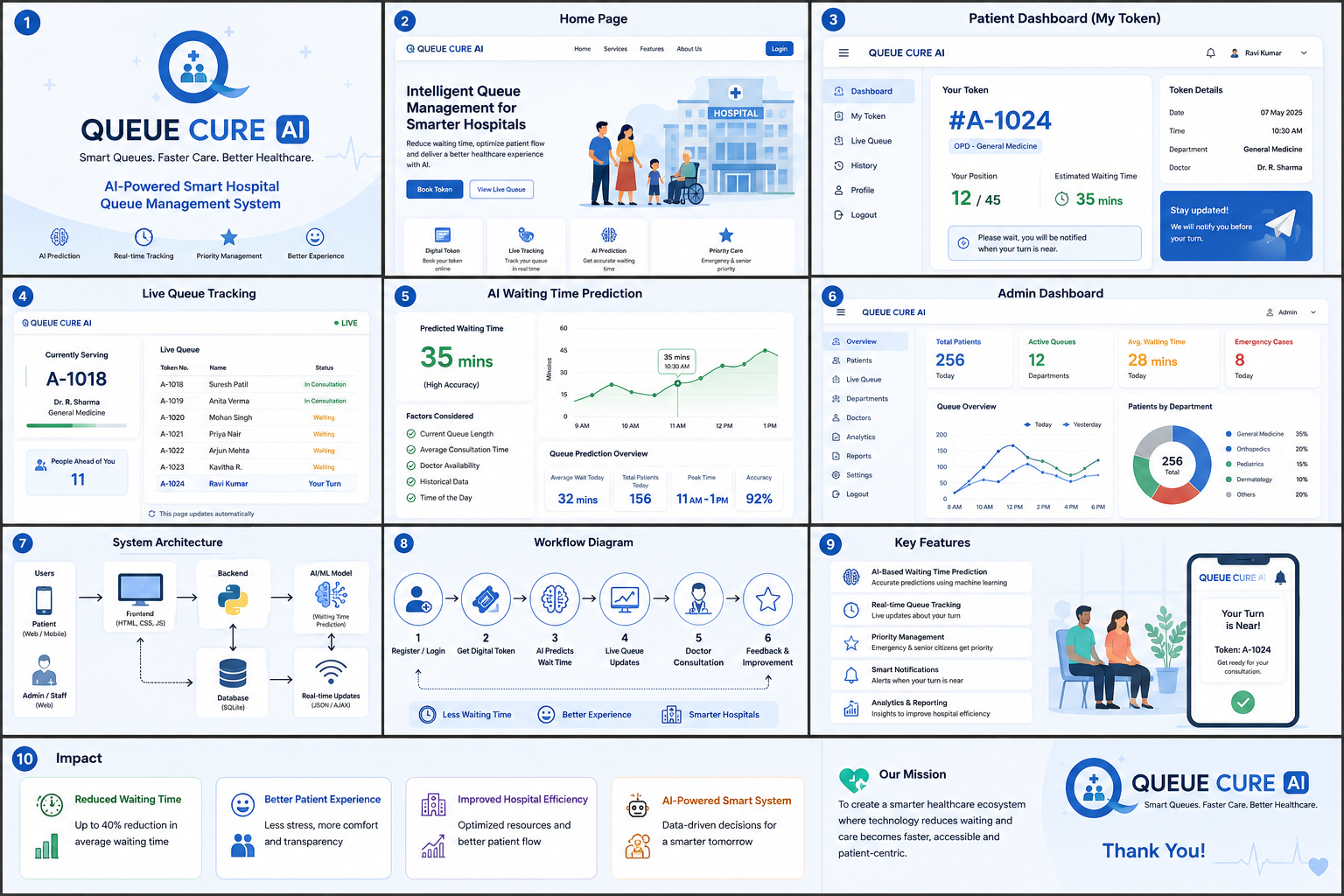
QUEUE CURE AI is an AI-powered smart hospital queue management platform that digitizes and optimizes patient queues.
Key features include:
- Digital token generation and appointment booking
- Real-time queue tracking
- AI-based waiting time prediction
- Emergency and senior citizen priority management
- Live notifications for patients
- Hospital dashboard for monitoring queue status
- Analytics for improving hospital efficiency and reducing congestion
The system allows patients to arrive closer to their appointment time while enabling hospitals to manage patient flow more effectively.
How we built it
We designed QUEUE CURE AI using a modern full-stack architecture.
- Frontend: HTML, CSS, JavaScript
- Backend: Python with Flask
- Database: SQLite
- Machine Learning: Scikit-learn for waiting time prediction
- Data Processing: Pandas and NumPy
- Version Control: Git and GitHub
The AI model analyzes factors such as patient volume, historical consultation durations, and queue patterns to estimate waiting times. The frontend communicates with the backend through REST APIs, while the administrative dashboard provides real-time monitoring of queue activities.
Challenges we ran into
Building an intelligent queue prediction system involved several challenges.
- Collecting realistic healthcare queue data for AI model training.
- Predicting waiting times accurately despite changing patient flow.
- Designing a simple and user-friendly interface suitable for patients of all age groups.
- Integrating real-time queue updates with backend processing.
- Managing time efficiently while developing multiple modules during the hackathon.
These challenges helped us improve both our technical implementation and teamwork.
Accomplishments that we're proud of
- Developed a complete AI-enabled hospital queue management prototype.
- Successfully integrated AI-based waiting time prediction.
- Designed an intuitive patient interface and administrative dashboard.
- Created a scalable solution that can be adapted for hospitals, clinics, diagnostic centers, and vaccination camps.
- Built a project with real social impact by improving healthcare accessibility and reducing unnecessary waiting.
What we learned
Working on QUEUE CURE AI strengthened our understanding of:
- Machine Learning model development and prediction techniques
- Full-stack web application development
- API integration and backend architecture
- Database management
- UI/UX design for healthcare applications
- Team collaboration, project planning, and rapid prototyping under hackathon deadlines
Most importantly, we learned that solving a real-world problem requires understanding people's needs as much as writing code.
What's next for QUEUE CURE AI
We plan to evolve QUEUE CURE AI into a complete smart hospital management solution by introducing:
- Mobile application for Android and iOS
- QR-code based digital check-in
- Integration with hospital management systems (HMS)
- Voice assistant support in multiple regional languages
- Predictive patient flow analytics using advanced AI models
- Doctor schedule optimization
- SMS and WhatsApp notifications
- Cloud deployment for multi-hospital access
- Secure authentication and compliance with healthcare data privacy standards
Our long-term vision is to make QUEUE CURE AI a scalable platform that helps hospitals deliver faster, smarter, and more patient-centric healthcare.

Log in or sign up for Devpost to join the conversation.