Inspiration
Traditional learning often assumes everyone learns best by reading textbooks or watching lengthy videos. But many people learn more effectively through curiosity, exploration, and interaction.
The inspiration for QuestKey came from a school history teacher I had when I was young. He never simply gave us information. Instead, he gave each student a different question to investigate. Each answer led to another question, making learning feel like solving a mystery rather than completing an assignment. That experience stayed with me for years.
I wanted to recreate that feeling using AI. Instead of asking, "How can AI explain this topic?", I asked, "How can AI turn learning itself into an adventure?"
My guiding principle became:
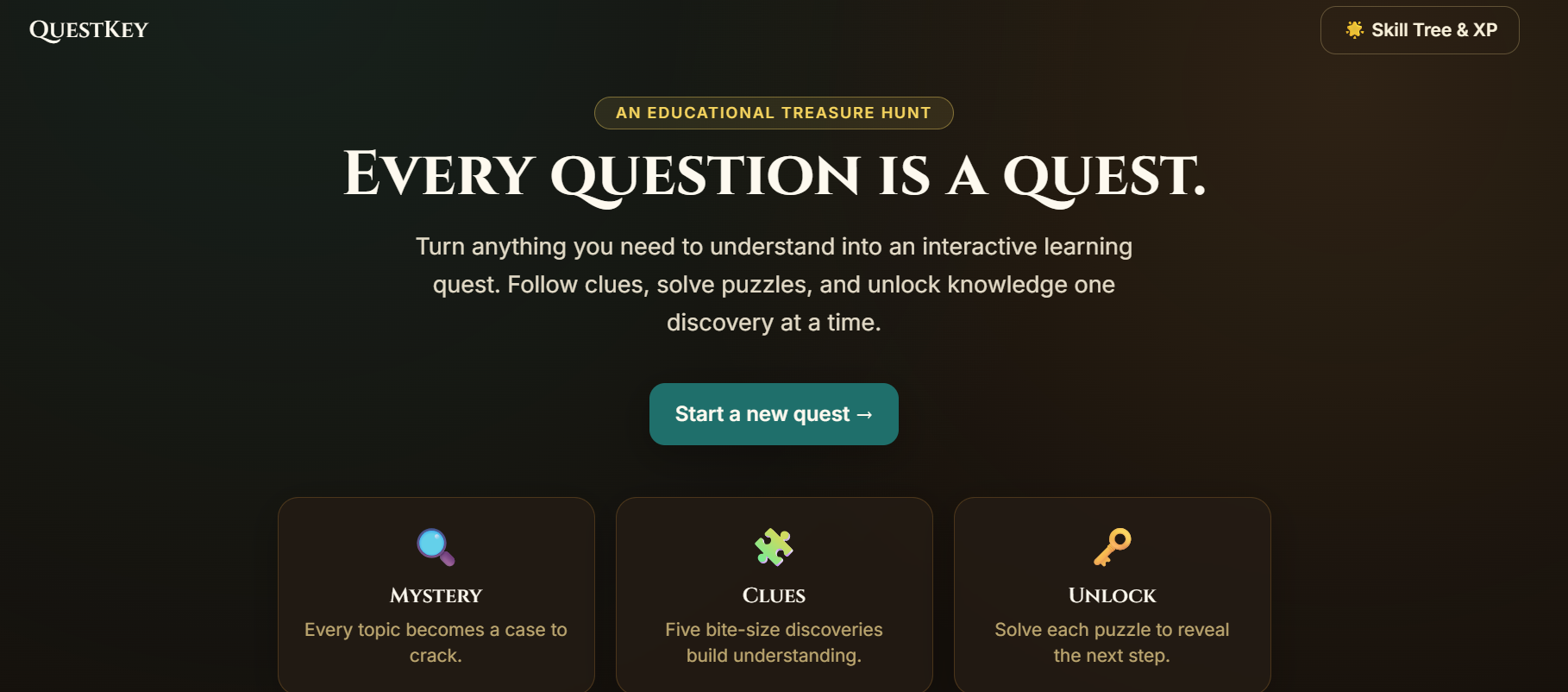
Every question is a quest.
What it does
QuestKey transforms any question into an AI-generated interactive learning experience.
A learner enters a topic they want to understand, chooses their current knowledge level, preferred adventure style, and accessibility preferences. QuestKey then generates a personalised learning quest complete with a mission, clues, interactive questions, hints, explanations, a final challenge, and a personal Codex where learners explain concepts in their own words.
Progress is rewarded through experience points, unlocked skills, and saved learning history, helping make complex topics more engaging and accessible.
How we built it
QuestKey was built as a React and TypeScript web application using Vite and Tailwind CSS, with an OpenAI-powered backend that dynamically generates each learning quest.
The application creates structured learning adventures based on the user's chosen topic, theme, and accessibility settings. It also uses AI to provide personalised feedback on learners' own explanations, encouraging active recall rather than passive consumption.
Progress, completed quests, XP, skills, and Codex entries are stored locally, allowing users to continue learning without regenerating completed adventures.
Challenges we ran into
Designing prompts that consistently generated engaging adventures while remaining educational and factually accurate was one of the biggest challenges.
Another challenge was balancing storytelling with learning. I wanted the adventure to make learning more enjoyable without allowing the narrative to distract from the educational objective.
I also spent time refining the user experience to keep each step short, approachable, and accessible, ensuring users always felt they were making progress.
Accomplishments that we're proud of
I'm proud that QuestKey goes beyond simply asking an AI to explain a topic.
Instead, it creates interactive learning experiences where understanding unlocks progress. Every quest is unique, personalised, and generated from a single question.
I'm also proud of the accessibility features, including simplified language, built-in text-to-speech, supportive hints, personalised AI feedback, and a learning experience designed to reduce cognitive overload rather than add to it.
What we learned
This project reinforced that AI is most powerful when it creates experiences rather than simply generating content.
I also learned how important prompt engineering, structured JSON responses, and thoughtful UX design are when building reliable AI applications. Most importantly, I discovered that curiosity is a powerful motivator. Framing learning as exploration changes how people engage with new ideas.
What's next for QuestKey
My vision is to make QuestKey a platform for personalised learning.
Future plans include user sign up and log in, database connectivity, adaptive difficulty that responds to learner performance, richer quest types, visual and multimedia learning experiences, collaborative classroom features, visual knowledge maps showing how concepts connect, and support for educators to generate curriculum-aligned quests.
Ultimately, I want QuestKey to become a place where anyone can ask a question and discover that learning can be an adventure.
Built With
- openai
- react
- tailwind
- typescript

Log in or sign up for Devpost to join the conversation.