-
-
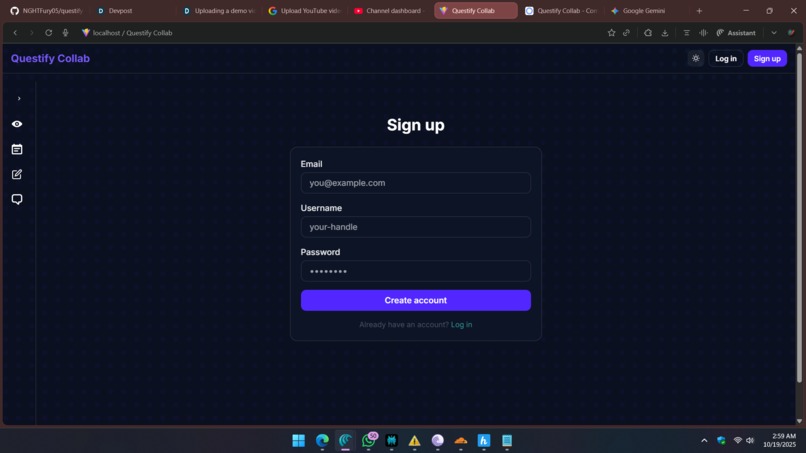
Log in Page
-
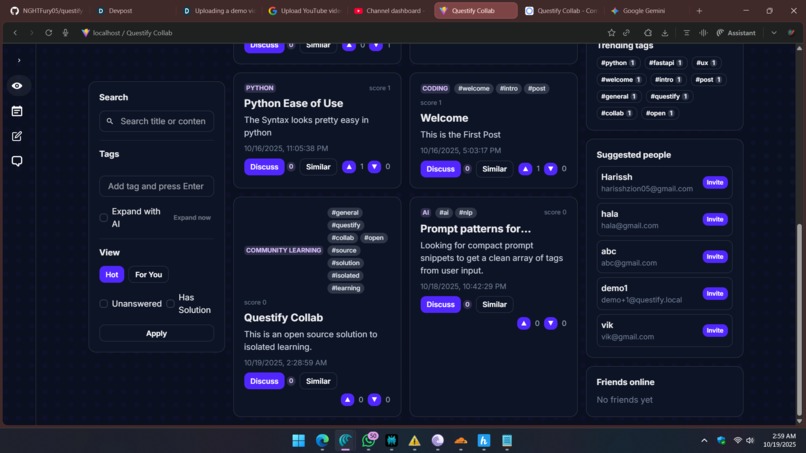
The User personalised Feed
The Spark
The Spark for Questify Collab came from the fragmented and lonely experience of modern online learning. A student watches a structured course lesson, but their real understanding comes from a scattered hunt across YouTube for analogies, Stack Overflow for code fixes, and blogs for real-world context. This "fragmented knowledge" is incredibly valuable but is almost always lost—it's never captured or fused back into the original lesson for the next student. We wanted to build a platform that solves this "Knowledge Fragmentation Gap" by building a tight loop between an AI-driven personal tutor and a community-driven collective mentor.
Learning Experience
This hackathon was a crash course in building a full-stack, AI-native application from scratch. We learned to focus our time on our unique features, not on rebuilding solved problems. We learned that getting a fast LLM like Llama 3 on Groq to return reliable, structured JSON is an art form. The difference between a failed API call and a perfect lesson plan wasn't the model, but the precision of our system prompt and its strict output formatting instructions.
The How
We chose a modern, high-velocity stack to build this prototype rapidly. Frontend: React (with Vite) for a blazing-fast setup, with the Chakra UI component library. This allowed us to build a polished, responsive UI without writing a single line of custom CSS. Backend: FastAPI (Python) was chosen for its raw speed and asynchronous capabilities, making it perfect for handling concurrent users and acting as a non-blocking gateway for external AI API calls. AI Engine: We used the Groq API to power our AI features. Its real-time streaming response was essential for the user experience, making the AI feel like a live tutor, not a slow-batch process. Database & Auth: Supabase provided our free Postgres database and handled all user sign-up and login logic via JWT.
The Challenges
Our biggest challenge was handling inconsistent JSON from the LLM. In the heat of the hackathon, the AI would occasionally add an extra comma or miss a bracket, crashing the frontend. We had to build resilient parsing and error-handling on the backend to catch these failures before they broke the user experience. The project summary includes a full social graph with friend requests and direct messaging. This was a classic case of aggressive scope creep. We started building it and quickly realized it was an entire project in itself, with its own database tables, API endpoints, and complex frontend state. The real challenge here wasn't technical; it was discipline. We had to make the hard call to stop building the social features and refocus all our energy on making the core Learn Earn Reputation loop absolutely flawless for the demo.
Built With
- css
- fastapi
- groq
- html
- javascript
- postgresql
- python
- react
- supabase
- vite

Log in or sign up for Devpost to join the conversation.