💡 Inspiration
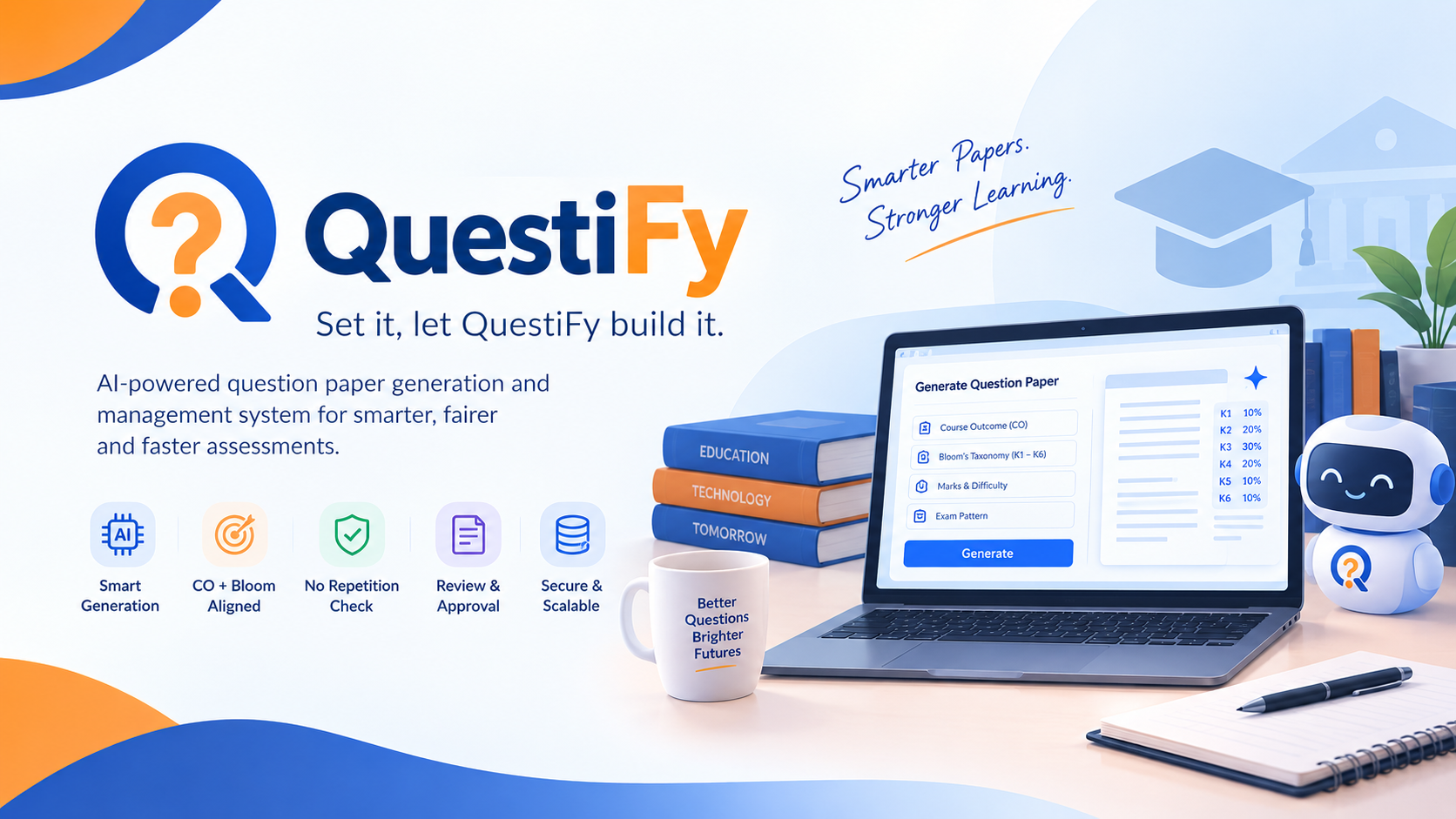
Creating question papers in colleges is often a time-consuming manual process. Faculty members need to balance Course Outcomes (COs), Bloom’s Taxonomy levels, marks, difficulty, syllabus coverage, and exam patterns, while also ensuring that questions from previous examinations are not repeatedly used.
We wanted to solve this problem with AI.
That idea led to QuestiFy — “Set it, let QuestiFy build it.” Our goal was to build more than a simple question generator: we wanted an intelligent platform that could support the entire question paper creation and review workflow.
🚀 What We Built
QuestiFy is an AI-powered question paper generation and management platform designed for colleges and universities.
The system allows institutions to manage their question banks and academic configurations, while faculty members can generate examination papers based on predefined requirements.
QuestiFy considers:
- Course Outcomes (CO1, CO2, etc.)
- Revised Bloom’s Taxonomy (K1–K6)
- Marks and question patterns
- Difficulty levels
- Unit and syllabus coverage
- Historical question repetition
- Answer key generation
- Faculty review and approval workflows
Instead of starting from scratch every time, faculty can provide the required examination details and let QuestiFy generate a structured paper using the institution's existing question bank and configurations.
🛠️ How We Built It
We designed QuestiFy as a distributed microservices-based application.
The frontend was developed using React and Vite, providing an interactive interface for administrators, faculty, coordinators, reviewers, and other academic roles.
For the backend, we used Java, Spring Boot, Spring Cloud, and Maven, with separate services responsible for authentication, institution management, question banks, paper generation, approvals, analytics, backups, and audit logging.
We used MySQL for structured transactional data and MongoDB for flexible documents such as generated papers and audit information.
The AI component combines constraint-based generation and Large Language Model capabilities. Constraint optimization helps maintain the required distribution of COs, Bloom's levels, and marks, while AI assists in generating and refining meaningful questions.
We also incorporated semantic similarity techniques to identify potentially repeated questions across historical papers.
📚 What We Learned
Building QuestiFy taught us that developing an AI application is not only about integrating an LLM.
We learned how important it is to combine AI with deterministic rules and domain constraints. A generated question may look correct, but an examination paper must also satisfy specific academic requirements.
We gained practical experience in:
- Microservices architecture
- REST APIs and service communication
- React-based frontend development
- Spring Boot backend development
- Database design with SQL and NoSQL
- AI-assisted content generation
- Constraint optimization
- Semantic similarity and repetition detection
- Role-based access control
- Approval workflows
- Audit logging and system design
Most importantly, we learned how to transform a real-world academic problem into a structured software solution.
⚡ Challenges We Faced
One of our biggest challenges was maintaining academic constraints while using AI.
Simply asking an AI model to generate a question paper does not guarantee that the final paper will contain the correct CO distribution, Bloom's Taxonomy levels, marks, or syllabus coverage.
To address this, we separated the problem into different layers. Constraint-based logic handles the strict requirements, while AI handles the more flexible task of generating and refining question content.
Another challenge was avoiding question repetition. Comparing questions only through exact text matching would fail when the same concept was expressed using different wording. We therefore explored semantic similarity to identify questions that were conceptually similar.
Designing multiple microservices was another challenge. Keeping authentication, question banks, paper generation, approvals, analytics, and auditing consistent required careful API design and service communication.
🌱 What's Next?
QuestiFy is designed with the potential to grow beyond question paper generation.
Future improvements could include better question-quality evaluation, personalized question recommendations, deeper learning analytics, multilingual question generation, and more advanced academic insights.
Our vision is to make examination creation faster, more consistent, curriculum-aware, and less repetitive, while keeping faculty members in control of the final paper.
QuestiFy — Set it, let QuestiFy build it.

Log in or sign up for Devpost to join the conversation.