-
-
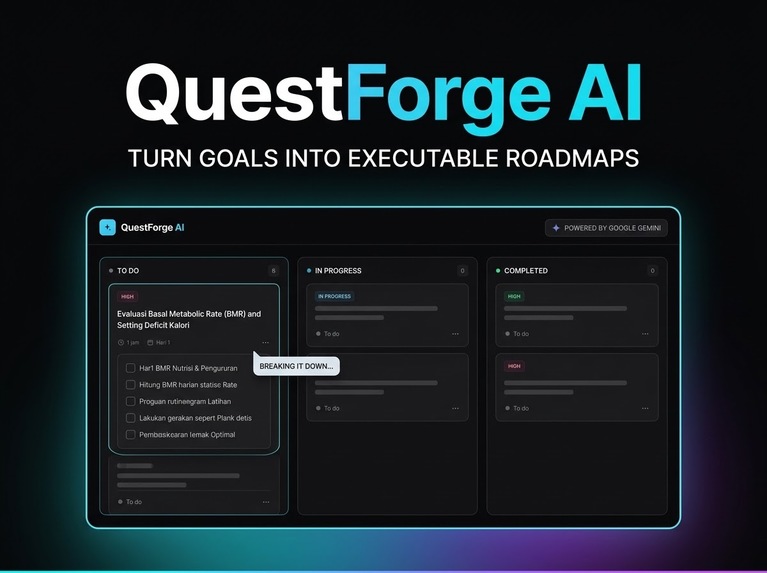
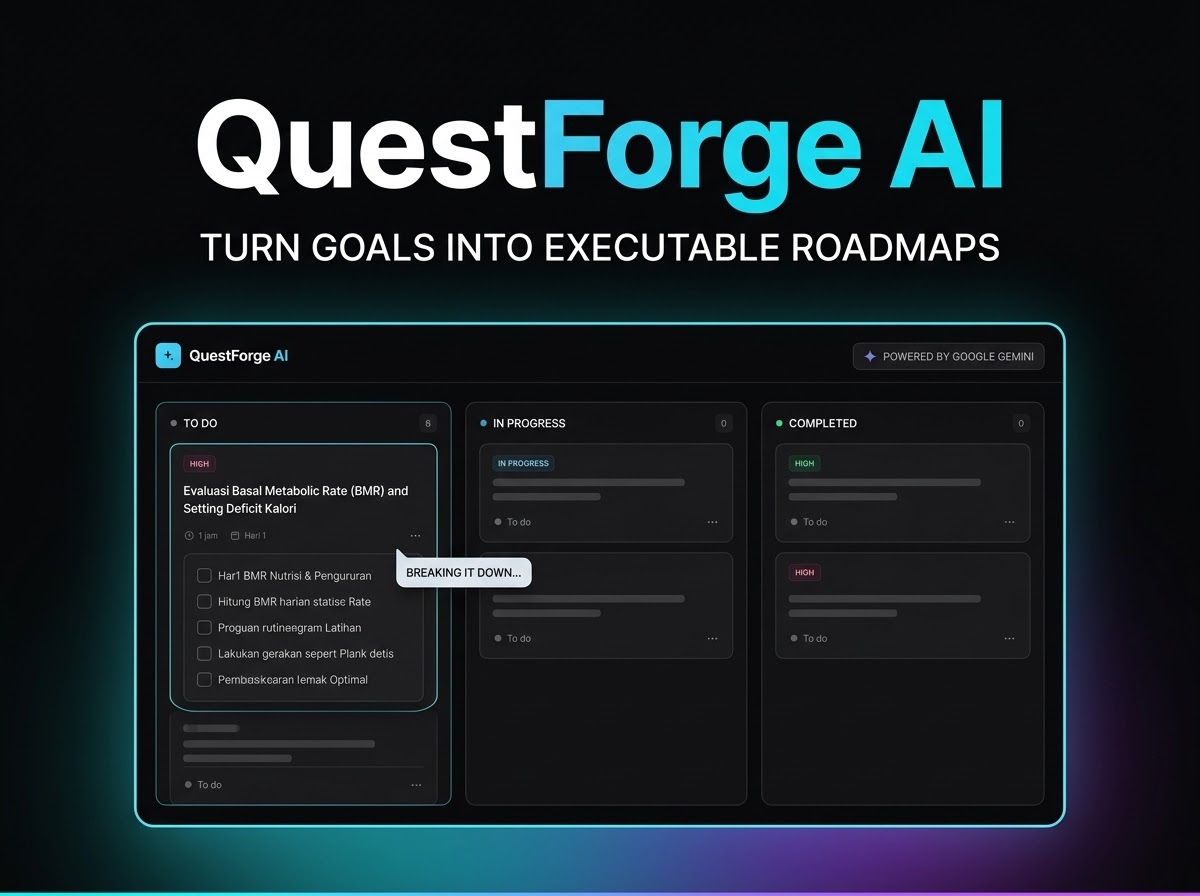
Dynamic Kanban interface plotting a structured roadmap directly from user input
Inspiration
We've all been there: staring at a massive, ambitious goal and feeling completely paralyzed by the sheer scale of it. Whether it's learning a new programming language, launching a startup, or getting into shape, the gap between wanting to do something and knowing what to do next is where dreams usually die. This phenomenon, often called "analysis paralysis," is what inspired QuestForge AI.
What it does
QuestForge AI is an intelligent copilot that turns ambitious goals into clear, executable roadmaps. Users simply describe their high-level objective (e.g., "Build a SaaS MVP in 7 days" or "Master Cloud Architecture"). QuestForge analyzes this objective and instantly generates a structured, step-by-step roadmap. Instead of just giving you a wall of text, it populates a sleek, interactive Kanban board (To Do, In Progress, Completed). Every generated "quest" includes priority levels, estimated timeframes, and bite-sized sub-tasks, allowing you to move seamlessly from high-level strategy to daily delivery.
How we built it
Semantic Parsing Engine: The core brain of the application relies on a custom Natural Language Processing (NLP) pipeline. When a user inputs an objective, the engine performs semantic extraction to understand the context and required steps. It utilizes heuristic decomposition algorithms to break down the primary goal into a logical tree of dependencies (sub-tasks).
Structured Data Serialization: To bridge the gap between human text and UI components, the engine enforces strict data serialization. The parsed tasks are systematically formatted into heavily structured JSON payloads. This guarantees that the hierarchical relationships (main task -> sub-tasks -> priority) are preserved and perfectly predictable.
Frontend Interface: We designed a minimalist, dark-mode UI heavily inspired by premium developer tools. We used modern web technologies (React and Tailwind CSS) to parse the JSON payloads into a dynamic Kanban board, utilizing smooth, glowing aesthetics that keep users focused without visual clutter.
Challenges we ran into
The most significant challenge was developing a robust parsing engine capable of handling the infinite variability of human language. Early iterations of our decomposition algorithm would sometimes fail to recognize dependencies or output malformed data structures, which would immediately break the Kanban UI routing. Fine-tuning the strict JSON schema to dynamically accommodate vastly different domains—like parsing a fitness goal versus a complex software architecture goal—took extensive iterative testing.
Another challenge was the UI/UX architecture. When the engine generates a complex tree of 20+ tasks, it can easily overwhelm the user. Designing the interface to feel manageable—using visual hierarchy, subtle ambient glows, and collapsible sub-node structures—was crucial to curing the very "analysis paralysis" we set out to solve.
Accomplishments that we're proud of
We are incredibly proud of how seamless the user experience feels. The transition from typing a single, abstract sentence to seeing a fully populated, production-grade project management board feels instantaneous. We're also deeply proud of the visual identity we established—it successfully masks a complex data-processing backend behind a highly polished, minimalist frontend.
What we learned
The Criticality of Data Structures: We learned that effectively mapping unstructured human ambition into a rigid UI requires flawless data serialization. Treating natural language strictly as a data-generation source completely changed how we approached state management in the frontend.
Algorithmic Latency Matters: Processing complex semantic trees takes computational power. Optimizing the pipeline to ensure the roadmap generates almost instantly was a massive learning curve, proving that in UX, speed is a feature.
Less is More in UI: We learned restraint in design. Stripping away unnecessary text and relying heavily on spatial layout, color-coded tagging systems, and typography made the tool exponentially more effective.
What's next for QuestForge AI
his is just the beginning. Our roadmap for QuestForge includes:
Ecosystem Integrations: Allowing users to one-click export their parsed roadmaps directly into existing environments like Jira, Trello, Notion, or GitHub Issues.
Dynamic Rerouting: If a user falls behind on a specific node, the engine will recalculate the remaining graph and dynamically adjust the timeline to keep the overall goal on track.
Progress Analytics: Adding visual dashboards to track completion velocity and provide mathematical insights into the user's workflow efficiency.
Built With
- ai
- algorithms
- api-integration
- data-structures
- frontend
- javascript
- json
- kanban
- natural-language-processing
- node.js
- productivity-tools
- project-management
- react
- state-management
- tailwind-css
- typescript
- ui-ux-design
- web-development

Log in or sign up for Devpost to join the conversation.