Inspiration
In today's information age, we're drowning in search results but starving for relevance. Traditional search engines return hundreds of results based on keyword matching, but they don't truly understand what we're looking for or help us identify which sources are most credible. We wanted to build a smarter search experience that goes beyond keywords, one that combines Google's comprehensive search data with AI-driven ranking to surface the most relevant, trustworthy results first and only those results. Our goal was to transform how people interact with search results by adding an intelligent credibility layer.
What it does
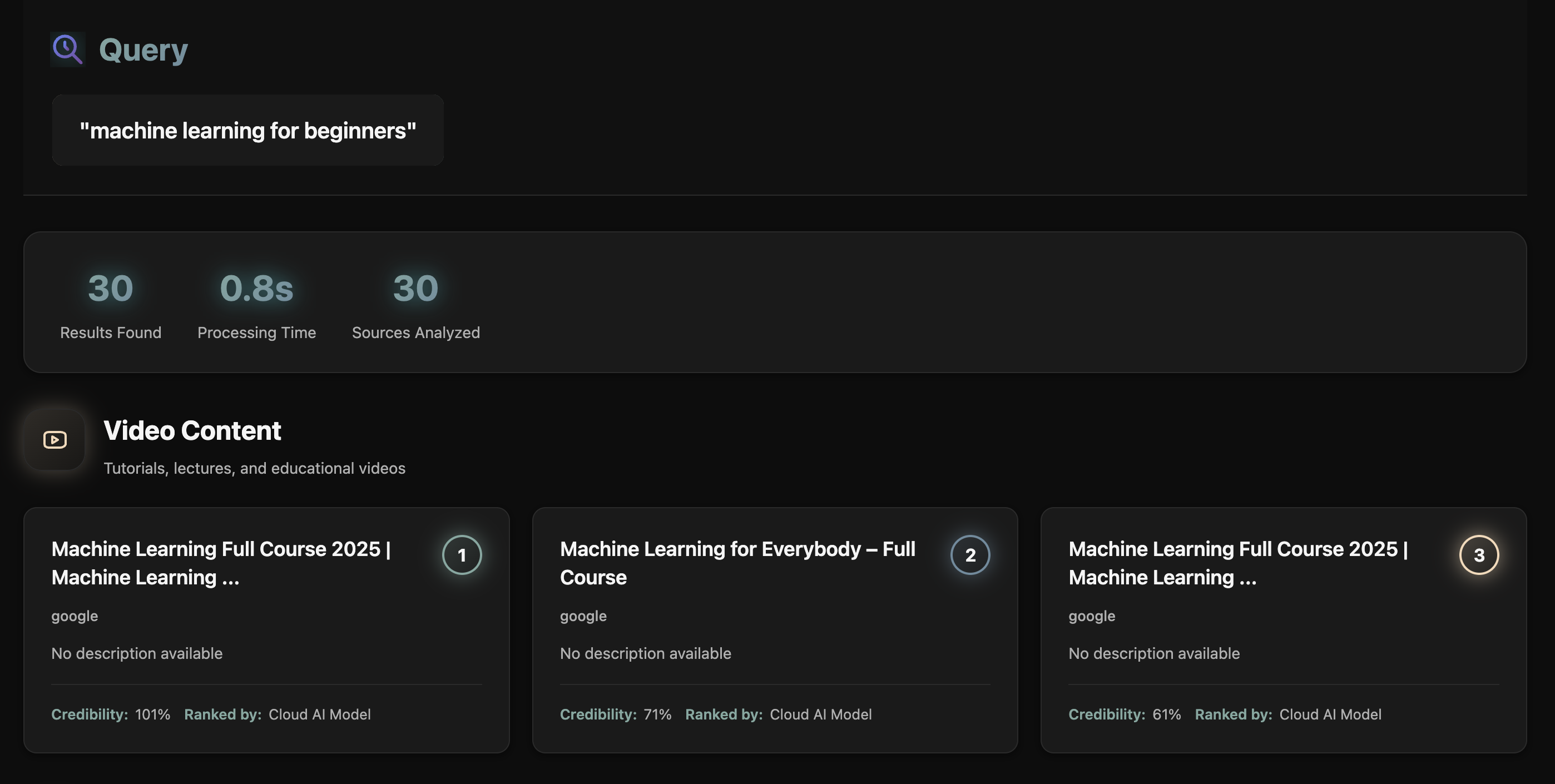
Query is a Chrome extension that enhances your Google search experience with AI-powered ranking and credibility scoring.
When you perform a Google search, Query captures your query and sends it to our backend system, which:
- Fetches comprehensive search results through SerpAPI
- Indexes and structures the data in Elasticsearch for efficient processing
- Analyzes each result using our Cloud AI ranking model
- Assigns credibility scores (0-100%) based on relevance, source quality, and content analysis
- Re-ranks results to surface the most credible and relevant information first
- Displays results in a clean, intuitive interface with visual ranking badges
Users see categorized results (articles, videos) with clear credibility indicators, making it easy to identify trustworthy sources at a glance. The top 3 results in each category get special visual badges to highlight the most valuable content.
How we built it
Frontend:
- Built a Chrome extension using vanilla JavaScript with a modern, responsive UI
- Implemented real-time result capturing and display using Chrome's Extension API
- Designed an intuitive results page with credibility scores, ranking badges, and categorized content
- Used HTML5 and CSS3 for a clean, professional interface with smooth animations
Backend:
- Developed a Flask API server in Python to orchestrate the ranking pipeline
- Integrated SerpAPI for programmatic access to Google search results
- Implemented Elasticsearch for efficient data indexing and storage
- Built a custom relevance scoring algorithm analyzing multiple signals (recency, source authority, content quality)
- Deployed on Google Cloud Platform with Vertex AI integration for ML-powered ranking
- Used Flask-CORS for secure cross-origin communication between extension and backend
Infrastructure:
- Fine tuned Gemini through Vertex AI and setup endpoints for scalable model inference
- Configured Elasticsearch clusters for high-performance data processing
- Implemented environment-based configuration for flexible deployment
- Added comprehensive logging and error handling for production reliability
Challenges we ran into
Data Normalization: Different result types (articles, videos, academic papers) come with varying metadata structures from SerpAPI. We had to build flexible parsers that could handle inconsistent data while maintaining accuracy.
Scoring Algorithm: Balancing multiple ranking signals (base Google rank, recency, source credibility, AI predictions) into a single meaningful score was complex. We iterated through several weighting schemes to find the right balance.
Elasticsearch Configuration: Fine-tuning Elasticsearch mappings to respect our custom AI-based rankings while maintaining query performance required deep understanding of inverted indices and scoring functions.
Cloud Integration: Connecting to Vertex AI dedicated endpoints required proper authentication handling, error recovery, and fallback mechanisms to ensure the extension always works even if the cloud service has issues.
Real-time Performance: Ensuring sub-2-second response times while fetching, processing, and ranking 20-30 results per query required careful optimization of our pipeline.
Accomplishments that we're proud of
Successfully built and deployed a complete end-to-end system from Chrome extension to cloud-based ML model
Efficiently indexed and processed thousands of structured search documents with sub-second query times
Achieved stable, meaningful ranking performance that noticeably improves result relevance
Created a clean, intuitive UI that makes credibility assessment effortless for users
Implemented robust error handling and fallback mechanisms for production reliability
Integrated multiple complex technologies (Chrome APIs, Flask, Elasticsearch, Vertex AI) into a cohesive system
Designed a scalable architecture that can handle increasing query volumes
What we learned
Technical Skills:
- How to design efficient data ingestion pipelines that handle real-time API data
- Techniques for tuning Elasticsearch mappings and scoring functions for custom ranking
- Best practices for integrating cloud-based ML models into web applications
- Chrome extension architecture and secure communication patterns
- Balancing algorithmic and AI-based scoring for optimal results
System Design:
- The importance of fallback mechanisms and graceful degradation
- How to architect systems for both performance and maintainability
- The value of comprehensive logging and monitoring in distributed systems
- Strategies for handling inconsistent external API data
Product Development:
- How small UX details (ranking badges, credibility scores, animations) significantly impact user experience
- The balance between feature richness and interface simplicity
- The importance of real-world testing and iteration based on actual usage patterns
What's next for Query
Enhanced AI Models: Train custom ranking models on user interaction data to continuously improve relevance scoring and personalization.
Expanded Content Types: Add support for news articles, research papers, shopping results, and local business listings with specialized ranking algorithms for each.
User Customization: Allow users to adjust ranking preferences (prioritize recent vs. authoritative, favor specific sources, etc.) to match their individual needs.
Collaborative Features: Enable users to share and discuss highly-ranked results, building a community-driven credibility layer.
Browser Extension Ecosystem: Expand beyond Chrome to Firefox, Safari, and Edge for broader accessibility.
Analytics Dashboard: Provide users with insights into their search patterns, most-used sources, and credibility trends over time.
API for Developers: Open up our ranking system as an API that other developers can integrate into their own applications.
Built With
- css3
- elasticsearch
- elastisearch
- flask
- gcp
- html5
- javascript
- python
- serp
- serpapi
- vertex-ai

Log in or sign up for Devpost to join the conversation.