-
-
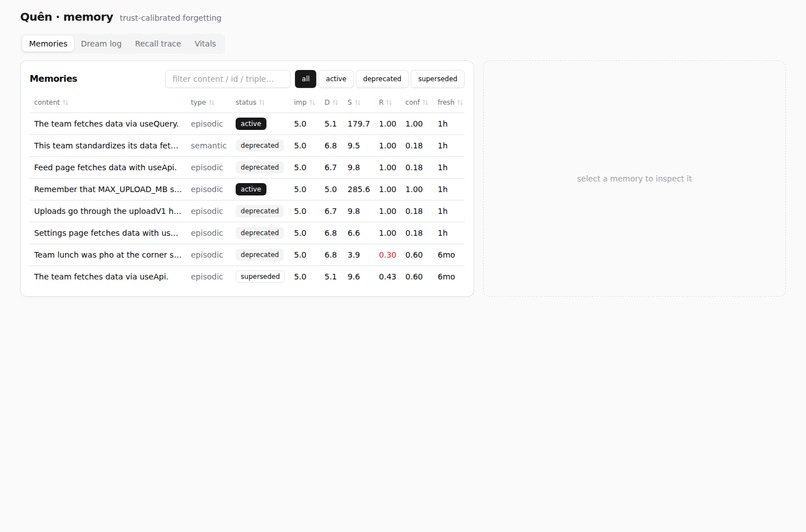
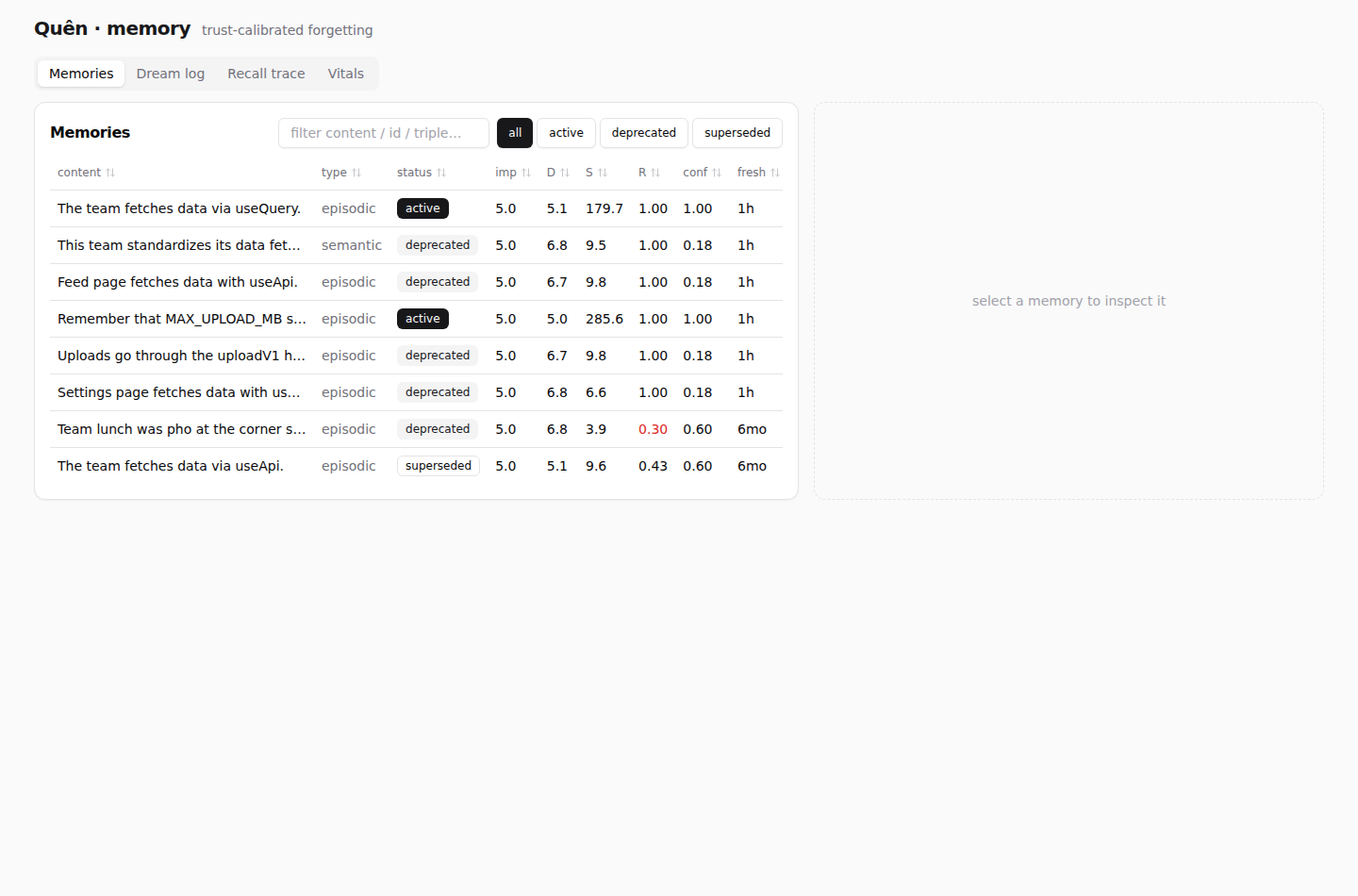
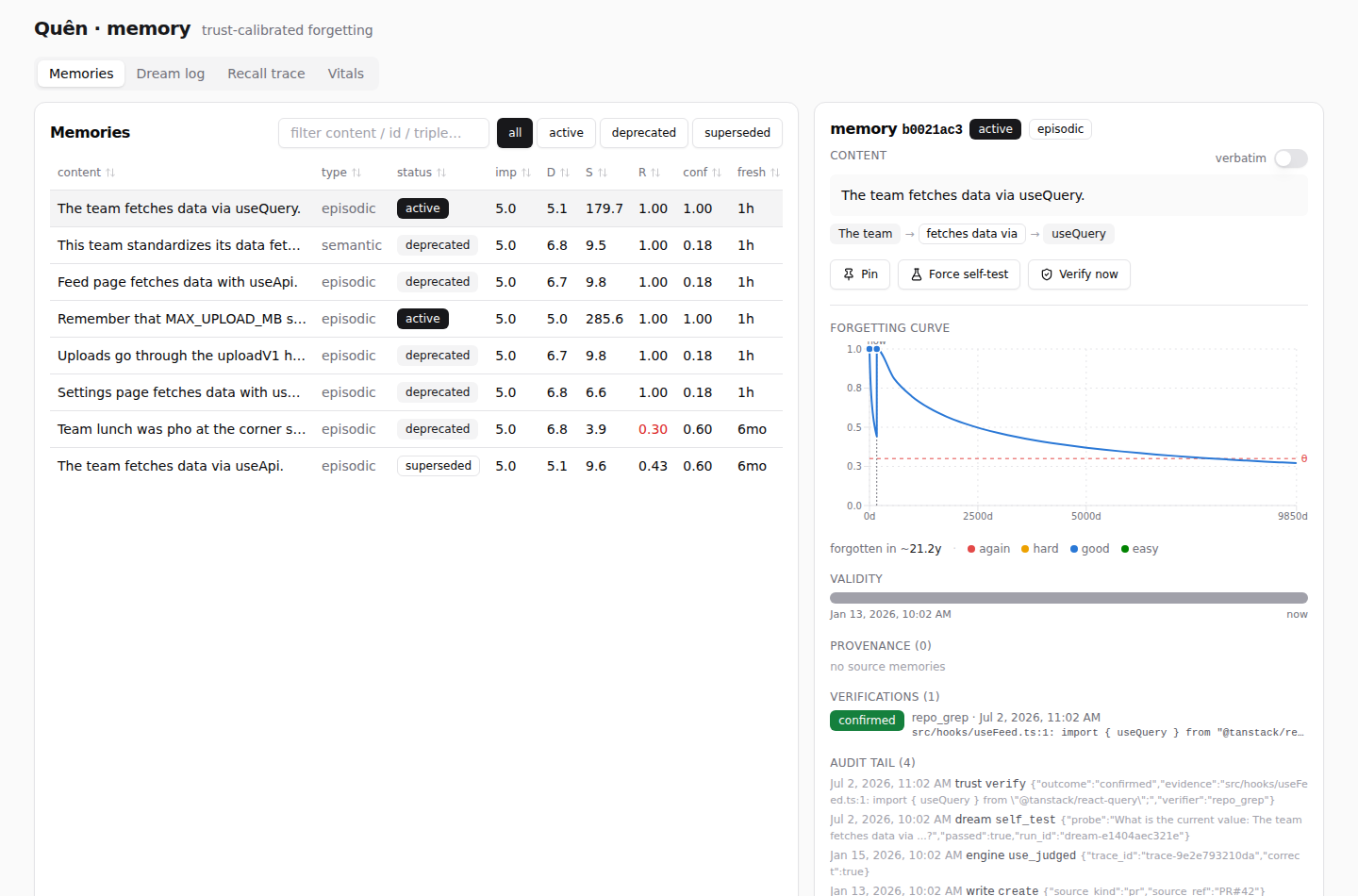
Memories — live FSRS decay
-
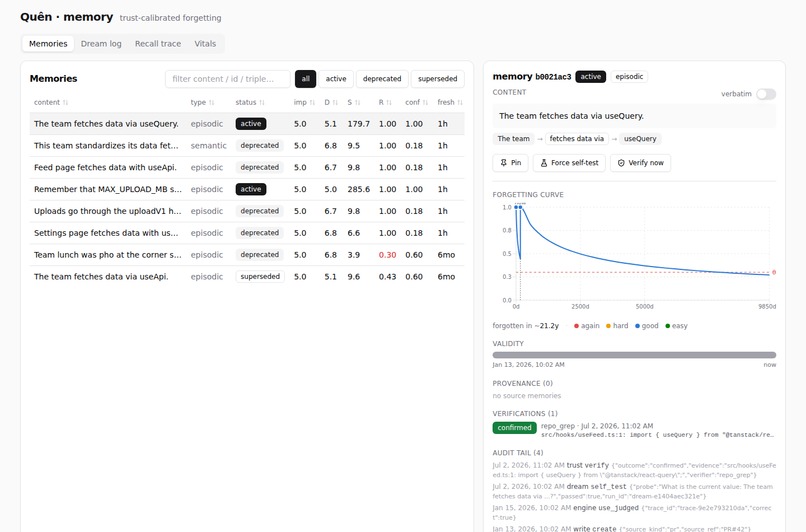
Memory detail — forgetting curve & validity
-
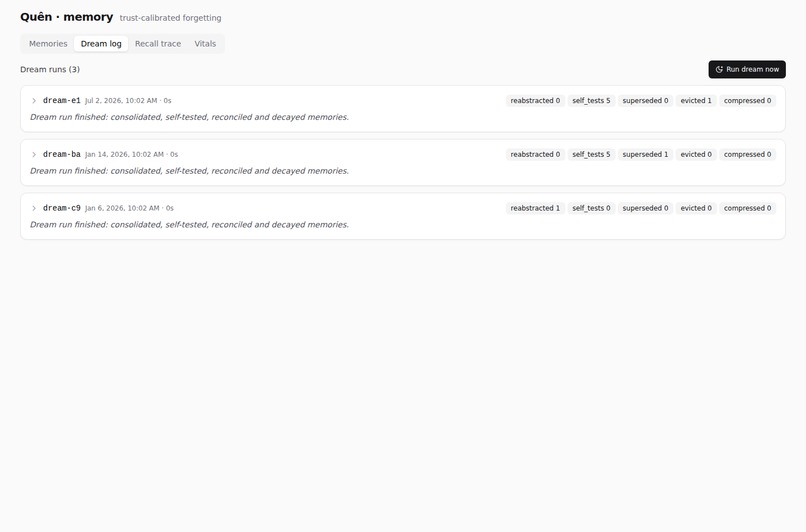
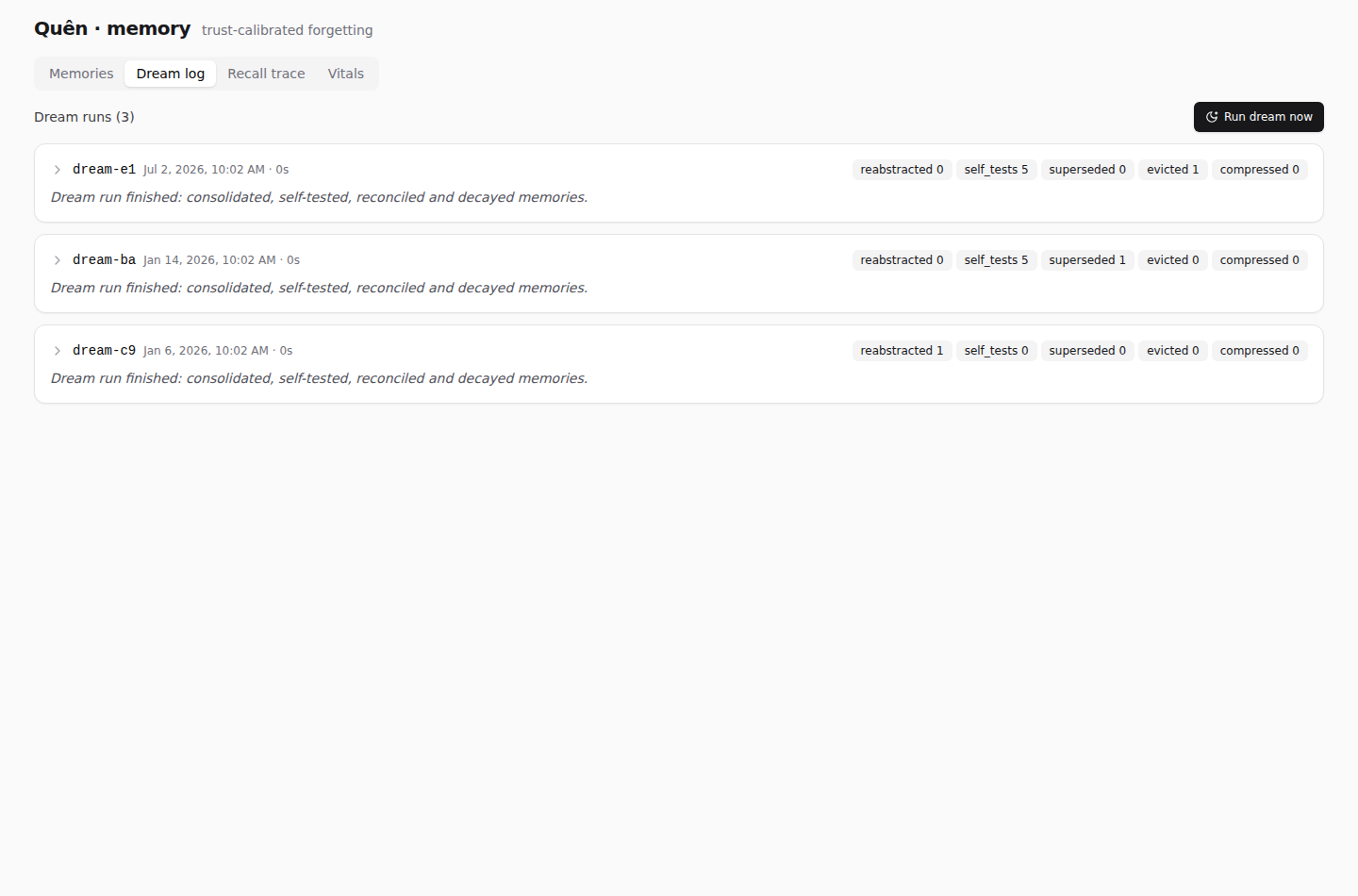
Dream log
-
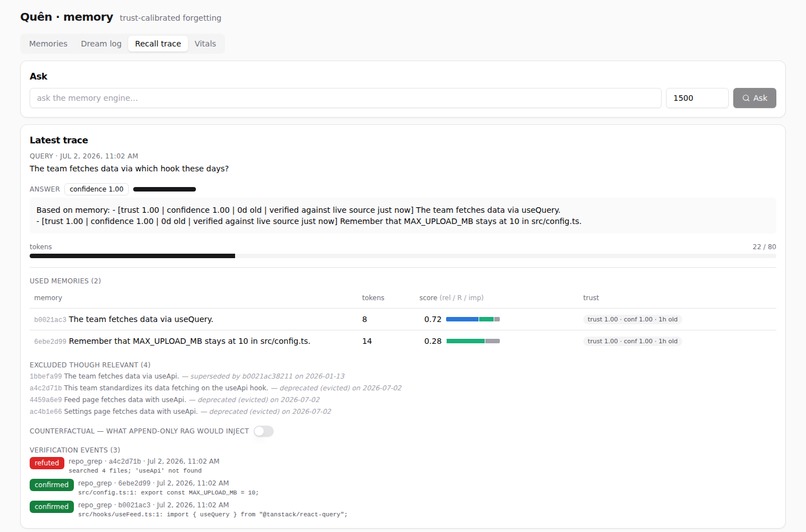
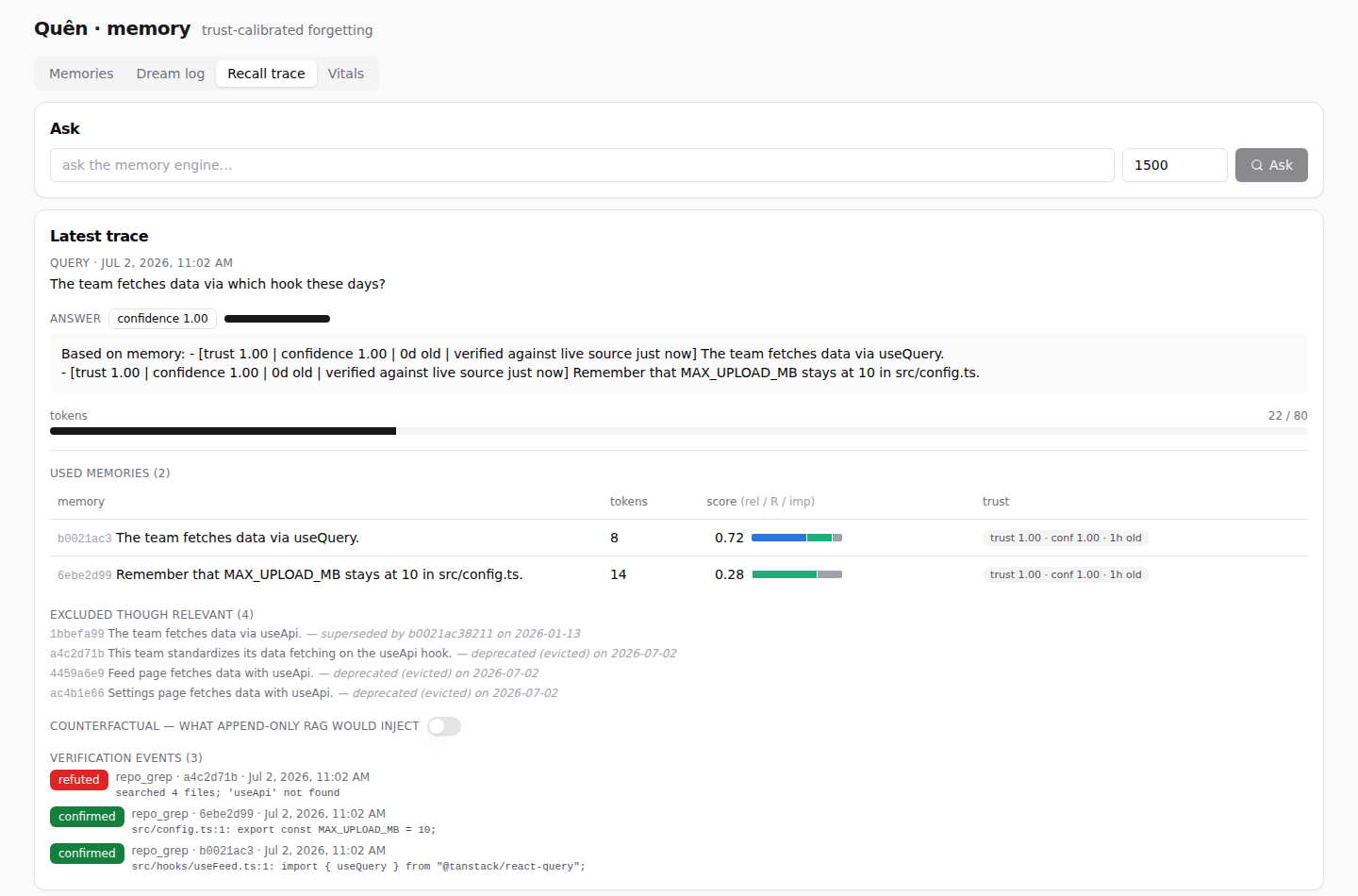
Recall trace
-
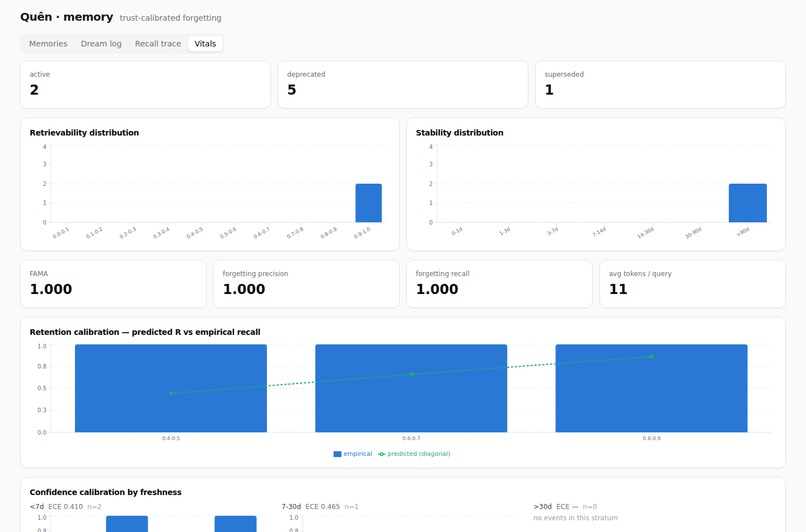
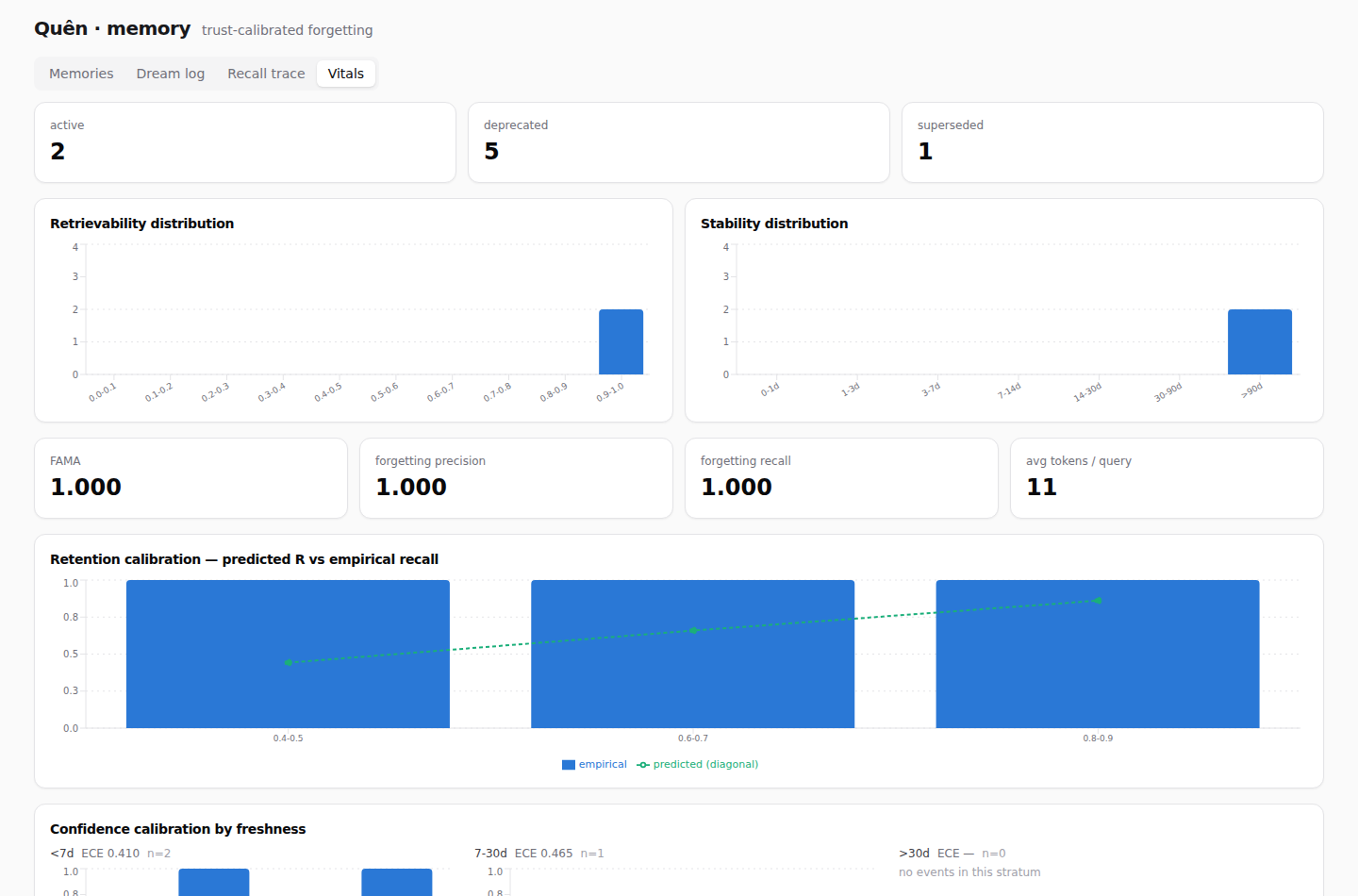
Vitals
-
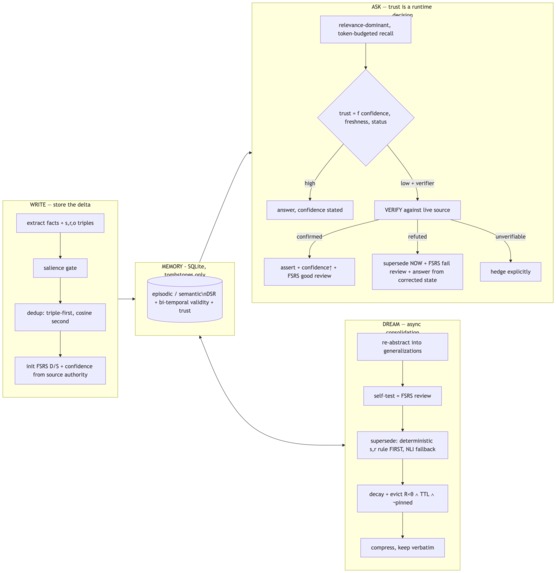
How it work
-
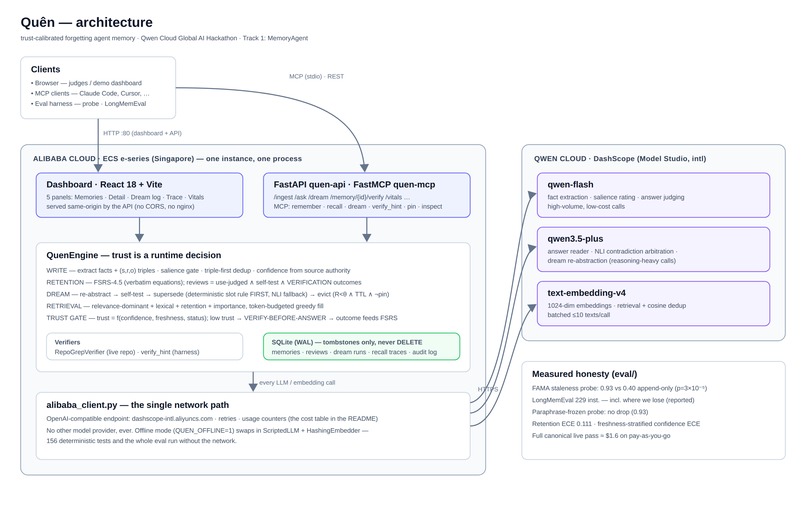
Architecture
-
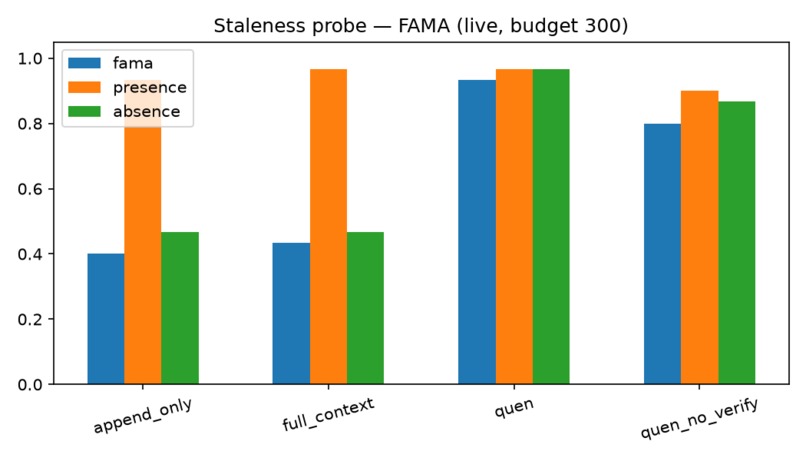
Fama by config
-
Budget curve
-
Confidence by freshness
-
Retention calibration
Project description
The problem
The sharpest failure mode of agent memory isn't forgetting too much — it's being confidently wrong from stale memory. Stale memory rarely fails at retrieval; it fails by making the agent act confidently on invalidated assumptions. Memora/FAMA measured it: agents frequently reuse invalidated memories.
What Quên does
Quên (Vietnamese for "to forget", sounds like Qwen) treats trust as a runtime decision, not a stored property:
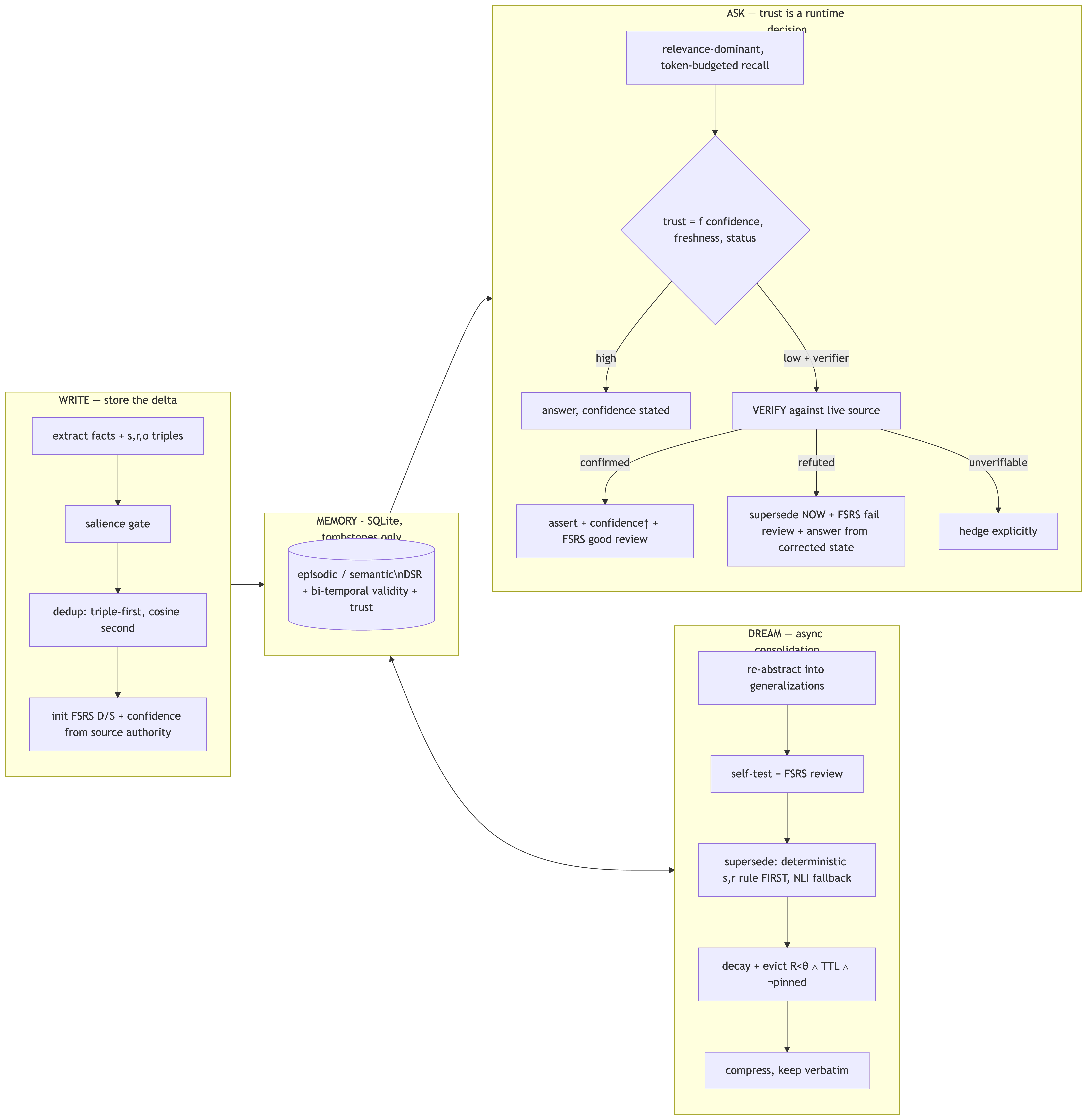
- Write the delta: Qwen extracts facts and (s,r,o) triples; a salience gate skips what a base model already knows; confidence comes from source authority (PR > doc > chat).
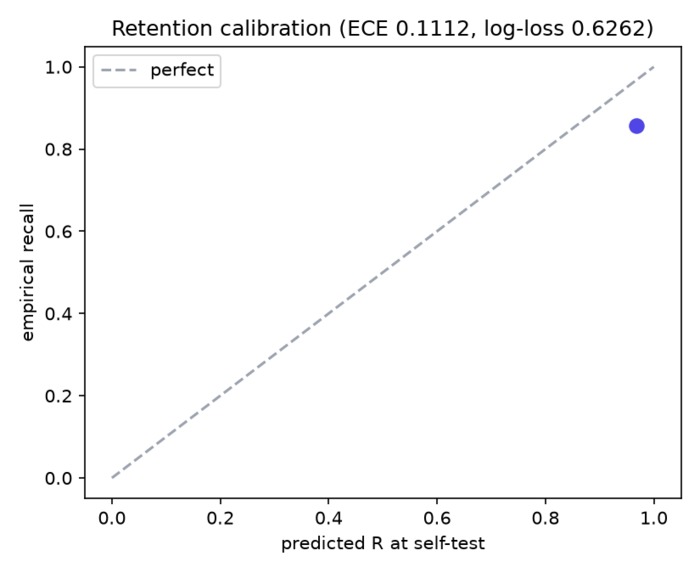
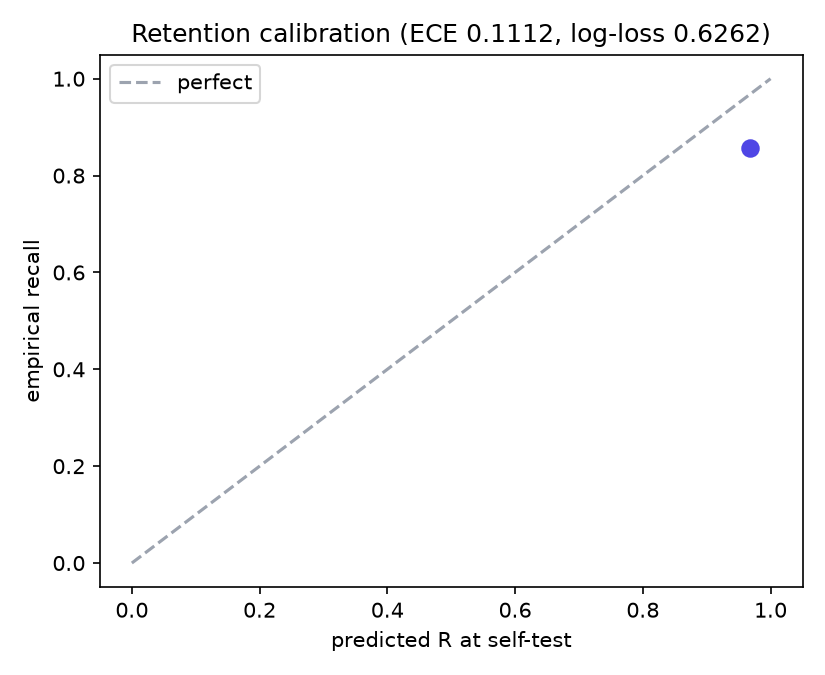
- Real forgetting math: retention state is FSRS-4.5 (the spaced-repetition equations, imported verbatim). Reviews come from three places: use-in-answer judged good/bad, dream self-tests, and verification outcomes — the closed loop nobody else ships.
- Dream consolidation: episodics re-abstract into generalizations; contradictions resolve deterministically first (same-(s,r)-new-o slot rule for functional relations — zero LLM calls, fully auditable) with a Qwen NLI fallback where augmentation never supersedes. Unused memories evict (R<θ ∧ TTL ∧ not pinned). Tombstones only — never hard-delete.
- Verify-before-answer: at answer time, trust = f(confidence, freshness, status). Low-trust memories get checked against the live source before the agent asserts them: confirmed → confidence rises + FSRS good review; refuted → tombstoned on the spot + fail review; unverifiable → the answer hedges explicitly.
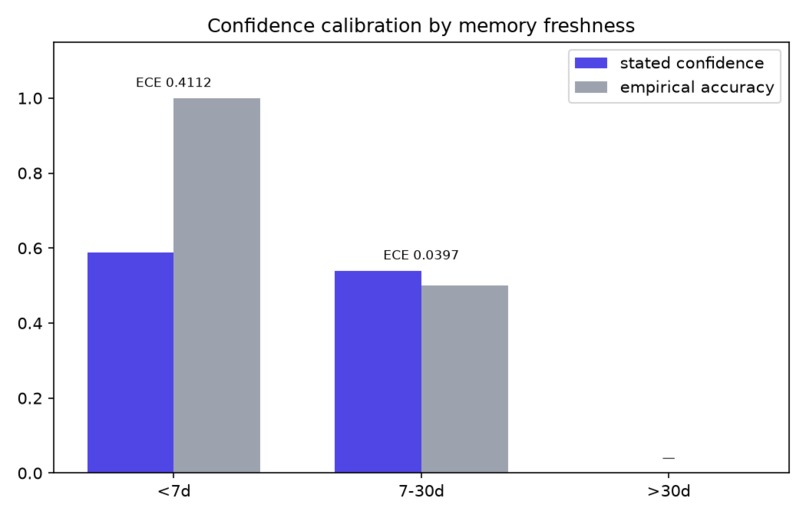
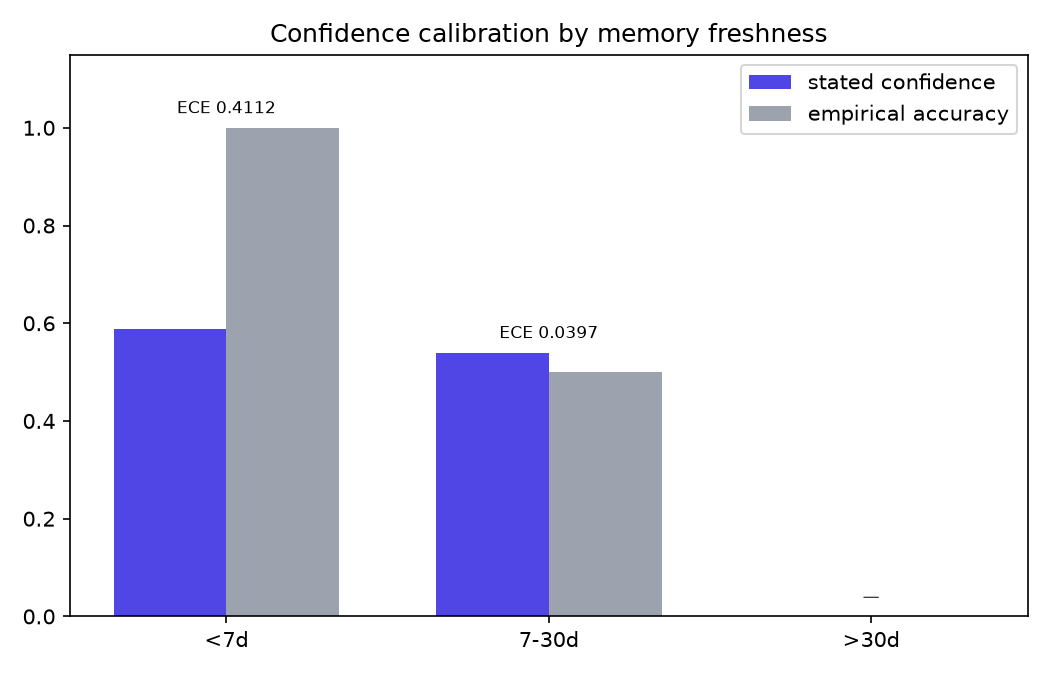
- Measured honesty: stated answer confidence is scored with freshness-stratified calibration (ECE), and the headline metric is FAMA = presence-of-valid ∧ absence-of-invalidated.
Results (live on Qwen via Alibaba Cloud DashScope, canonical run)
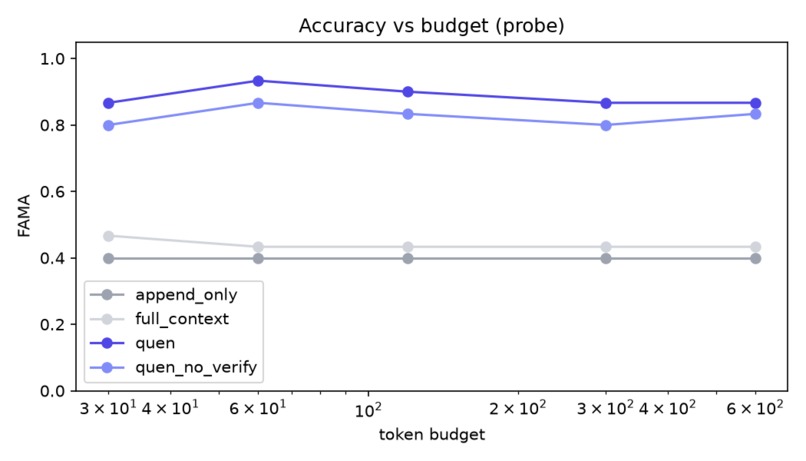
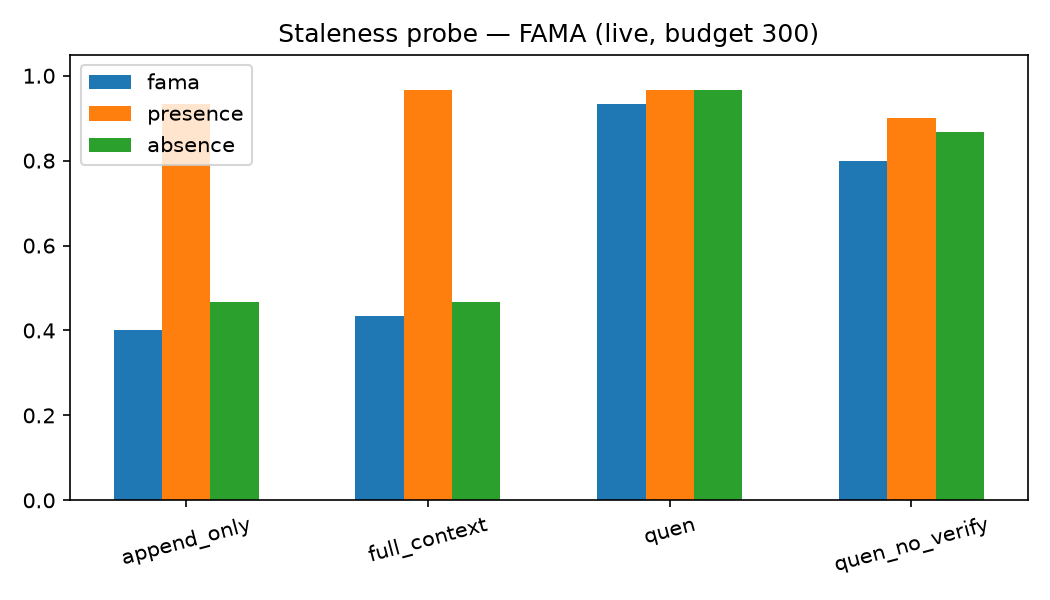
- Code-staleness probe (n=30): FAMA 0.933 [0.79, 0.98] vs 0.40 append-only RAG / 0.43 full-context (paired McNemar p = 3×10⁻⁵); forgetting precision/recall 0.842/0.938; verify ablation +0.13 FAMA.
- Paraphrase-frozen probe: 0.933 — no drop; the mechanism, not our phrasing, carries the result.
- LongMemEval (n=229, external anchor with no staleness): we lose knowledge-update to turn-level append-only RAG (0.31 vs 0.54, p=0.0015) and tie on temporal reasoning and abstention — reported, not hidden. Forgetting is a tax on staleness-free recall and a large win the moment the world changes.
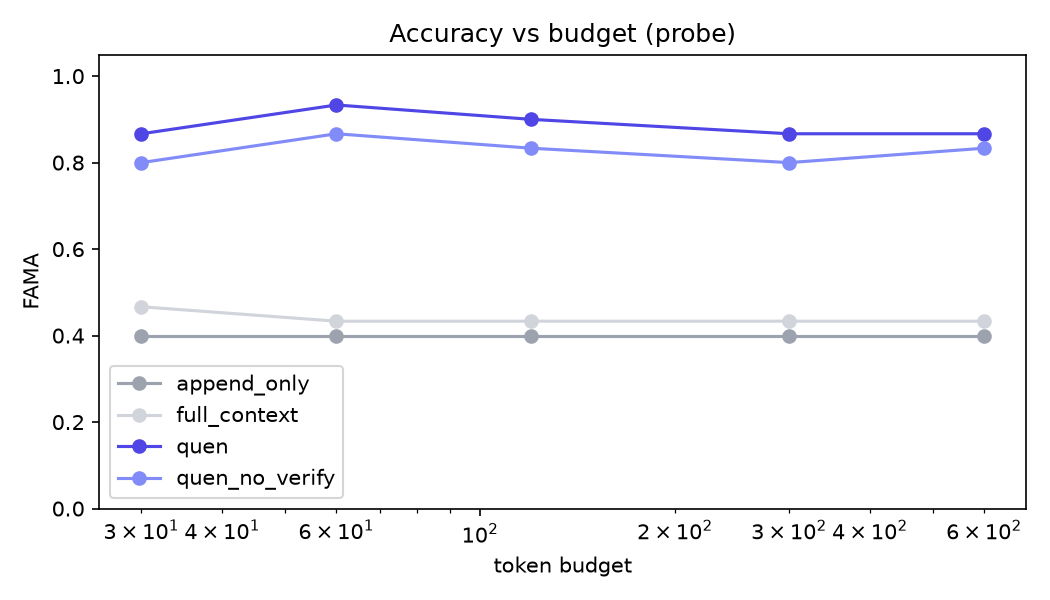
- Budget curve: baselines flat at every budget (their failures are trust failures); Quên holds 0.87–0.93 from a 30-token budget up.
- The whole canonical live eval cost ≈ $1.6 (usage counters × DashScope pricing — the cost table is in the README).
- We also ran an adversarial audit of our own algorithms — 11 biases found, fixed, and regression-tested (over-forgetting multi-valued facts, recency bias in trust, eviction starvation, strawman baselines, self-serving scoring…). The full table is in the README.
How it's built (all Qwen, all Alibaba Cloud)
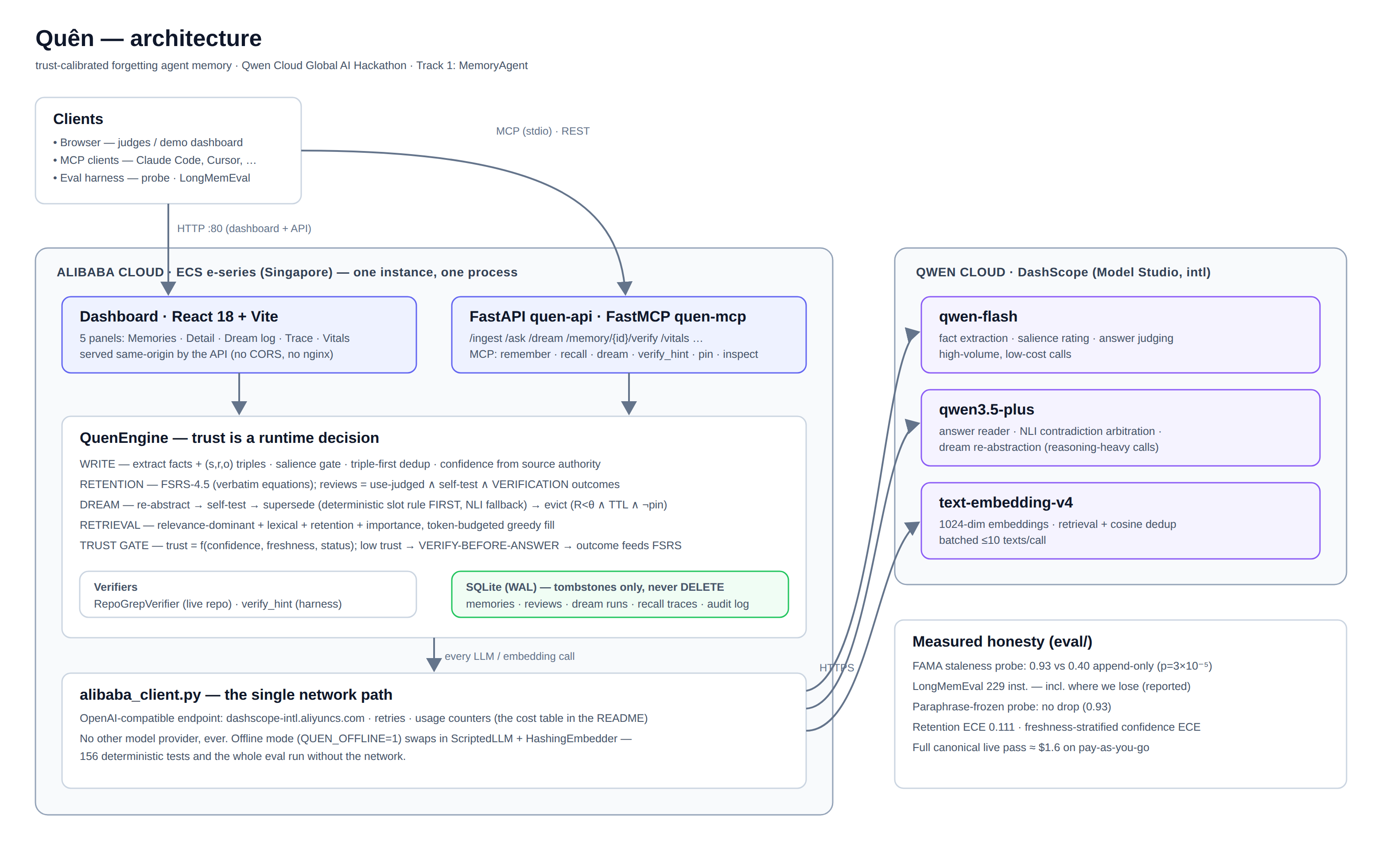
qwen-flash (extraction/salience/judging) + qwen3.5-plus
(reader/NLI/re-abstraction) + text-embedding-v4, all through one client
(alibaba_client.py) on the DashScope international endpoint. Backend =
FastAPI + SQLite (WAL, audit-logged, tombstones only) on an Alibaba Cloud
ECS instance that also serves the React dashboard same-origin. A thin
FastMCP server (8 tools — remember/recall/ask/judge/dream/verify_hint/
pin/inspect — closing both the per-memory verification loop and the
per-answer retention loop) drops the same engine into any MCP harness, and
a Claude Code hooks kit (integrations/claude-code/) loads memories at
SessionStart and captures the conversation at SessionEnd/PreCompact.
Everything — 176 tests and the full eval — also runs 100% offline
(deterministic scripted LLM + hashing embedder), so judges can reproduce
without a key.
What's next
Temporal-hierarchical digests (TiMem-style graduated compression), a
Letta-style sleep-time dream scheduler, FSRS weight re-fit from the
calibration events the store already records, and context-cache-aware
prompt ordering (DashScope bills cached prefixes at ~10% of fresh input —
our usage counters already track the hits). Full roadmap:
docs/ROADMAP.md. Recent flag-gated additions already measured offline:
compact trust tags (−35% delivered tokens/query at identical FAMA) and
spaced self-test scheduling (52-week sim: 221 vs 427 tokens/query against
append-only from an active store 6× smaller, 203 evictions/yr, stale-free
rate 1.0).
Links
- Live demo (Alibaba Cloud ECS, Singapore): http://47.236.141.124/
- Repo: https://github.com/phamthanhhang208/quen
Built With
- fast-api
- python
- qwen
- react
- typescript


Log in or sign up for Devpost to join the conversation.