Inspiration
AI coding assistants made writing code fast, but nobody built an AI to keep code good. Teams still review by hand against their own checklists, hand-fix hundreds of SonarQube issues to pass a quality gate, chase CVEs in dependencies, and spend weeks getting a new developer to understand an unfamiliar codebase. We wanted one open-source suite that does the work around writing code: review, design, fix, secure and explain — on open models, with your own key, and with every cent visible.
What it does
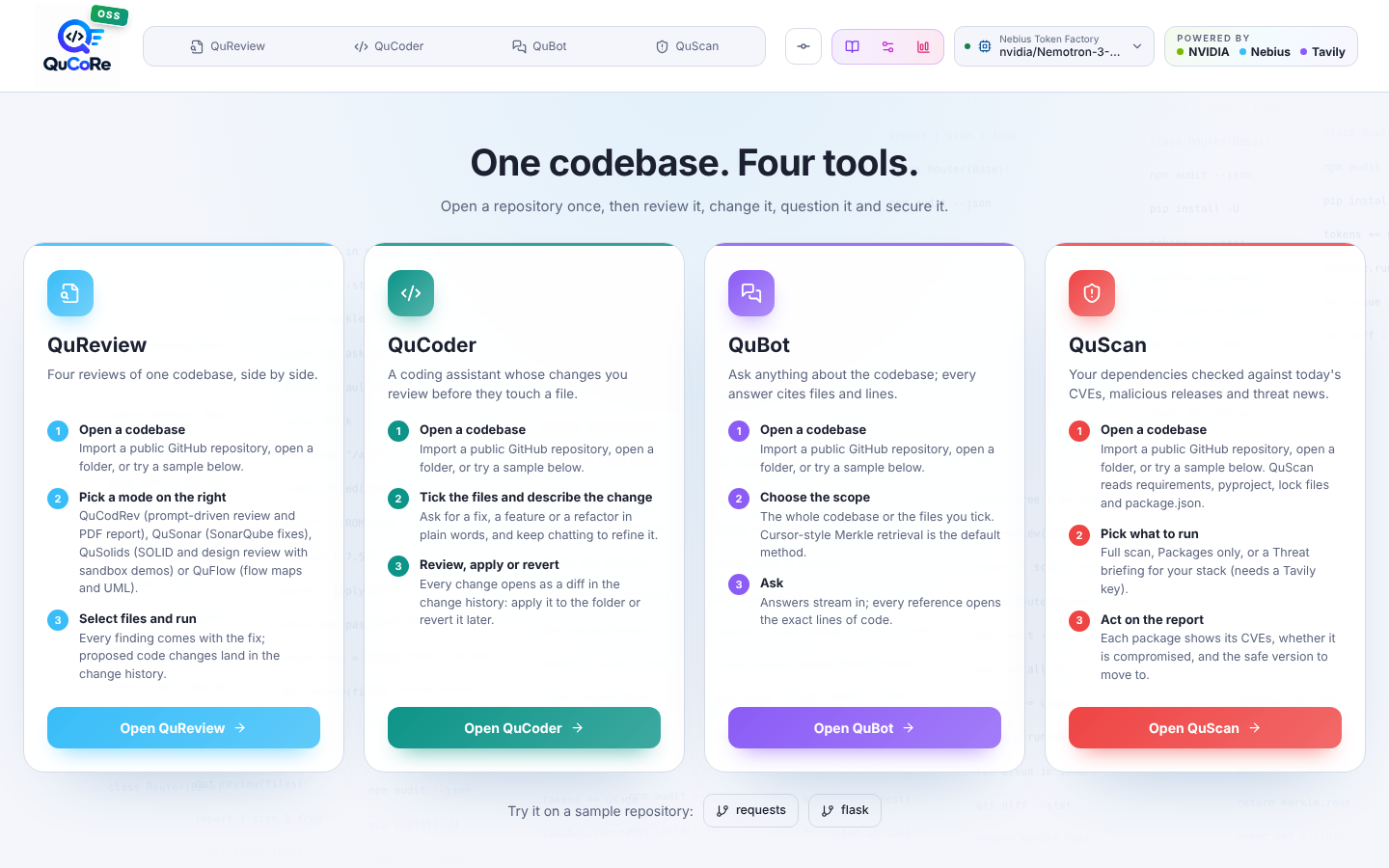
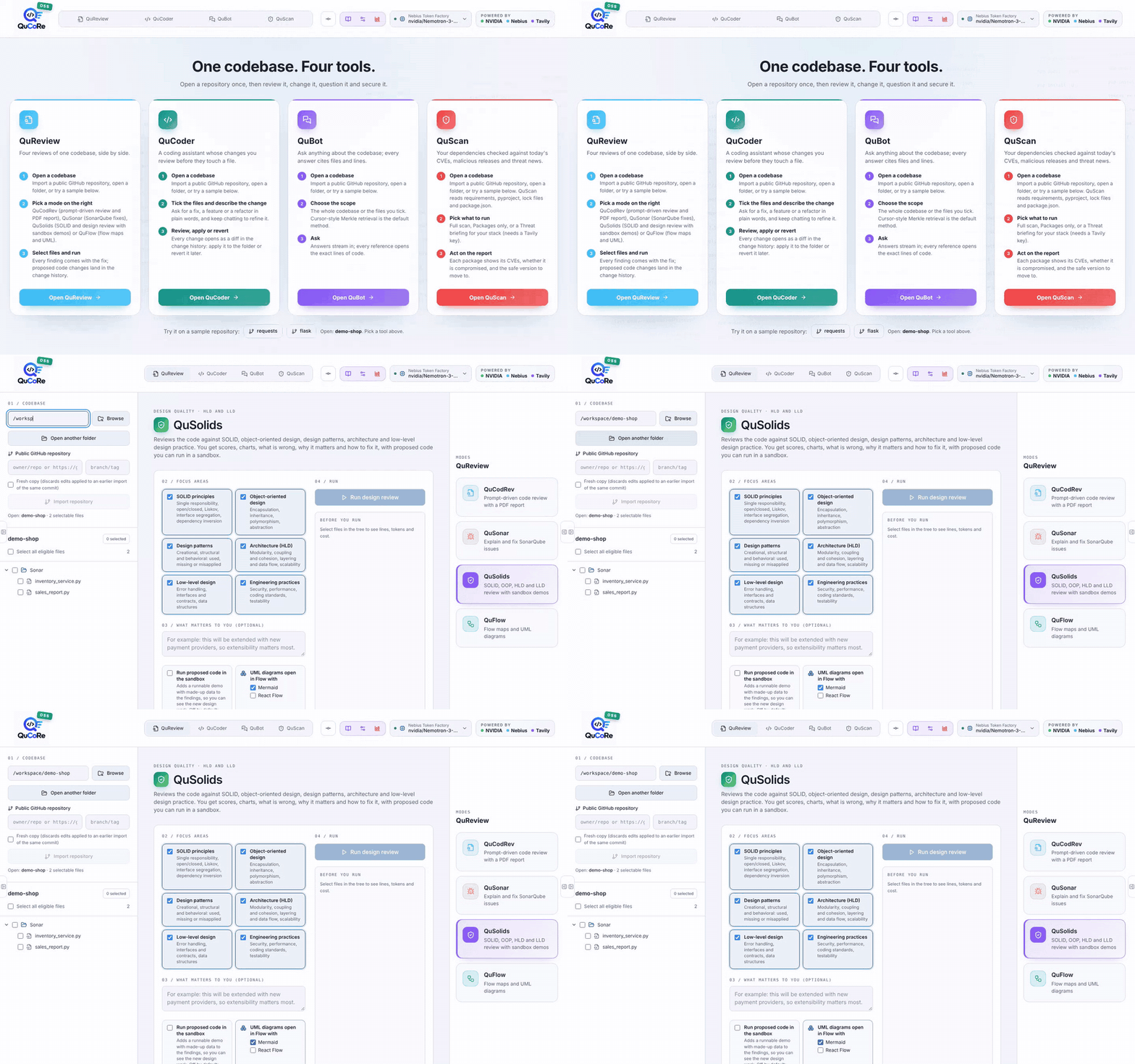
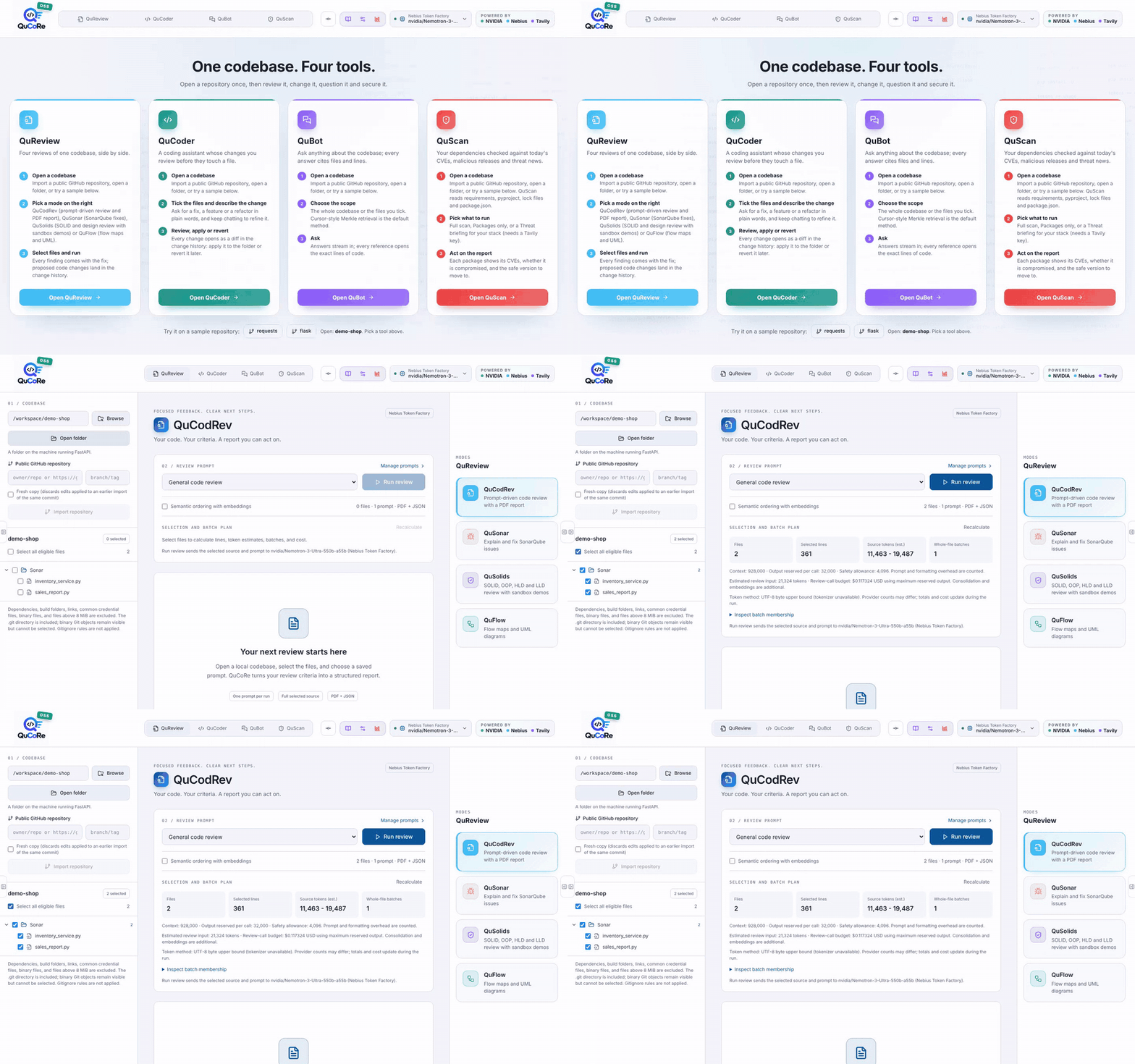
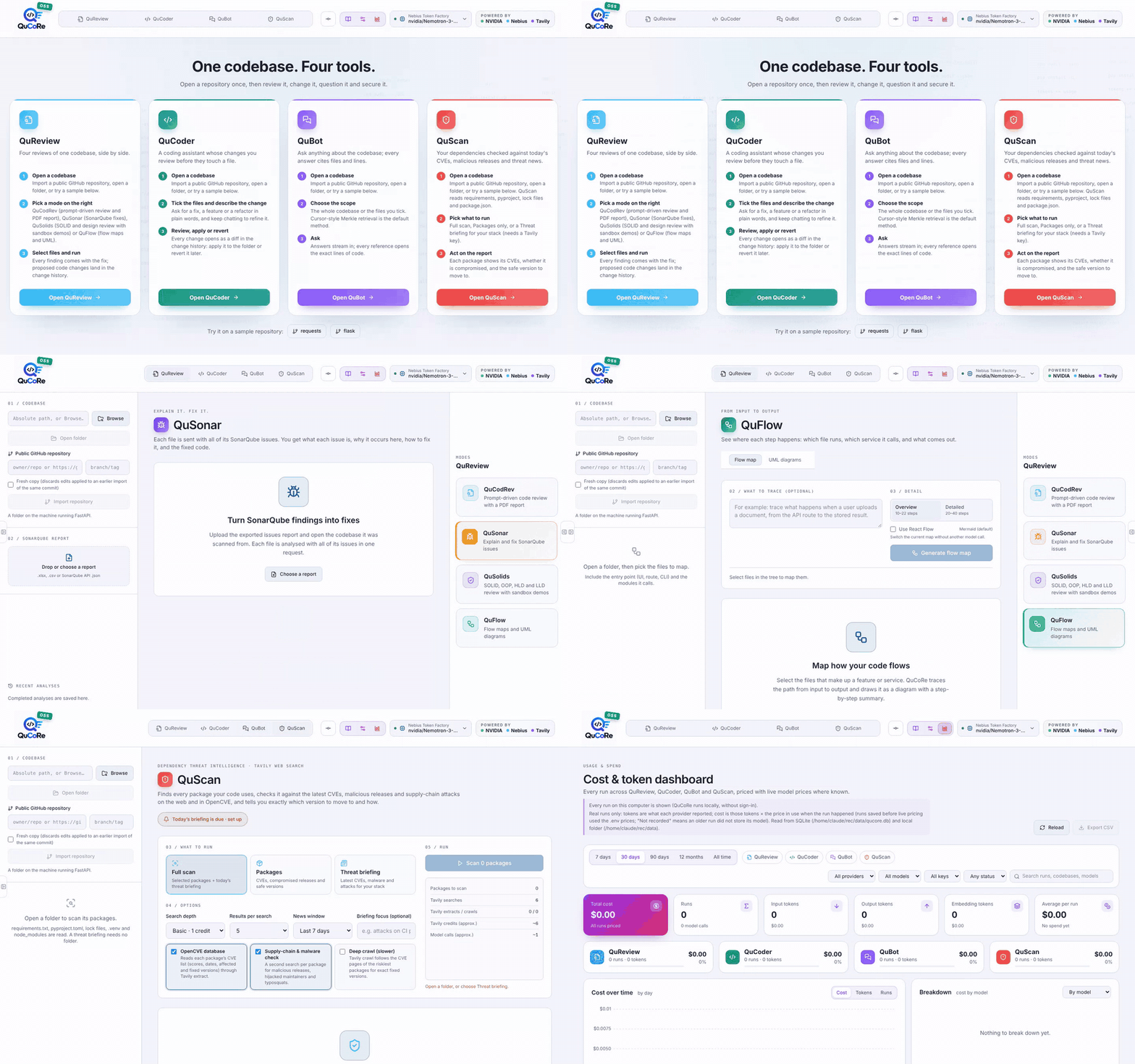
QuCoRe (Quick Code Review) is a suite of developer tools powered by NVIDIA Nemotron on Nebius Token Factory, the Nebius sandbox and Tavily:
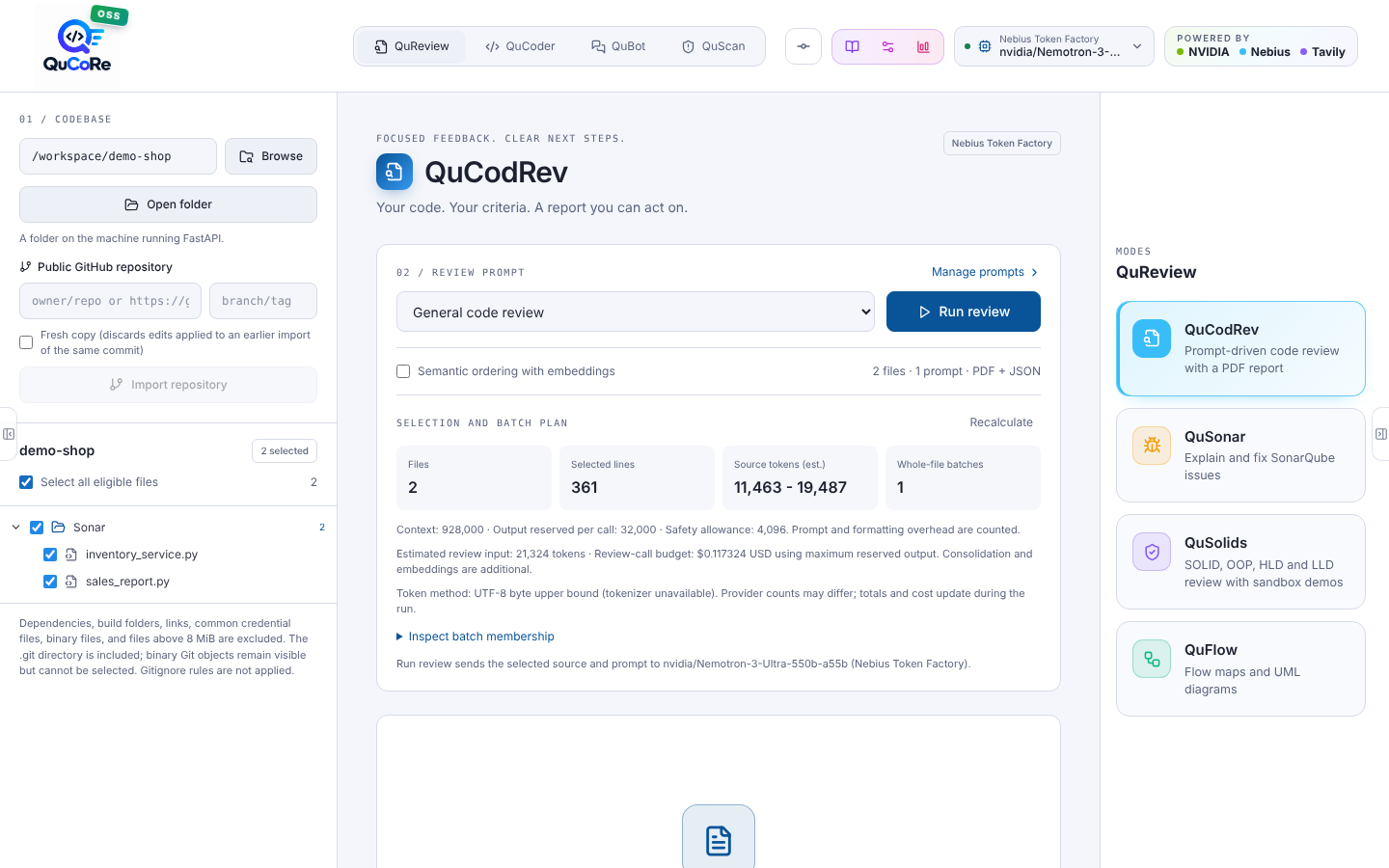
- QuCodRev – reviews code against your own prompt or checklist and produces a PDF report.
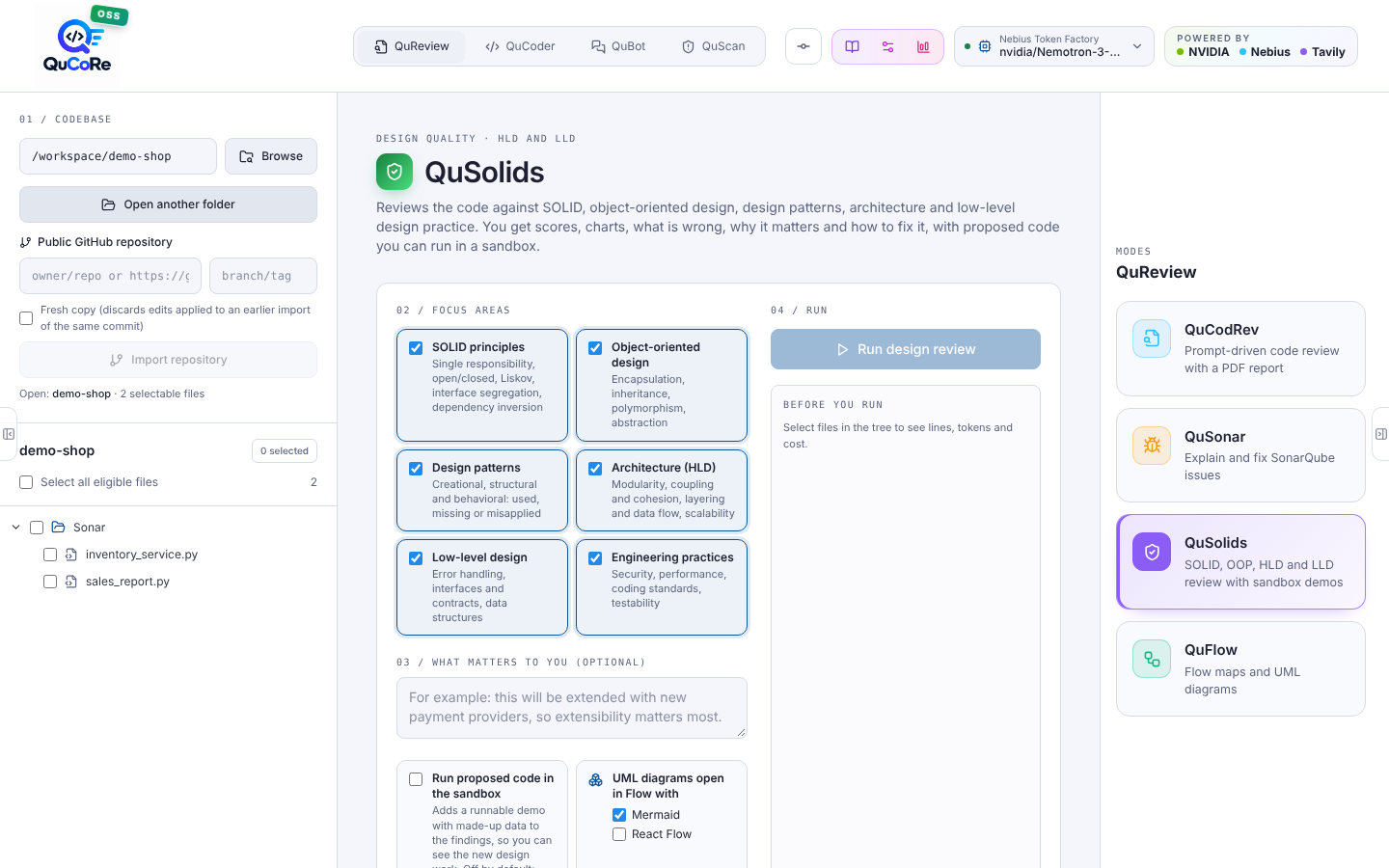
- QuSolids – scores SOLID, OOP, design patterns, HLD and LLD, proposes the improved design, and runs a before/after demo in the Nebius sandbox (Python and Node.js), with Run, Edit, Reset, Stop and Fix with AI.
- QuFlow – flow maps, HLD and UML diagrams of an unfamiliar codebase.
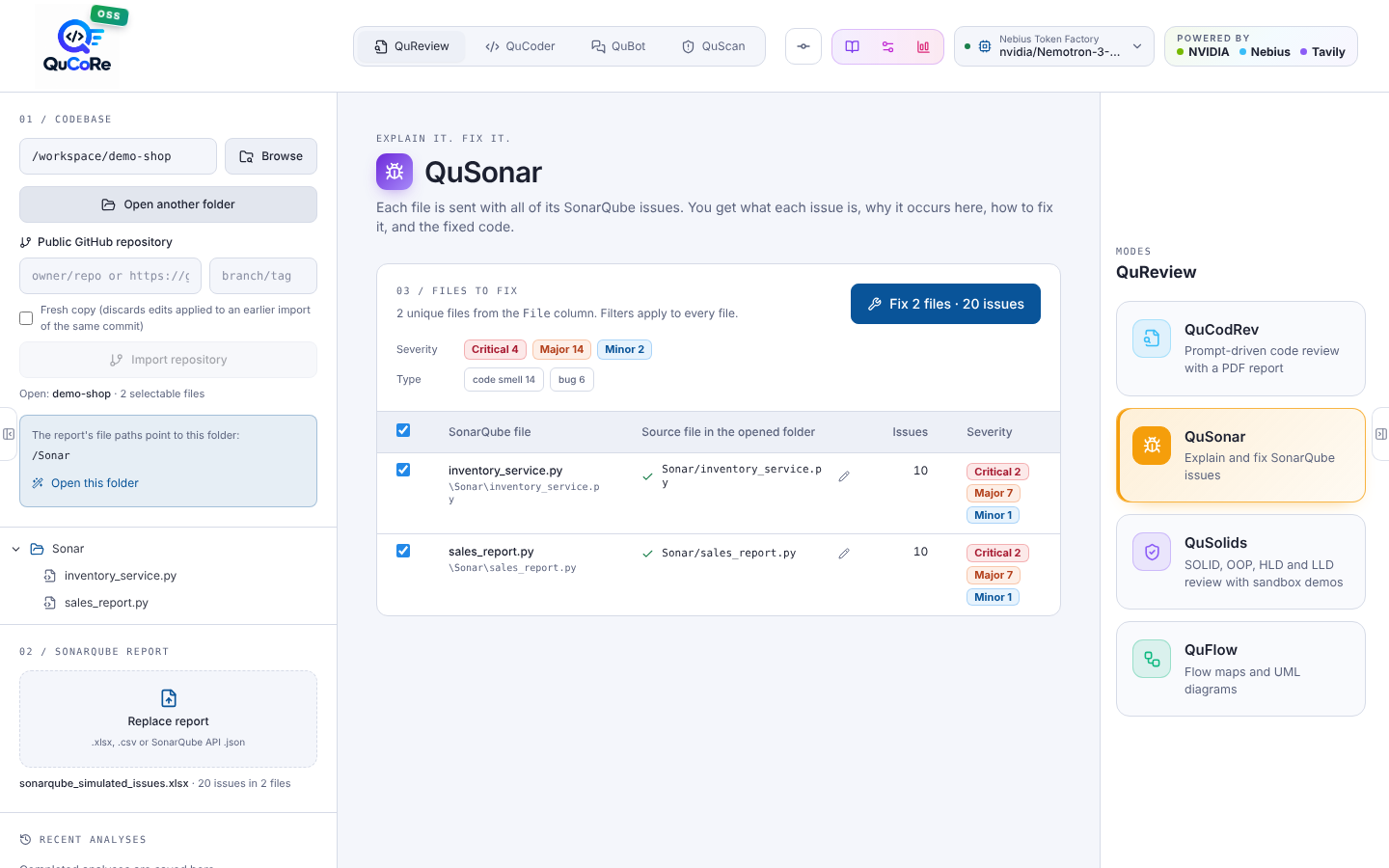
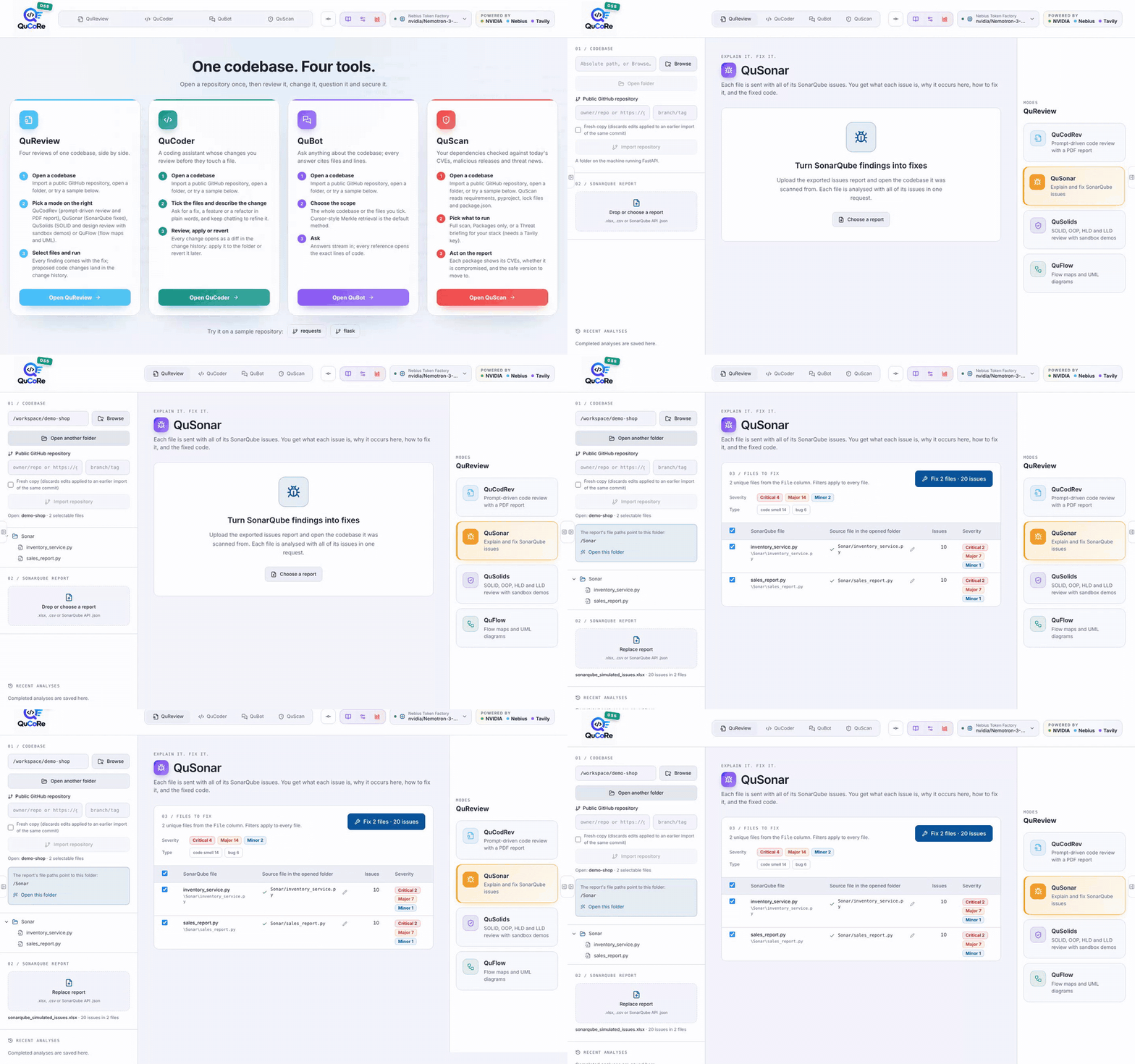
- QuSonar – upload a SonarQube export; every issue is matched to the exact file and line, explained and fixed.
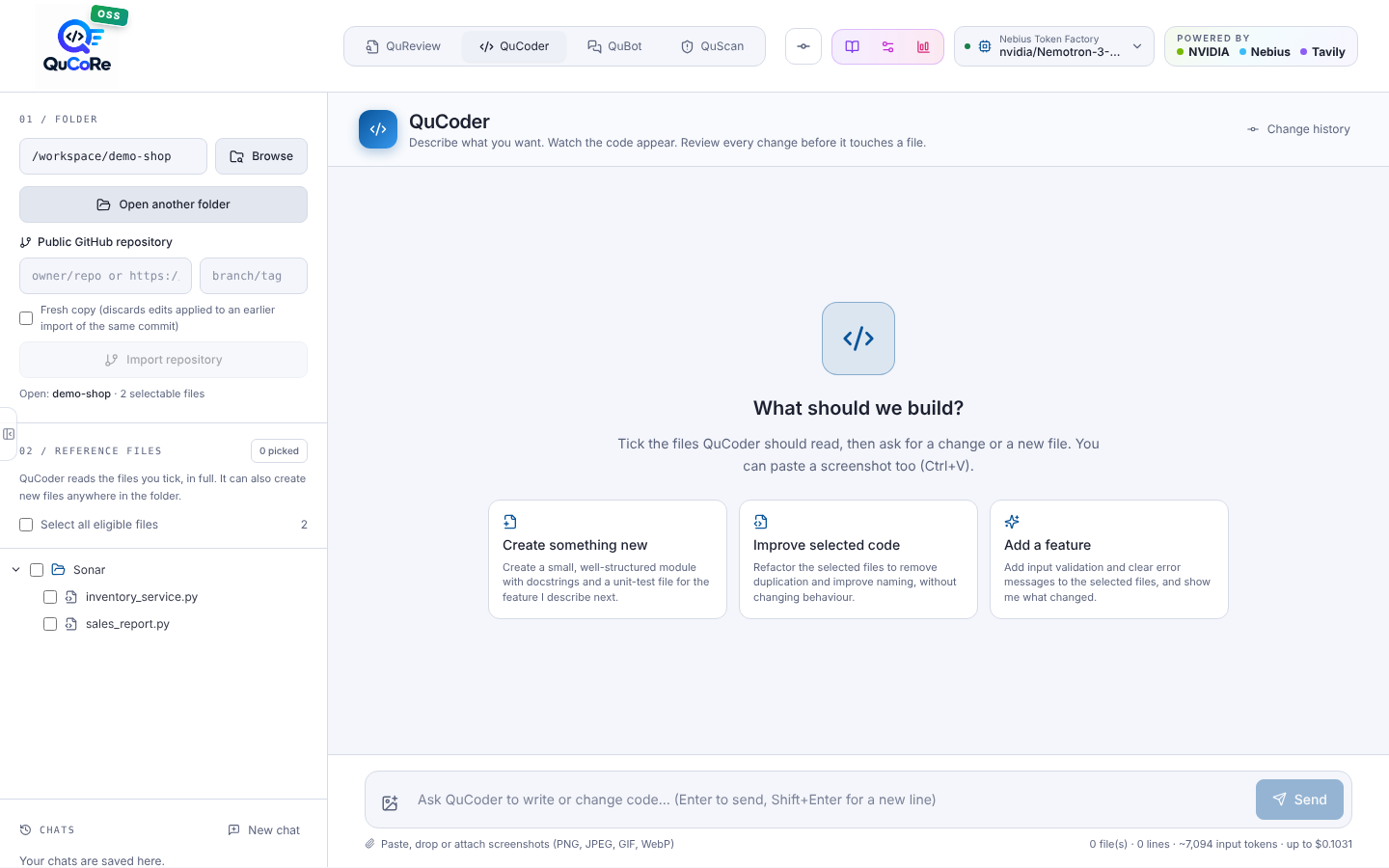
- QuCoder – describe a change; get a reviewable diff to apply or revert.
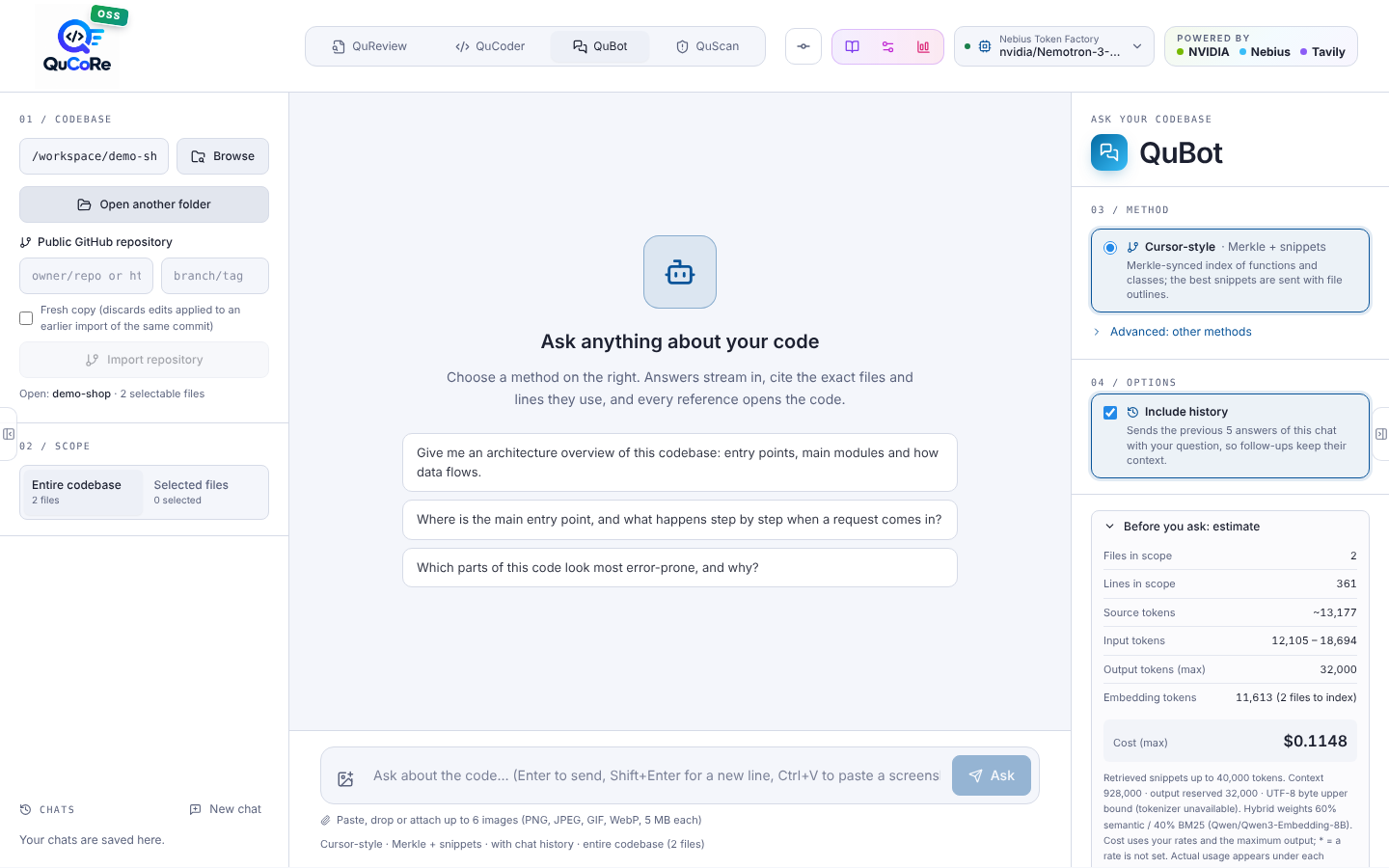
- QuBot – ask questions about the codebase; answers cite files and line numbers (hybrid RAG with Qwen3 embeddings, BM25 and Merkle-synced indexing).
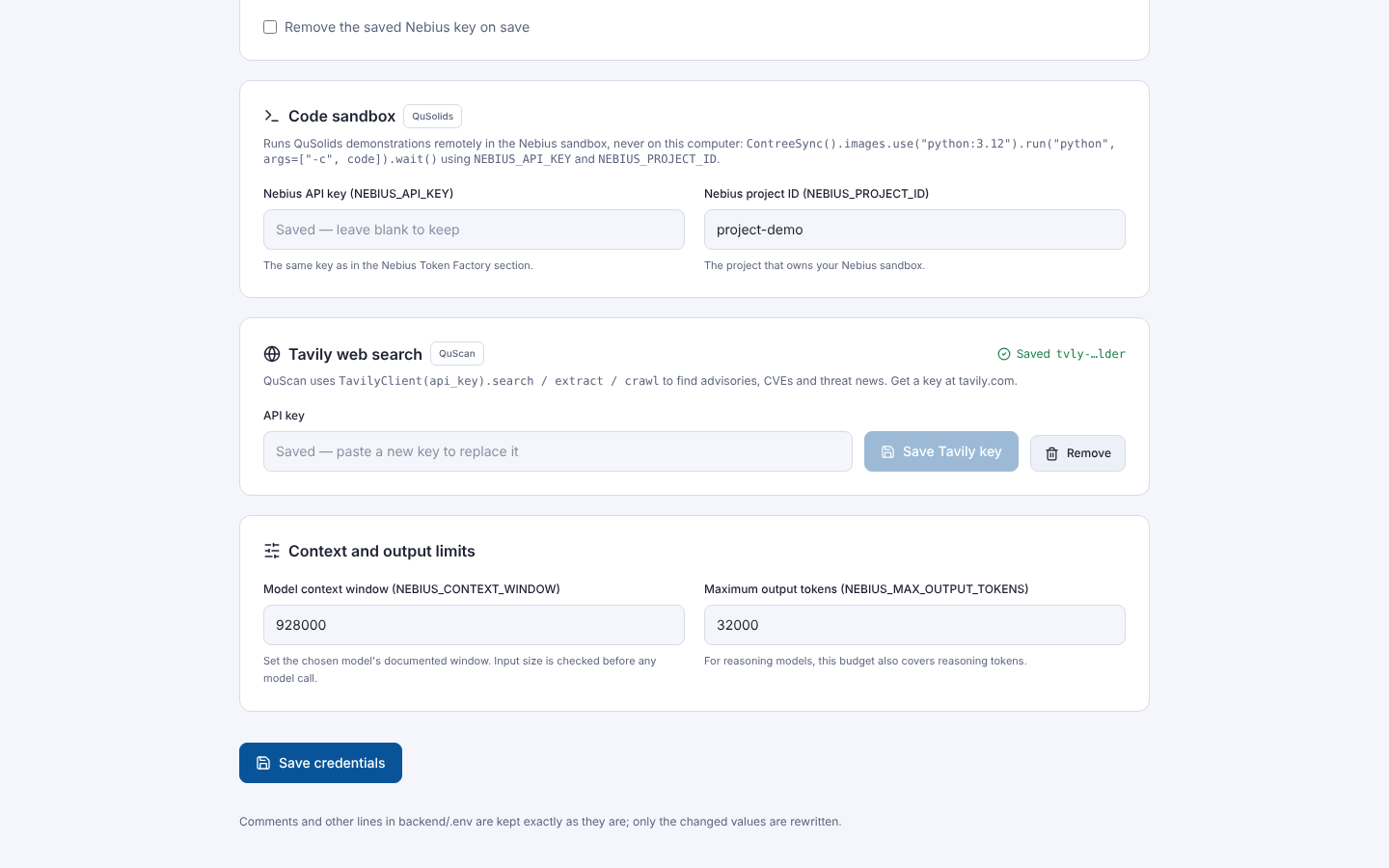
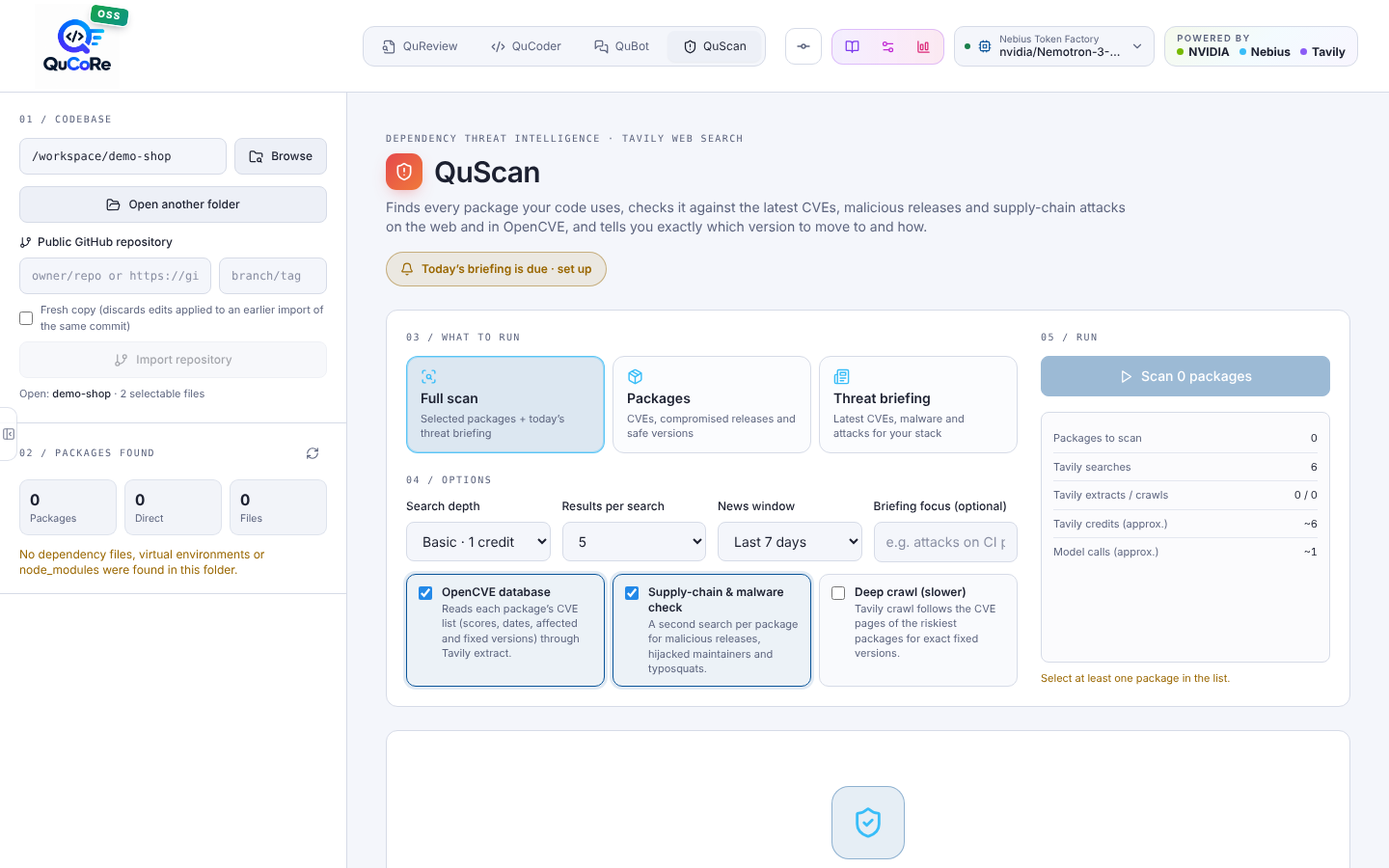
- QuScan – finds every dependency, uses Tavily to search advisories and threat news, and Nemotron returns CVEs with the safe version to upgrade to.
Every change lands in a change history (diff → apply / revert), every run is priced in a cost & token dashboard, and built-in guided tours walk new users through each tool. It runs locally (open-source edition) or as a multi-user website at qucore.dev with Google / GitHub sign-in, guests, bring-your-own-key and daily limits.
How we built it
- Backend: Python + FastAPI. Every tool follows one pattern: read the code exactly → plan the token budget → call Nemotron → validate the answer in code → save a report or a reviewable change.
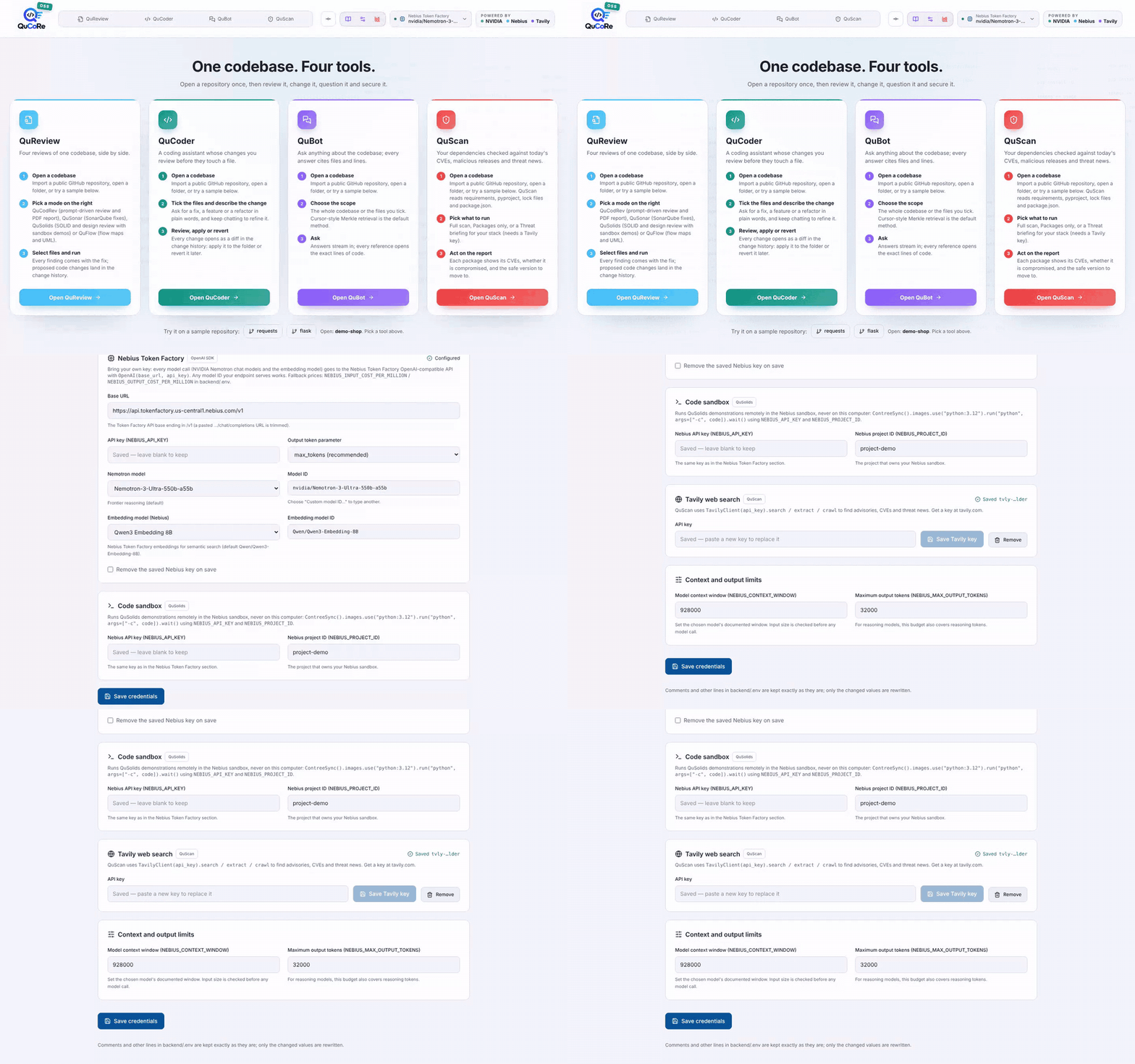
- Models: NVIDIA Nemotron 3 Ultra / Super / Nano and Nano Omni (vision) through Token Factory's OpenAI-compatible API — one client for chat, streaming and embeddings. Users switch models per task from the header.
- Nebius sandbox: model-written programs never run on our server; they run remotely through
contree-sdkinpython:3.12/node:22-slimimages. - Tavily: search, extract and news search feed QuScan's evidence; the backend checks version ranges arithmetically.
- Frontend: React + Vite + Tailwind, Monaco diffs, Mermaid / React Flow diagrams, driver.js tours.
- Hosted edition: Supabase (Postgres + Storage), Qdrant Cloud for vectors, Google / GitHub OAuth, AES-GCM encrypted per-user keys, automatic data deletion, one Docker service.
Challenges we ran into
- Trusting model output. We made code do the arithmetic (scores, version ranges, token budgets, costs), validated every finding against the real files, and dropped any CVE not present in the evidence.
- Long contexts without silent truncation. Whole files are packed into batches checked against the model's context window before any call.
- Matching SonarQube paths written on another machine to the opened project (longest-suffix matching).
- Running untrusted code safely. Sandbox runs are isolated in their own worker process with hard deadlines, Stop, and key masking.
- Multi-user privacy. Every workspace, report, index and key is scoped to its owner; uploads skip
.envand key files, strip git hooks, and are deleted automatically. - Reasoning tags (
<think>…</think>) had to be stripped from answers, even while streaming.
Accomplishments that we're proud of
Seven working tools in one app, structured and validated output instead of chat transcripts, real code running in the Nebius sandbox, a live public demo, and a fully open-source local edition (AGPL-3.0) that anyone can run with their own Nebius key.
What we learned
Open models like Nemotron are strong enough for serious engineering work when you give them exact context and verify their answers in code. A single OpenAI-compatible endpoint (Token Factory) made switching between Nano, Super and Ultra a one-line change, which let us match model size to each task's cost and depth.
What's next for QuCoRe
Pull-request integration, quality-gate re-checks after QuSonar fixes, team rule packs, unit-test generation in the sandbox, IDE extensions, and an enterprise edition.
Built With
- fastapi
- nebius
- postgresql
- python
- react
- tavily