Inspiration
When two satellites are predicted to pass dangerously close, an operator may need to move its satellite out of the way. If both satellites can maneuver, which one should move?
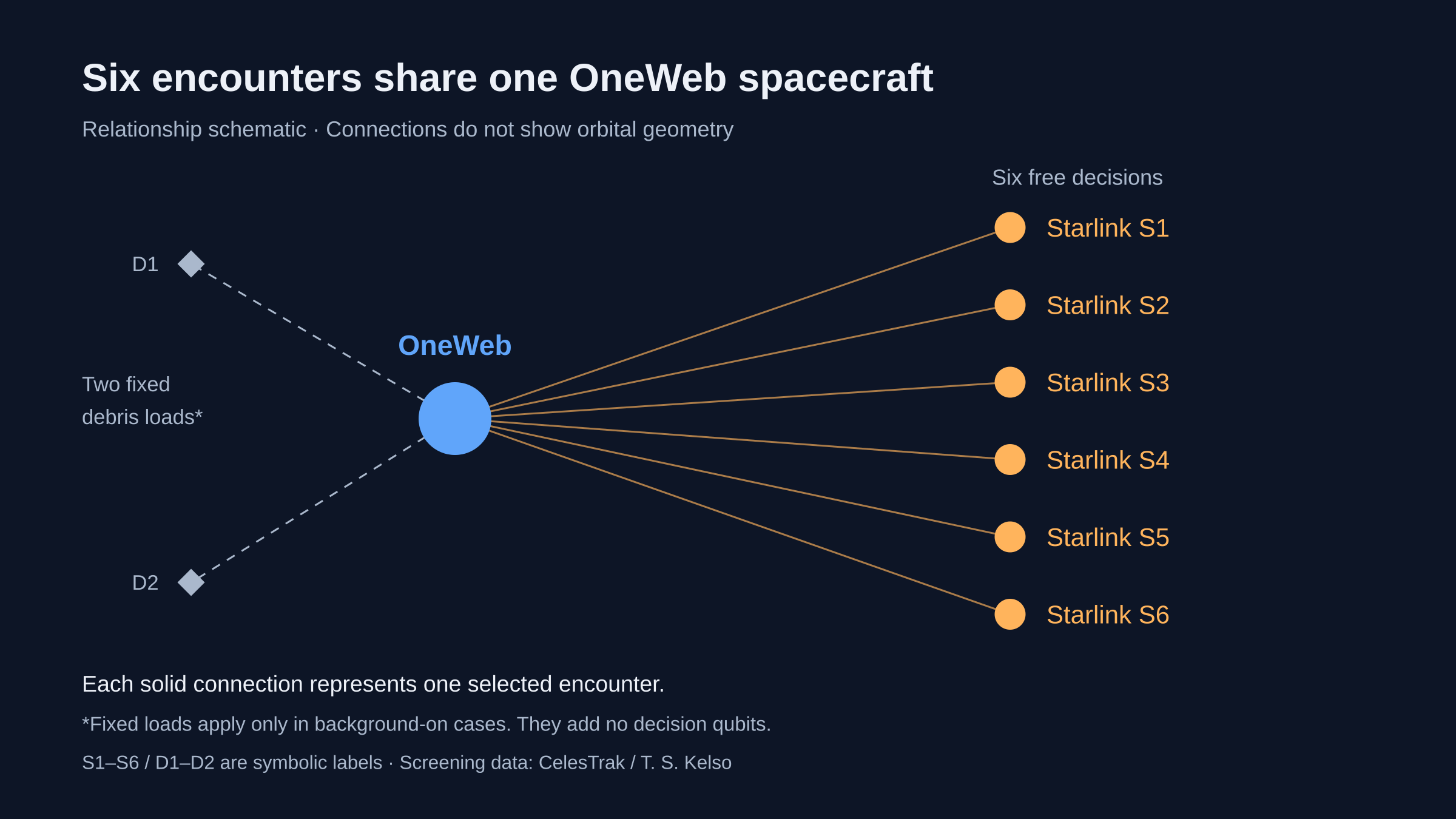
We explored this question using six predicted OneWeb–Starlink encounters involving the same OneWeb satellite and six different Starlink satellites. Should that one OneWeb satellite have to dodge every time, repeatedly spending fuel on avoidance maneuvers? Or should Starlink take on every response, leaving one company to carry the entire burden?
Qubital compares possible assignments to find those that balance modeled workload between operators and individual satellites. We tested a quantum optimization approach against classical methods and ran the final circuit on an IBM quantum processor.
Because public screening data does not include actual maneuver costs or fuel reserves, we use modeled workload to compare assignments. We do not claim measured fuel savings or longer satellite lifetimes. Our recommendations assume a response is needed; they do not determine whether a maneuver is necessary or calculate the maneuver itself.
What it does
Qubital studies six predicted OneWeb–Starlink encounters selected from a frozen CelesTrak SOCRATES dataset. Each encounter becomes one binary decision: assign conditional response responsibility to OneWeb or to Starlink.
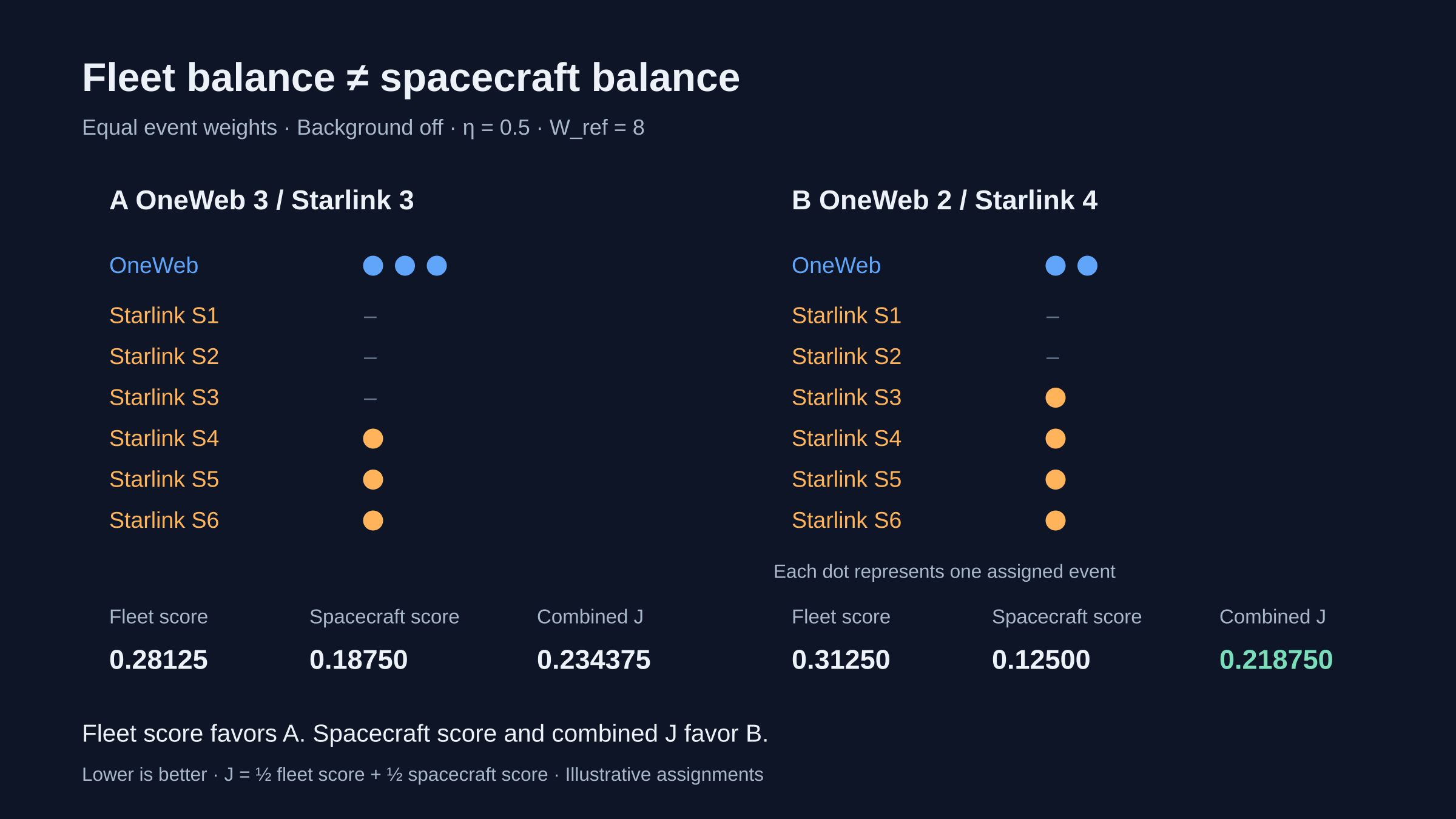
The objective discourages concentrating too much modeled workload on either one fleet or one satellite. We compare equal event weights with a priority-weighted version based on relative MAX_PROB screening values, used as modeled priority weights rather than actual collision probabilities. We also test whether including two time-aligned debris encounters as fixed background workload changes the preferred assignments.
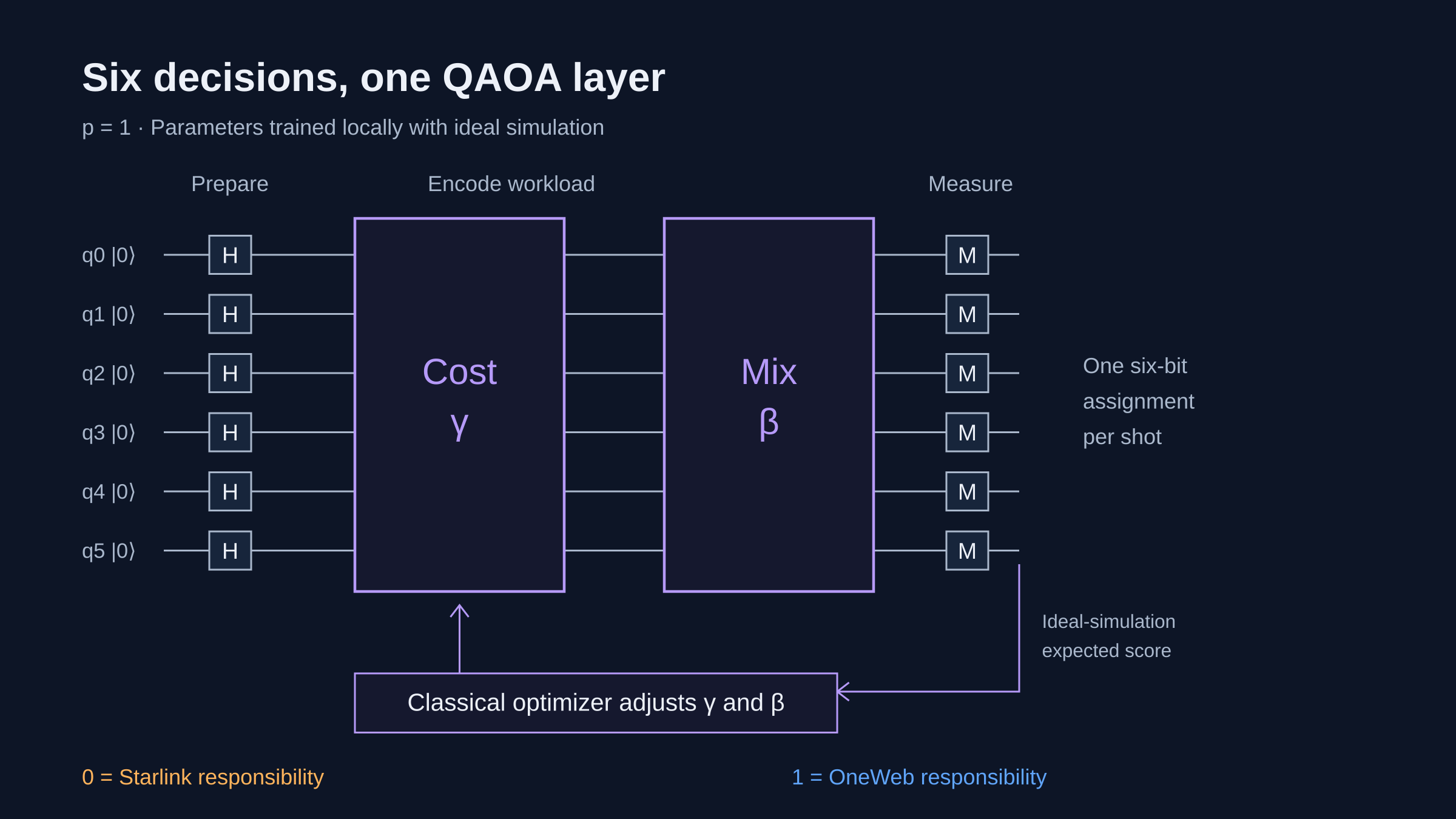
Six decisions give us 64 possible assignments. That makes the problem small enough to solve exactly, which gives us a reliable reference for checking every quantum result.
The distinction between data and assumptions matters here. The encounters are real catalog-based predictions. The workload weights are modeling choices. Qubital does not calculate avoidance burns, estimate actual fuel use, or establish that an assignment is physically safe.
How we built it
We started with a synthetic fuel-and-reserve example, then kept it as a separate reference model when we added the real-data responsibility model.
For the new model, we wrote a direct scorer and independently expanded the objective into a QUBO. We converted that polynomial into an Ising cost operator and built a six-qubit, one-layer QAOA circuit in Qiskit.
Before optimizing any angles, we checked every assignment in each of the four study cases:
direct score = QUBO value = Ising basis energy plus its constant offset.
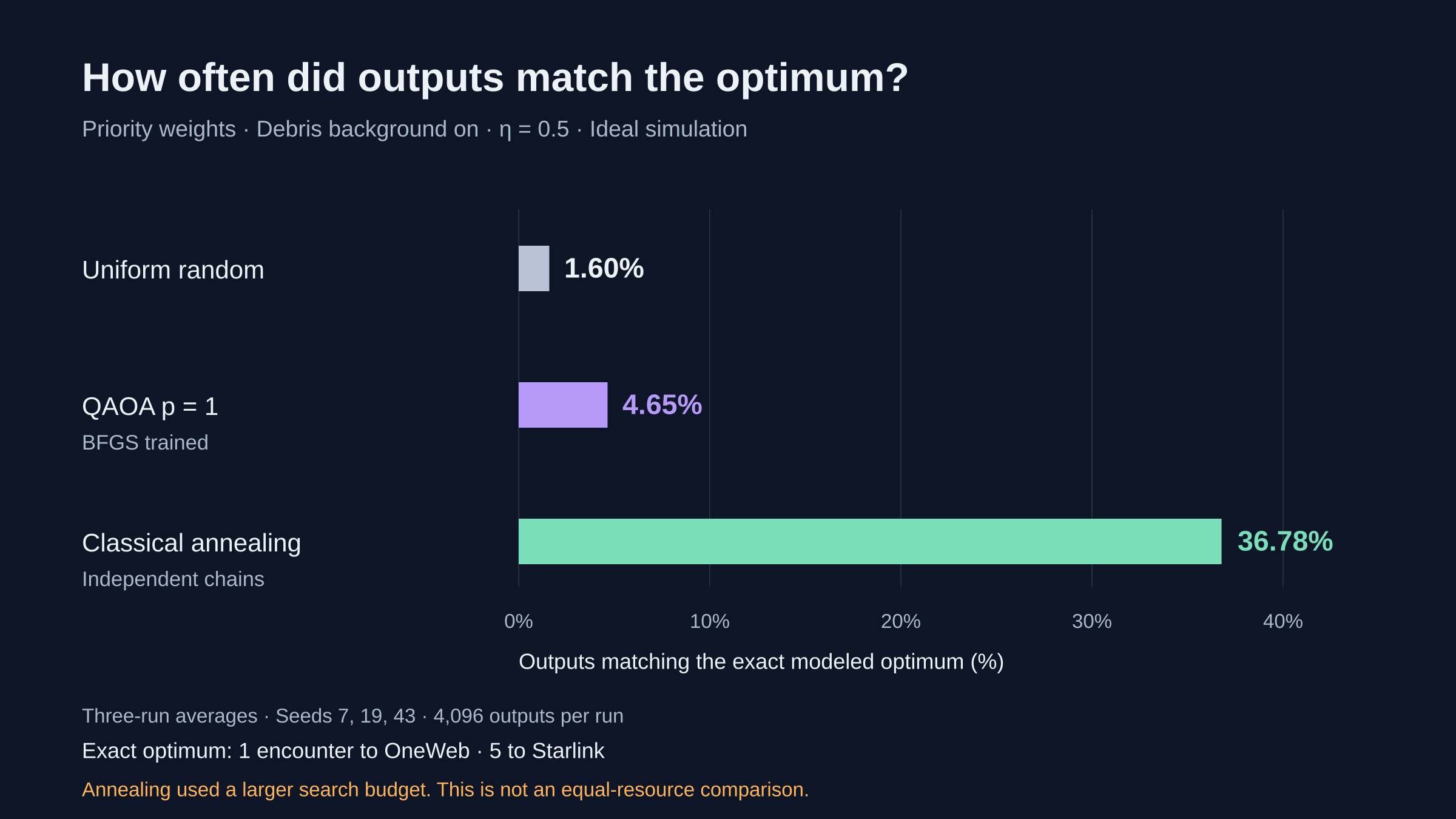
We compared QAOA with exact enumeration, uniform random sampling, and independent simulated-annealing runs. The local experiments use three recorded seeds and 4,096 final shots per selected circuit.
We then tested optimizer robustness using four deterministic starts per seed. A larger-budget COBYLA study converged on 20 of 48 starts. A separately declared BFGS cross-check, using analytic statevector gradients, converged on all 48. Both studies and their full attempt histories remain available.
Finally, we took the verified priority-weighted, background-on circuit to IBM Quantum. We trained the angles locally, compiled the circuit for ibm_fez, and submitted one SamplerV2 job containing the main circuit and six measurement-mapping controls.
This was fixed-angle hardware sampling, not optimization performed on the device.
Challenges we ran into
One challenge was deciding what the data could actually support. SOCRATES provides screening predictions, not maneuver costs or spacecraft fuel reserves. We therefore separated the original synthetic fuel model from the real-data workload study instead of presenting invented costs as measurements.
Another challenge was optimizer stopping behavior. Our initial runs exhausted their evaluation budgets without formally converging. We retained those results, recorded the stopping-policy changes, and tested the follow-up across all four cases rather than only the hardware target.
Bit ordering also needed careful attention. A reversed measurement string can assign a response to the wrong event while still looking like a valid answer. We checked logical-to-physical layouts, classical measurement wiring, and six known control patterns.
The selected data also expose a modeling limitation: two encounters share the same OneWeb satellite and occur 2.844 seconds apart. They are different events, but their physical responses could be coupled. Our assignment model does not simulate that coupling.
Results and accomplishments
The project now has both verified ideal-simulator results and a completed IBM hardware experiment.
- The final suite passed 233 tests in both tested environments, with no failures or skips.
- In the unit-weight case without debris background, BFGS-trained, one-layer QAOA sampled an exact optimum in 52.40% of shots, averaged across three seeds, compared with 23.15% for uniform sampling.
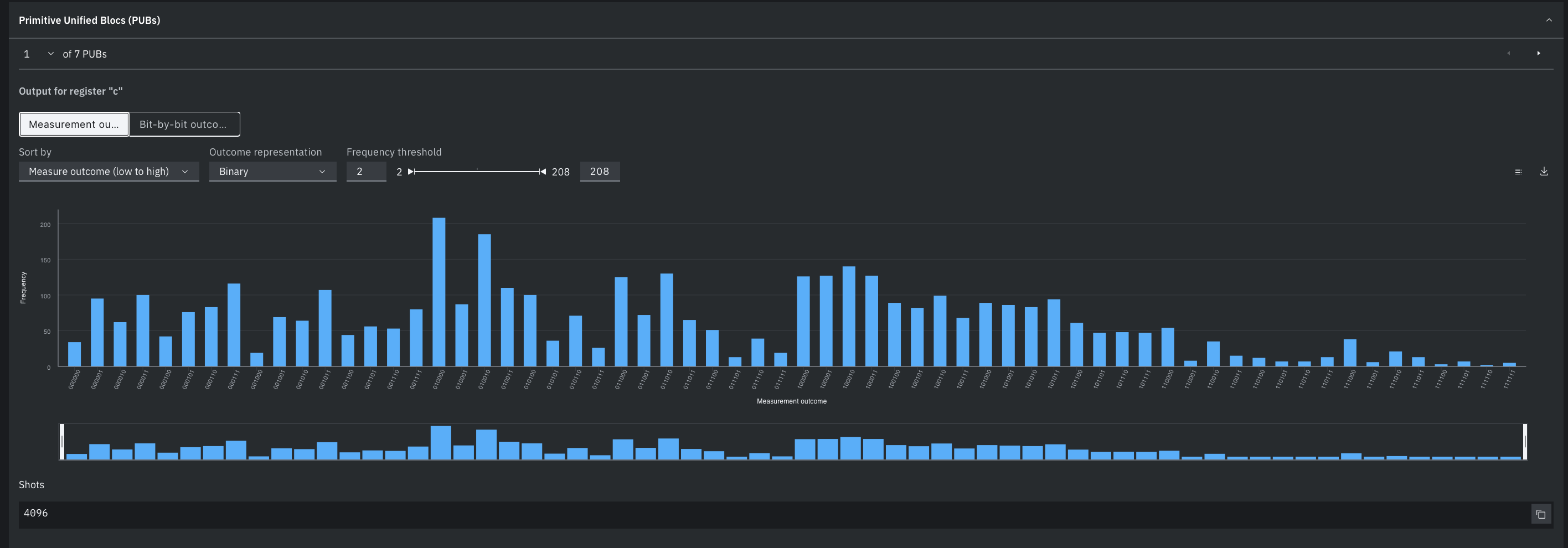
- The IBM run executed 4,096 main shots plus 192 mapping-control shots. The compiled main circuit had depth 142 and 54 CZ gates.
- IBM reported 3 QPU seconds used, consuming 0.047299 Runtime Units.
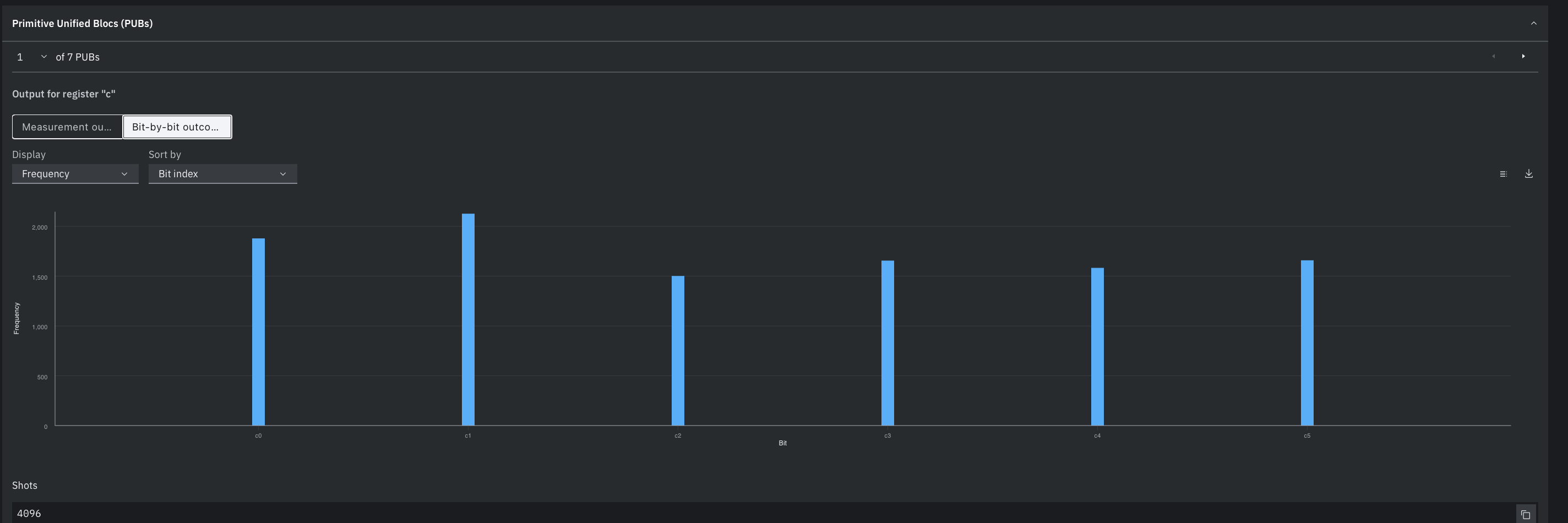
- The hardware sampled the exact modeled optimum,
000010, 208 times out of 4,096 shots: 5.08%. The paired ideal run at the same angles sampled it 177 times: 4.32%.
Optimum-hit rate tells only part of the story. Although the hardware had a higher optimum-hit percentage, its average objective was worse: 0.51067 versus 0.50280 for the paired ideal samples. That does not show that noise helped the algorithm.
We retained the raw counts, circuit files, layouts, angles, software versions, job ID, usage records, and comparison scripts.
IBM job ID: dbsgu4habdes73fr5530
What we learned
A working quantum circuit is only one part of an optimization experiment. The objective, encoding, optimizer, decoder, and comparison methods all affect what the result means.
Our hardware run showed why reporting only the best sampled answer is insufficient. A distribution can produce the optimum more often while also producing worse outcomes elsewhere.
We also learned to separate implementation correctness from real-world validity. Exhaustive checks can establish that our circuit encodes the intended objective. They cannot establish that our workload assumptions describe executable satellite maneuvers.
The classical results keep the project grounded. Exact enumeration already solves this six-bit instance completely, and the annealing baseline achieved higher optimum-hit rates with a different computation budget. Our results support a checked quantum implementation and a hardware comparison, not a claim of quantum advantage.
What's next for Qubital
The next useful step is to test additional frozen encounter sets with different satellite-sharing patterns. We would also examine how sensitive the assignments are to the workload weights and the balance between fleet-level and satellite-level burden.
Before moving toward operational use, we would need domain validation of the responsibility model and constraints describing coupled responses. Real maneuver costs would require geometry, propulsion, uncertainty, and reserve information that this dataset does not provide.
For the quantum experiments, a controlled comparison of unmitigated and mitigated hardware sampling would help distinguish improvements in measurement quality from changes caused by optimizer settings or shot fluctuations.
