Inspiration
Disagreements are a normal part of everyday life—whether it is friends deciding what to do, roommates dividing chores, or university students debating the direction of a group project. However, everyday arguments quickly become frustrating when people struggle to organize their thoughts on the spot, misunderstand the other person's perspective, repeat points without making progress, or lack a neutral third party to keep the conversation on track.
We drew inspiration from the playful multiplayer room experience of Krillion.io — Puffer Party, the AI-assisted dispute analysis of ArgueResolver, and the character-driven presentation of retro 2D pixel-art games. Combining these ideas with the Digital Sidekick theme, we wanted to build something that works alongside you rather than simply completing the task for you. Instead of building an AI that immediately tells two people who is right, we created quarrel.io: a space where human players remain responsible for their own arguments while working with personal AI lawyers that help them organize and present their cases.
What it does
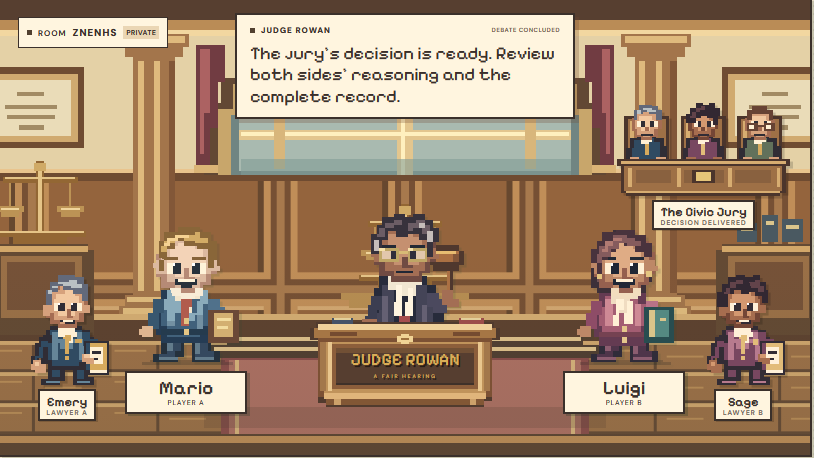
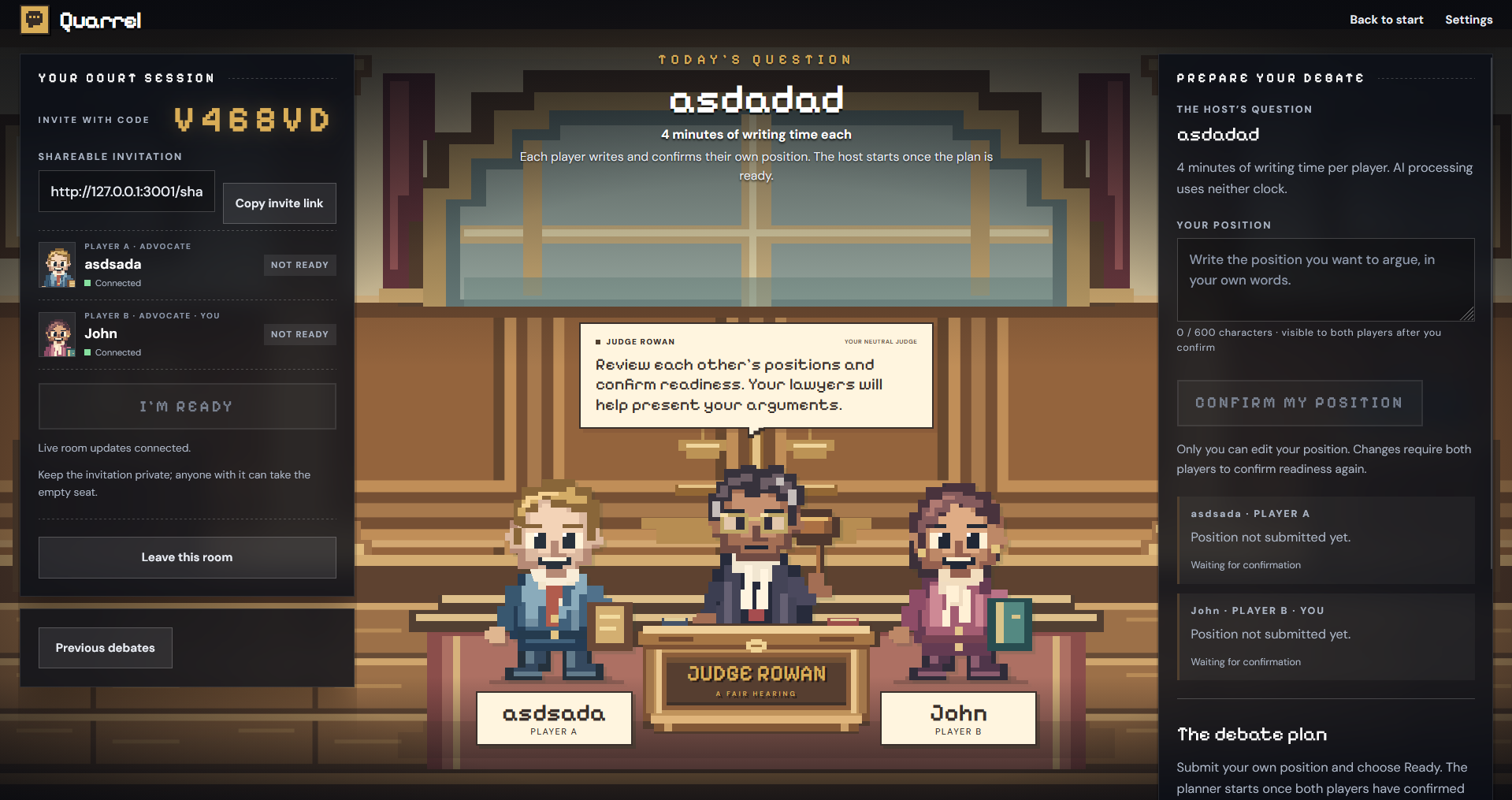
quarrel.io is a real-time, multiplayer 2D pixel-art debate platform where two players argue opposing sides of a disagreement alongside their own personal AI lawyers (Digital Sidekicks), while a neutral AI judge summarizes each stage and an AI jury delivers a final verdict.
A full debate flows through seven structured steps:
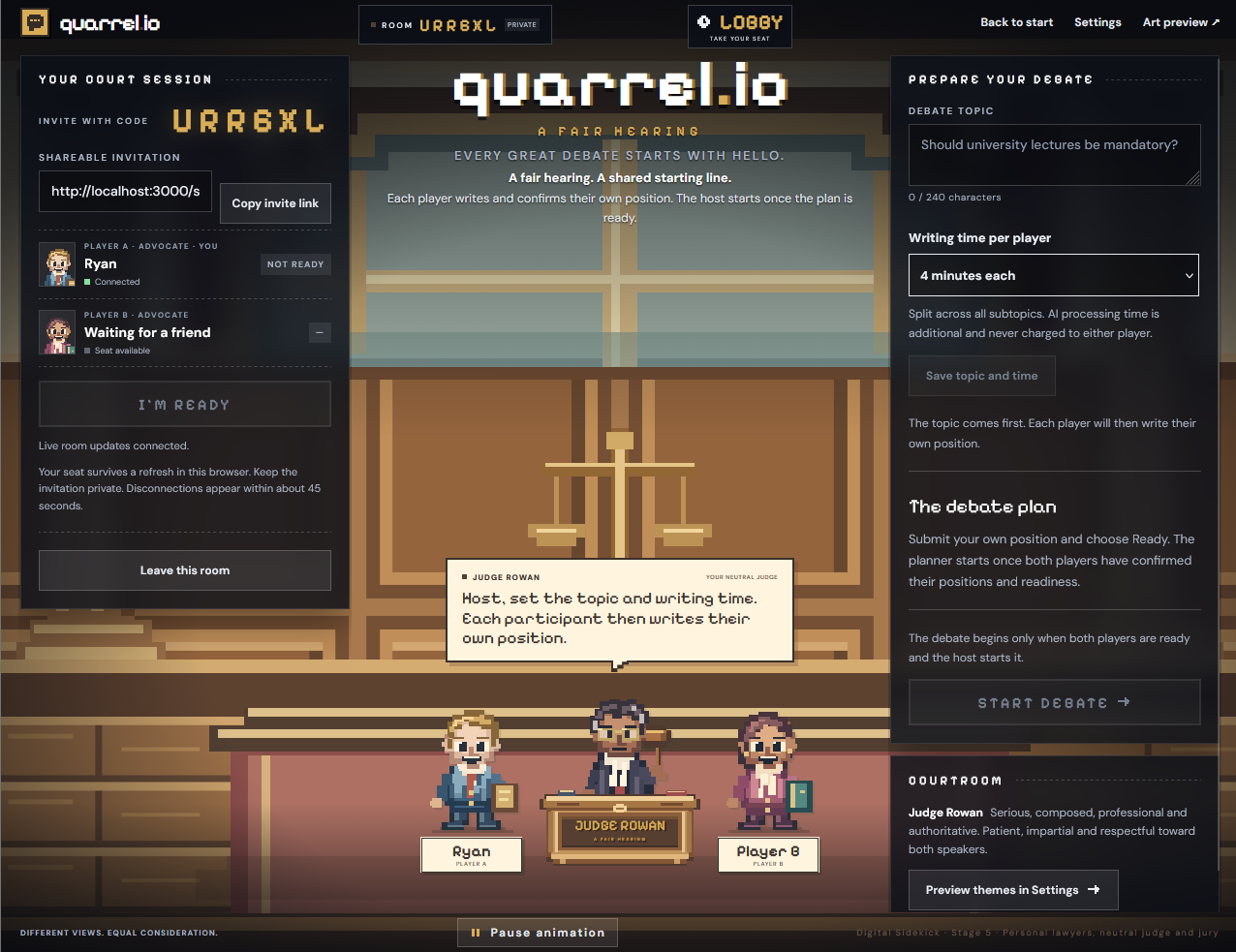
- Create a Debate Room: Player A creates a private room and receives a six-character invitation code. Player B joins via the code or link with no account registration required, and both are assigned separate player identities.
- Select the Debate Topic: The host sets the topic and total writing duration (2, 4, 6, or 10 minutes per player). Each participant independently writes their opening position without being able to edit the other's stance.
- AI Debate Planning: An AI Planner analyzes the main topic and both positions to break the debate into 2–5 timed subtopics (guaranteeing at least 30 seconds per player per subtopic, with one optional regeneration by the host).
- Debate Through Personal AI Lawyers: Players take turns writing arguments. When a player submits a point, their dedicated AI lawyer organizes and restyles it to match the selected theme's persona—preserving the player's intended meaning without inventing evidence or introducing unrelated claims. Players can also use private lawyer consultations (completely invisible to their opponent) to refine their reasoning before submitting an official argument.
- Clocks: Each player has an individual countdown clock for the current subtopic. Only the active writer's clock ticks down, and both clocks pause during AI processing. Server-authoritative timing logic prevents browser refreshes from resetting the clocks.
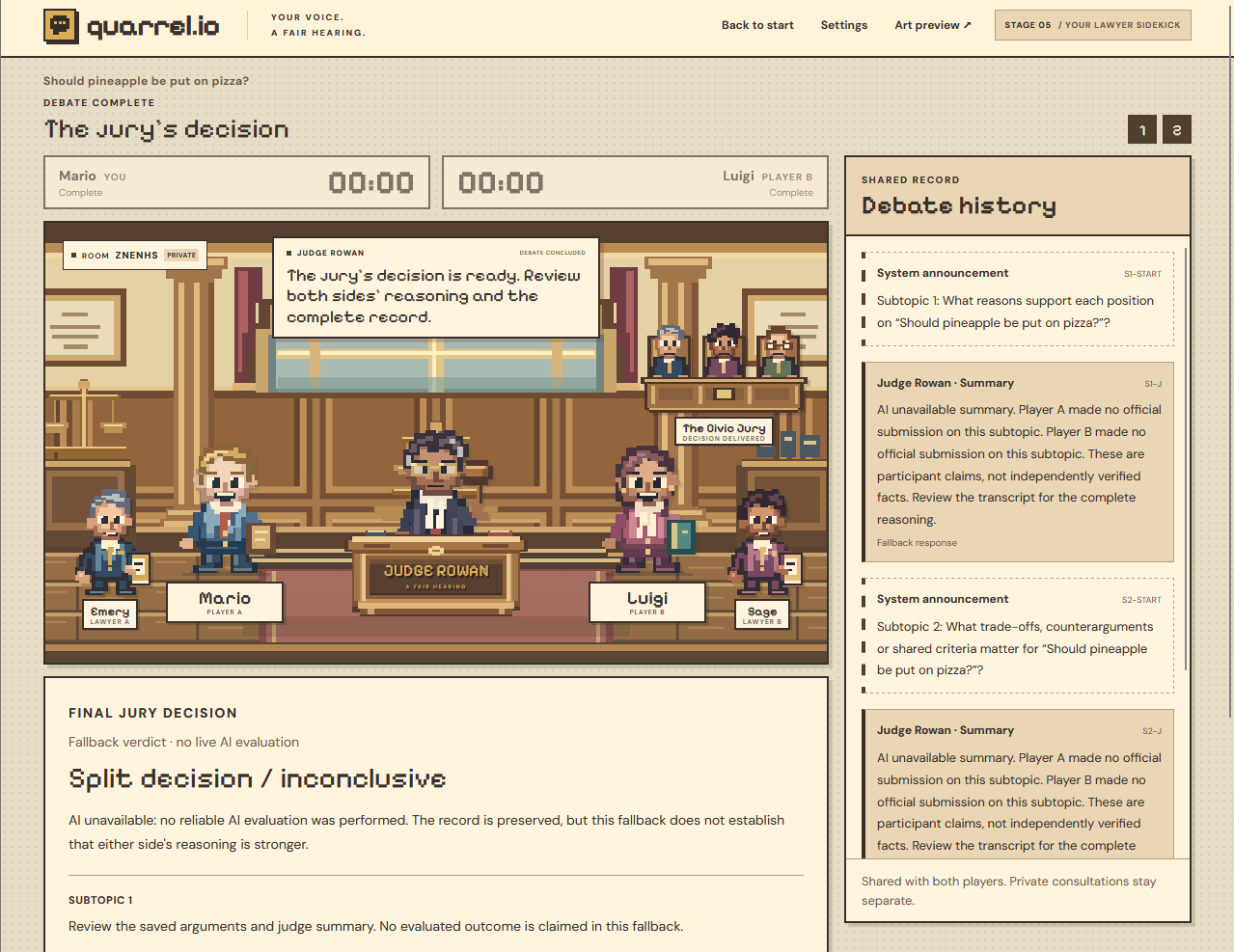
- Judge Summaries: After each subtopic concludes, a neutral AI Judge reviews the public transcript, summarizes both sides' main arguments, and highlights key points of disagreement for both players.
- Final Jury Verdict: Once all subtopics finish, an AI Jury evaluates the official debate and judge summaries to deliver a reasoned verdict based strictly on the reasoning presented rather than objective truth.
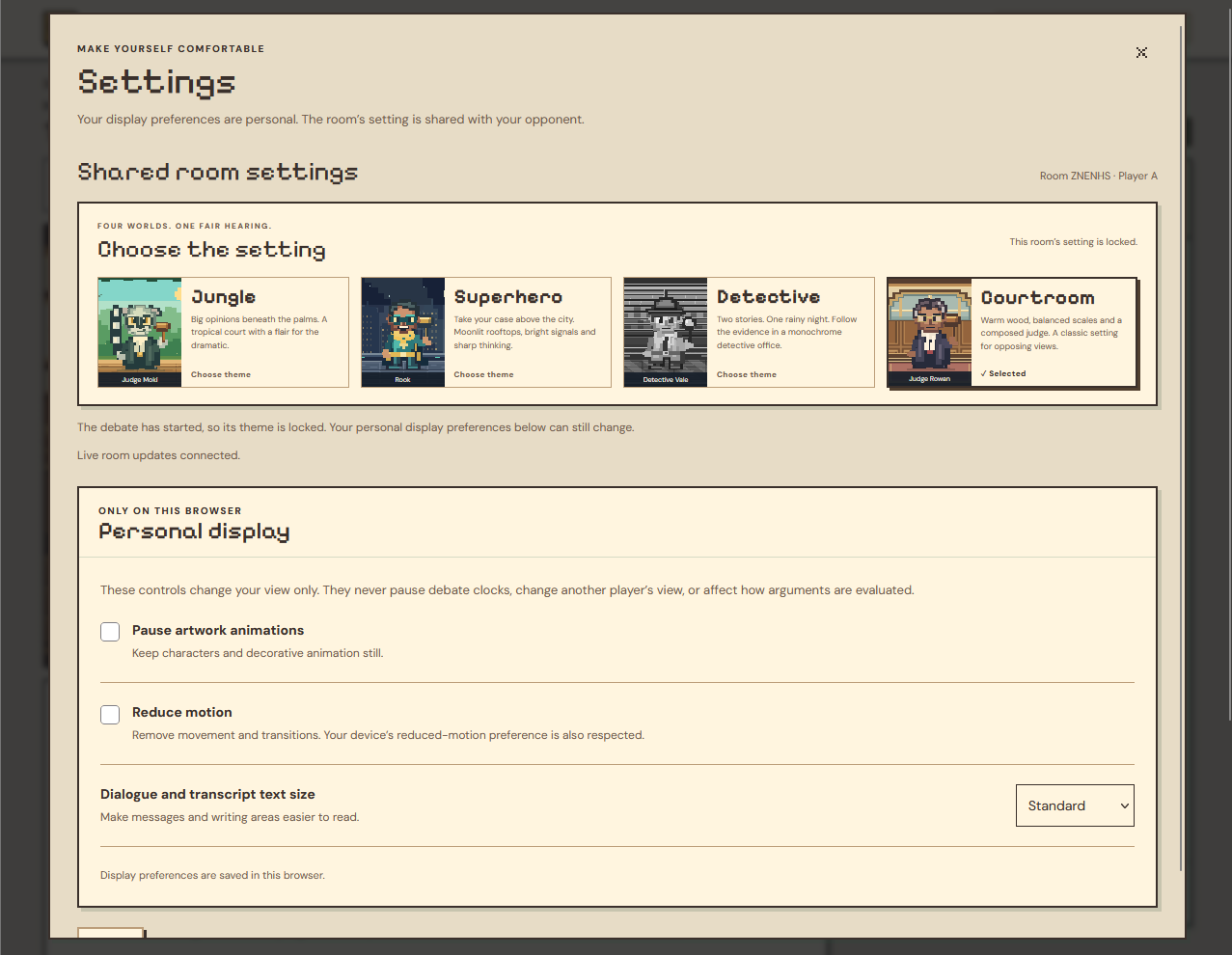
All of this takes place across four original 2D pixel-art themes—Courtroom (Default), Jungle, Superhero, and Detective / Film Noir—each featuring distinct visuals, dialogue styles, and Text-to-Speech voice playback while sharing the exact same underlying debate rules and judging standards.
How we built it
- Frontend: Built with Next.js , React, TypeScript, and Tailwind CSS, paired with original 2D pixel-art characters, environments, and animations to make the interface feel like an interactive game rather than a standard chatbot.
- Backend & Realtime Synchronization: Powered by Supabase Cloud and PostgreSQL. We used Supabase Realtime to synchronize room states, turn transitions, clocks, and public debate history across clients. Supabase Anonymous Authentication assigns distinct player sessions without friction, while Row Level Security and Next.js server-side API routes enforce access control. On the backend, we also built the full rematch lifecycle, historical debate preservation and retrieval, results acknowledgement storage, and error recovery mechanisms.
- Multi-Role AI & Text-to-Speech System: Integrated the Google Gemini API using role-specific instructions, structured response validation, and theme-specific personality configurations across five distinct roles: AI Planner, Player A's Lawyer, Player B's Lawyer, AI Judge, and AI Jury, along with Text-to-Speech so the AI characters can voice their responses aloud. To manage API usage and rate limits effectively, we split our Gemini integration across two separate API keys—one dedicated exclusively to TTS generation and another for the core debate AI roles—alongside deterministic fallback responses and duplicate-verdict prevention.
- Testing & Deployment: Verified using Vitest automated unit and integration suites, Supabase Cloud integration tests, and multi-session browser tests, with deployment hosted on Vercel.
Challenges we ran into
- Multiplayer Synchronization : Keeping both participants locked into the exact same debate phase, subtopic, and clock state required careful coordination. We had to handle active writing countdowns, pause both clocks during AI generation, and resolve clock and state edge cases on the server so timers could not be manipulated on the client side.
- AI Argument Faithfulness & Role Separation: Because the human players must remain responsible for their own arguments, we had to constrain the AI lawyers so they would restyle and structure inputs into themed personas without hallucinating facts or changing the player's core stance. Separating the context and duties across five distinct AI roles required strict prompt boundaries and output validation.
- Privacy Between Opponents: Private consultations between a player and their AI lawyer needed to remain strictly confidential. We had to ensure these interactions were invisible to the opposing player on the client and completely excluded from the public context evaluated by the AI Judge and AI Jury.
- AI Reliability & Provider Rate Limits: Handling malformed outputs, API latency, and rate limits without trapping players in unfinished debates was a major hurdle. At our Stage 5 testing checkpoint, while live Gemini planning, selected lawyer presentations, and a live judge summary were confirmed, provider quota and rate limits prevented us from confirming a live Gemini jury verdict and live private consultation under full load.
Accomplishments that we're proud of
- True Human-AI Sidekick Collaboration: Completing the debate system where personal AI lawyers genuinely assist players through private consultations, themed presentations, and Text-to-Speech voice delivery while keeping humans in charge of the debate.
- Hardened Backend & Thoroughly Tested Architecture: Achieving 539 passing automated tests, passing TypeScript and production build checks, verifying Supabase Cloud integration, server-authoritative clocks, private lawyer access controls, and two-player isolated browser sessions, and delivering a reliable backend rematch lifecycle, historical debate preservation, duplicate-result prevention, and results acknowledgement storage.
- Cohesive Multi-Theme Pixel-Art Experience: Supporting four distinct pixel-art environments and character casts using a shared configuration that preserves identical debate mechanics and evaluation fairness across all themes.
What we learned
- Orchestrating Multi-Agent AI Workflows: Designing an application where five separate AI roles interact taught us how to scope context windows strictly—ensuring, for example, that a private lawyer knows its client's drafts while the judge and jury only ever see official public submissions.
- Designing for Real-Time Resilience: Building synchronized chess-style clocks alongside live LLM and TTS calls showed us the importance of server-authoritative state management, API key isolation for quota management, idempotent result handling, and deterministic fallbacks so network hiccups or API quota limits never break a live multiplayer session.
What's next for Quarrel.io
- Voice Input: Adding Speech-to-Text so players can speak their arguments aloud or talk directly with their AI lawyers, complementing our existing Text-to-Speech voice playback.
- Future Optional Features : Exploring Character Customization so players can choose different pixel-art avatars within each theme, and Team Debate Mode to support up to four players per side taking turns representing their team.
Built With
- geminiapi
- next.js
- react
- supabase
- tailwindcss
- typescript
- vercel
