Inspiration
Retail investors and quantitative traders are constantly bombarded with static, lagging market data and disjointed technical indicators. Traditional tools tell you what already happened, but they leave you completely in the dark regarding probabilistic future price paths. We wanted to bridge the gap between institutional-grade machine learning forecasting and accessible, cross-platform market intelligence.
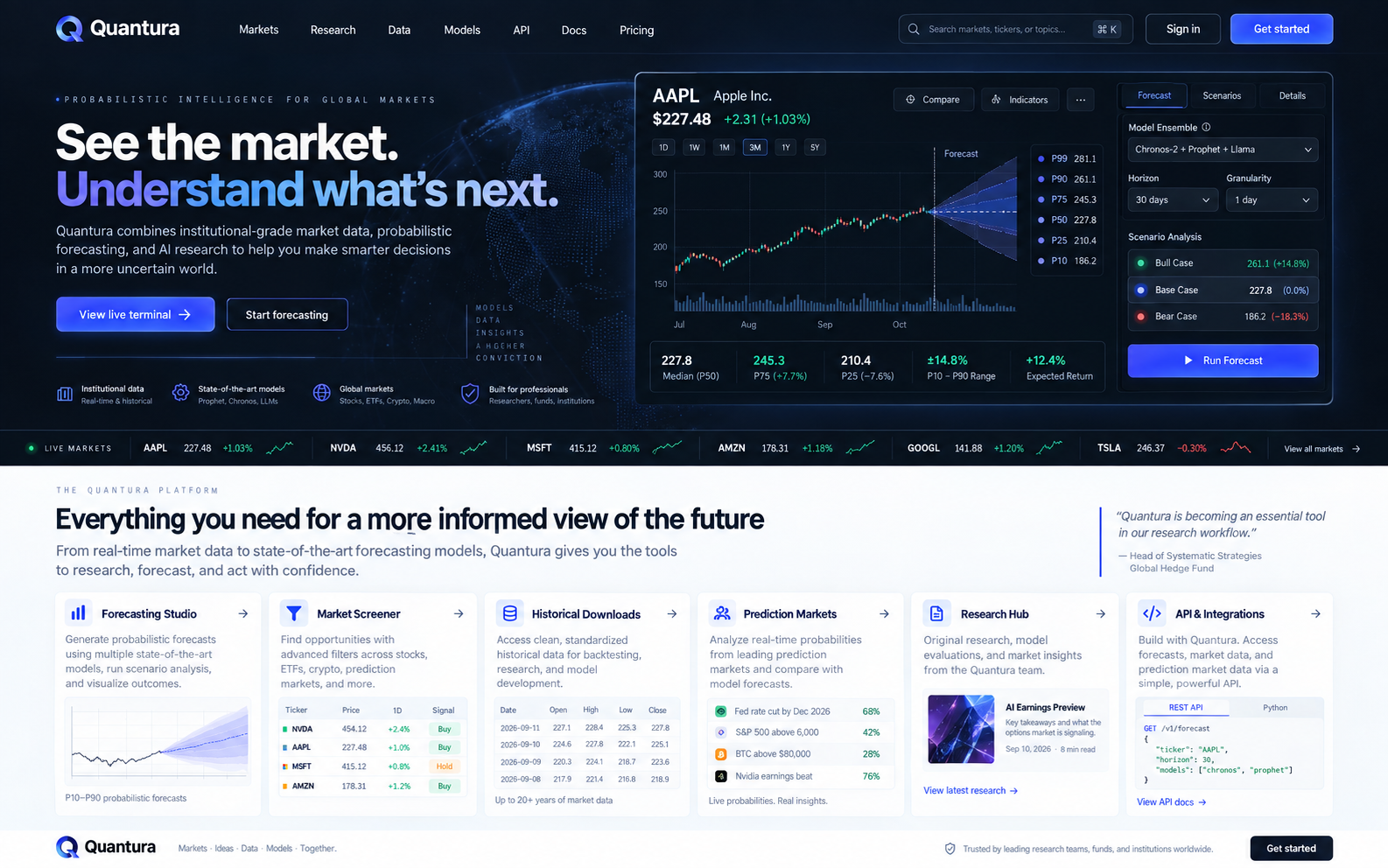
Quantura was born out of the need for a unified platform that transforms complex time-series data and multi-variable forecasting models into clear, actionable, probabilistic price bounds (such as P10, P50, and P90 thresholds) so traders can visualize risk and opportunity with mathematical precision.
What it does
Quantura is an AI-powered market intelligence and stock forecasting platform engineered to deliver real-time predictive analytics:
- Probabilistic Forecasting: Leverages deep learning time-series architectures (including TensorFlow-backed predictive engines) to map out potential price ranges and volatility bounds.
- Automated Alerts & Data Parsing: Seamlessly integrates with financial data streams (like Yahoo Finance options tables and real-time execution pipelines via Alpaca API) to monitor price action against custom quantile thresholds, dispatching automated alerts when thresholds are crossed.
- Cross-Platform Access: Designed for modern workflows across web, iOS, and Android applications, ensuring real-time intelligence is always at your fingertips.
How we built it
Quantura's architecture combines robust cloud infrastructure with advanced analytics pipelines:
- Backend & AI Engine: Built using Python, leveraging deep learning frameworks (TensorFlow, Hugging Face integrations) for time-series forecasting and statistical modeling.
- Automation & Data Pipelines: Utilizes custom Python scripts and Google Apps Script integrations to handle options data extraction, automated threshold monitoring, and event-driven alerting.
- Frontend & Infrastructure: Deployed via modern web frameworks on Vercel, backed by Firebase for real-time synchronization across web and mobile app interfaces.
Challenges we ran into
- Handling High-Dimensional Time-Series Noise: Financial data is notoriously noisy. Balancing model generalization while avoiding overfitting on volatile historical price action required careful engineering of our TensorFlow forecasting layers and rigorous validation metrics.
- Real-Time Data Latency: Synchronizing live market feeds with heavy quantitative evaluation scripts required optimizing our API polling and asynchronous processing logic to ensure alerts fired instantly without blocking pipeline execution.
What we learned
Building Quantura reinforced the importance of translating complex statistical outputs into intuitive user interfaces. A sophisticated deep learning model is only as good as its readability; bridging heavy quantitative data science with a clean, responsive product experience was our biggest breakthrough.
Built With
- huggingface
- python
- vercel


Log in or sign up for Devpost to join the conversation.