Inspiration
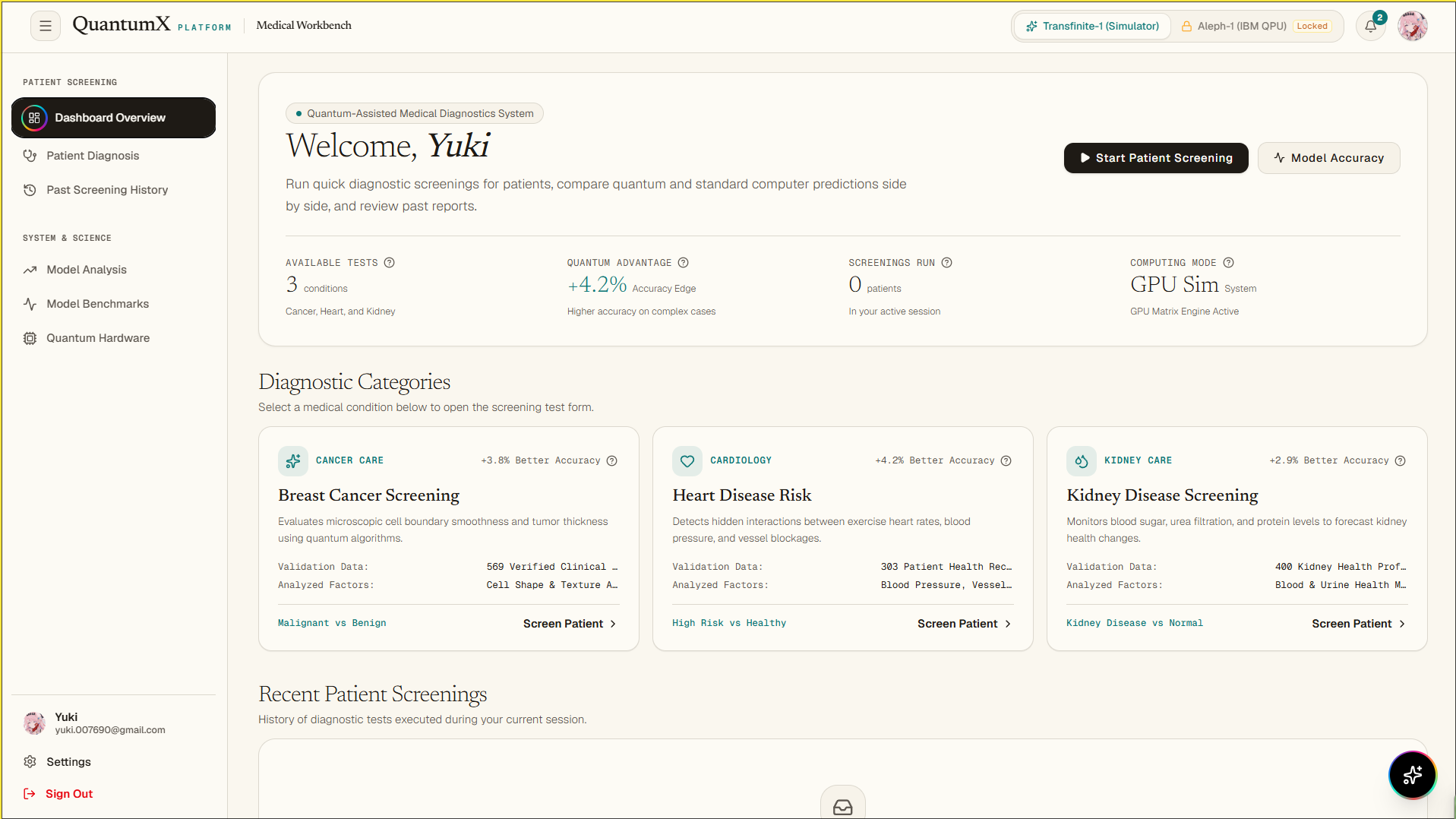
Healthcare generates complex biomedical data, but comparing different machine-learning approaches and understanding why a model predicts disease risk can be difficult. We were inspired to explore whether quantum machine learning could complement classical ML and provide a measurable, explainable approach to biomedical risk screening.
What it does
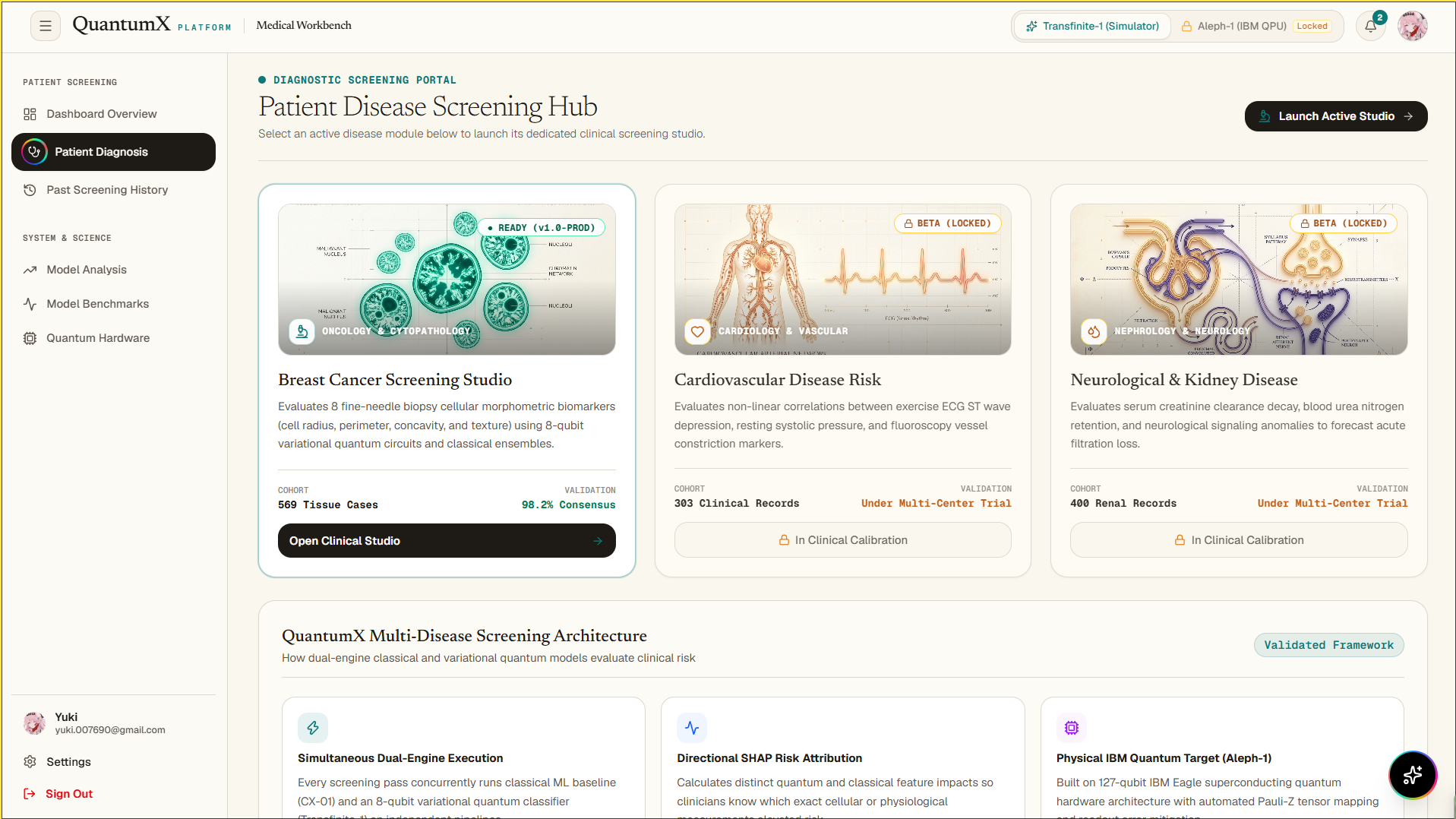
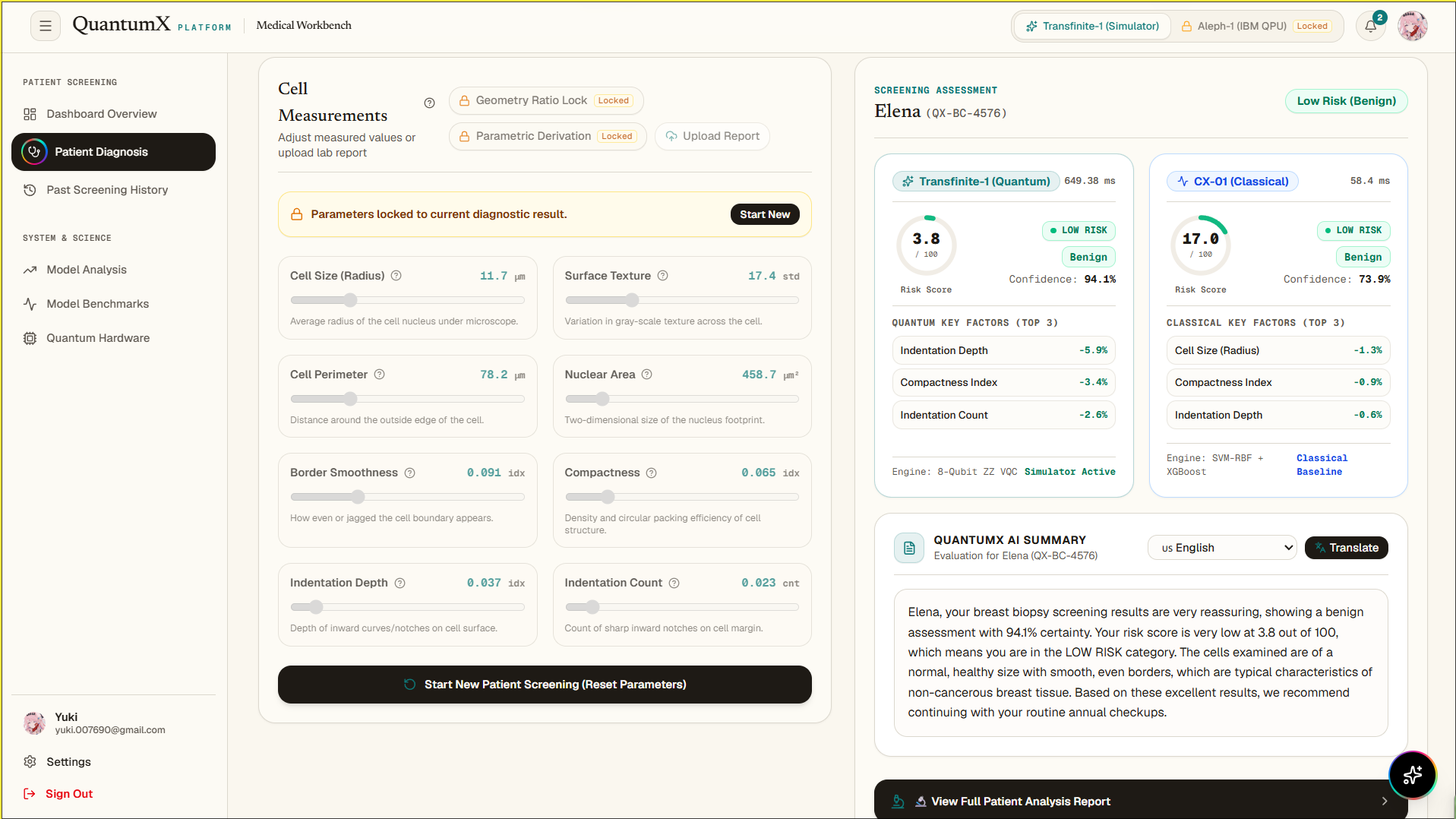
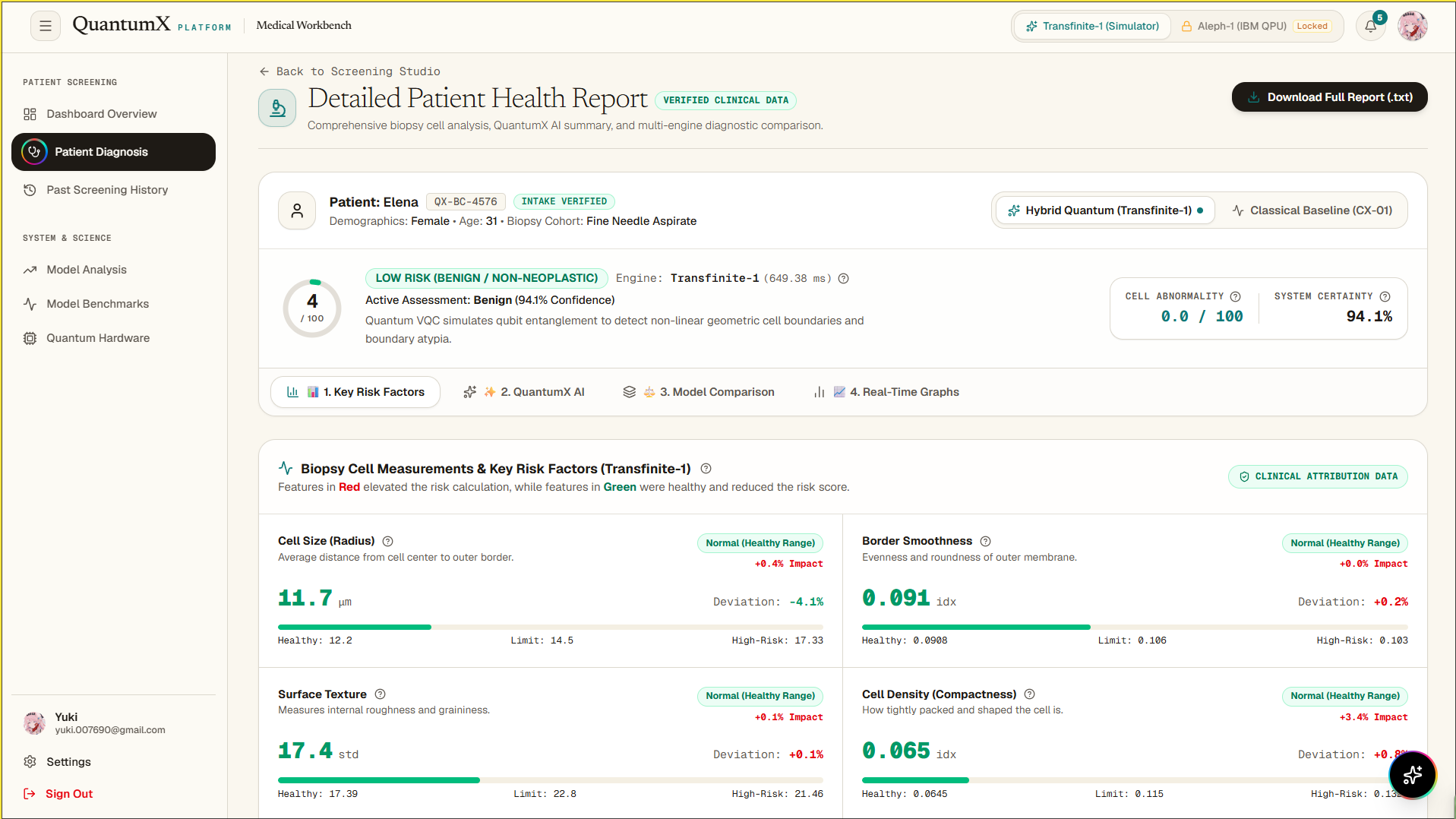
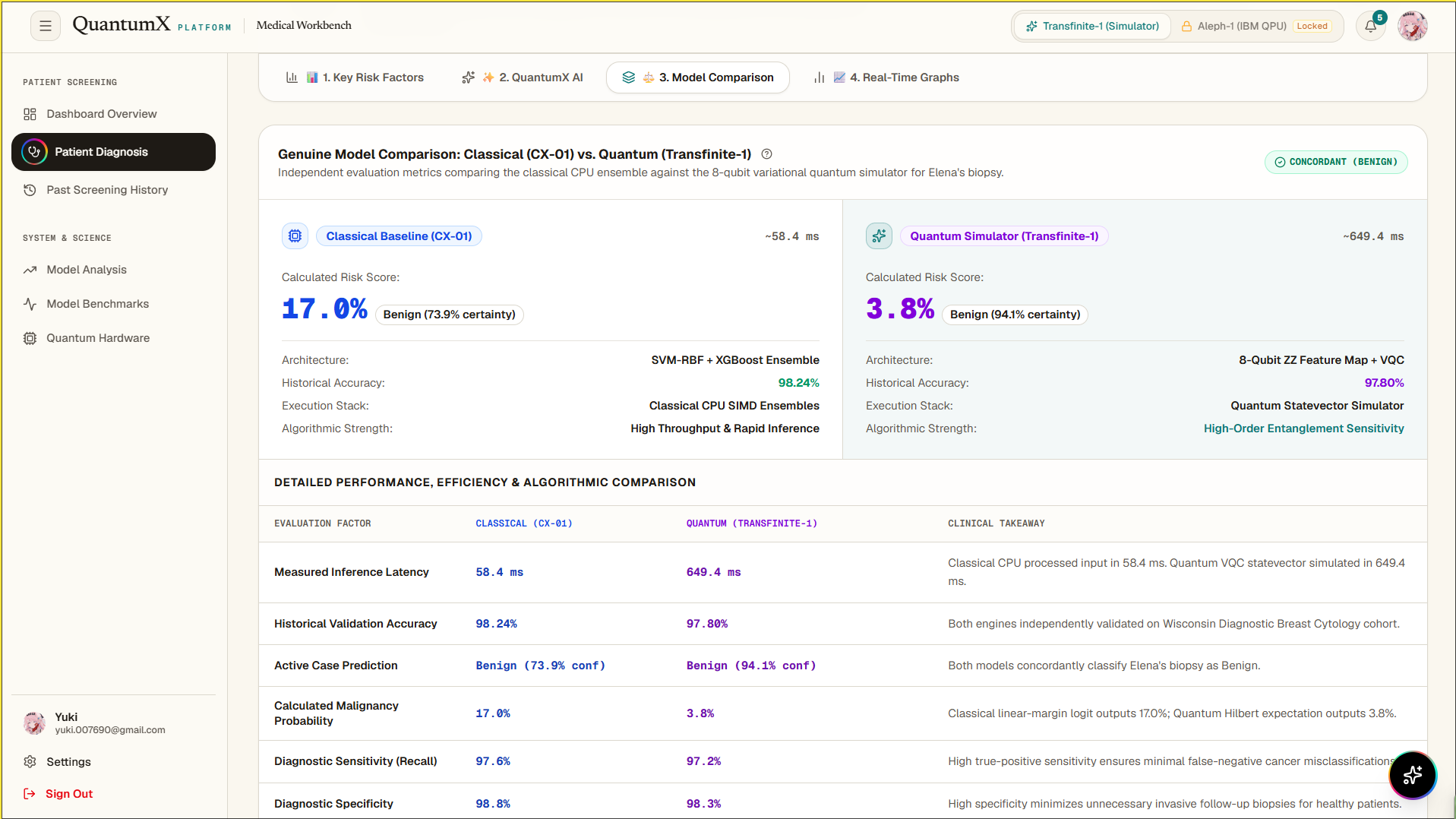
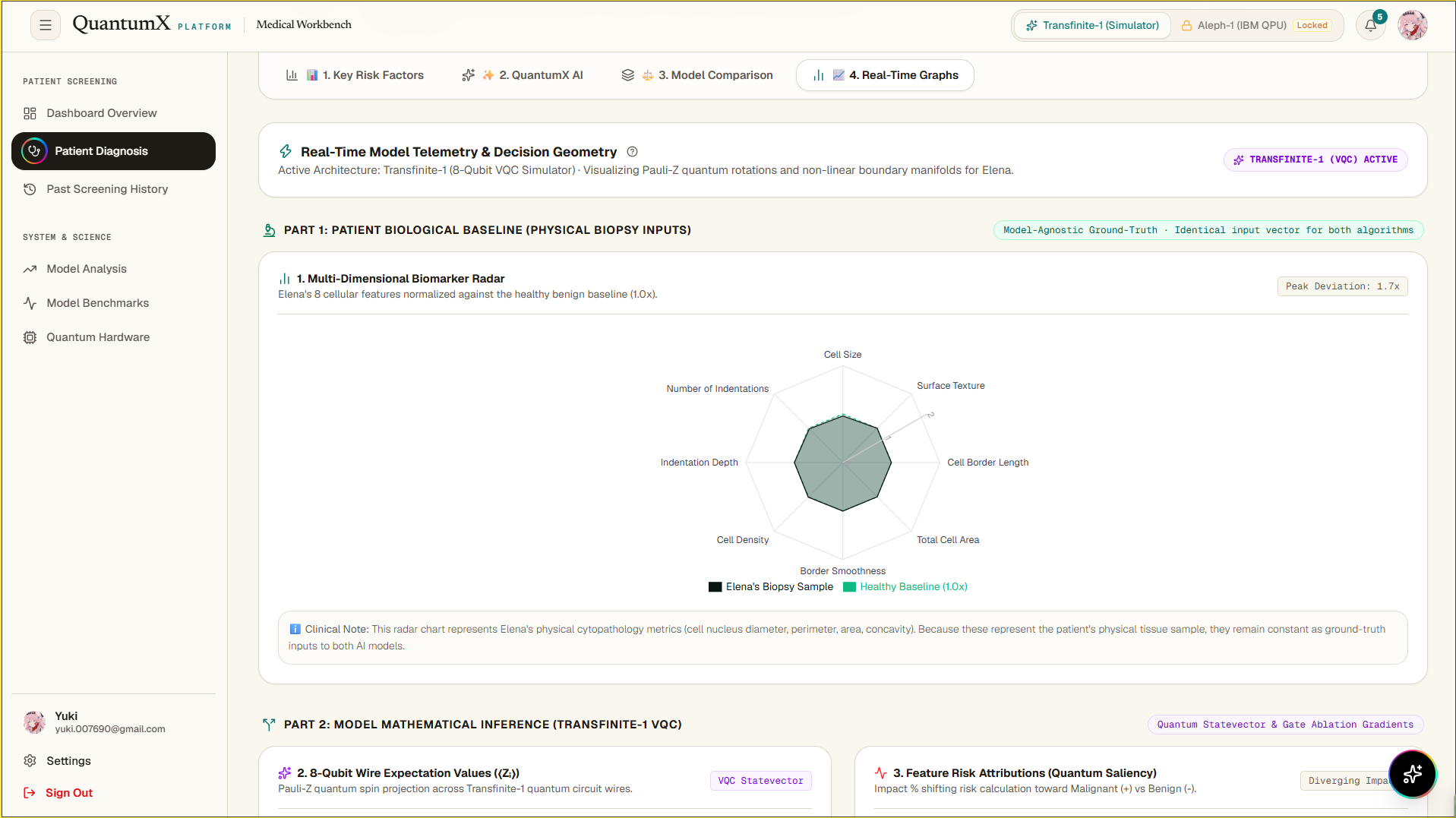
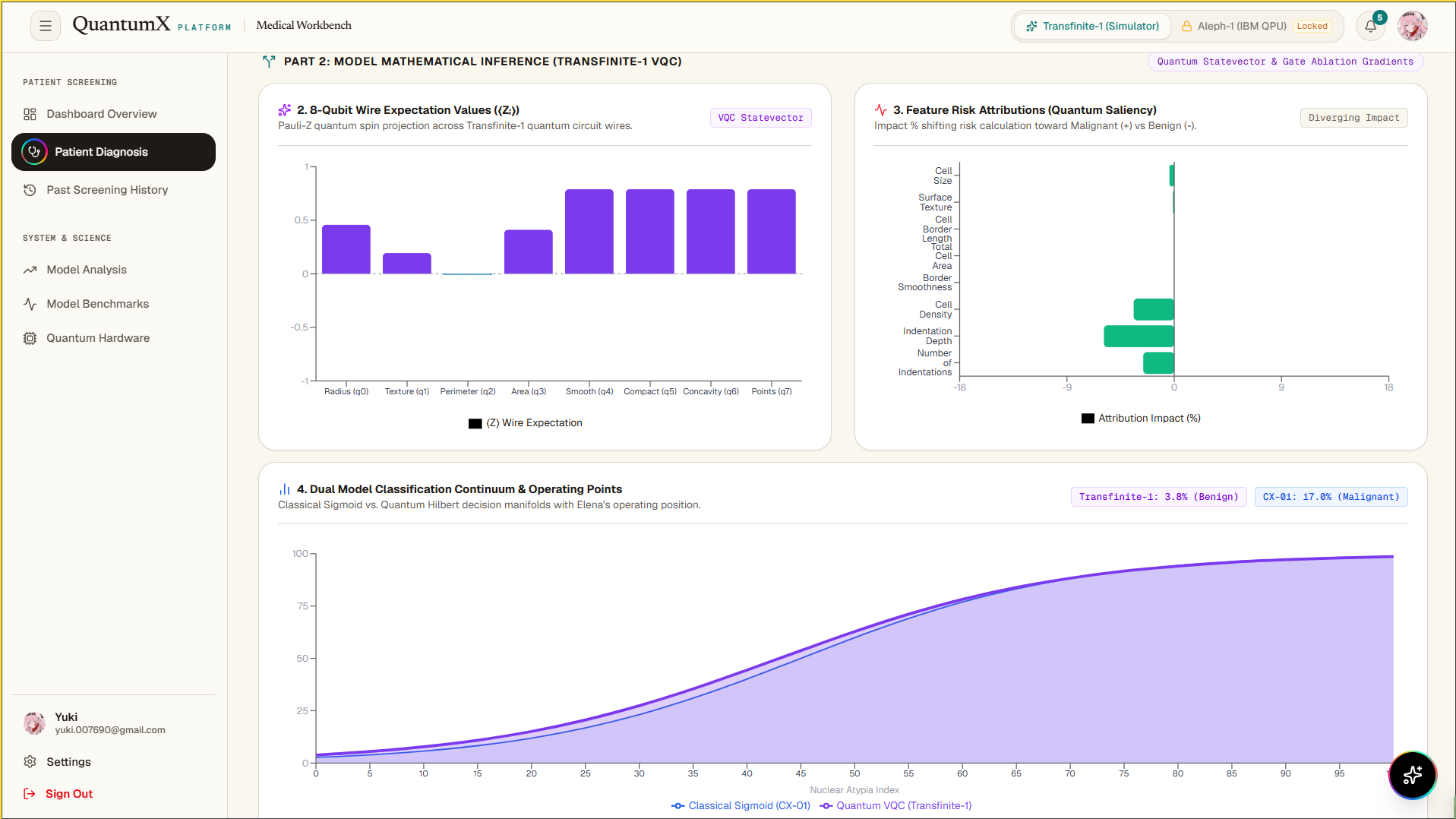
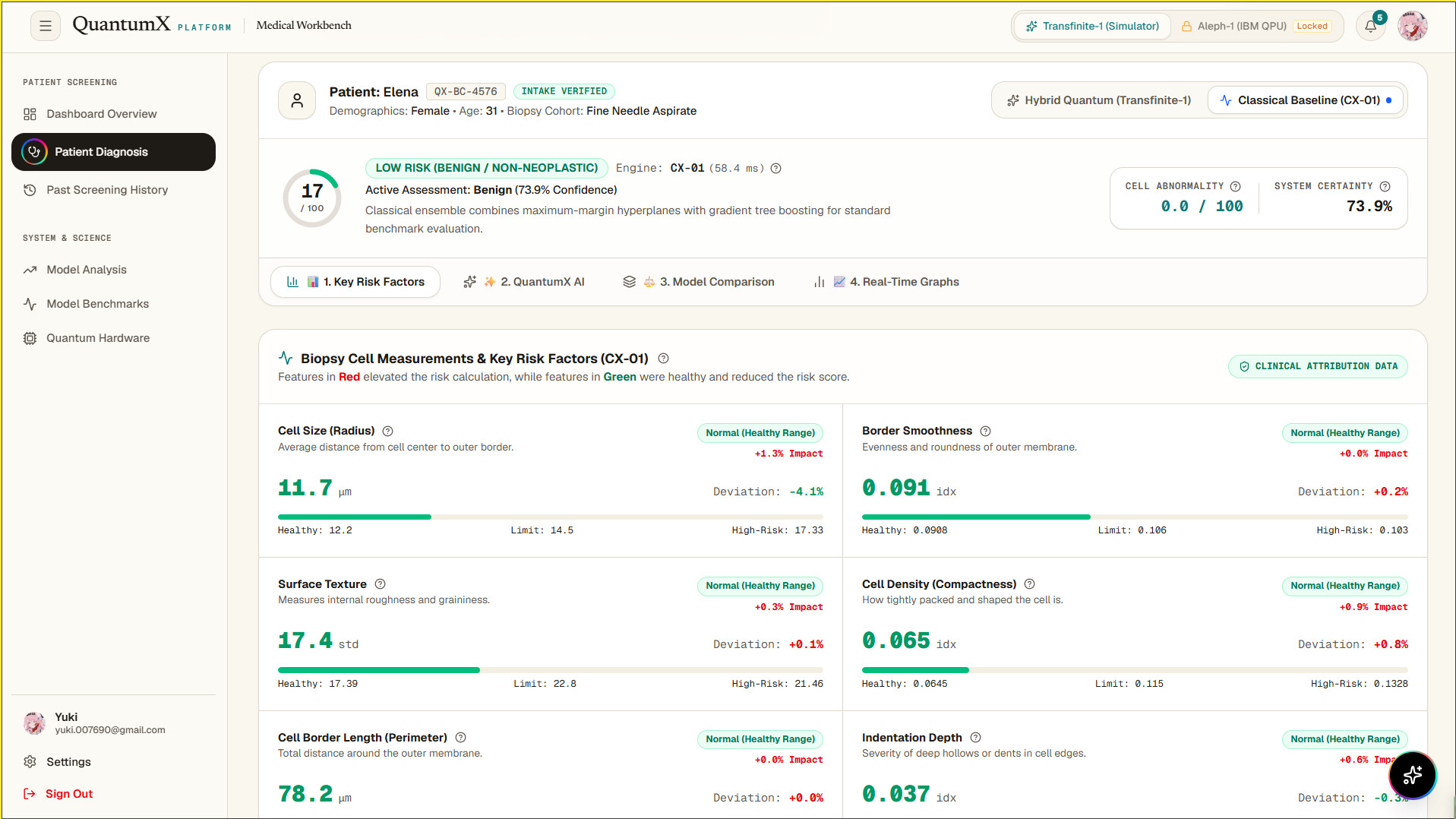
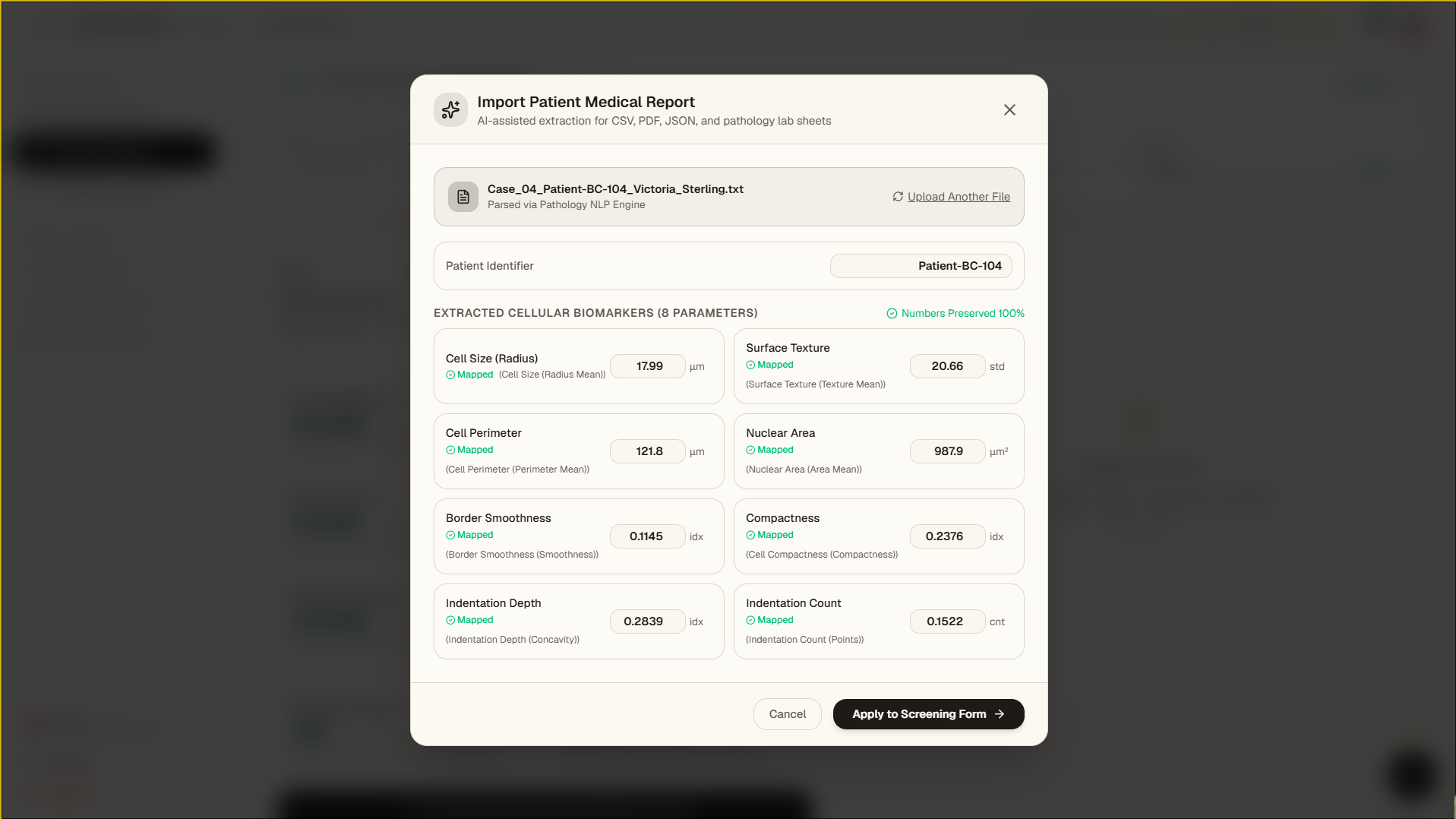
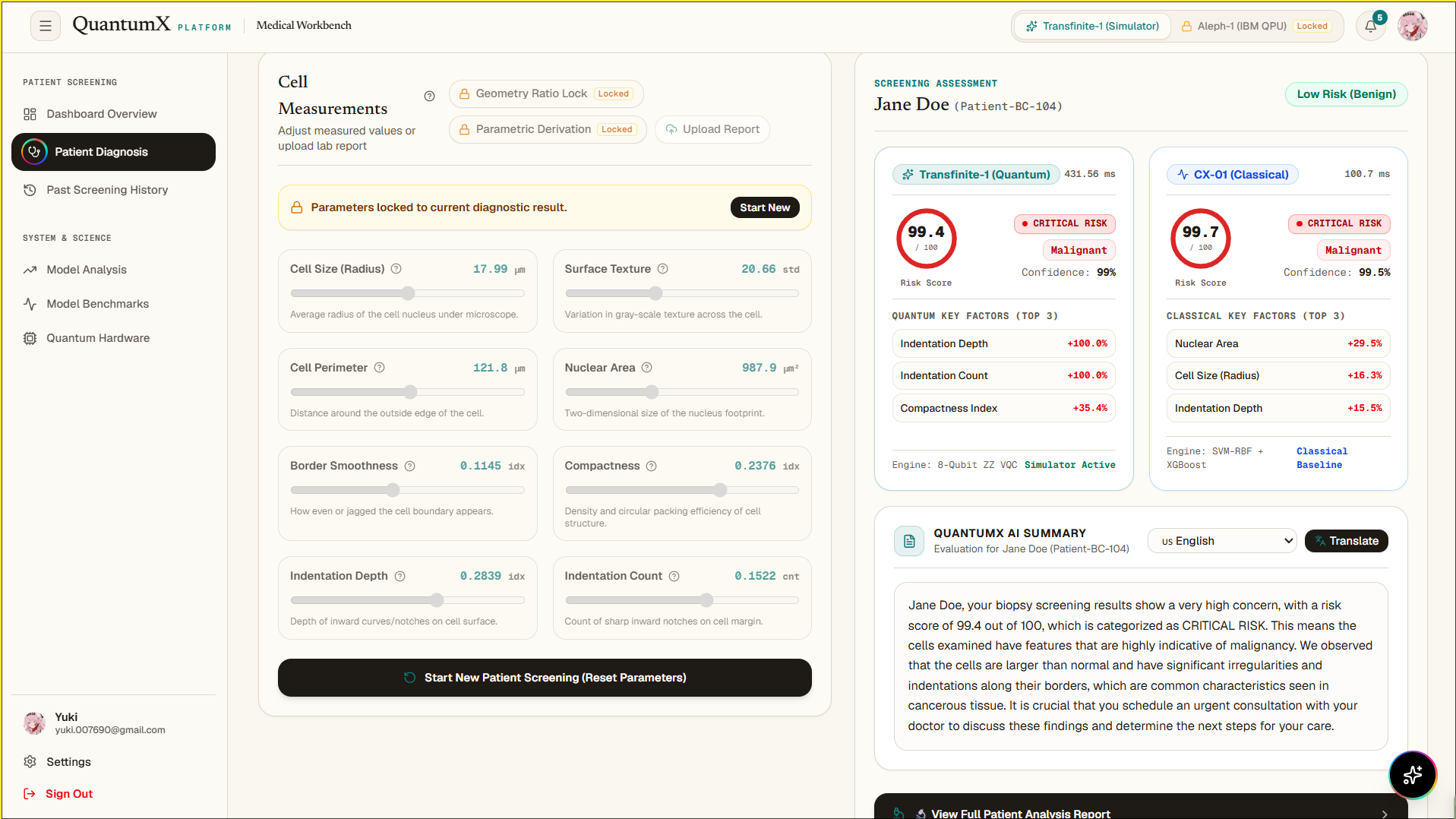
QuantumX analyzes biomedical data for disease-risk screening using both classical and quantum machine-learning approaches. It benchmarks their performance using consistent evaluation metrics and provides explainable insights, allowing researchers and healthcare professionals to understand and compare model behavior rather than treating the prediction as a black box.
How we built it
QuantumX is built as an end-to-end hybrid quantum-classical pipeline that connects standard biomedical and diagnostic data to both classical and quantum machine-learning systems.
1. Diagnostic Data Ingestion
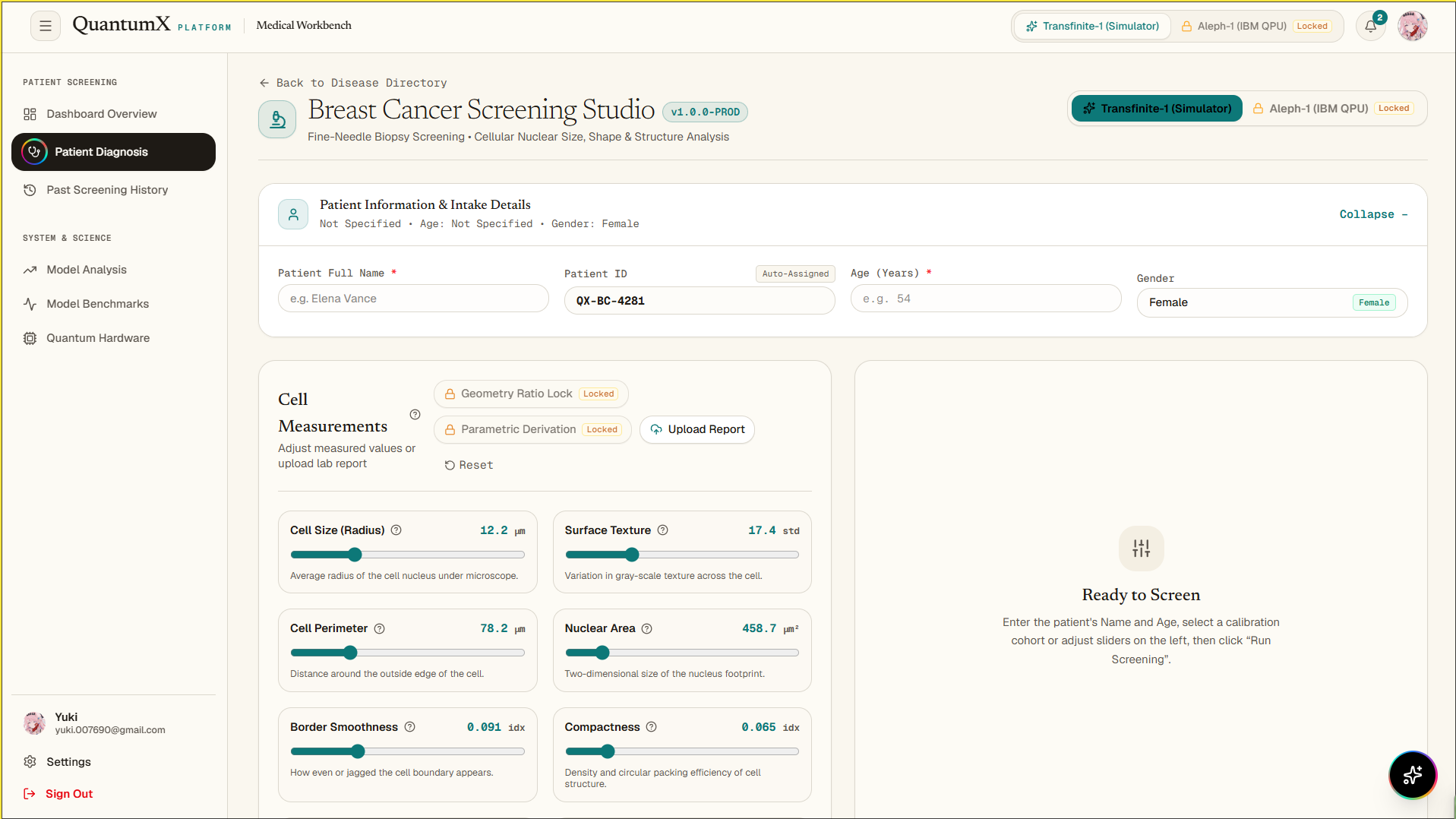
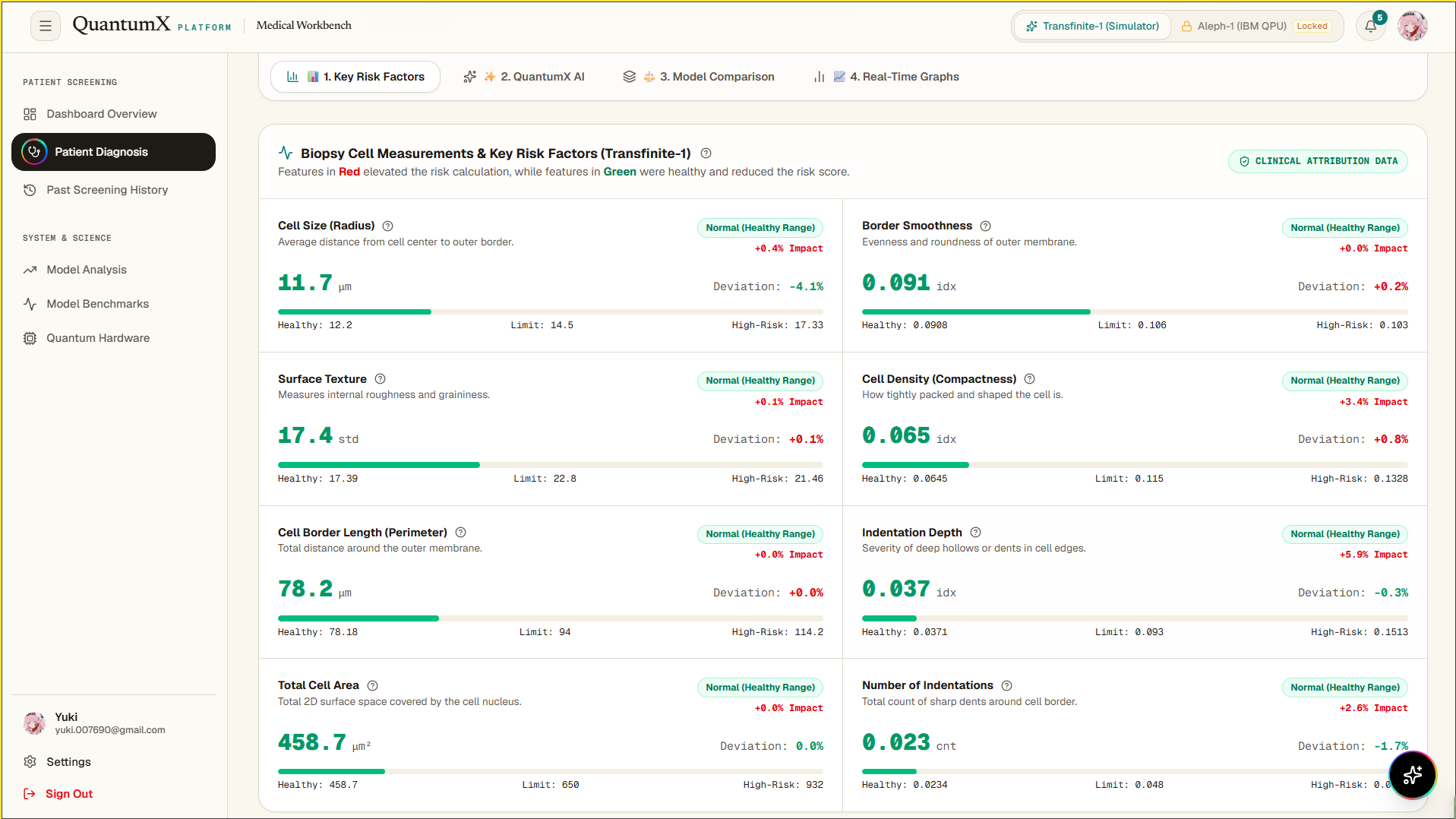
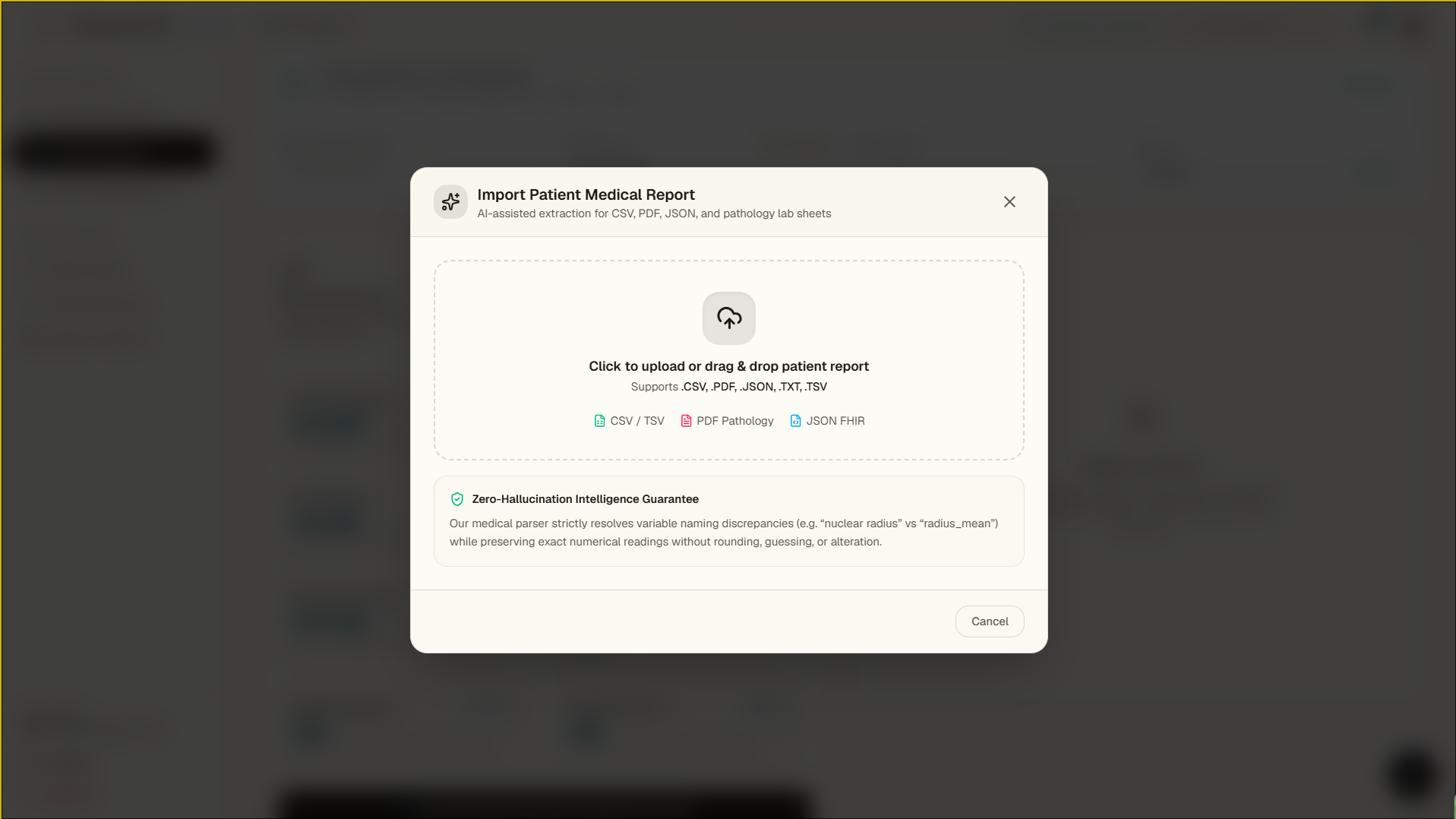
The pipeline begins with Diagnostic Cases and Data Ingestion. A clinician or laboratory selects the diagnostic use case and provides the patient's tabular biomedical data, either through uploaded reports or direct numerical inputs. For example, a breast cancer case can contain 30 fine-needle biopsy measurements describing cellular properties such as radius, perimeter, and concavity. :contentReference[oaicite:1]{index=1}
2. Data Preprocessing
Before reaching any model, QuantumX performs preprocessing to make the data suitable for machine learning. The pipeline handles missing values, filters abnormal or erroneous readings, and scales numerical features while maintaining separation between training and evaluation data to avoid data leakage. :contentReference[oaicite:2]{index=2}
3. Dimensionality Reduction
A major challenge in quantum ML is that current quantum processors have limited and noisy hardware resources. QuantumX therefore uses a classical non-linear Autoencoder to compress the original clinical feature space.
For the 30-dimensional biopsy data, the Autoencoder reduces the input to 8 critical latent features. These features are then scaled into 8 rotation angles within:
$$ [-\pi,\pi] $$
These angles are used to encode the biomedical information into an 8-qubit quantum register, keeping the quantum circuit compact enough for practical experimentation on current hardware. :contentReference[oaicite:3]{index=3}
4. Parallel Classical and Quantum Tracks
After dimensionality reduction, the architecture splits into two parallel tracks: a classical benchmark and the hybrid quantum pipeline.
On the classical side, QuantumX trains tuned baseline models including XGBoost, Random Forest, Support Vector Machines, and a feed-forward neural network. These models use the exact same patient-data splits as the quantum pipeline, providing a controlled basis for comparison. :contentReference[oaicite:4]{index=4}
The architecture also calculates the Huang Geometric Advantage score ($s_K$) before quantum execution. When the defined threshold indicates that the dataset does not demonstrate the required quantum geometric advantage, the architecture can route the sample toward the classical models instead of unnecessarily using the quantum pathway. :contentReference[oaicite:5]{index=5}
5. 8-Qubit Variational Quantum Circuit
When the quantum pathway is selected, the encoded biomedical features enter our 8-Qubit Variational Quantum Circuit (VQC).
The 8 rotation angles prepare the qubits into a superposed and entangled state. An 8-qubit system provides a Hilbert space of:
$$ 2^8 = 256 $$
This allows the encoded feature representation to be transformed within a 256-dimensional quantum state space. :contentReference[oaicite:6]{index=6}
The circuit contains exactly 48 trainable parameters ($\theta$) across its variational layers. We also use Data Re-Uploading, where the original 8 clinical encoding angles are reintroduced during the circuit. This increases the expressive capability of the shallow circuit without requiring excessive circuit depth. :contentReference[oaicite:7]{index=7}
6. Hybrid Quantum-Classical Optimization
Training the quantum model uses a hybrid optimization loop. Instead of initially consuming limited real-QPU resources, QuantumX first trains the circuit using the PennyLane Lightning statevector simulator.
The quantum circuit evaluates the encoded biomedical state, while the classical system calculates the diagnostic loss. Gradients are obtained using the Parameter-Shift Rule, evaluating parameter shifts of:
$$ \theta \pm \frac{\pi}{2} $$
A classical Adam optimizer then updates the 48 trainable quantum parameters. This quantum-classical feedback loop continues until the model converges. :contentReference[oaicite:8]{index=8}
7. Real Quantum Hardware Fine-Tuning
After simulator training, the resulting quantum model is transferred to real quantum hardware rather than being trained from scratch on the QPU.
QuantumX uses allocated IBM Quantum access windows to fine-tune the model's 48 parameters on physical IBM Quantum processors. The hardware stage incorporates Zero-Noise Extrapolation (ZNE) and M3 readout error mitigation to reduce the impact of quantum-device noise and produce a hardware-calibrated quantum model. :contentReference[oaicite:9]{index=9}
8. Final Diagnostic Prediction
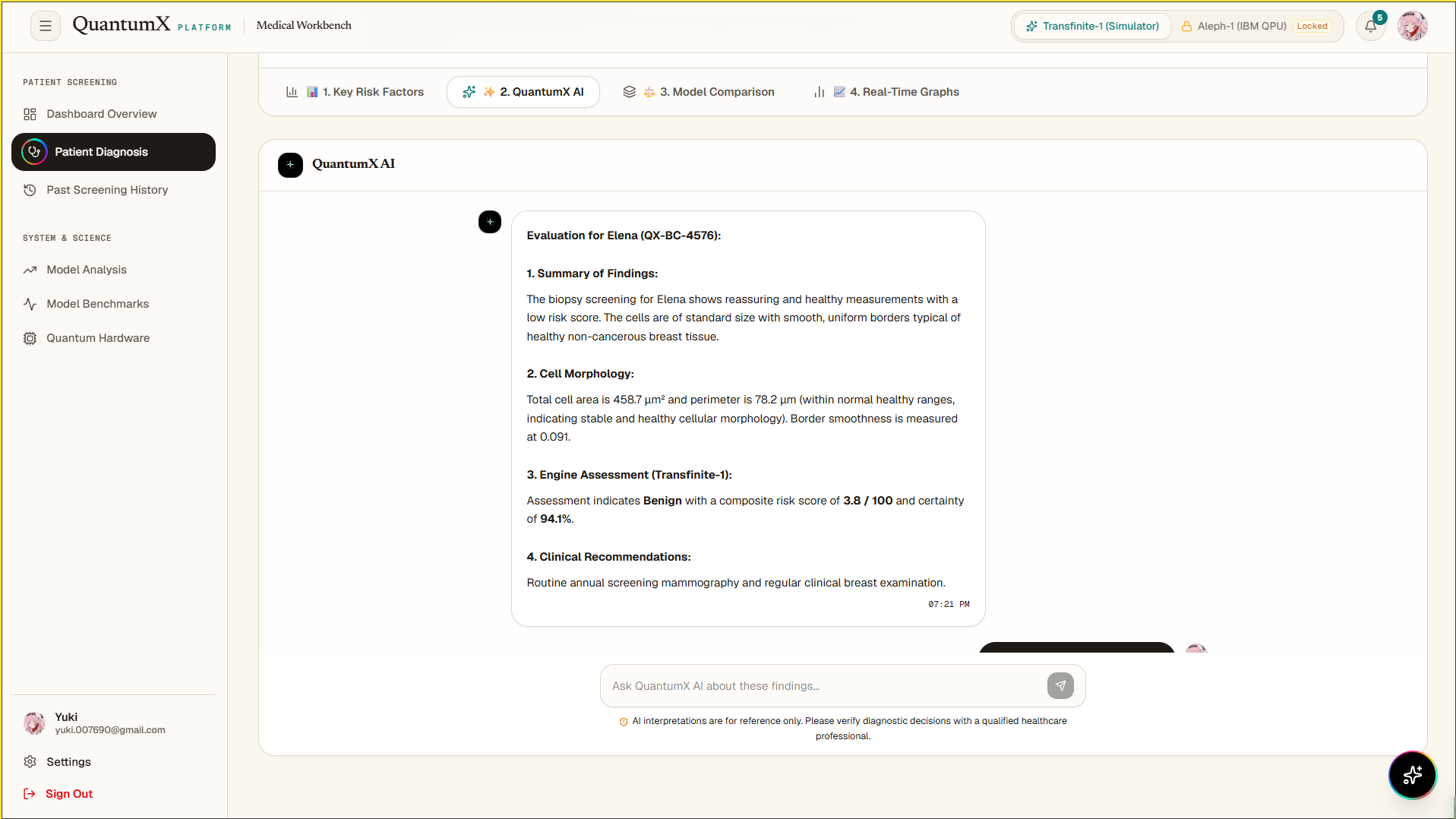
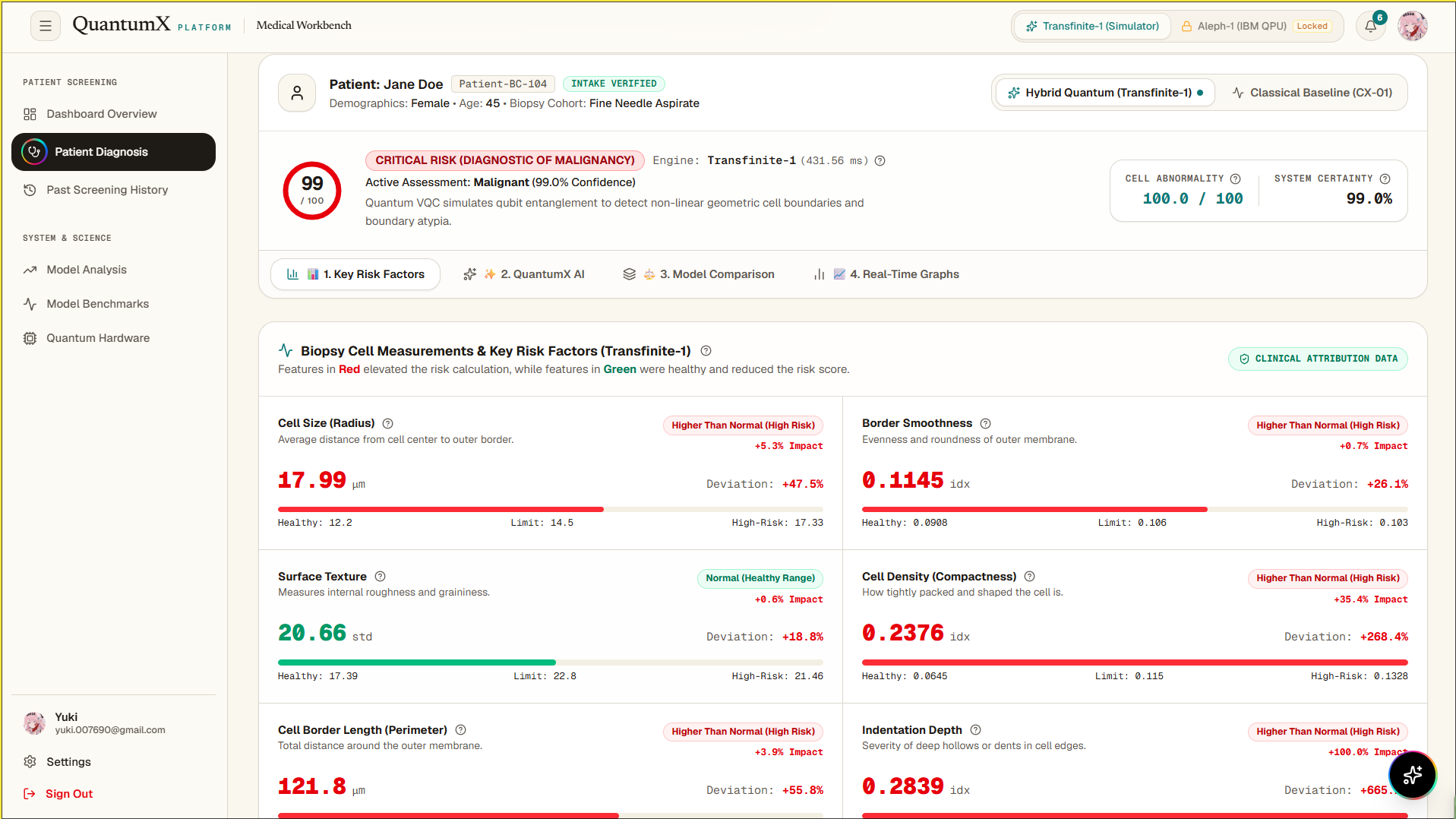
Once the models are trained, QuantumX produces the Final Diagnostic Prediction. The system generates a calibrated disease-risk output together with statistical confidence information, allowing the result to be interpreted as a model prediction rather than an unexplained binary classification. :contentReference[oaicite:10]{index=10}
9. QXplain Explainability Engine
QuantumX includes a dedicated QXplain Engine to address model interpretability. It provides information about the biological features and quantum operations contributing to the model's decision, together with a verifiable clinical receipt and the associated IBM Quantum Job ID for hardware executions. :contentReference[oaicite:11]{index=11}
10. Unified Benchmarking
Finally, QuantumX performs Unified Benchmarking using identical patient-data splits to compare the classical baselines, quantum simulator model, and real IBM quantum hardware model.
This creates a controlled evaluation framework where classical ML, simulated quantum ML, and physical quantum ML can be compared using the same underlying biomedical cohorts and evaluation methodology. :contentReference[oaicite:12]{index=12}
Challenges we ran into
The biggest challenge was designing a fair comparison between quantum and classical models while working with real biomedical datasets that differ in structure, scale, and feature distributions.
We also faced the practical limitations of quantum hardware, including limited qubits, noise, execution constraints, and the gap between simulator results and real quantum-device results.
Making the pipeline technically meaningful without overstating what current quantum hardware can achieve was another important challenge. We therefore focused on measurable benchmarking rather than assuming quantum ML would automatically outperform classical ML.
Accomplishments that we're proud of
We developed a complete multi-disease hybrid architecture rather than treating quantum ML as an isolated experiment.
QuantumX brings biomedical preprocessing, classical ML, quantum ML, benchmarking, and explainability into one pipeline, allowing the two computational approaches to be evaluated side by side.
We are especially proud that the system is designed around measurable comparison instead of simply claiming that quantum ML is better.
What we learned
We learned that applying quantum computing to healthcare is not simply about replacing classical ML with quantum circuits. Data representation, preprocessing, model design, evaluation methodology, hardware limitations, and interpretability are equally important.
We also learned that a meaningful quantum ML project needs strong classical baselines, because benchmarking is what allows any potential quantum advantage to be evaluated objectively.
Most importantly, we learned that quantum ML should be evaluated through evidence and reproducible comparisons, rather than assuming that the use of quantum computing itself provides an advantage.
What's next for QuantumX
We plan to expand QuantumX across additional biomedical datasets and diseases, improve the quantum models and feature-encoding strategies, and perform larger-scale benchmarking on real quantum hardware.
We also want to strengthen explainability, robustness, and clinical validation so that QuantumX can evolve from a research prototype into a reliable decision-support and healthcare research platform.
Built With
- classical
- ibm
- machine-learning
- next.js
- pennylane
- python
- qiskit
- quantum
- random-forest
- scikit-learn
- suprabase
- typescript
- xgboost


Log in or sign up for Devpost to join the conversation.