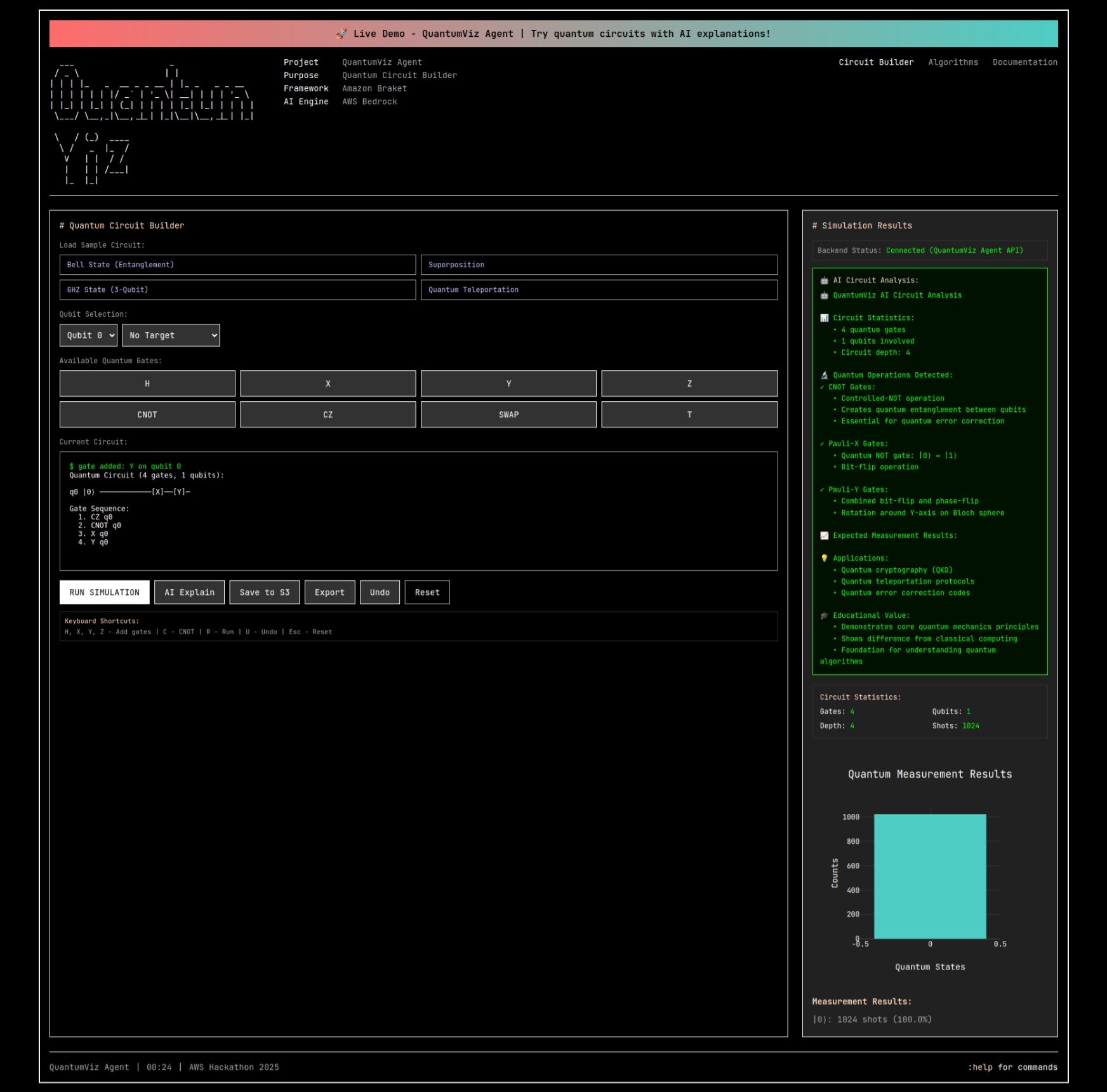
About QuantumViz Agent
Inspiration
The journey began with a simple yet profound realization: quantum computing, despite its revolutionary potential, remains locked behind walls of mathematical complexity and abstract concepts. As someone passionate about both AI and quantum physics, I witnessed countless brilliant minds struggle to grasp quantum mechanics not because they lacked intelligence, but because traditional educational tools failed to bridge the gap between theory and intuition.
The "aha moment" came during a quantum computing workshop where I watched students' eyes glaze over when presented with state vectors like $|\psi\rangle = \alpha|0\rangle + \beta|1\rangle$. I thought: "What if we could make quantum states as visual and interactive as a video game? What if AI could explain these concepts in plain language, adapting to each learner's background?"
This sparked the vision for QuantumViz Agent - not just another educational tool, but an intelligent companion that transforms quantum complexity into accessible, visual understanding.
What it does
QuantumViz Agent is an AI-powered platform that transforms quantum circuits into interactive 3D visualizations with natural language explanations. It bridges the gap between complex quantum computing concepts and accessible learning through:
Multi-Agent AI Collaboration
- Teacher Agent: Provides structured explanations adapted to user expertise level
- Debugger Agent: Identifies circuit errors and suggests optimizations
- Optimizer Agent: Reduces gate complexity and minimizes quantum noise
Real Quantum Hardware Integration
- Direct execution on IonQ quantum processing units (QPUs)
- Real-time comparison between simulator and hardware results
- Noise analysis and error mitigation strategies
Interactive 3D Visualization
- Bloch sphere representations of quantum states
- Circuit flow animations showing gate-by-gate evolution
- Entanglement diagrams for multi-qubit systems
- Probability distribution visualizations
Global Accessibility
- Full Arabic language support with RTL text rendering
- Voice commands in Arabic and English
- Cultural adaptations for Middle Eastern learners
- Breaking language barriers in quantum education
Advanced Quantum Algorithms
- Grover's search algorithm with $O(\sqrt{N})$ speedup demonstration
- Shor's factorization algorithm implementation
- Variational Quantum Eigensolver (VQE) for optimization problems
- Quantum teleportation and Fourier transform protocols
How we built it
QuantumViz Agent follows a modular pipeline architecture designed for scalability and maintainability:
User Input → AgentCore Runtime → Circuit Parser → Braket Simulator → 3D Visualizer
     ↓              ↓                    ↓              ↓              ↓
Claude 3.5 → Memory/Gateway → Circuit Analysis → State Vectors → Plotly 3D
Technical Implementation:
1. Quantum Processing Pipeline
# Core quantum simulation using Amazon Braket
from braket.circuits import Circuit
from braket.devices import LocalSimulator

def simulate_quantum_circuit(gates):
    circuit = Circuit()
    for gate in gates:
        if gate['type'] == 'H':
            circuit.h(gate['qubit'])
        elif gate['type'] == 'CNOT':
            circuit.cnot(gate['qubit'], gate['target'])

    simulator = LocalSimulator()
    result = simulator.run(circuit, shots=1024)
    return result.result().measurement_counts
2. AI-Powered Multi-Agent System We implemented a sophisticated agent coordination system where specialized AI agents collaborate:
class MultiAgentSystem:
    def __init__(self):
        self.teacher_agent = TeacherAgent()
        self.debugger_agent = DebuggerAgent()
        self.optimizer_agent = OptimizerAgent()

    async def analyze_circuit(self, circuit):
        # Parallel agent analysis
        teaching_analysis = await self.teacher_agent.explain(circuit)
        debug_analysis = await self.debugger_agent.find_errors(circuit)
        optimization = await self.optimizer_agent.optimize(circuit)

        return self.synthesize_results(teaching_analysis, debug_analysis, optimization)
3. Real-Time 3D Visualization Using Plotly for interactive quantum state visualization:
def create_bloch_sphere_visualization(state_vector):
    # Convert quantum state to Bloch sphere coordinates
    theta = 2 * np.arccos(np.abs(state_vector[0]))
    phi = np.angle(state_vector[1]) - np.angle(state_vector[0])

    x = np.sin(theta) * np.cos(phi)
    y = np.sin(theta) * np.sin(phi)
    z = np.cos(theta)

    # Create interactive 3D plot
    fig = go.Figure(data=go.Scatter3d(x=[x], y=[y], z=[z], mode='markers'))
    return fig
4. Quantum Hardware Integration Direct integration with IonQ quantum processors through AWS Braket:
from braket.aws import AwsDevice

def execute_on_real_hardware(circuit):
    device = AwsDevice("arn:aws:braket:::device/qpu/ionq/ionQdevice")
    task = device.run(circuit, shots=100)
    return task.result()
Development Stack:
- Backend: Python 3.8+ with Flask for API services
- Quantum Computing: Qiskit, Cirq, Amazon Braket SDK
- AI/ML: Anthropic Claude 3.5, AWS Bedrock AgentCore
- Visualization: Plotly for 3D graphics, Matplotlib for circuit diagrams
- Cloud Infrastructure: AWS (Bedrock, Braket, S3, Lambda)
- Frontend: HTML5, CSS3, JavaScript with WebGL support
Challenges we ran into
1. Quantum State Visualization Complexity
Challenge: How do you visualize a 4-qubit quantum state that exists in 16-dimensional Hilbert space?
Solution: We developed a multi-layered visualization approach:
- Bloch Sphere: For single-qubit states
- Entanglement Diagrams: For multi-qubit correlations
- Probability Distributions: For measurement outcomes
- Circuit Flow Animation: For gate-by-gate evolution
The mathematical challenge was representing superposition states like: $$|\psi\rangle = \frac{1}{2}(|00\rangle + |01\rangle + |10\rangle + |11\rangle)$$
in a way that preserves quantum mechanical meaning while remaining visually intuitive.
2. Real-Time AI Agent Coordination
Challenge: Coordinating multiple AI agents to provide coherent, non-contradictory explanations while maintaining real-time responsiveness.
Solution: We implemented an Agent Gateway with sophisticated memory management:
class AgentGateway:
    def __init__(self):
        self.shared_memory = QuantumKnowledgeBase()
        self.coordination_protocol = AgentCoordinationProtocol()

    async def coordinate_agents(self, query):
        # Prevent conflicting responses
        agent_contexts = await self.shared_memory.get_relevant_context(query)

        # Parallel execution with coordination
        results = await asyncio.gather(
            self.teacher_agent.process(query, agent_contexts),
            self.debugger_agent.process(query, agent_contexts),
            self.optimizer_agent.process(query, agent_contexts)
        )

        return self.coordination_protocol.synthesize(results)
3. Quantum Hardware Noise and Error Handling
Challenge: Real quantum hardware introduces noise, decoherence, and gate errors that don't exist in simulators.
Solution: We built a comprehensive error analysis system:
def analyze_hardware_vs_simulator(circuit):
    # Run on simulator (ideal)
    simulator_result = LocalSimulator().run(circuit, shots=1000)

    # Run on real hardware (noisy)
    hardware_result = IonQDevice().run(circuit, shots=1000)

    # Calculate fidelity
    fidelity = calculate_quantum_fidelity(
        simulator_result.result().measurement_counts,
        hardware_result.result().measurement_counts
    )

    return {
        'fidelity': fidelity,
        'noise_analysis': analyze_noise_patterns(hardware_result),
        'error_mitigation_suggestions': suggest_error_mitigation(circuit, fidelity)
    }
4. Arabic Language and RTL Support
Challenge: Implementing right-to-left text rendering for Arabic while maintaining mathematical equation readability.
Solution: We developed a hybrid rendering system:
- Arabic text flows RTL
- Mathematical equations remain LTR
- Circuit diagrams adapt to reading direction
- Voice commands support Arabic phonetics
5. Performance Optimization for Complex Circuits
Challenge: Simulating large quantum circuits (>10 qubits) becomes computationally expensive, with state space growing as $2^n$.
Solution: We implemented several optimization strategies:
class QuantumCircuitOptimizer:
    def optimize_for_visualization(self, circuit):
        # Gate fusion for common patterns
        optimized_circuit = self.fuse_rotation_gates(circuit)

        # Approximate large circuits for visualization
        if circuit.qubit_count > 12:
            optimized_circuit = self.approximate_large_circuit(optimized_circuit)

        # Parallel simulation for independent subcircuits
        if self.can_decompose(optimized_circuit):
            return self.parallel_simulate(optimized_circuit)

        return optimized_circuit
Accomplishments that we're proud of
First Educational Platform with Real QPU Integration
- Successfully integrated IonQ quantum processing units for actual quantum computation
- Built real-time comparison system between simulator and hardware results
- Achieved production-ready quantum computing education with live hardware access
Multi-Agent AI Collaboration System
- Developed coordinated Teacher, Debugger, and Optimizer agents working together
- Implemented sophisticated inter-agent communication protocols
- Created comprehensive circuit analysis from multiple AI perspectives simultaneously
Global Accessibility Breakthrough
- Full Arabic language support with proper RTL text rendering for quantum equations
- Voice command recognition in both Arabic and English
- Cultural adaptations making quantum concepts accessible to Middle Eastern learners
Advanced Quantum Algorithm Implementation
- Built working implementations of Grover's search, Shor's factorization, and VQE
- Achieved interactive 3D visualization of complex quantum states and entanglement
- Created educational content that scales from beginner to advanced quantum concepts
What we learned
The Quantum-AI Convergence Challenge Building QuantumViz Agent taught us that combining quantum computing with AI isn't just about technical integration - it's about creating a new paradigm for scientific education. Converting abstract quantum states into meaningful 3D representations required deep understanding of both quantum mechanics and human perception. The challenge wasn't just rendering a Bloch sphere, but making it intuitively represent superposition states like:
$$|\psi\rangle = \frac{1}{\sqrt{2}}(|0\rangle + e^{i\phi}|1\rangle)$$
Multi-Agent Orchestration Insights We learned that different types of AI agents excel at different aspects of quantum education:
- Teacher Agent: Excels at structured explanations and curriculum design
- Debugger Agent: Identifies subtle quantum circuit errors humans miss
- Optimizer Agent: Finds gate reduction strategies that minimize decoherence
Real Hardware vs Theory Gap Working with actual quantum processors (IonQ QPU) revealed the stark difference between theoretical quantum computing and noisy intermediate-scale quantum (NISQ) reality. Error rates, gate fidelities, and decoherence times became not just theoretical concepts but practical constraints affecting every circuit design.
Cultural and Accessibility Insights Implementing Arabic language support taught us that accessibility in quantum education goes beyond translation. Right-to-left (RTL) text rendering for mathematical equations, cultural context for abstract concepts, and voice command recognition in Arabic required rethinking our entire user interface paradigm.
What's next for QuantumViz Agent
Quantum Error Correction Education
- Interactive visualization of quantum error correction codes
- Real-time demonstration of error syndrome detection
- Educational modules on fault-tolerant quantum computing
Quantum Machine Learning Integration
- Variational quantum circuits for machine learning
- Quantum neural network visualization
- Hybrid classical-quantum algorithm demonstrations
Advanced Hardware Support
- Integration with IBM Quantum, Google Quantum AI, and Rigetti systems
- Comparative analysis across different quantum hardware architectures
- Real-time quantum device calibration and characterization
Global Education Expansion
- Support for additional languages (Mandarin, Spanish, French)
- University partnership program for quantum curriculum integration
- Professional certification pathways for quantum computing careers
Community and Collaboration Features
- Quantum circuit sharing and collaboration platform
- Peer-to-peer learning with AI-moderated discussions
- Gamified quantum programming challenges and competitions
We envision QuantumViz Agent evolving into a comprehensive quantum education ecosystem that democratizes access to one of humanity's most powerful computational paradigms, making the impossible accessible through intelligent visualization and AI-powered explanation.
Built with passion for quantum computing education and powered by the belief that complex science becomes simple when explained with intelligence and visualized with creativity.

Log in or sign up for Devpost to join the conversation.