
Inspiration
Quantum computing is developing faster than most researchers, students, and educators can follow. Every week, arXiv publishes a new wave of papers on algorithms, error correction, hardware, sensing, and simulation. Even experts rarely have enough time to inspect every title and abstract, determine what is relevant, and understand how the papers connect.
We built QuantumListener because keeping up with research should not require spending hours scrolling through arXiv. Instead, researchers should be able to listen to a reliable weekly briefing while commuting, exercising, or working in the laboratory.
What it does
QuantumListener is an autonomous research agent that turns the weekly stream of arXiv quantum-physics papers into a source-backed podcast.
Each week, it:
- Retrieves new and substantially updated "quant-ph" papers.
- Deduplicates different revisions of the same work.
- Classifies every paper into one of five areas: Quantum Algorithms, Quantum Error Correction, Quantum Hardware, Quantum Measurement and Sensing, and Quantum Simulation.
- Produces an accessible summary and a more technical explanation of each paper.
- Separates metadata facts, author-reported results, and AI-generated interpretations.
- Organizes the papers into a coherent weekly podcast script.
- Generates narration, chapter timestamps, a transcript, and complete show notes.
- Publishes the finished episode and displays it through a simple web interface.
Listeners can play the newest episode, jump between the five subject areas, browse every paper included that week, open the original arXiv sources, and review previous episodes.
How we built it
QuantumListener uses the Strands Agents SDK to coordinate a team of specialized agents.
The arXiv Scout retrieves and normalizes papers. The Category Editor organizes them into the five research areas. The Paper Listener explains each paper, while the Evidence Editor checks generated claims against the paper’s metadata and abstract. The Podcast Writer connects the individual summaries into a coherent program, and the Audio Producer turns the approved script into a finished episode.
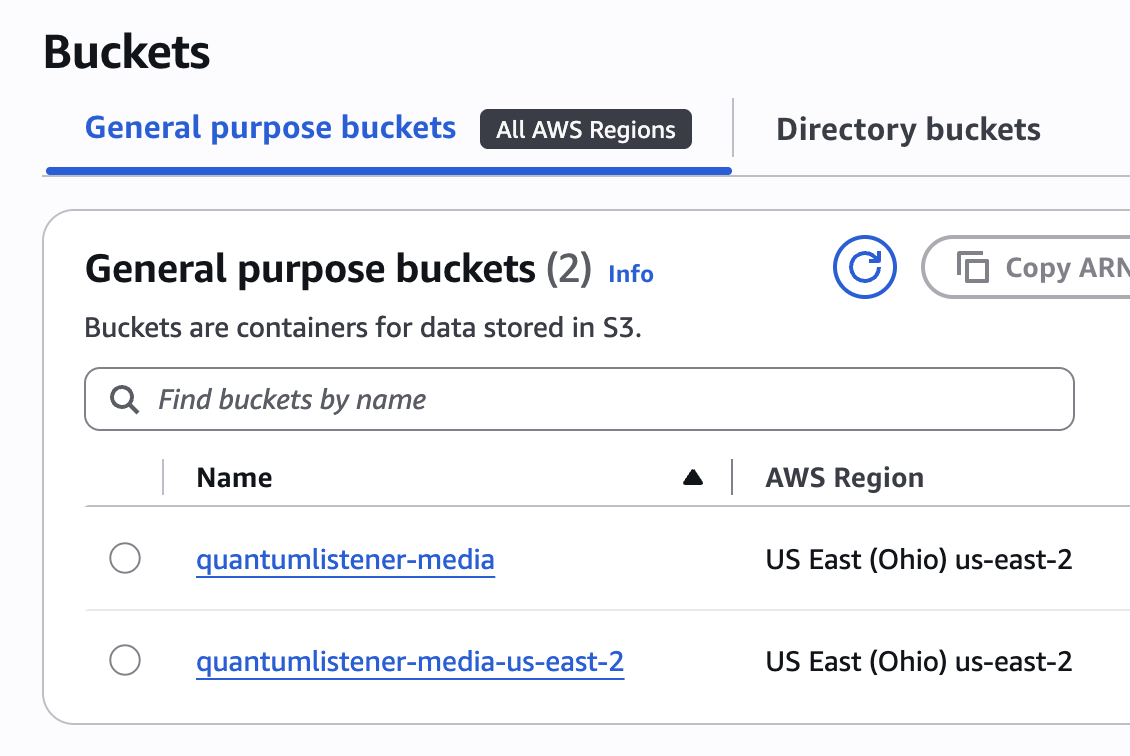
Amazon Bedrock provides the language model used by the Strands agents. Amazon Polly generates the narration, while FFmpeg assembles and normalizes the audio. Episode files, transcripts, and show notes are stored in Amazon S3. Amazon DynamoDB stores papers, weekly runs, evidence records, and publication status. Amazon EventBridge and Amazon SQS support the scheduled weekly workflow, and the application is deployed through Amazon EC2.
The website provides an accessible audio player, chapter navigation, category filters, paper citations, transcripts, and an episode archive. QuantumListener also generates an RSS feed so its reports can eventually be followed through standard podcast applications.
QuantumListener was created as a new project for this hackathon. Selected provider-neutral ingestion, evidence, and media-processing ideas were adapted from our earlier QubitReel prototype and are disclosed in the public repository. The production agent and infrastructure were rebuilt around Strands Agents and AWS services.
Challenges we ran into
The first challenge was scale. A weekly quant-ph feed may contain many papers, and every paper still needs to be retrieved, classified, summarized, and represented in the show notes without allowing one popular subject to overwhelm the others.
The second challenge was scientific accuracy. Abstracts contain claims made by authors, not independently verified conclusions. QuantumListener therefore labels statements according to their evidence type and avoids turning phrases such as “we demonstrate” into unsupported declarations of fact.
We also had to handle papers that belong to several areas, scientific terms that text-to-speech systems may mispronounce, failed model calls, revised arXiv submissions, and partially generated episodes. The publication workflow is atomic, so an incomplete weekly run cannot replace the most recent working episode.
Finally, migrating from a Google-based prototype to an AWS-native architecture required separating the scientific workflow from individual cloud providers and rebuilding the agent layer with Strands Agents.
Accomplishments that we're proud of
We are proud that QuantumListener does real work from beginning to end. It does not merely answer questions about a manually supplied paper. It discovers an entire weekly collection, organizes it, checks its summaries, produces a program, generates the audio, and publishes the result.
We are also proud of its evidence-first design. Every summary links back to its original arXiv record, and the system distinguishes source metadata, author claims, and QuantumListener interpretations.
Most importantly, the final product is intentionally simple: press play and catch up with a week of quantum research.
What we learned
We learned that an effective research agent needs both autonomy and restraint. Agents are useful for handling repetitive work at scale, but they also need structured outputs, deterministic validation, provenance, retry policies, and human approval at consequential publication stages.
We also learned that audio changes how scientific information should be presented. A podcast cannot simply read a database of summaries aloud. It needs pacing, pronunciation guidance, transitions, chapters, and enough context to help listeners understand why one paper matters in relation to the others.
What's next for QuantumListener
Next, we plan to add personalized research feeds, multilingual episodes, improved scientific pronunciation, citation-lineage maps, private laboratory watchlists, and shorter daily briefings.
We also want listeners to choose their preferred technical depth, follow specific researchers or subjects, and ask follow-up questions about an episode through the same Strands agent system. Our long-term goal is to make the expanding quantum-computing literature something researchers can understand anywhere, even when they do not have time to sit down and read.

Log in or sign up for Devpost to join the conversation.