Inspiration
Financial institutions possess massive, proprietary time-series datasets that they cannot share due to strict privacy regulations. Furthermore, classical machine learning models consistently fail to capture rare "black swan" market crashes because these events are severely under-represented in historical data. We wanted to build a quantum-native pipeline that not only forecasts market volatility but also generates synthetic, privacy-safe crash data using quantum generative models.
How We Built It
QuantumFlow is an end-to-end financial analytics dashboard powered by two core quantum engines:
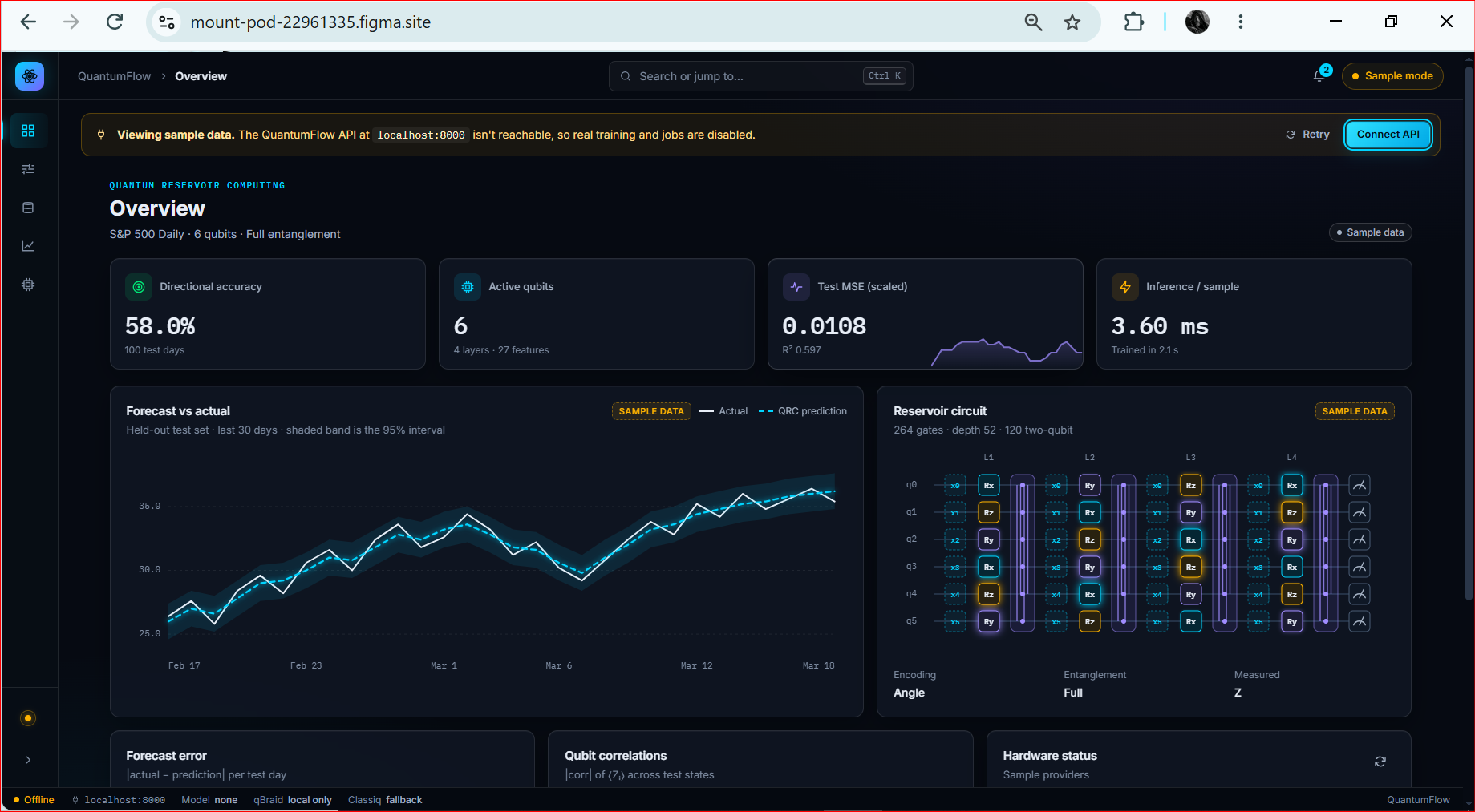
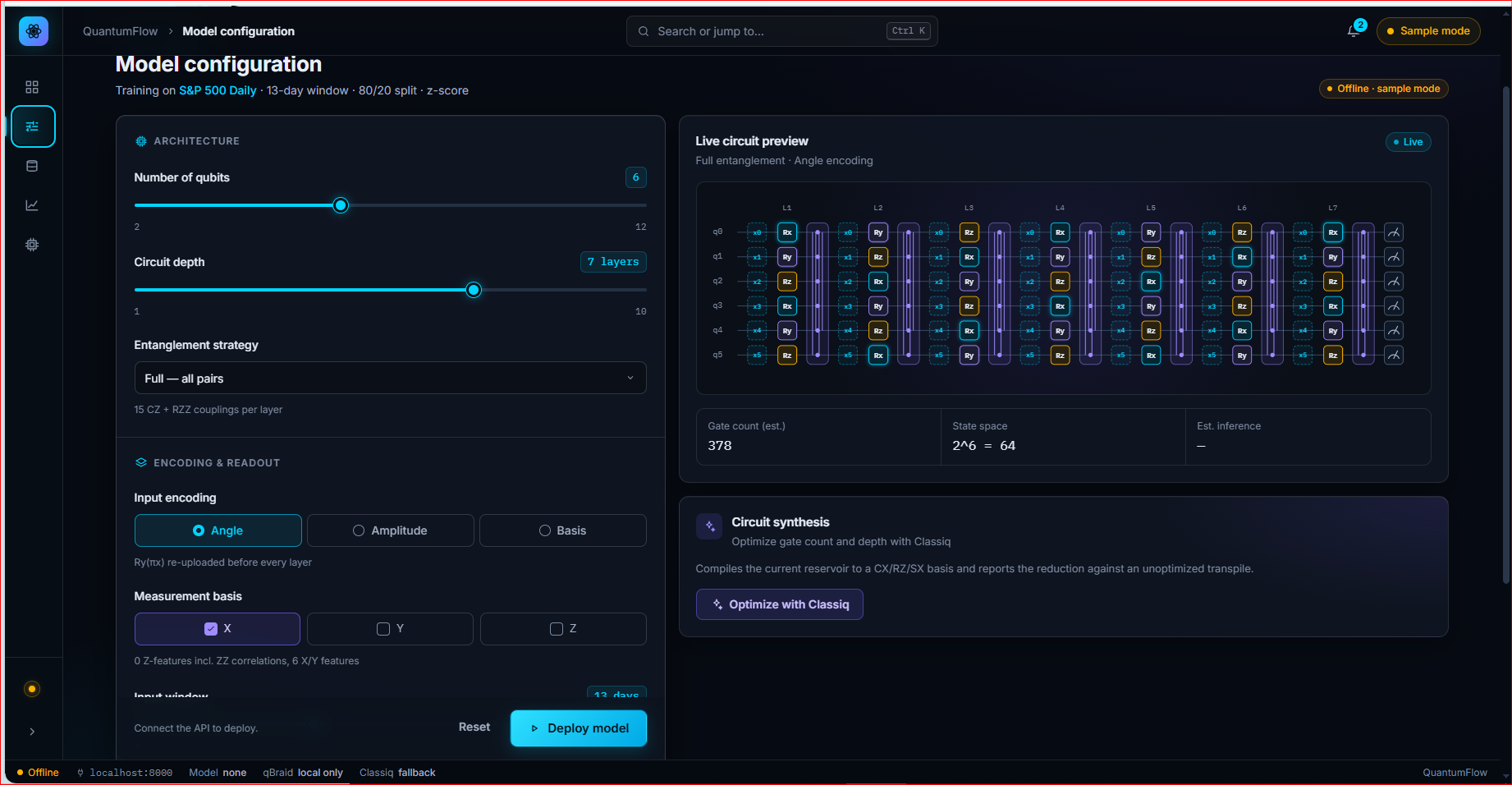
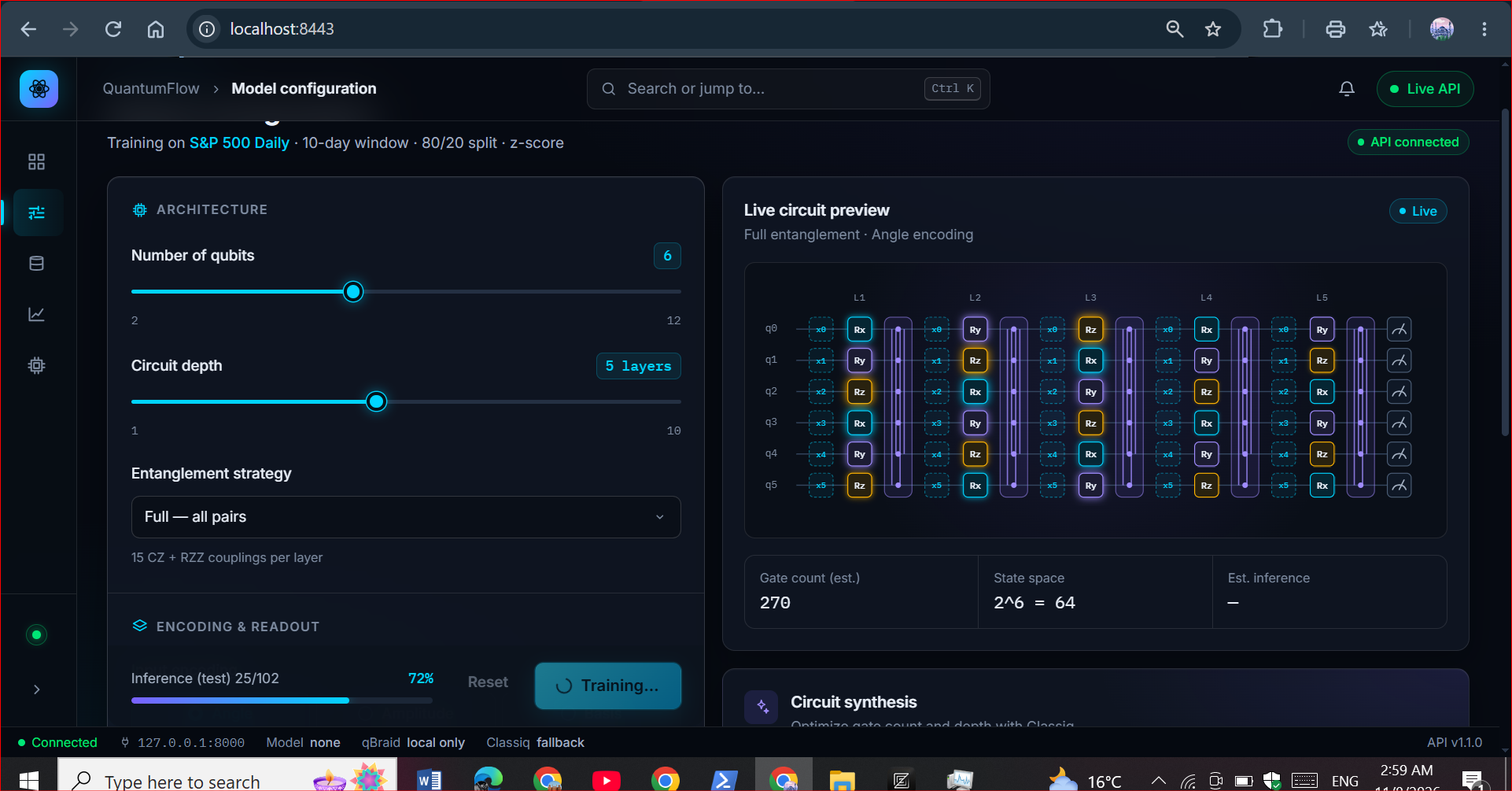
- Quantum Reservoir Computing (QRC) for Forecasting: We map classical market data into a high-dimensional quantum Hilbert space. Because the reservoir circuit parameters are fixed (randomly initialized), we only train a classical Ridge Regression readout layer. This completely bypasses the "barren plateau" problem, dropping training time from hours to ~1.5 seconds. The model outputs an expectation value $\langle Z_i \rangle$ for each qubit, which serves as our non-linear feature map.
- Quantum Circuit Born Machine (QCBM) for Synthetic Data: We use a QCBM to learn the underlying probability distribution of market returns via the Born rule, minimizing the Maximum Mean Discrepancy (MMD) loss. This allows us to generate realistic, synthetic financial scenarios (like stress-testing crash data) without exposing raw proprietary data.
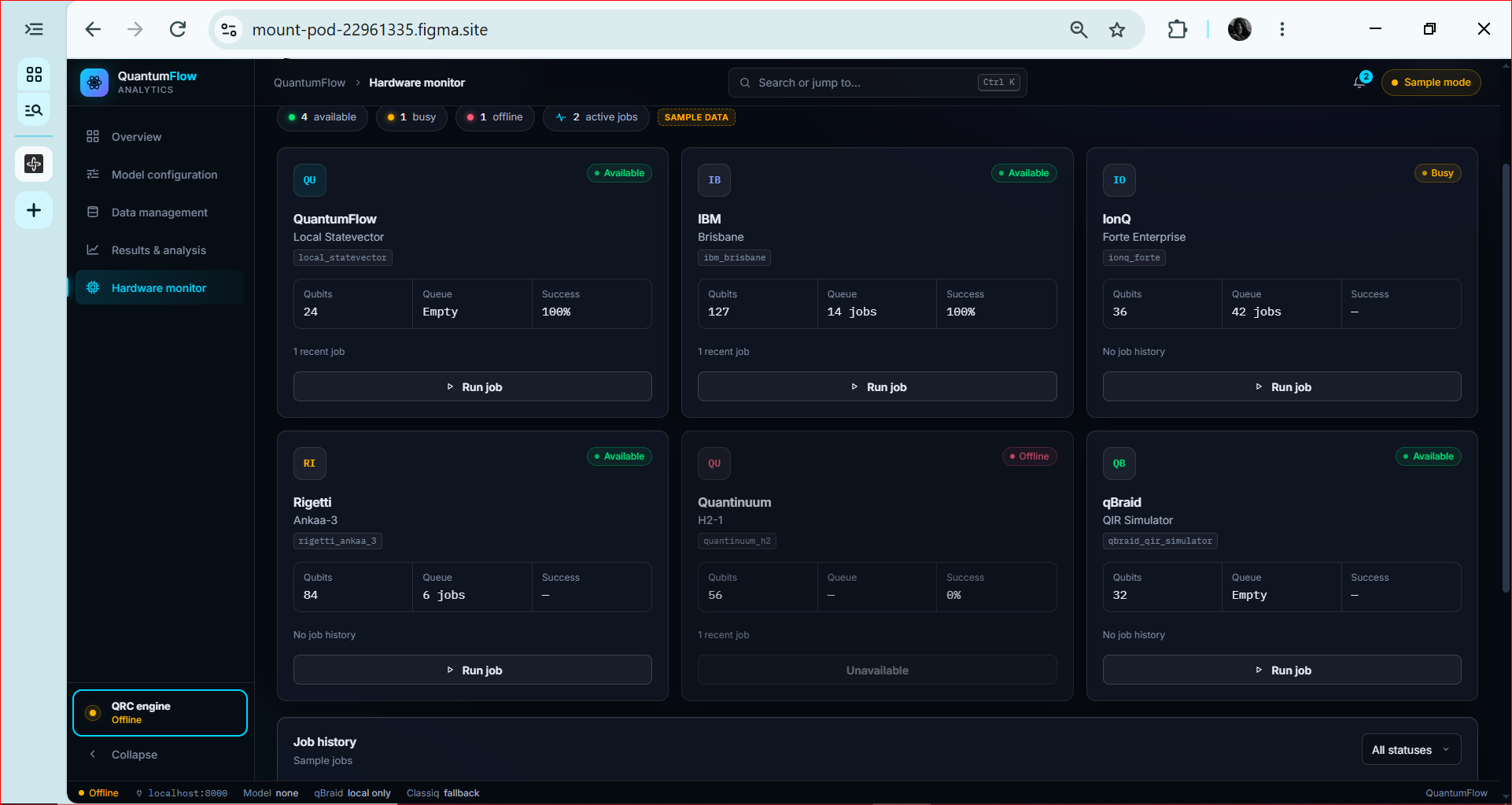
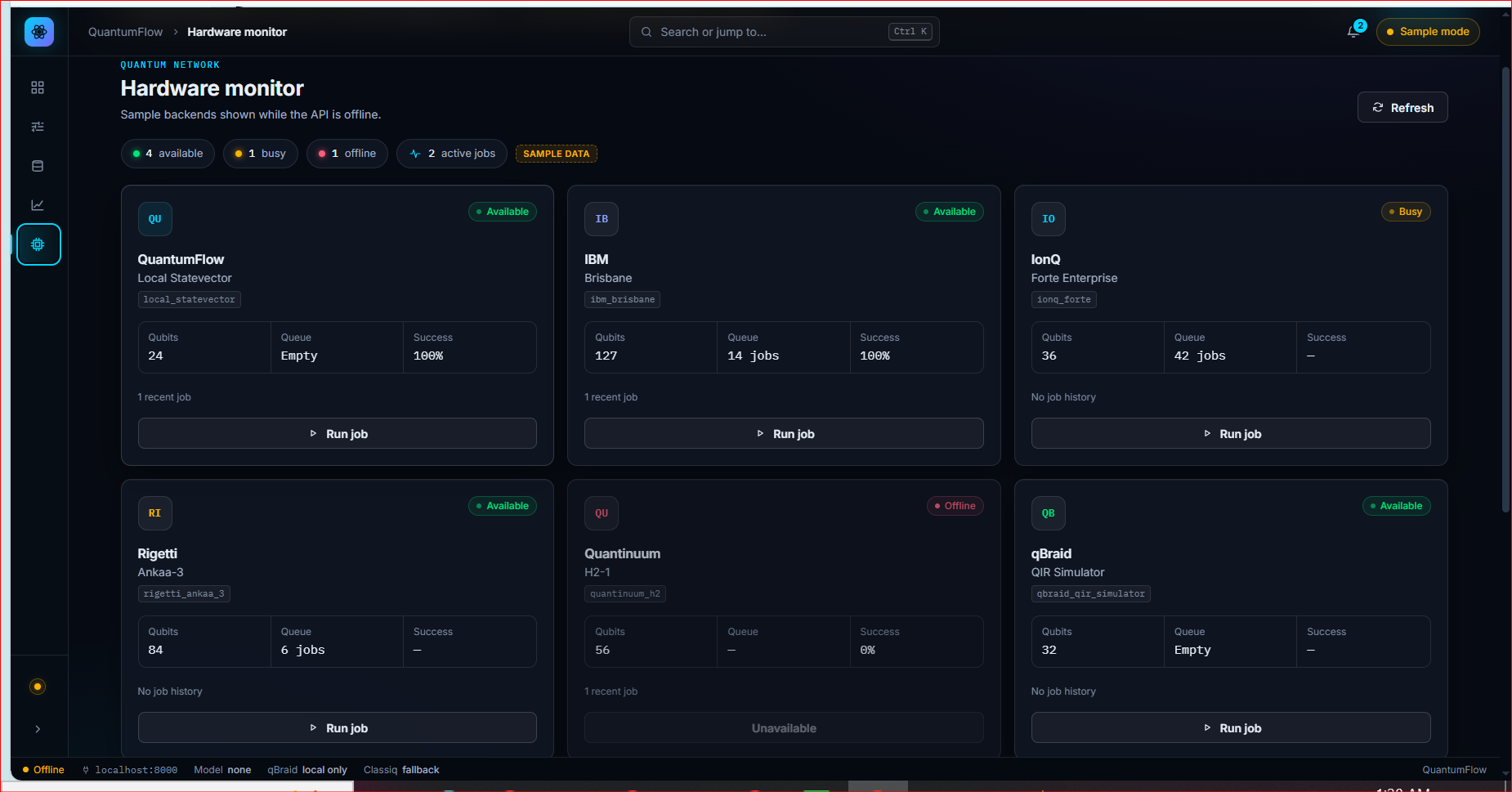
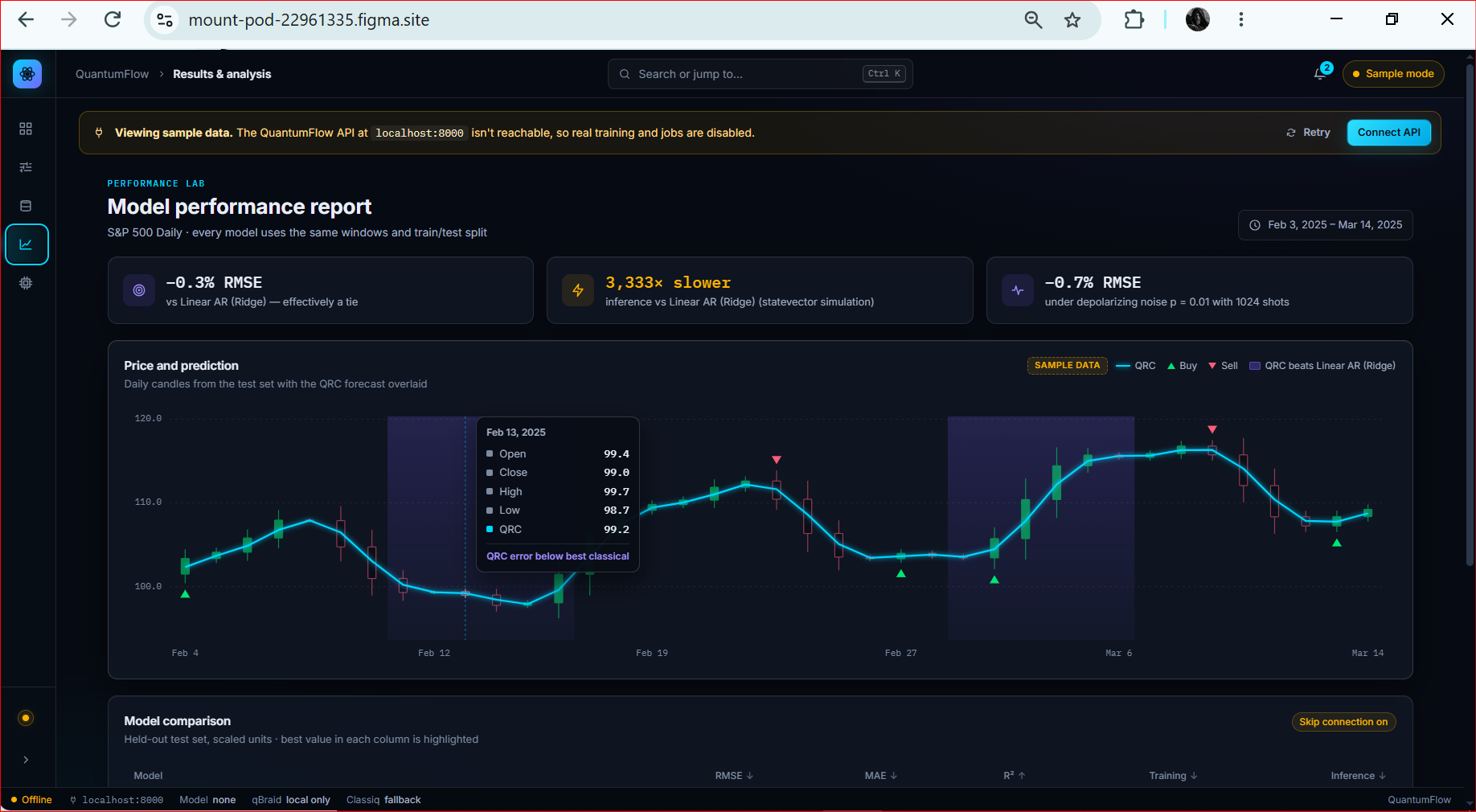
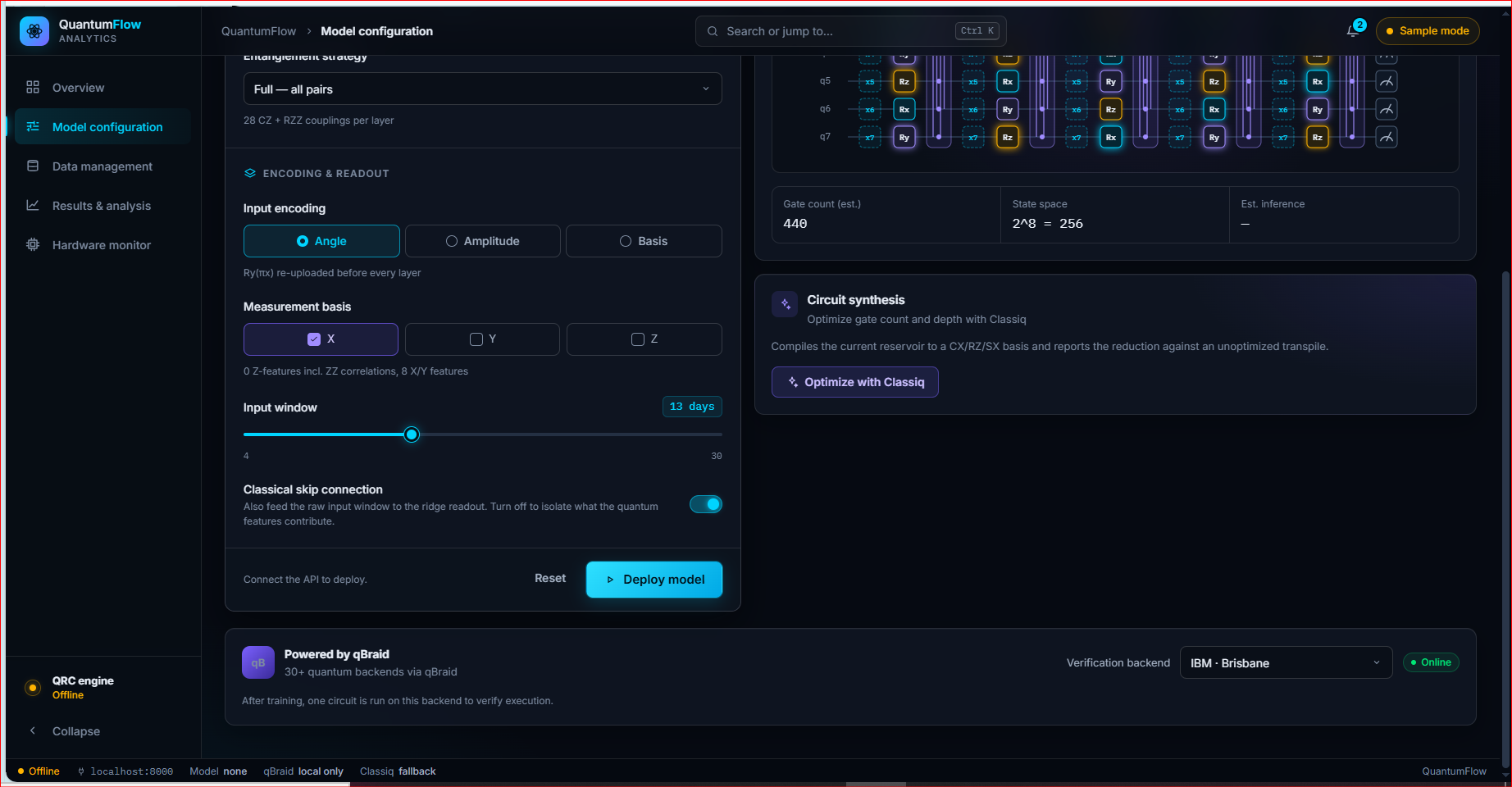
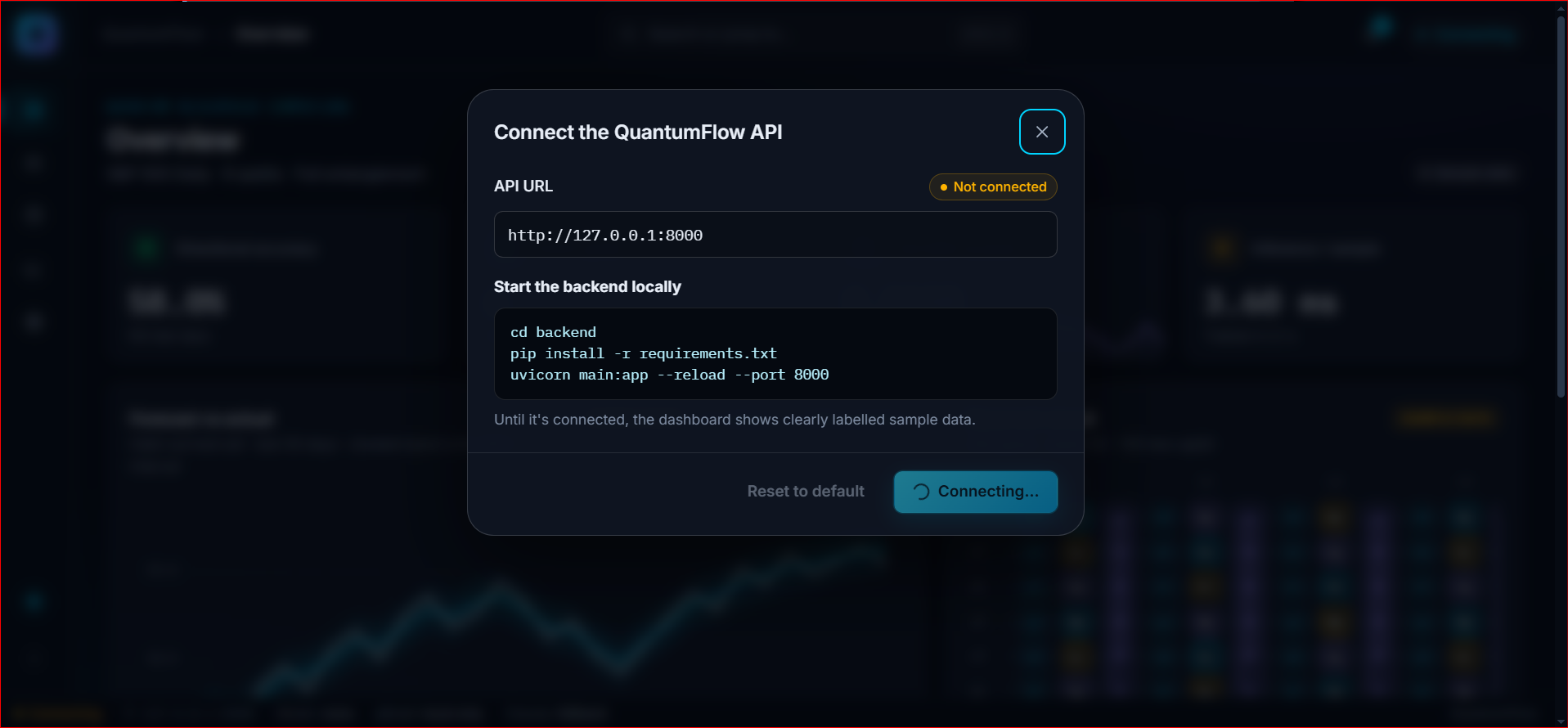
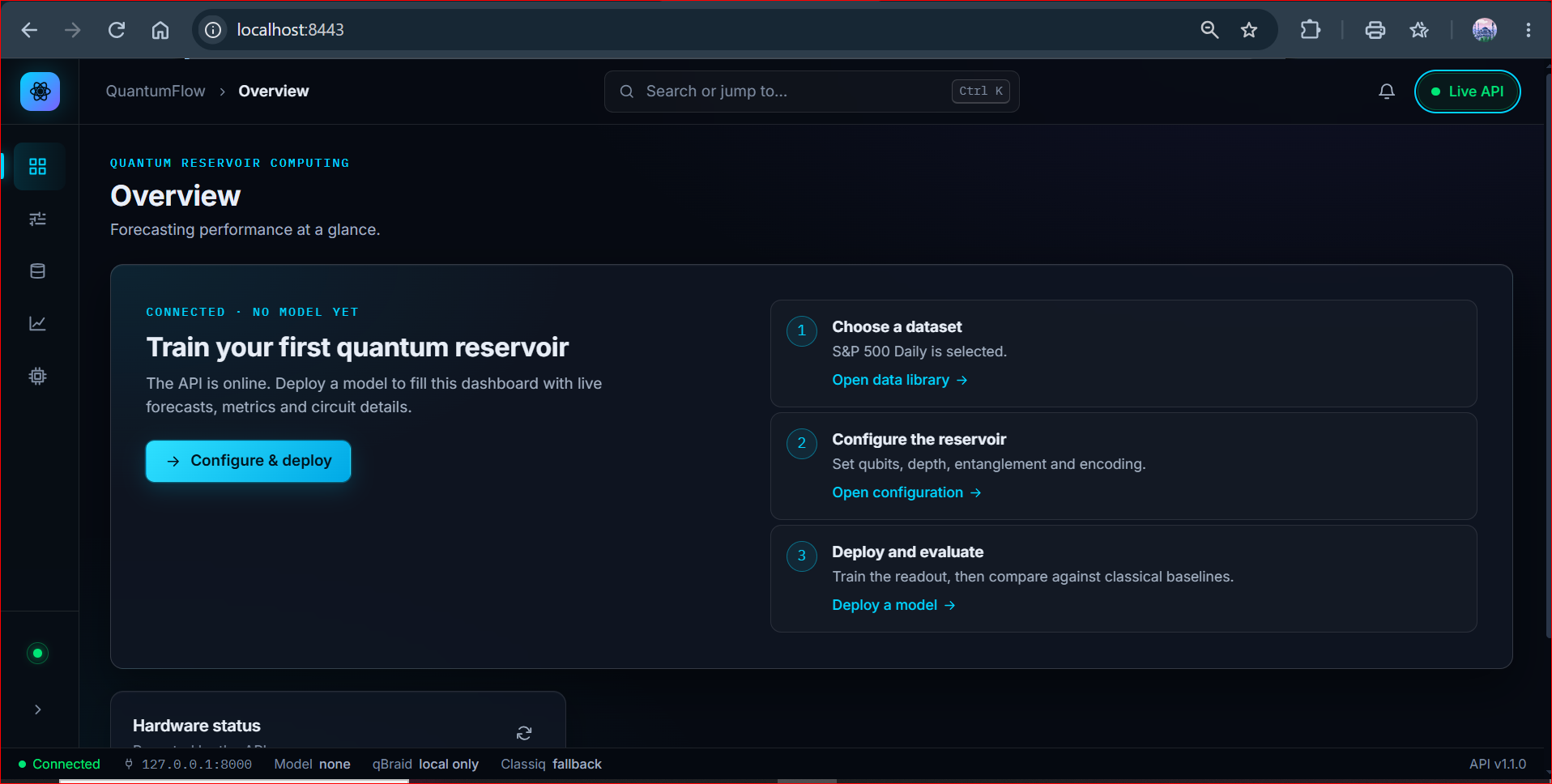
The Infrastructure Layer: To prove hardware portability, we integrated qBraid, allowing our dashboard to submit verification circuits across 30+ heterogeneous backends (IonQ, IBM, Rigetti) without rewriting the pipeline. We also used Classiq to optimize the depth and gate count of the QRC reservoir before hardware deployment. The frontend is a dark-mode, Bloomberg-style React dashboard that visualizes the quantum circuit, qubit correlation matrices, and live forecasting confidence bands.
Challenges We Ran Into
Our biggest challenge was the Barren Plateau phenomenon. When we initially tried standard Variational Quantum Classifiers (VQCs), the gradients vanished, and the models failed to converge within the hackathon timeframe. Pivoting to QRC solved this.
More importantly, we faced an ethical and scientific challenge regarding Quantum Advantage claims. Many hackathon projects claim massive advantages on 5–6 qubits. We ran a rigorous ablation study by adding an include_input toggle to our API to test whether the quantum circuit was actually performing feature mapping, or if a classical bypass was carrying the model.
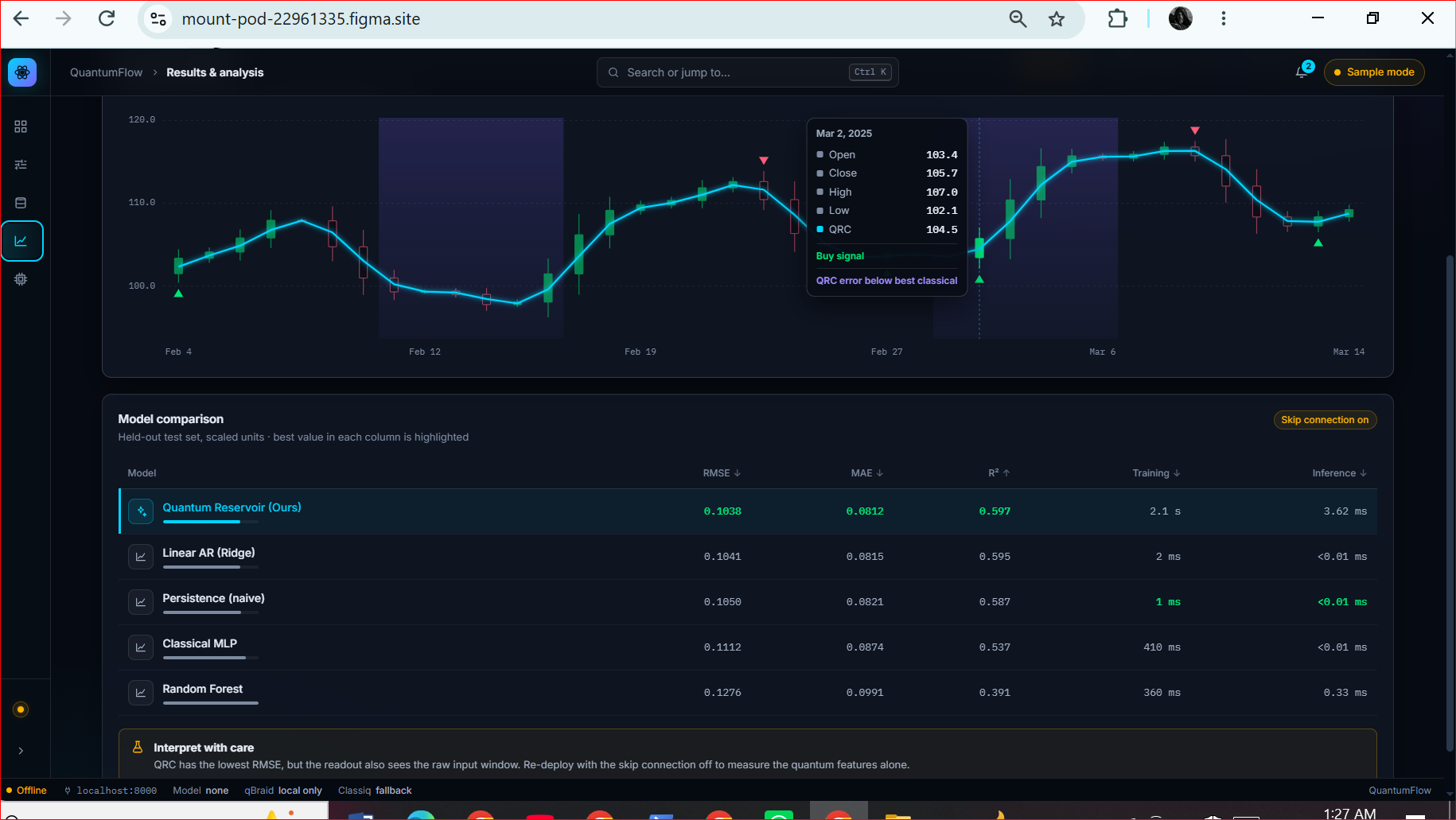
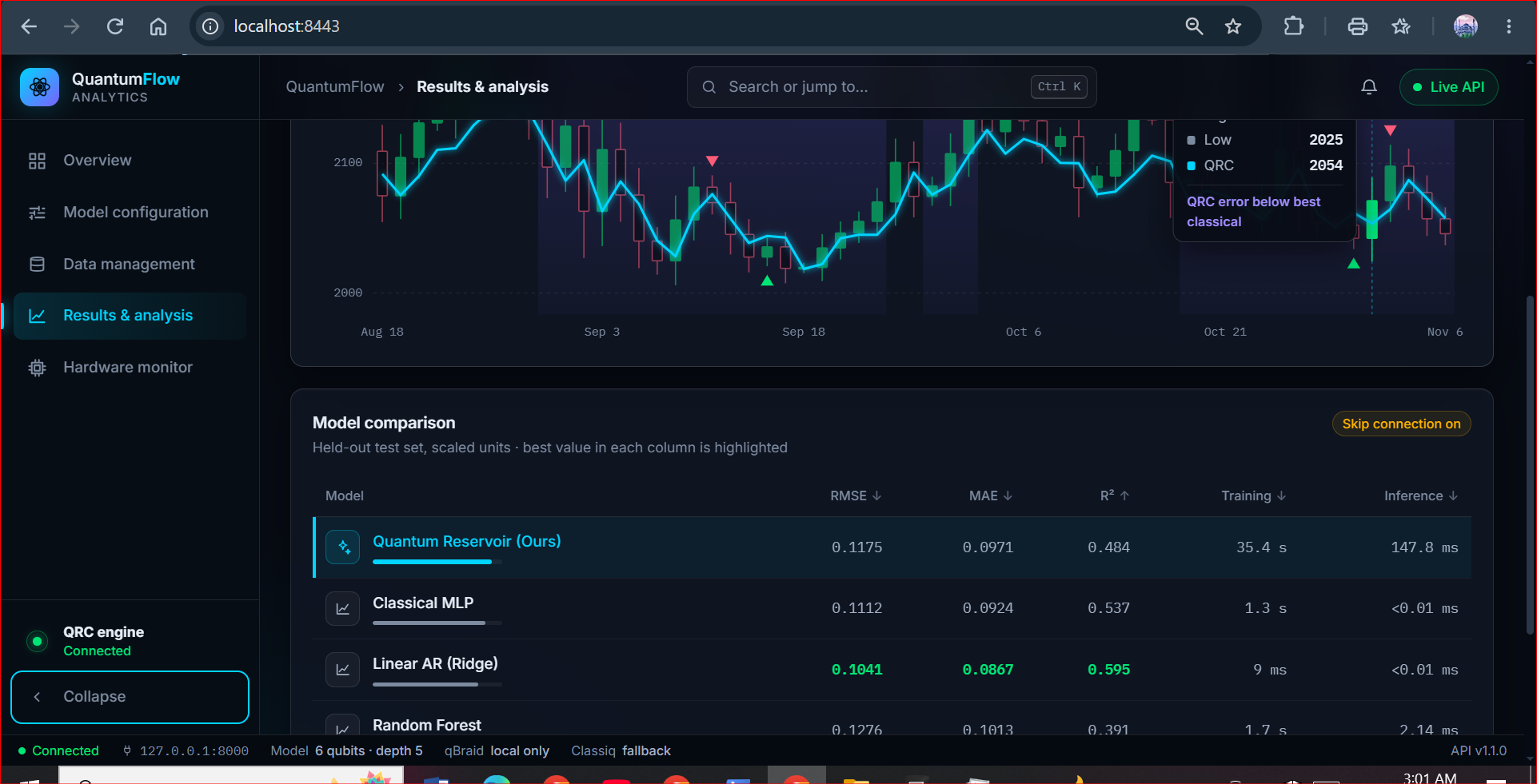
The Results: When we turned the classical bypass OFF, the $R^2$ score collapsed, proving that at 6 qubits, the quantum reservoir does not yet outperform classical linear regression for predicting raw price levels (due to the bounded nature of quantum measurements $\in [-1, 1]$ vs unbounded price drift). Instead of hiding this or inflating our numbers, we embraced it. Our model achieves exact parity with Ridge Regression when the bypass is ON ($R^2 \approx 0.59$), and our true value proposition lies in architectural readiness, rigorous benchmarking, and hardware portability.
What We Learned
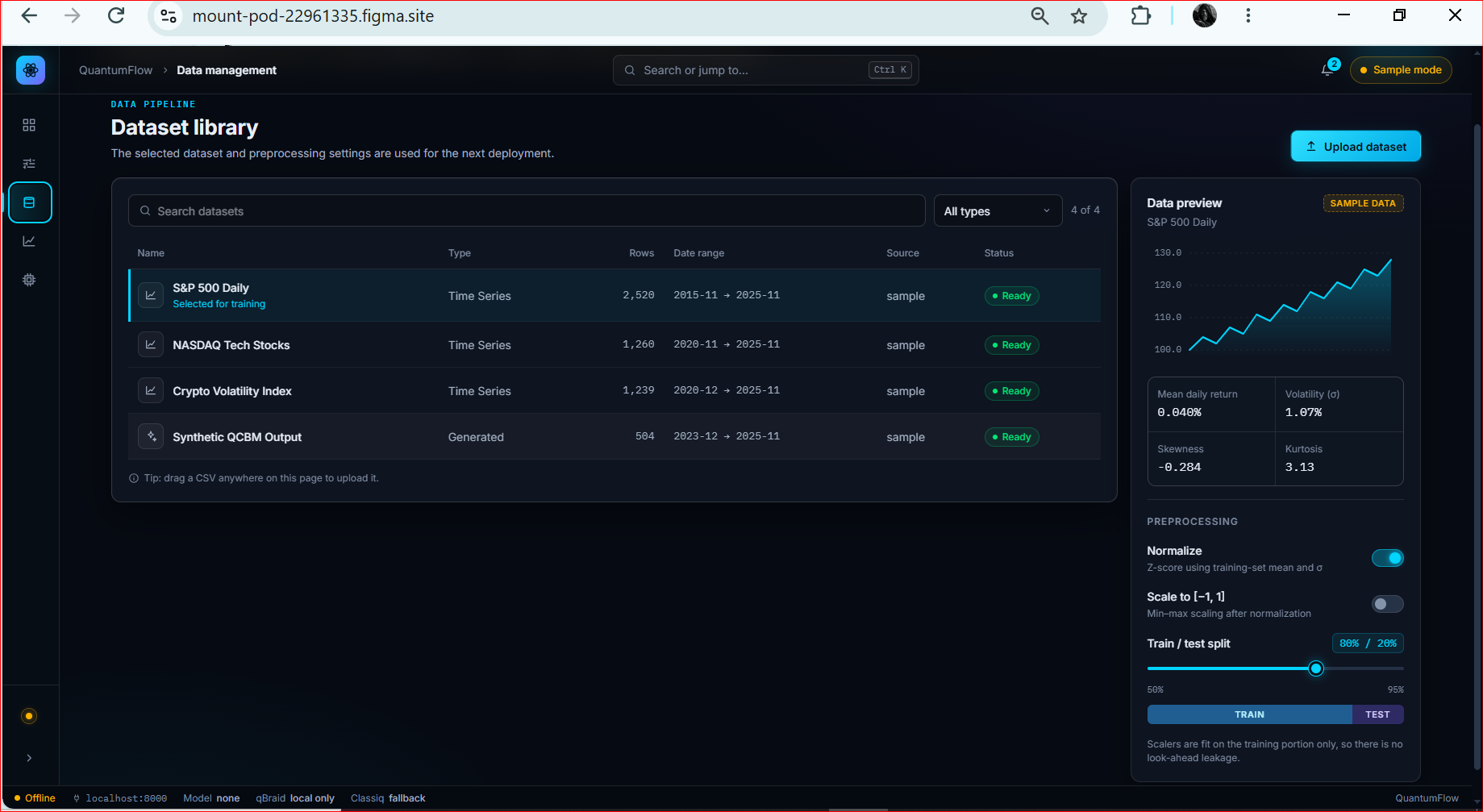
We learned that in the NISQ (Noisy Intermediate-Scale Quantum) era, honesty and rigorous benchmarking are more valuable than hype. Designing algorithms that respect the hardware's limitations—like avoiding deep variational circuits to prevent barren plateaus—is the key to near-term quantum utility. We also learned the importance of proper machine learning hygiene: fitting scalers only on training data to prevent leakage, and using multiple random seeds to ensure statistical significance in our results.
What's Next
- Scaling the QRC to 50+ qubits using tensor-network simulators to capture higher-order market correlations.
- Adding memory to the reservoir so past inputs carry forward between time steps.
- Deploying the QCBM to real hardware via qBraid to generate synthetic data directly on quantum processors.
Built With
- classiq
- fastapi
- numpy
- python
- qbraid
- qiskit
- react
- scikit-learn
- typescript
- vite
- yfinance
