-
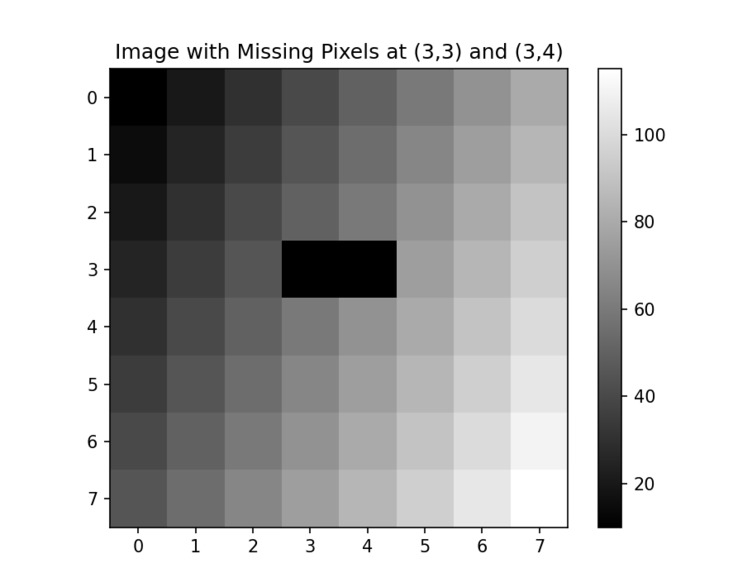
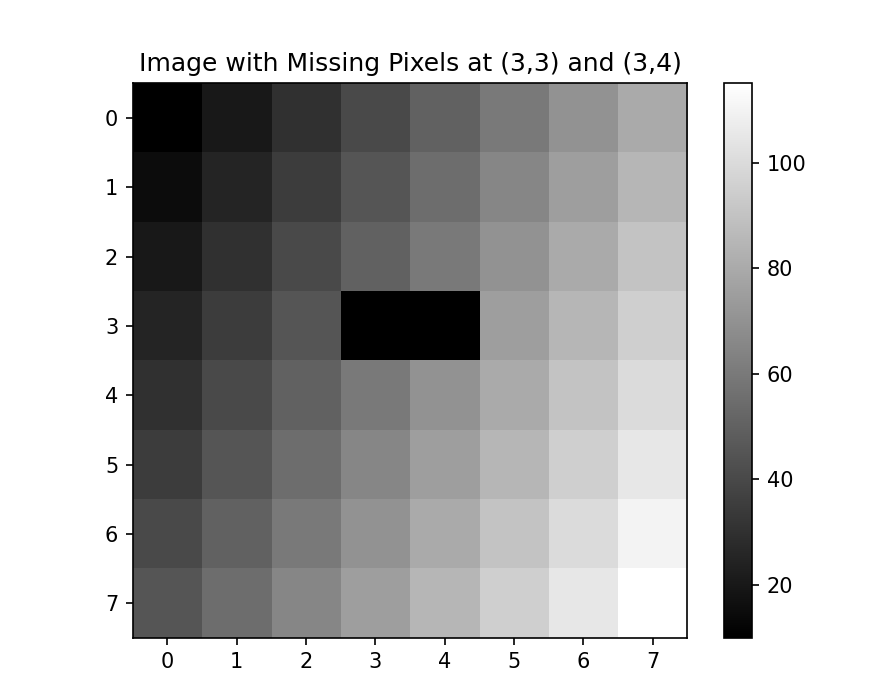
gradient with missing pixels
Inspiration
We had gone over image matrices in linear algebra class, so when we were researching different Ax = b quantum challenges. We decided to research to see if we could build something cool off at. We then looked into more real-world solutions that use linear systems and found out about image inpainting. We thought it was really interesting and decided to test a quantum vs classical approach in our solution.
What it does
This project is our take on the Advanced Quantum Track problem of using a quantum algorithm to solve Ax=b. The idea behind it is to create an Ax=b matrix system from missing pixels in images and have items in x be the color value of the pixel corresponding to that vector item. We did show this in the classical solution which solved 2 missing pixels in a gradient image by using a numpy method to solve x = A^-1*b. While we did show a different Ax=b matrix solution done by the quantum algorithm, if the quantum algorithm VQLS was properly represented using the same gradient, and then extrapolated for x, it would be very similar to the classical solution but perhaps slightly off. For a small 8x8 matrix like this, the quantum algorithm would be overkill and the classical algorithm would outperform it, but the idea behind showing this example was to show that VQLS could be used to repair missing pixels in images (due to its property of being able to solve for a matrix equation) rather than using a classical solution. This is good because images can scale up to millions of pixels easily, and using a normal solution would take an enormous amount of time. A quantum algorithm would take a lot less time than a normal solution albeit would still be slow currently due to current computers not handling qubits well. In the future quantum algorithms will definitely be much better off compared to classical solutions in regards to, say repairing a movie just because of the time complexity advantage it has due to utilizing superposition.
Challenges we ran into
Being beginners in Quantum Computing Lots of dimension bugs Understanding things like how to build variational circuits, using the Hadamard test, or even just interpreting quantum outputs took a lot of time.
Accomplishments that we're proud of
We got a working quantum circuit to solve a real math problem We managed to model missing image pixels as a linear system and solve it both classically and quantumly
What we learned
We learned how to take a linear algebra concept like Ax = b and apply it to a real-world problem like image inpainting. We tried out quantum programming for the first time and learned how variational algorithms and the Hadamard test work. Most importantly, we learned how to turn new concepts into something practical, while having a lot of fun figuring it out.
What's next for QuantumFiller
Next, we want to scale QuantumFiller to handle larger images and more missing pixels using sparse matrix techniques. We’re also exploring ways to optimize the quantum circuit further and test it on actual quantum hardware. Long term, we’d love to apply it to real-world cases like restoring damaged satellite images or medical scans.


Log in or sign up for Devpost to join the conversation.