Inspiration
We were inspired to explore how quantum-native techniques could be used to construct new cryptographic methods especially hash functions that remain secure in the presence of quantum adversaries. The idea of controlled quantum walks, using classical input to evolve the quantum state in a unique way seemed ideal for constructing a secure high-entropy hashing mechanism.
What it does
Our project, Quantum Alternate Controlled Walk-Based Block Hashing (QAWCBH), is a quantum-native hash function that maps classical input messages to high-entropy, deterministic quantum-derived hash outputs. The scheme uses position-controlled quantum walks to encode data, yielding outputs that are unpredictable, collision-resistant, and irreversible. All computation is done within the quantum circuit, with no classical preprocessing or compression steps.
How we built it
We implemented QAWCBH using Qiskit, IBM's quantum computing framework. The algorithm initializes quantum registers based on message data. Then applies a series of message-guided coin flips and controlled operations. As it does this it evolves the system via a quantum walk for a number of steps proportional to input size. It extracts hash outputs from the final quantum state-vector using amplitude scaling and quantization. We innovated on existing quantum walk hash models by introducing byte-level control of quantum coin angles, improving entropy and runtime performance. All tests were run using Qiskit's state-vector simulator.
Challenges we ran into
Performance bottlenecks: Our first implementation (bit-level encoding) resulted in long runtimes (~3 seconds per hash). Switching to byte-level encoding reduced quantum gate overhead and improved performance significantly.
Entropy tuning: Balancing determinism with randomness required careful selection of theta angle sets and walk depth.
Quantum circuit limitations: We had to design the circuit to fit within the constraints of near-term quantum processors (e.g., ≤6 qubits for 256-bit inputs).
Accomplishments that we're proud of
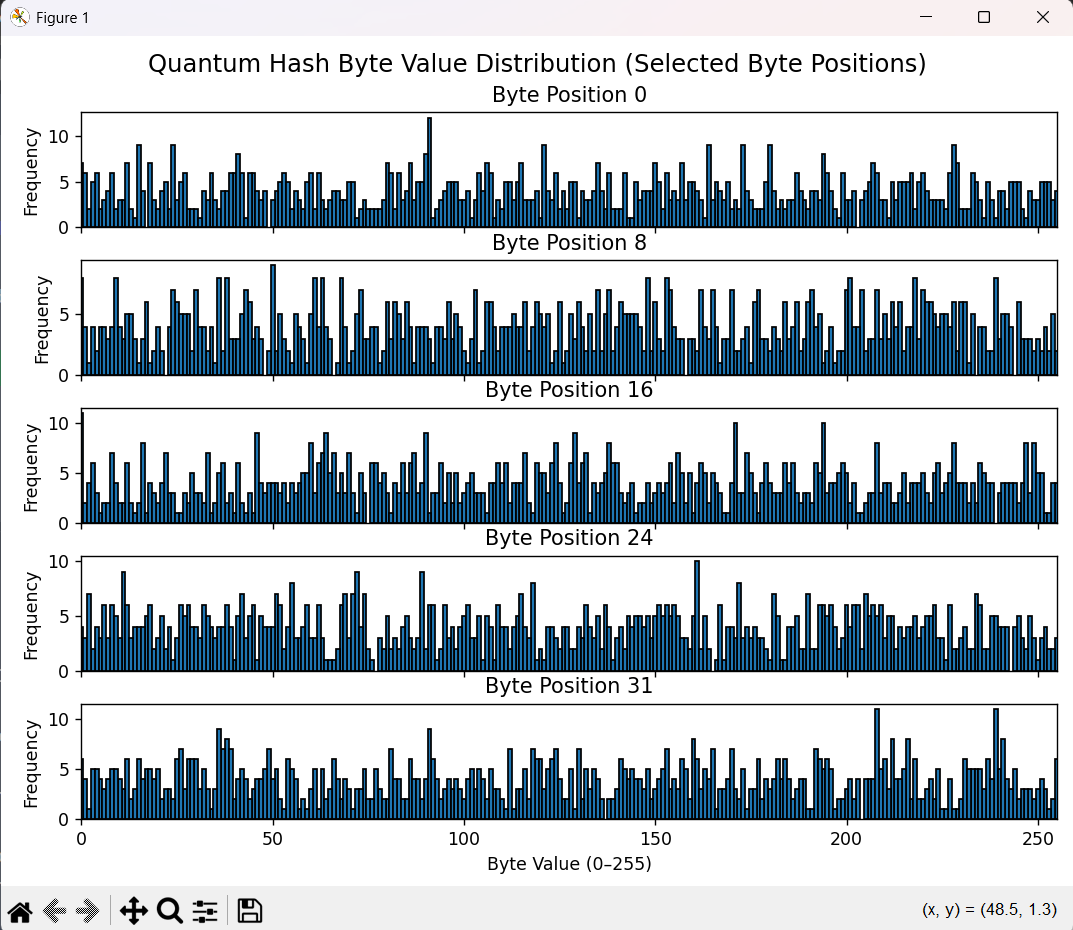
We developed a fully quantum hashing algorithm with no classical hashing methods, achieved near-maximal entropy: 0.99998 bit-level and 7.93 byte-level, demonstrated zero collisions across 1000 randomized inputs, significantly outperformed qHash, a prior quantum hash function, in all metrics including entropy, runtime, and collision resistance.
What we learned
We learned how to implement a quantum walk given parameters through our hashed message, and how to extract the probabilities of the state-vector to make a secure hash.
What's next for Quantum Walk Hash Function for Cryptocurrency
Deploy on real quantum hardware to test performance under real-world noise and decoherence. Explore scalability strategies for longer inputs and multi-block chaining. Investigate hybrid integration with blockchain technologies for quantum-resistant transaction validation. Further study the entropy dynamics of quantum walks under different encoding schemes. Open-source the QAWCBH framework for further research and community use.
Built With
- python
- qiskit

Log in or sign up for Devpost to join the conversation.