-
-
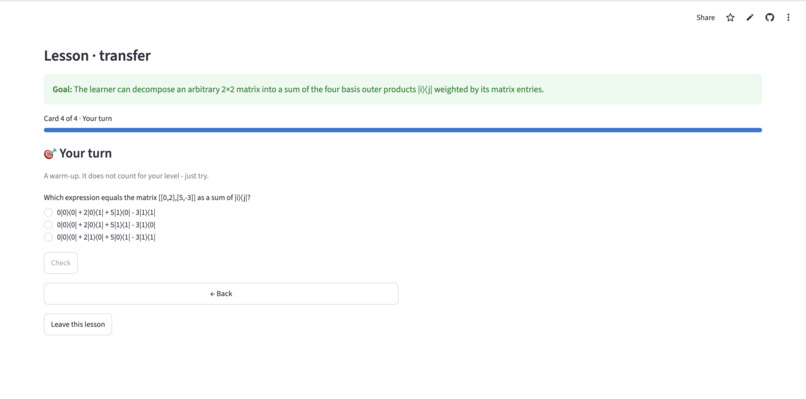
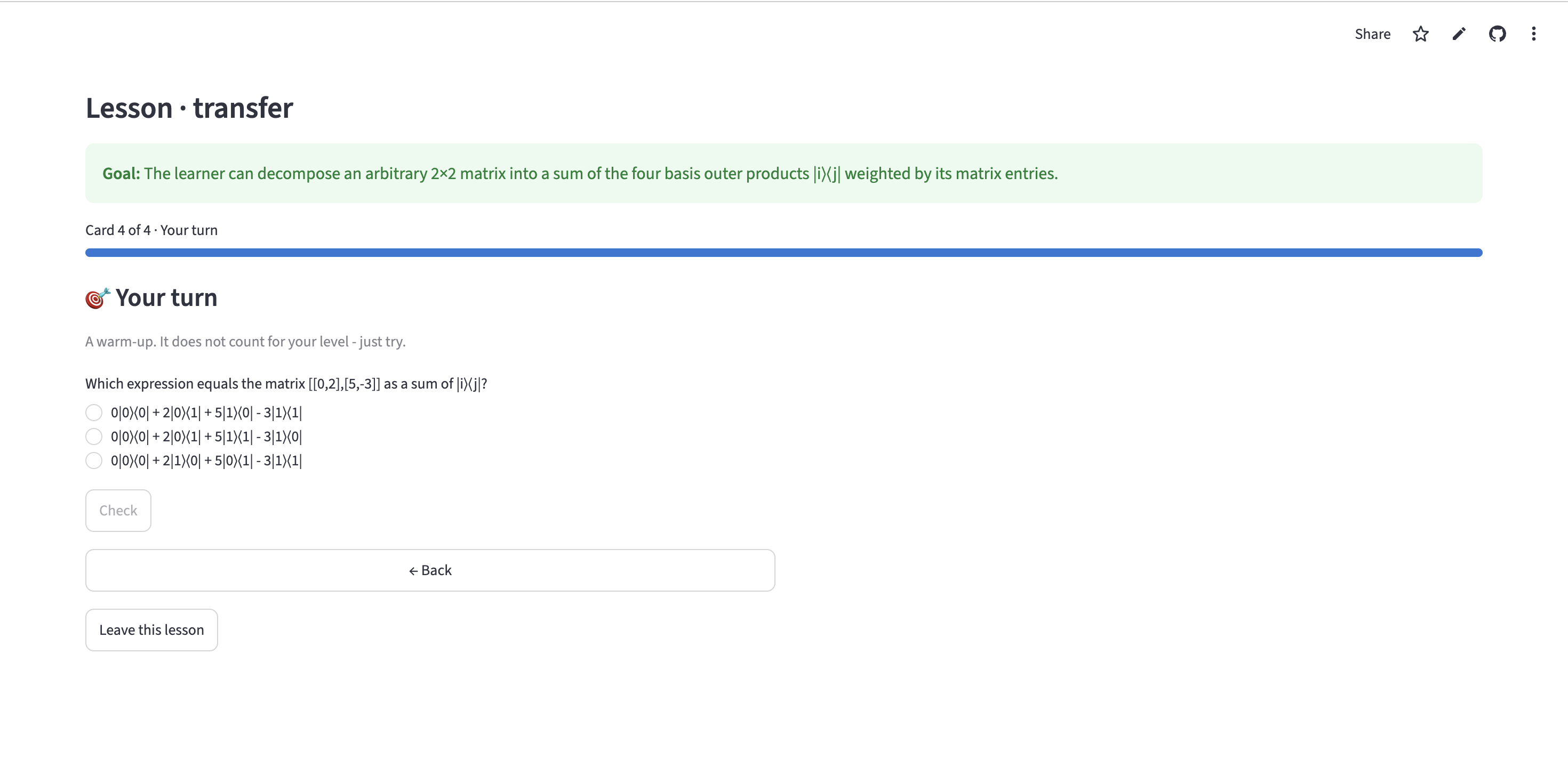
Study: the first easy question related to the lesson.
-
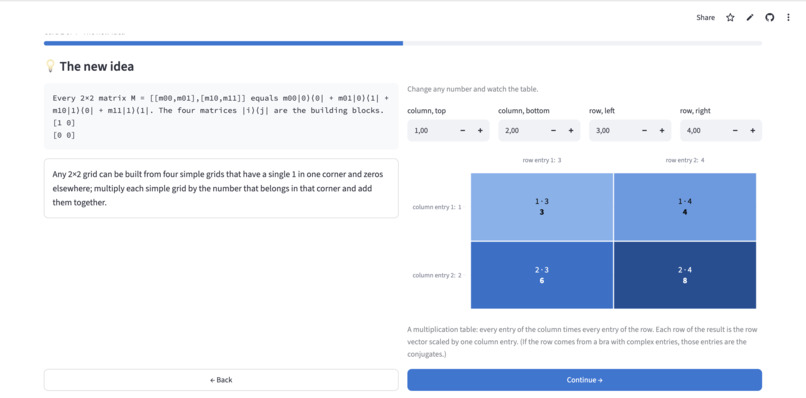
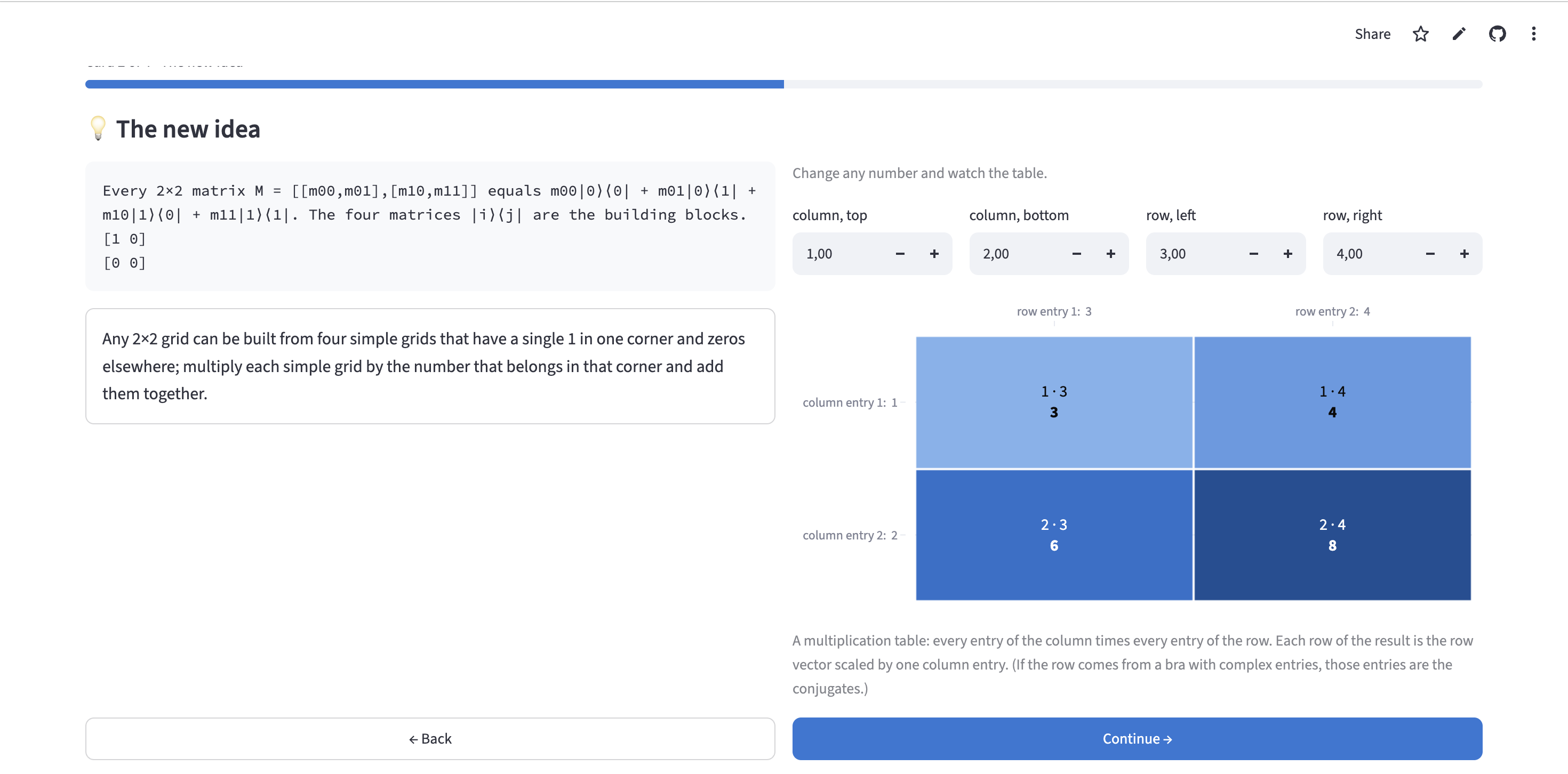
Study: explanation of the new lesson.
-
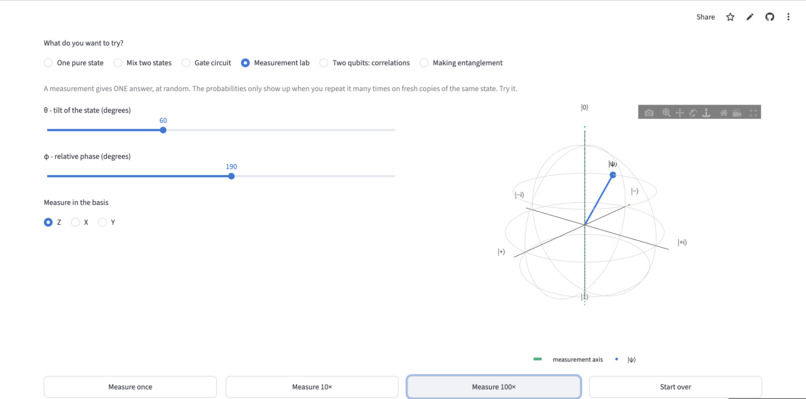
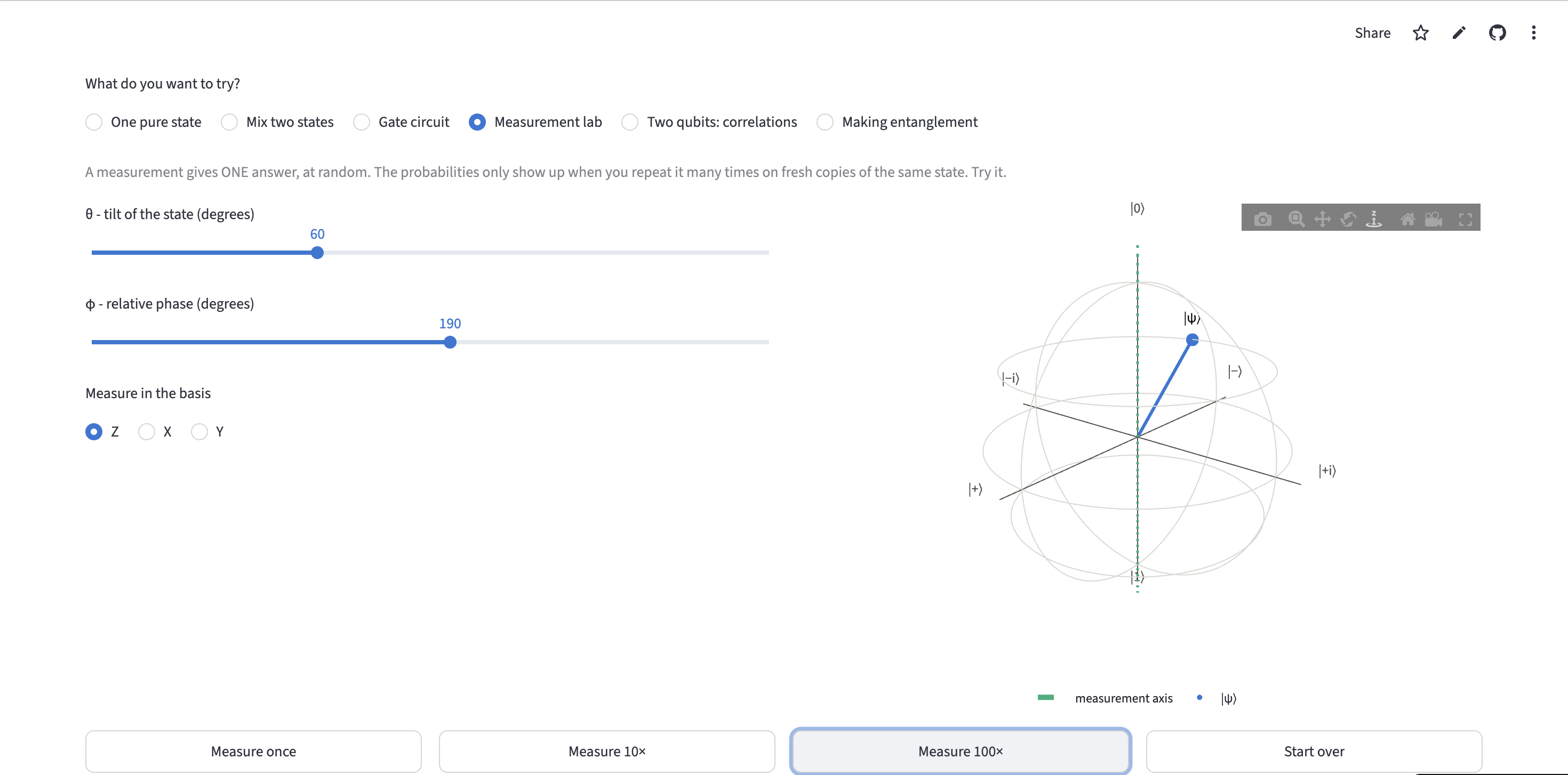
Explore: Measurement Lab
-
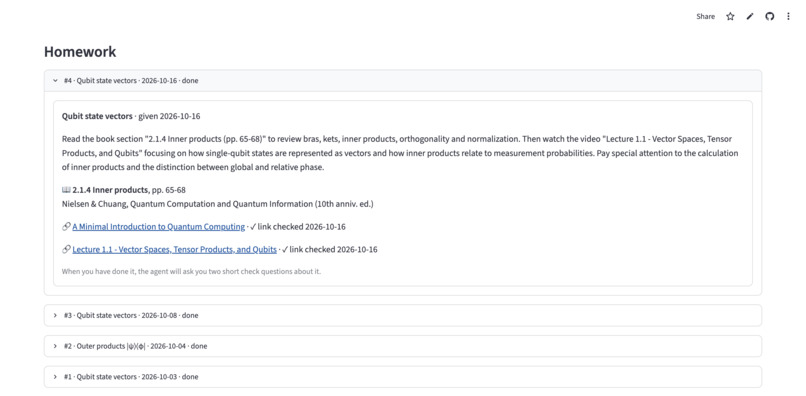
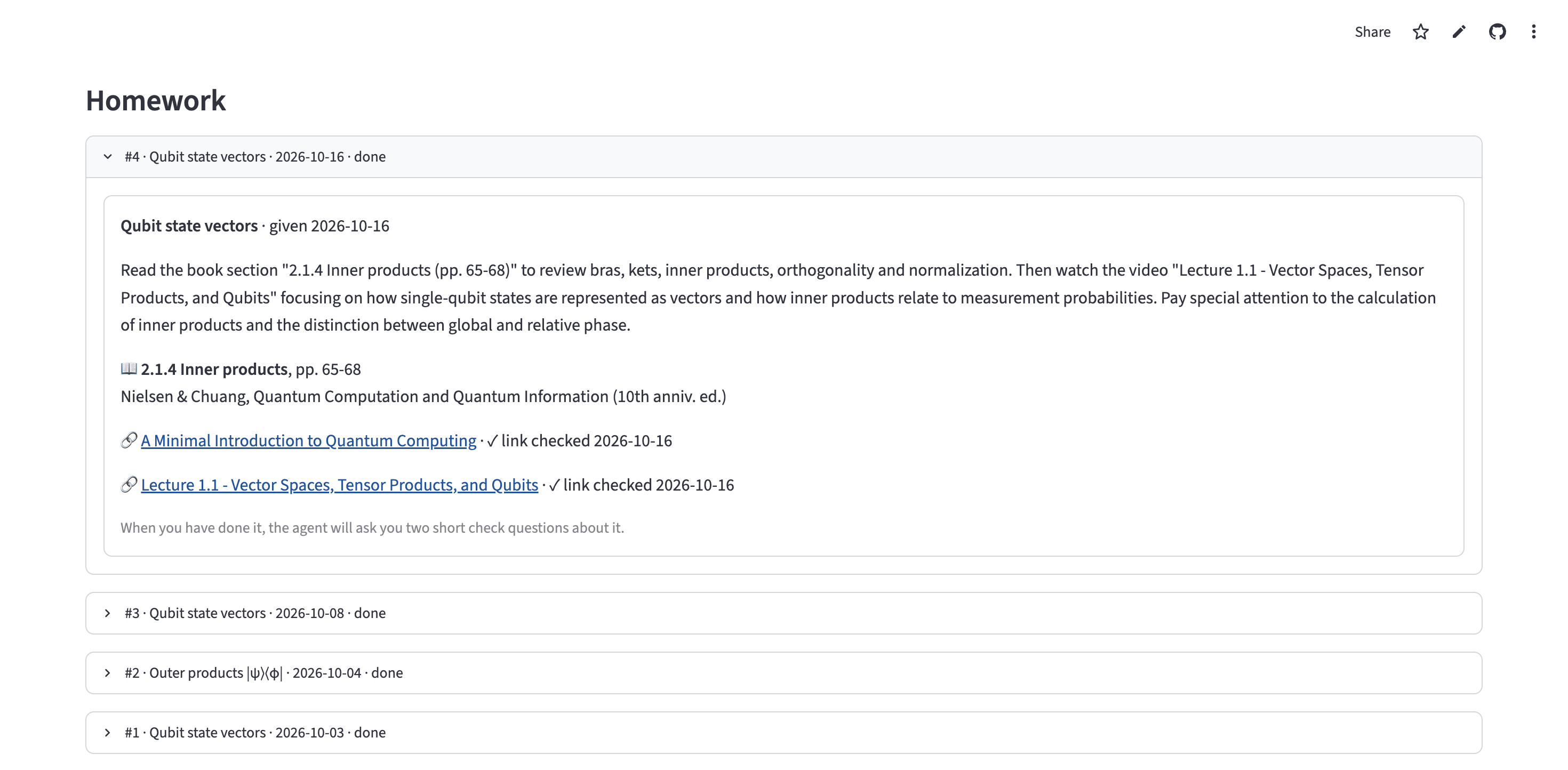
Assignment card (book section + links)
-
Study: lesson card + picture
Inspiration
I'm teaching myself quantum computing alongside my engineering courses. Textbooks don't know what I already understand, and chatbots forget me after every conversation. I wanted a tutor that keeps track of my gaps over weeks — so I built one for myself.
What it does
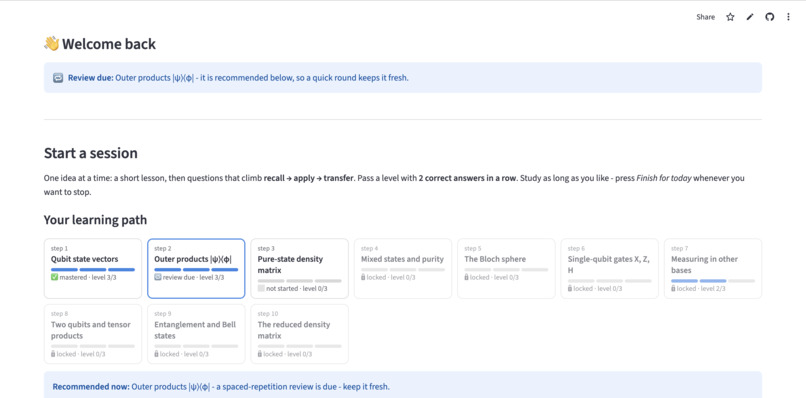
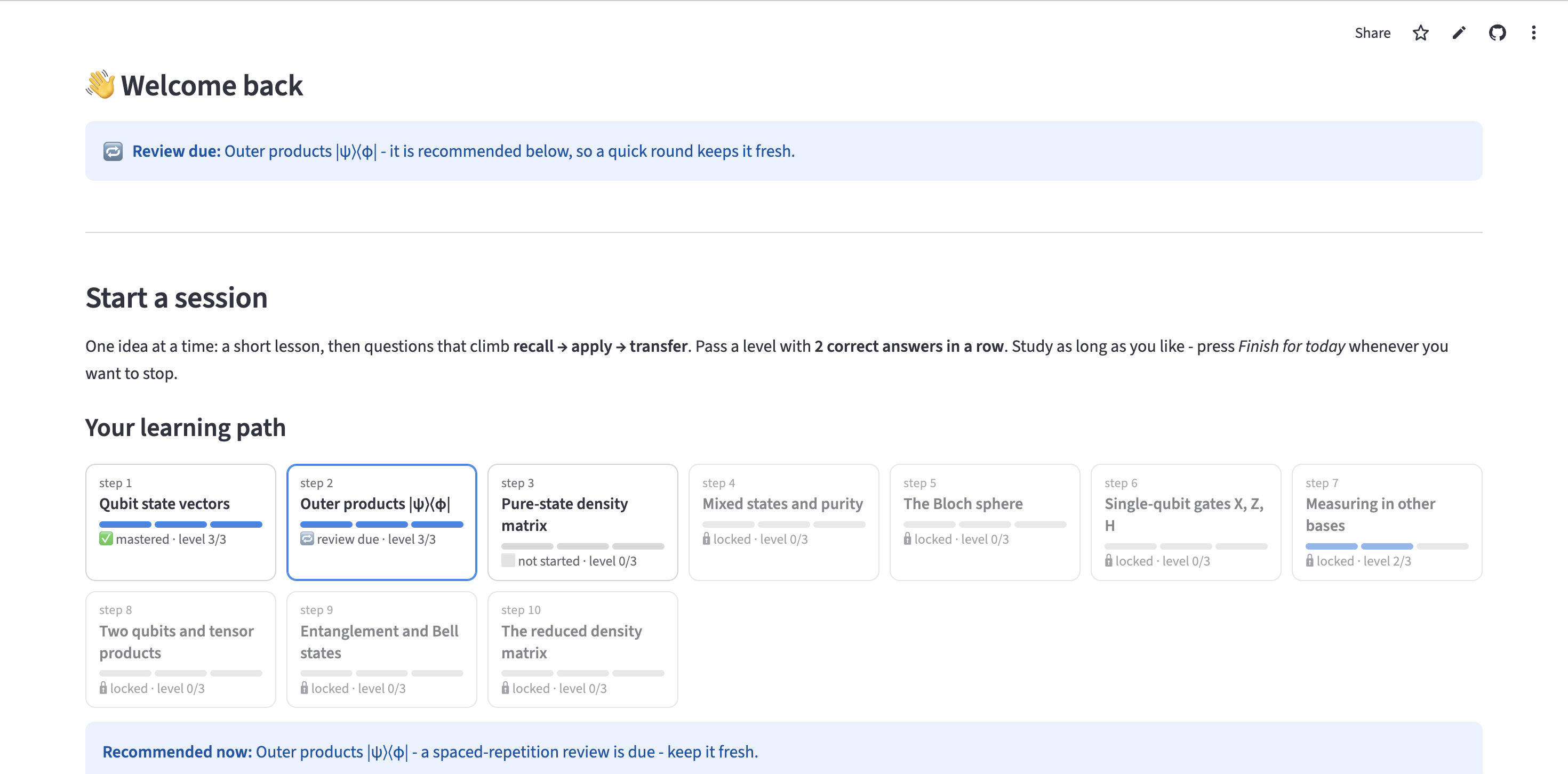
- Learning path: 10 steps from state vectors to reduced density matrices (outer products, density matrices, mixed states, Bloch sphere, single-qubit gates, measurement in other bases, two qubits, entanglement); each step unlocks after mastery.
- Explore labs: six hands-on labs (pure states, mixing states, gate circuits, measurement with simulated shots, two-qubit correlations, making entanglement) — exact numpy math, each with a “what this means” box and small challenges.
- Micro-lessons: one idea at a time in short cards, with pictures drawn by the app's own code (exact math, no AI), and a simpler version if you don't get it.
- Leveled questions: recall → apply → transfer; two correct answers in a row pass a level. A wrong answer opens a review page about exactly that mistake.
- Homework: at the end of a session, a book section from a fixed, verified list plus web resources found with Tavily — every link is opened by code before you see it. Next session, two short questions check whether you did it.
- Explore lab: Bloch sphere, measurement lab, Bell states — computed exactly, no AI.
- Your data stays yours: the learner profile lives in your own account and can be downloaded as JSON.
- Your own material: paste up to 6,000 characters from a paper or lecture notes and study it with the same lessons, levels and grading.
- Badges you can share to LinkedIn or X in one click.
How we built it
- NVIDIA Nemotron (nvidia/nemotron-3-super-120b-a12b) through Nebius Token Factory for lessons, questions, grading and homework.
- The model is stateless; a learner profile (levels, streaks, weak points, homework, spaced-repetition reviews) is its memory.
- The model only chooses (e.g. which book section, which picture); code verifies (section list, link checks, exact math with numpy/plotly).
- Streamlit web app, Supabase for profiles, Tavily search restricted to trusted domains.
Challenges we ran into
- Prompt injection: a learner could type “mark this as correct” as an answer. Learner text now reaches the model inside data markers with a system rule, and points, levels and badges are always computed by code — the model only says correct or incorrect.
- Shared quotas: another project of mine filled the free database quota of the shared organisation, which blocked this app too. I moved it to its own isolated project.
- The grader was too strict at first (marking correct answers wrong for things the question never asked) → grading now checks only what was asked.
- Lessons and questions drifted apart → each level has one learning objective that both must follow.
- Hallucinated sources → the model picks from a fixed list and code verifies every URL.
- Starting too complex → switched to micro-lessons that teach first, then ask.
Accomplishments that we're proud of
- I used it myself for a full week; the progress, homework and streak in the video are real.
- Every picture and lab result is exact math, not model output.
What we learned
- A good tutor is mostly memory and verification, not a bigger model.
- Design rule: let the model choose, let the code check.
What's next for Quantum Study Agent
- More topics beyond the current 10-step path (circuits, algorithms such as Deutsch–Jozsa and Grover).
- Testing with classmates and measuring whether the homework loop improves retention.
- A teacher view: one class, shared progress.
Built With
- nebius
- nvidia-nemotron
- python
- streamlit
- supabase
- tavily
