Inspiration
Formula 1 is a perfect fusion of physics, data, and decision-making under milliseconds of uncertainty. We were inspired by the challenge of optimizing real-time race strategies like pit stops, tire wear, and overtaking, using cutting-edge computation. Our fascination with quantum optimization and AI-driven multi-agent systems led us to create Quantum RaceCraft, a simulator that combines both worlds to rethink competitive mobility.
What it does
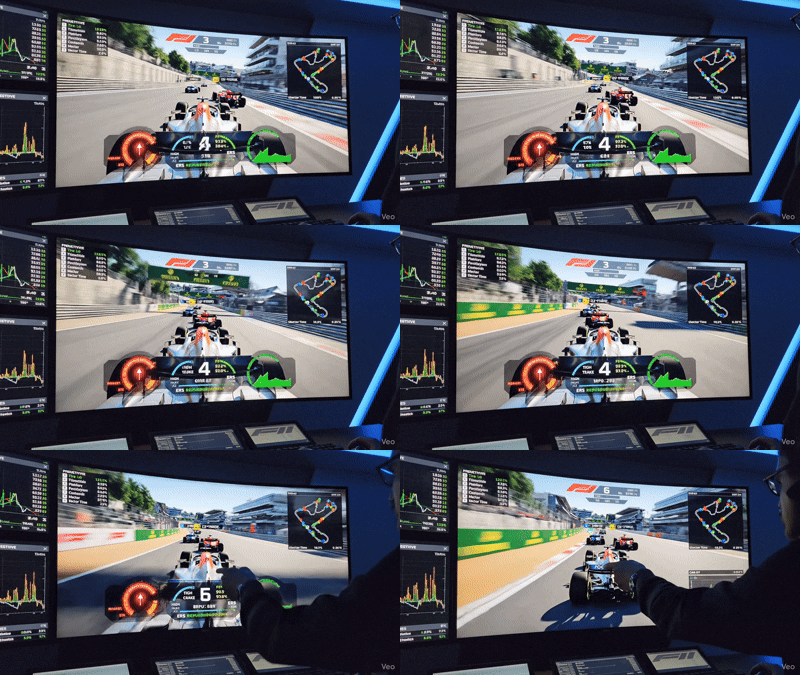
Quantum RaceCraft simulates an F1-style race with multiple autonomous car agents competing on a track.
- Each car adapts its strategy based on speed, fuel, and tire degradation.
- A Quantum Optimizer (QUBO) determines the optimal pit stop strategy to minimize total race time.
- An AI simulation loop executes these strategies and visualizes a live leaderboard with real-time performance metrics. In short: it’s a hybrid AI–Quantum decision engine for competitive racing.
How we built it
- Implemented a Python-based race simulator to track lap progression, speed, and tire wear.
- Modeled pit stop decisions as a QUBO problem: \[\min f(x) = \sum_i c_i x_i + \sum_{i<j} Q_{ij} x_i x_j\]
- Solved the optimization using Qiskit’s QAOA and integrated results into the live race simulation.
- Visualized outcomes with matplotlib, displaying race dynamics and quantum-optimized decisions.
- This hybrid loop allows AI to handle dynamic racing and Quantum to handle strategic optimization.
Challenges we ran into
- Translating complex race dynamics into a mathematical QUBO formulation.
- Synchronizing real-time AI simulation with quantum backend results.
- Ensuring reproducibility on classical simulators when quantum resources were limited.
Accomplishments that we're proud of
- Built a working prototype that demonstrates real-time F1 strategy optimization using Quantum + AI.
- Designed a scalable hybrid architecture that can extend to Formula E, drones, and autonomous mobility systems.
- Created a clear visualization showing quantum-enhanced decisions outperforming naive strategies.
- Successfully merged two advanced paradigms: Reinforcement Learning and Quantum Optimization, into one cohesive system.
What we learned
- How to bridge the gap between theoretical quantum optimization and practical AI-driven simulation.
- The power of hybrid computing architectures in solving real-time, multi-agent optimization problems.
- Efficiently using QAOA and heuristic solvers to tackle constraint-heavy, stochastic environments.
- The importance of modularity (building clear interfaces between AI and Quantum modules accelerates development).
What's next for Quantum RaceCraft
- Extend to multi-agent reinforcement learning for driver behavior simulation.
- Add real telemetry data from F1 or Formula E to enhance realism.
- Use Quantum Annealing for energy-efficient strategy optimization.
- Deploy as an interactive simulation dashboard for race engineers and AI researchers.
- Explore integration with Digital Twins and Edge AI systems for predictive racing analytics.

Log in or sign up for Devpost to join the conversation.