-
-
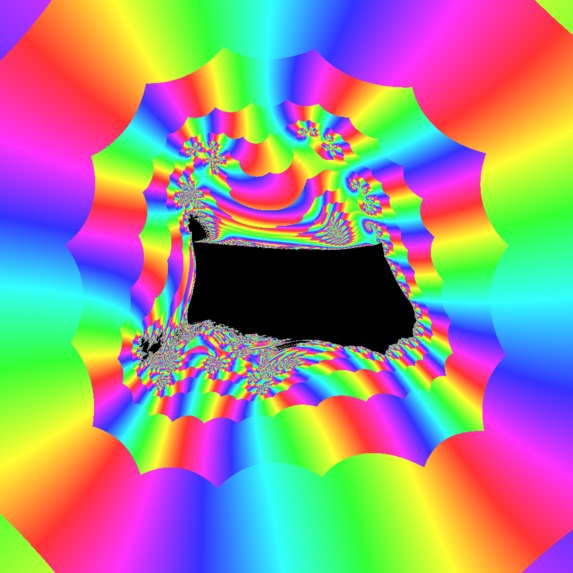
Output of manifold quantum fractal
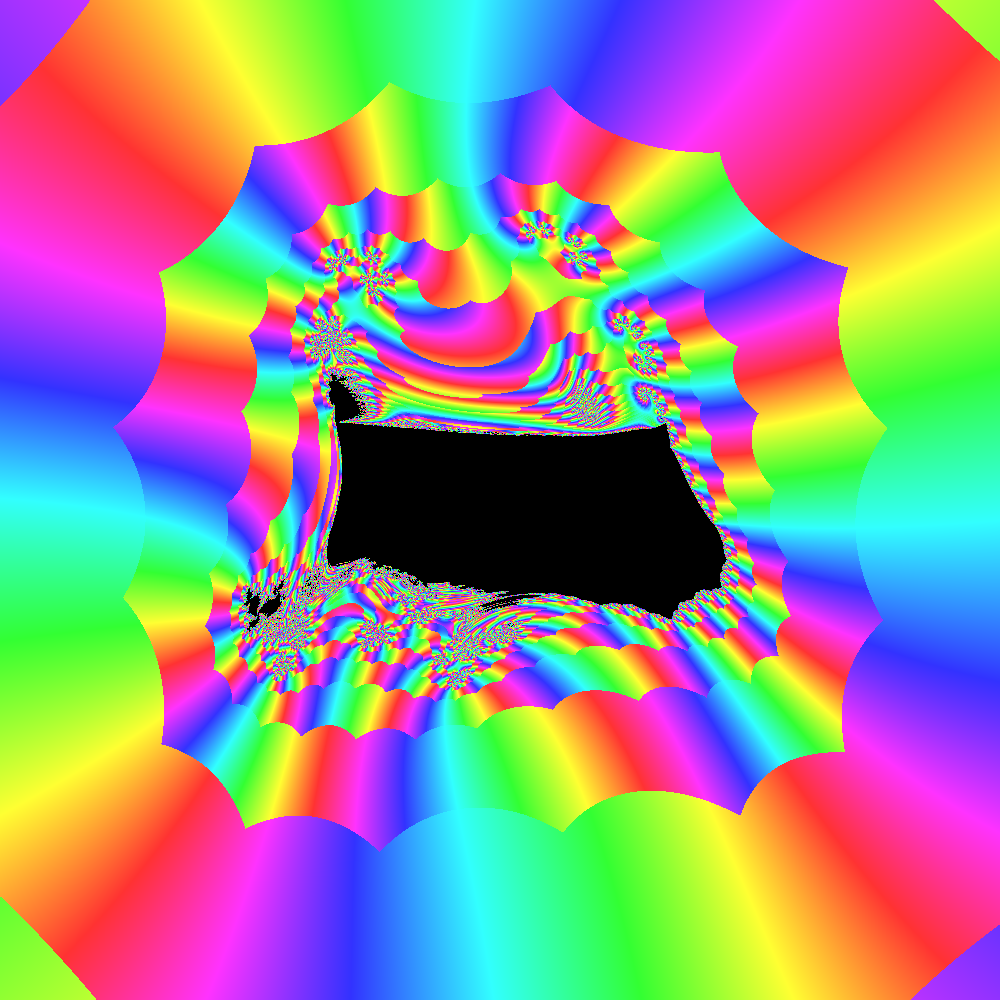
Technical Architecture: The Quantum Phase Manifold
The core of my project is the transition from a discrete quantum state to a continuous geometric space.
Quantum Phase Extraction I initialize a 4-qubit register in a superposition state. Through the application of Entanglement operators (CNOT), I generate a set of correlated phase anchors, denoted as $\Theta = {\theta_0, \theta_1, \theta_2, \theta_3}$. These are derived from the measurement of the qubits: $$\theta_n \in {0, \frac{\pi}{2}, \frac{\pi}{4}, \frac{\pi}{8}}$$
Trigonometric Coordinate Transformation Instead of using a static initial constant $c$, I define a spatial transformation function $F(x, y)$ that modulates the complex plane based on the quantum phases: $$c_x = \sin(x + \theta_0) \cdot \cos(y + \theta_1)$$ $$c_y = \cos(x + \theta_2) \cdot \sin(y + \theta_3)$$ This ensures that the initial conditions of the fractal are "entangled" across the $x$ and $y$ axes.
Complex Quadratic Map Every pixel undergoes a non-linear iteration until it reaches a divergence threshold or the maximum iteration count $I_{max}$: $$z_{n+1} = z_n^2 + (c_x + i c_y)$$ The final image is a visualization of the escape-time $I$ for the manifold at every coordinate $(x, y)$.
About the Project
Inspiration I was inspired by the idea of Deterministic Quantum Synthesis. Rather than using a quantum computer as a simple random number generator, I wanted to use it to define the fundamental "vibrations" of a mathematical space. The Quantum Phase Manifold represents the intersection of subatomic probability and complex dynamics.
How I built it As a solo developer, I built this system from the ground up: I wrote the Q# kernel to manage qubit entanglement. By using CNOT gates, I ensured that the horizontal and vertical phases of the fractal were non-locally correlated. I developed a C# rendering engine using SkiaSharp. I had to map the discrete results from the Azure Quantum SDK into a continuous trigonometric field to drive the fractal math. I implemented an escape-time algorithm where the constant $c$ is a dynamic function of the coordinate space, shifted by the quantum phases.
Challenges I faced The biggest hurdle was defining the relationship between the quantum phases and the spatial coordinates. I had to iterate through various trigonometric models to ensure the quantum influence created structured geometry rather than visual noise. I ran into significant versioning issues with the Q# compiler. Solving the "damn errors" regarding shorthand syntax and array mapping required stripping the code back to its most explicit, robust logic to ensure the project would build and run reliably.
I learned that the bridge between quantum results and classical visualization is where the real creativity happens. Mapping entanglement to spatial symmetry taught me how to visualize complex physics through the lens of geometry.

Log in or sign up for Devpost to join the conversation.