About the Project
Inspiration
The inspiration for Quantum Foundations came from my PhD interview for a theoretical physics position. As part of the selection process, I had to take an oral physics examination covering advanced topics such as quantum mechanics, classical mechanics, statistical physics, and electromagnetism. Rather than asking students to simply derive equations, the exam focused on conceptual understanding and physical intuition.
During my preparation, I realized that the greatest challenge in learning quantum mechanics is not the mathematics—it's developing intuition. In classical (Newtonian) mechanics, we can often picture physical phenomena because they resemble experiences from everyday life. In contrast, quantum mechanics describes a microscopic world that cannot be directly observed, making many concepts feel abstract and counterintuitive. Students often memorize formulas without truly understanding what is happening physically.
This experience inspired me to build Quantum Foundations: an interactive learning platform designed to help students develop intuition about quantum mechanics through visual explanations, guided reflections, and conceptual questions. My goal is to help learners think like physicists, understand what is happening at the microscopic level, and build the confidence needed to succeed in oral examinations and advanced physics courses.
How I Built It
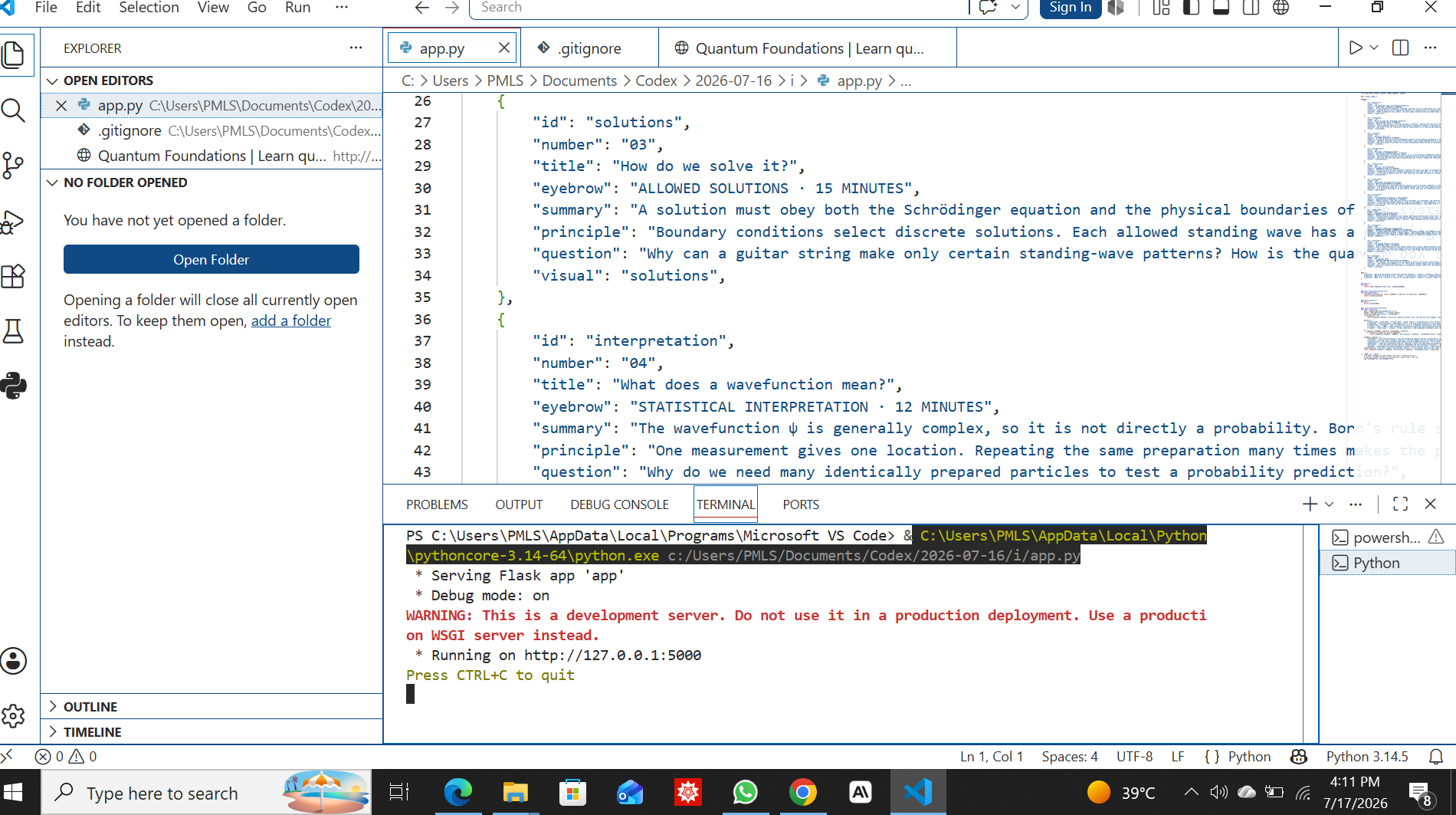
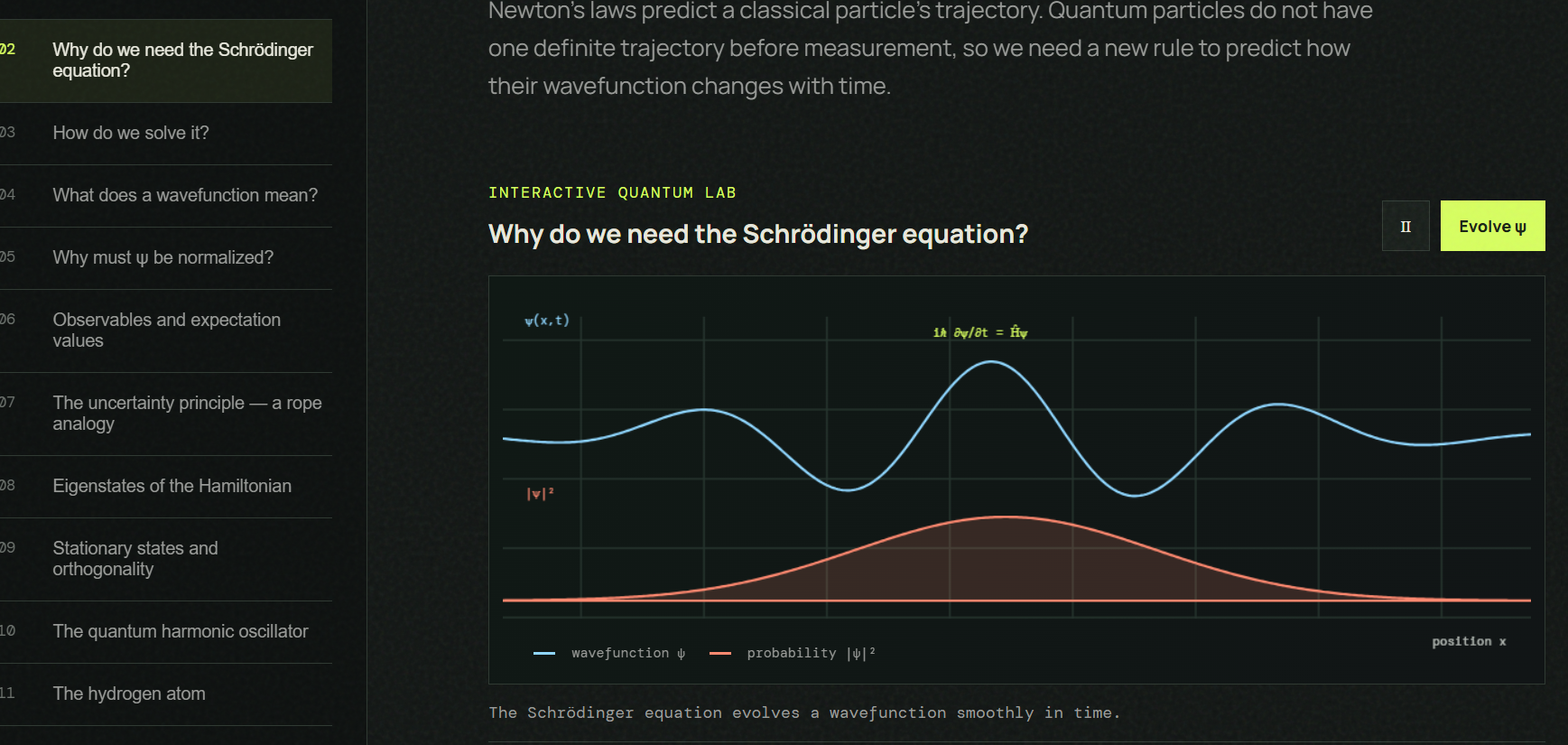
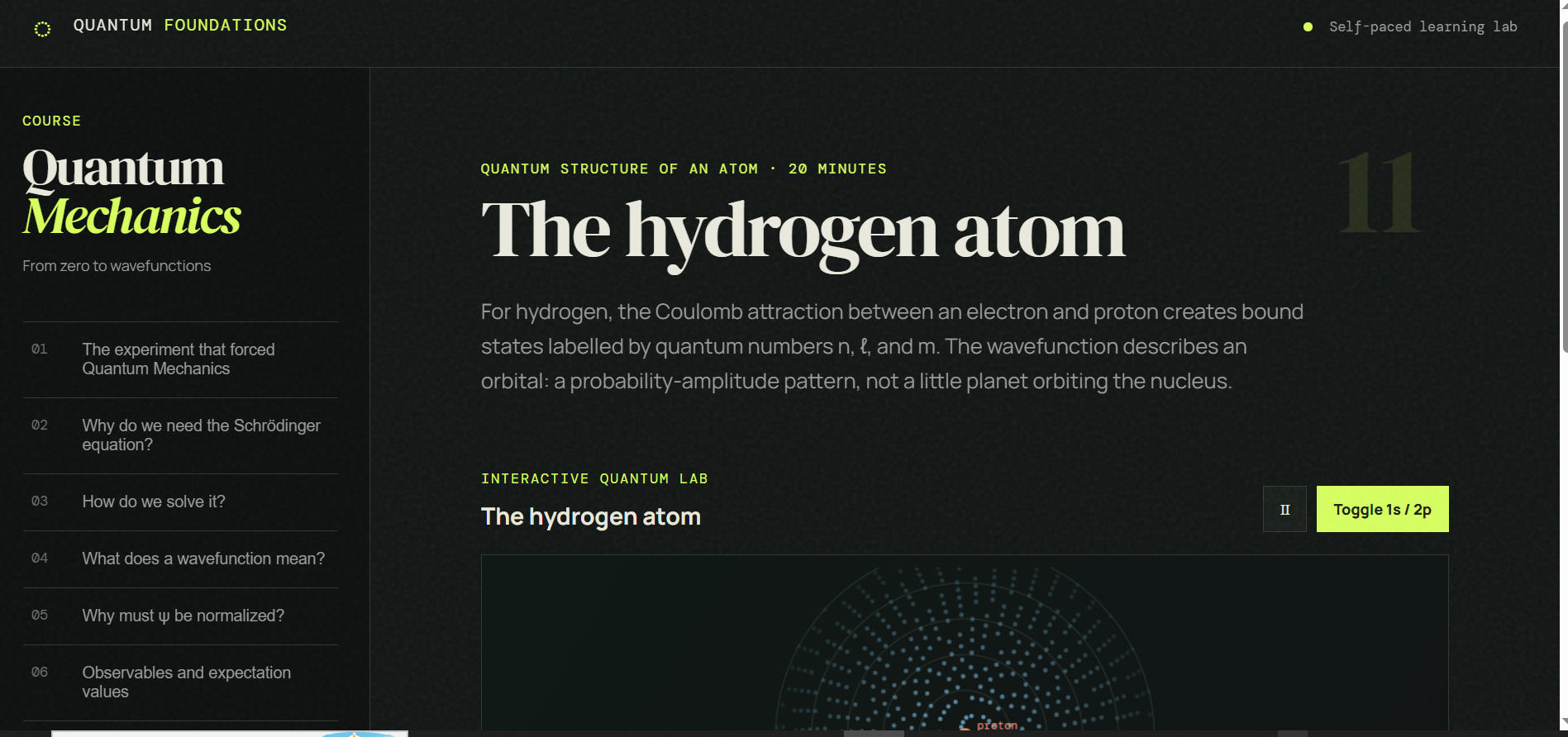
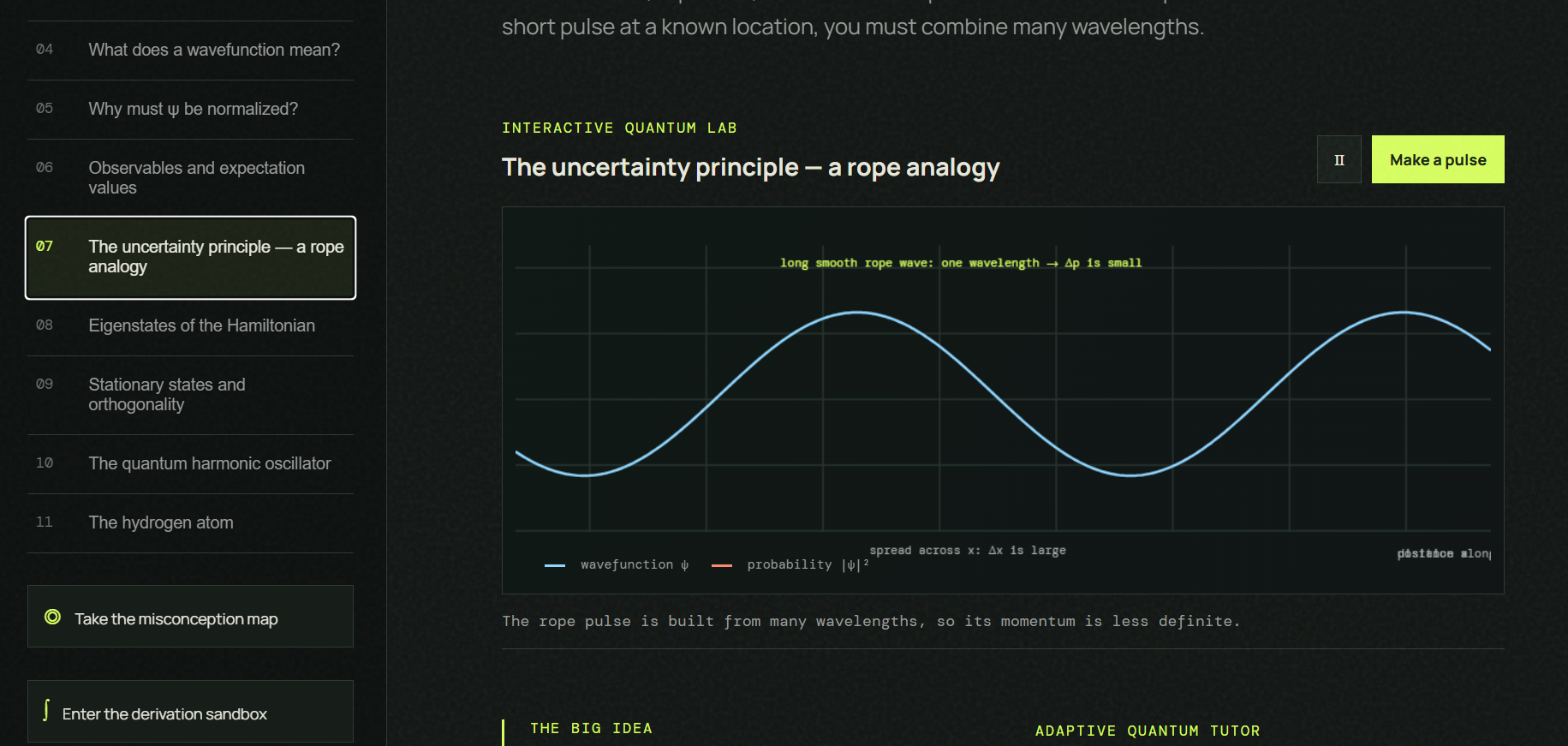
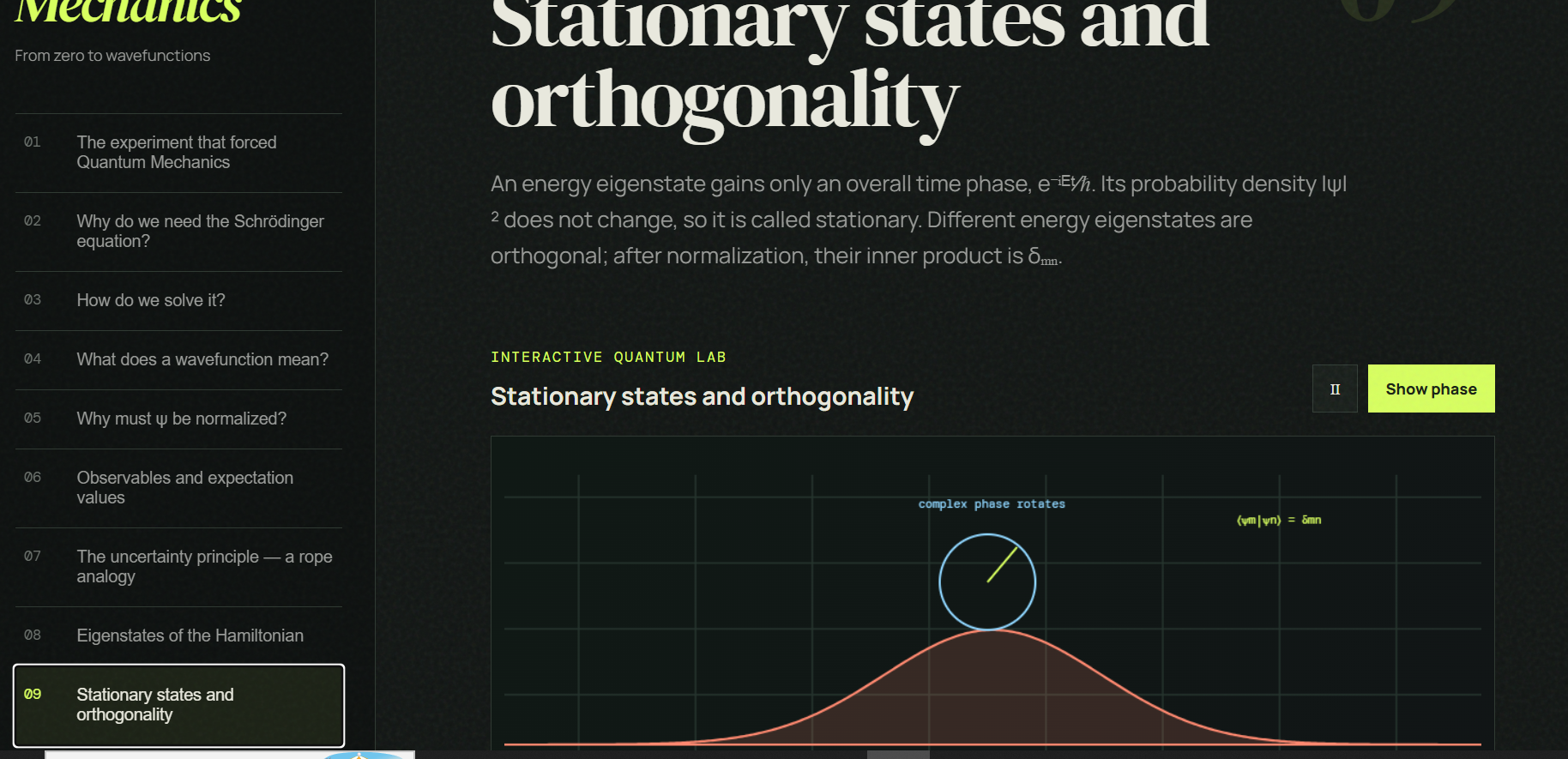
I built the project as a lightweight web application using Python and Flask, with HTML, CSS, and JavaScript powering the interactive user interface. The application organizes quantum mechanics into carefully structured lessons that gradually introduce concepts such as the double-slit experiment, the Schrödinger equation, wavefunctions, normalization, observables, the uncertainty principle, energy eigenstates, the quantum harmonic oscillator, and the hydrogen atom.
Each lesson combines intuitive explanations with interactive visualizations, reflection prompts, and quizzes that encourage students to reason through concepts rather than memorize definitions. The design emphasizes conceptual understanding and active learning.
Throughout development, I used Codex to accelerate coding tasks, refine the project structure, improve implementation, and iterate more efficiently while keeping the educational content scientifically accurate.
Challenges
The biggest challenge was translating highly mathematical quantum mechanics into intuitive visual explanations without sacrificing scientific accuracy. Every lesson required balancing simplicity with correctness so that beginners could build intuition while still learning the underlying physics.
Another challenge was designing interactive questions that encourage genuine reasoning instead of simple memorization. I wanted students to think through each concept the way they would during an oral examination, where understanding matters far more than recalling equations.
What I Learned
This project taught me that effective physics education is not just about presenting formulas—it is about helping students develop intuition. Building interactive educational software also strengthened my skills in web development, educational design, and creating learning experiences that actively engage students.
In the future, I plan to expand Quantum Foundations with AI-powered tutoring, personalized learning paths, additional advanced physics topics, and richer interactive simulations to make higher-level physics education more accessible to students around the world.
What's Next for Quantum Foundations?
This MVP focuses on building strong conceptual intuition in quantum mechanics, but it is only the beginning. Future versions of Quantum Foundations will include:
- AI-powered tutoring that provides personalized explanations, asks follow-up questions, and adapts to each student's level of understanding.
- Interactive simulations for quantum phenomena such as wave packet evolution, tunneling, spin, and quantum measurement, allowing students to experiment with concepts in real time.
- Adaptive learning paths that identify misconceptions through quizzes and reflections, then recommend targeted lessons for improvement.
- Expanded physics content, covering electromagnetism, statistical mechanics, classical mechanics, relativity, and particle physics to create a complete interactive physics learning platform.
- Oral exam preparation mode, where students practice answering conceptual questions and receive feedback similar to a real PhD or university oral examination.
- Accessibility improvements, including multilingual support and mobile-friendly learning, making advanced physics education available to students worldwide.
The long-term vision is to make Quantum Foundations an intelligent learning companion that helps students understand physics intuitively rather than simply memorizing equations.


Log in or sign up for Devpost to join the conversation.