-
-
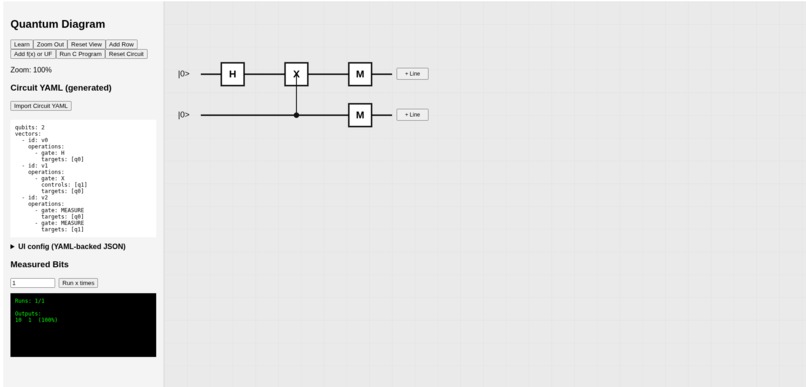
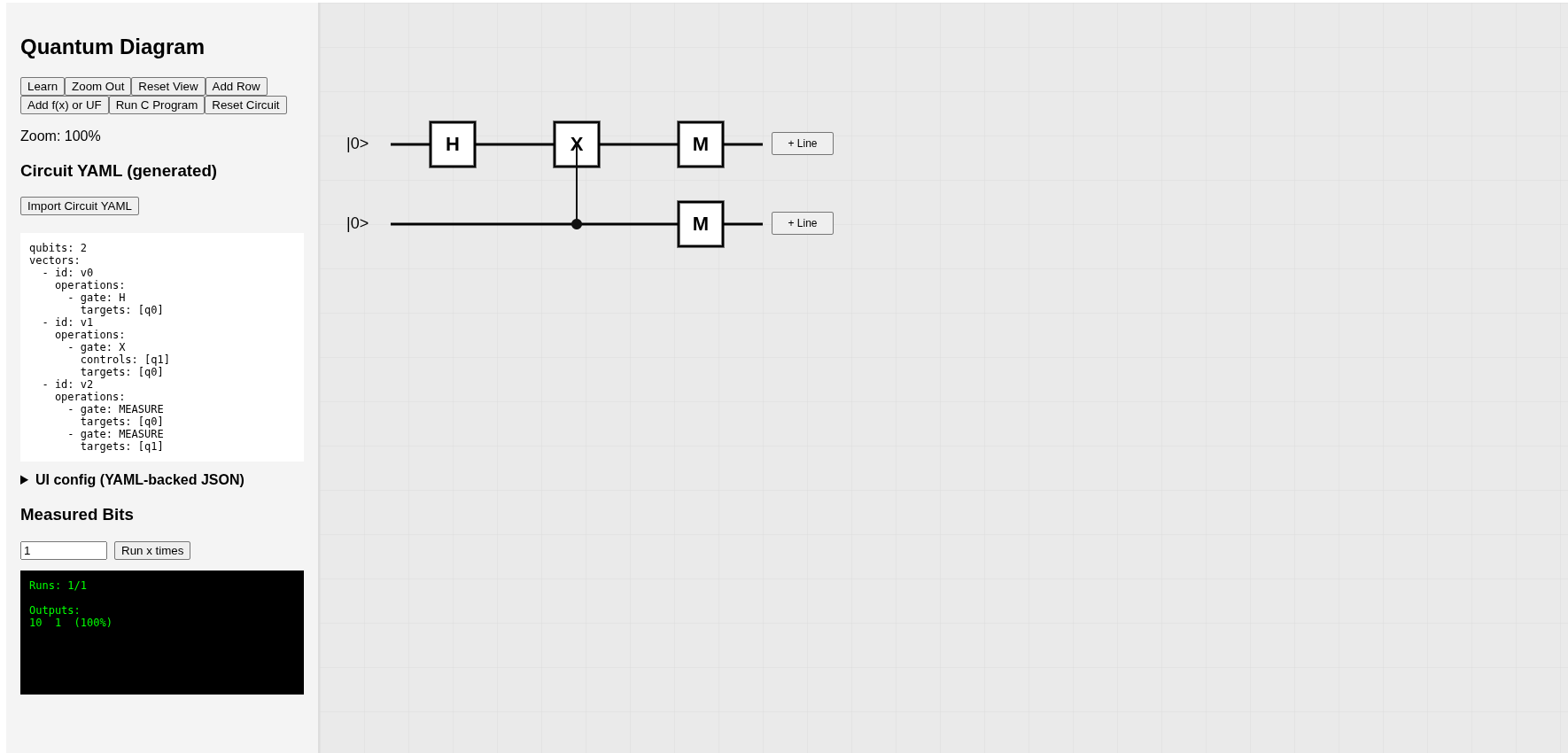
Bell State Preparation
-
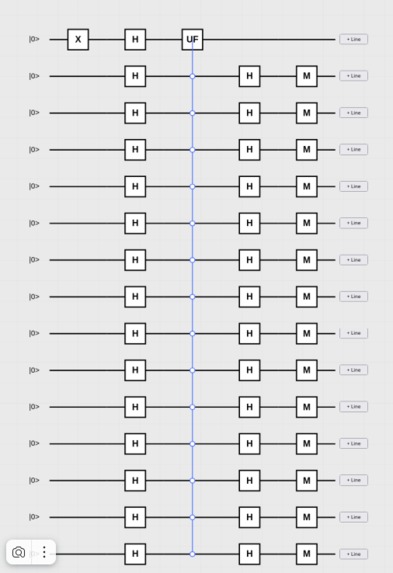
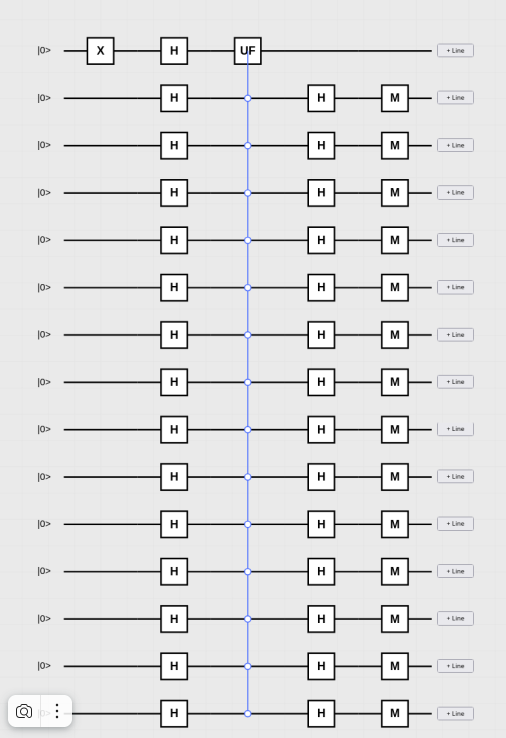
Deutsch-Jozsa
-
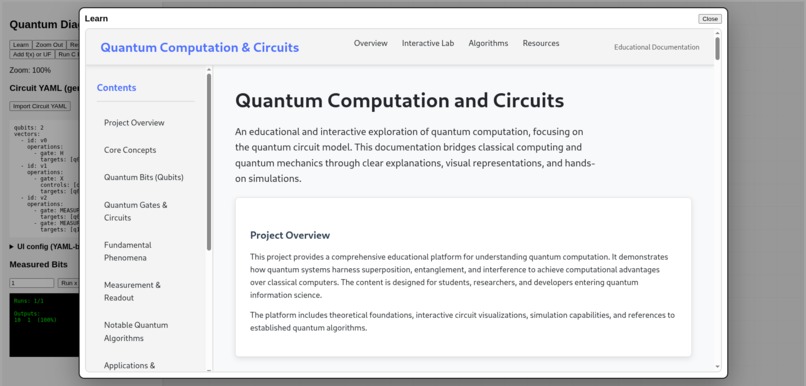
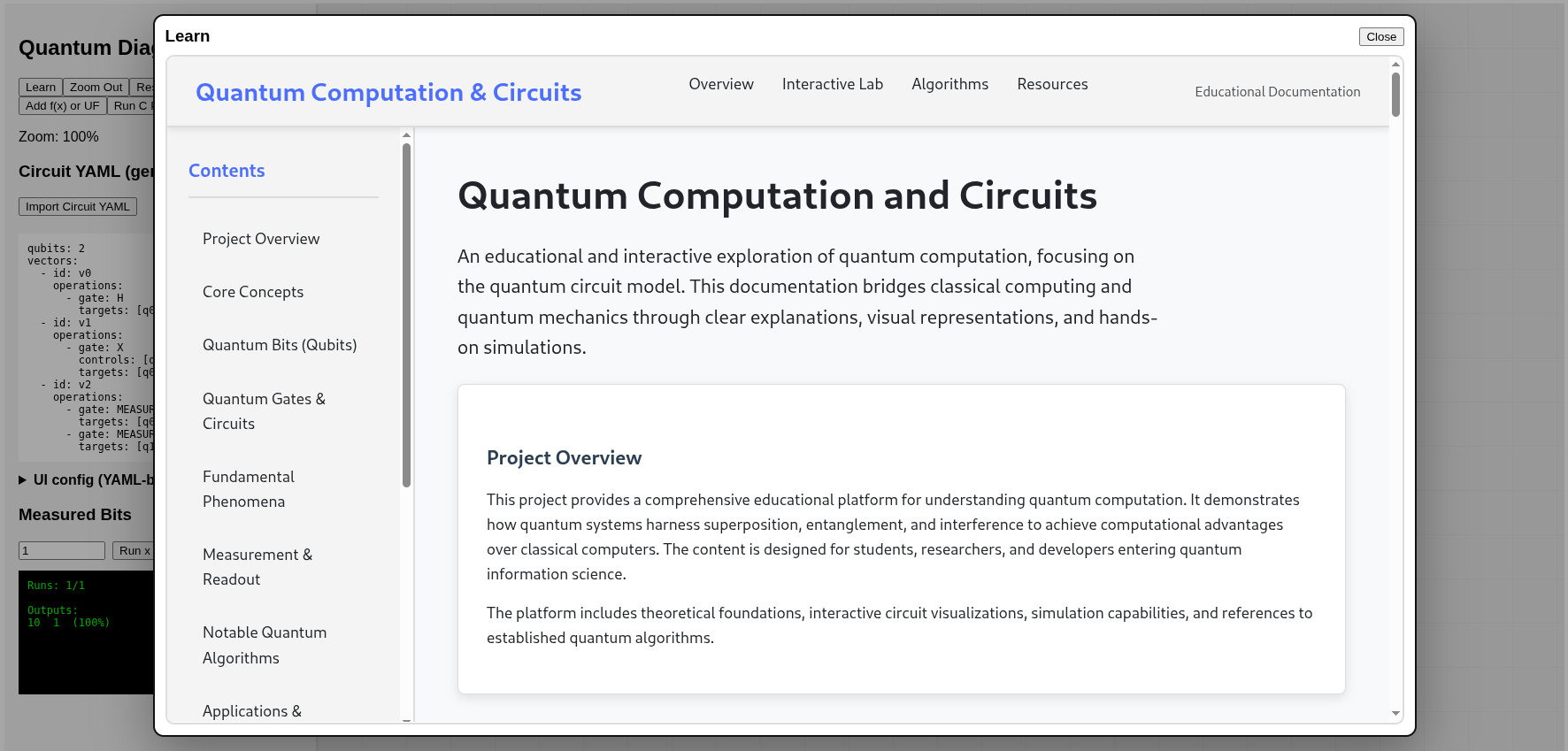
Educational Page
-
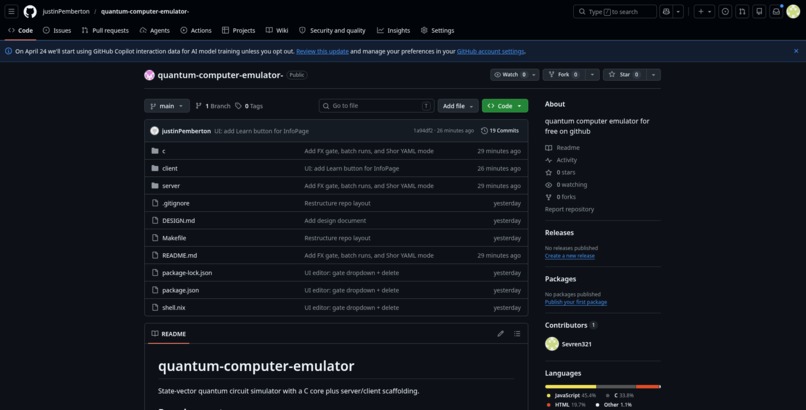
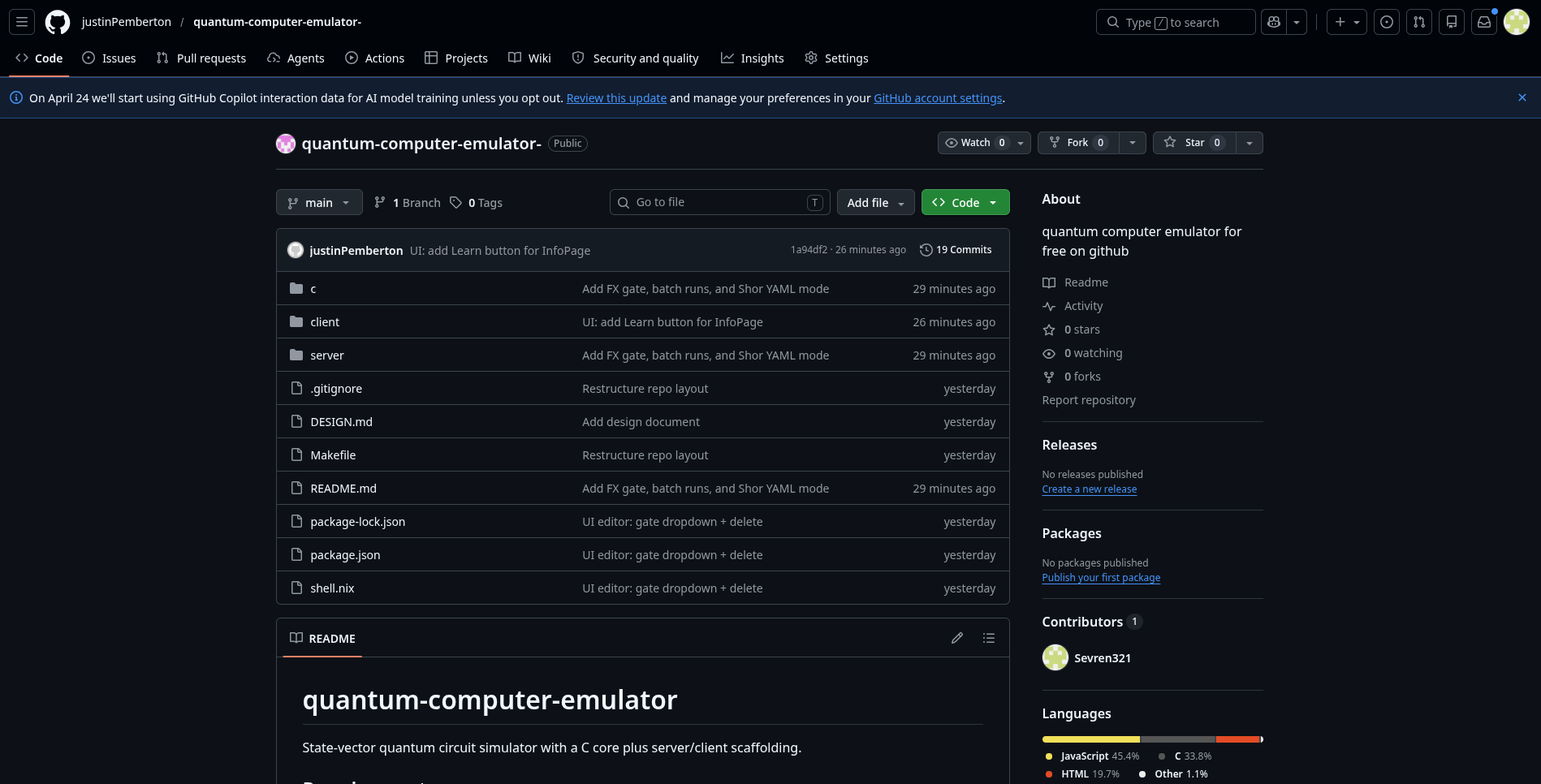
Github Repository
Inspiration
Quantum computing is one of the most exciting frontiers in technology, yet it remains extremely difficult for students and developers to experiment with. Most quantum simulators are either cloud-only, overly complex, or too slow for real-time learning.
As computer science students at Cal Poly Pomona, we were inspired by the growing need for accessible quantum education. We wanted to build a fast, local, and educational quantum computer emulator that anyone could run on their laptop — no internet or expensive hardware required. The BroncoHacks 2026 theme gave us the perfect opportunity to turn this vision into reality!
What it does
Quantum Computer Emulator is a full-stack quantum circuit simulator that allows users to:
- Build quantum circuits interactively using common gates (H, X, Y, Z, CNOT, etc.)
- Visualize qubits on Bloch spheres in real time
- Run simulations and see measurement probabilities instantly
- Explore educational documentation with detailed explanations of quantum gates, algorithms, and theory
- Learn foundational quantum algorithms such as Deutsch-Jozsa, Grover’s, and Bell state creation
It combines a high-performance C simulation backend with a modern React frontend, making quantum computing both fast and understandable.
How we built it
We took a full-stack approach:
- Backend: A high-performance state-vector simulator written in C for speed and efficiency.
- Frontend: React.js with modern UI components for circuit building and visualization.
- Documentation: A complete, self-contained HTML/CSS/JS educational page (
infopage.html) with interactive 2-qubit simulator, matrices, and theory. - Integration: REST API connecting the C core to the React frontend.
We worked collaboratively — one teammate focused on the simulation core and backend, while the other developed the UI, documentation, and interactive learning experience.
Challenges we ran into
- Optimizing the C simulation core to handle multi-qubit operations efficiently under time pressure.
- Implementing accurate Bloch sphere visualizations and real-time state updates.
- Designing an intuitive drag-and-drop circuit builder while keeping the interface clean.
- Converting complex quantum theory into beginner-friendly educational content.
- Integrating the C backend with the React frontend smoothly.
Debugging floating-point precision issues in quantum state normalization was especially tricky!
Accomplishments that we're proud of
- Successfully implementing a working quantum simulator with both C core and modern web UI in under 36 hours.
- Creating a beautiful, fully responsive educational documentation page that stands on its own.
- Achieving real-time visualization of quantum states (Bloch spheres + probabilities).
- Building something that is genuinely useful for students learning quantum computing.
- Delivering a complete, polished product with documentation, demo, and source code.
What we learned
- Deepened our understanding of quantum information theory (especially gate matrices and state evolution).
- Improved skills in performance-oriented C programming and numerical computing.
- Learned how to rapidly integrate low-level languages with modern web frameworks.
- The importance of clear educational design when explaining complex technical topics.
- How to collaborate effectively under tight hackathon deadlines.
What's next for Quantum Computer Emulator
We plan to continue development after the hackathon by:
- Adding support for more qubits and larger circuits
- Implementing additional algorithms (Grover’s, Shor’s, VQE)
- Introducing full Dirac bra-ket notation support, allowing users to input and visualize quantum states directly in standard mathematical notation
- Adding circuit saving/loading and export features
- Creating a gallery of pre-built example circuits
- Packaging it as an easy-to-install desktop application
- Expanding the educational content into a full interactive textbook
Our ultimate goal is to make this the go-to open-source tool for learning and teaching quantum computing.


Log in or sign up for Devpost to join the conversation.