-
-
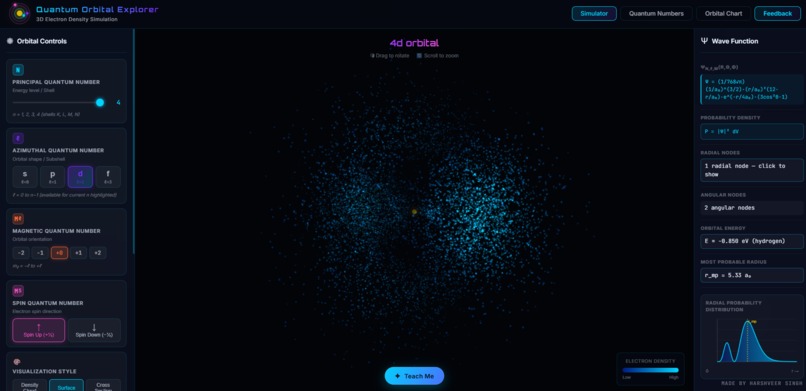
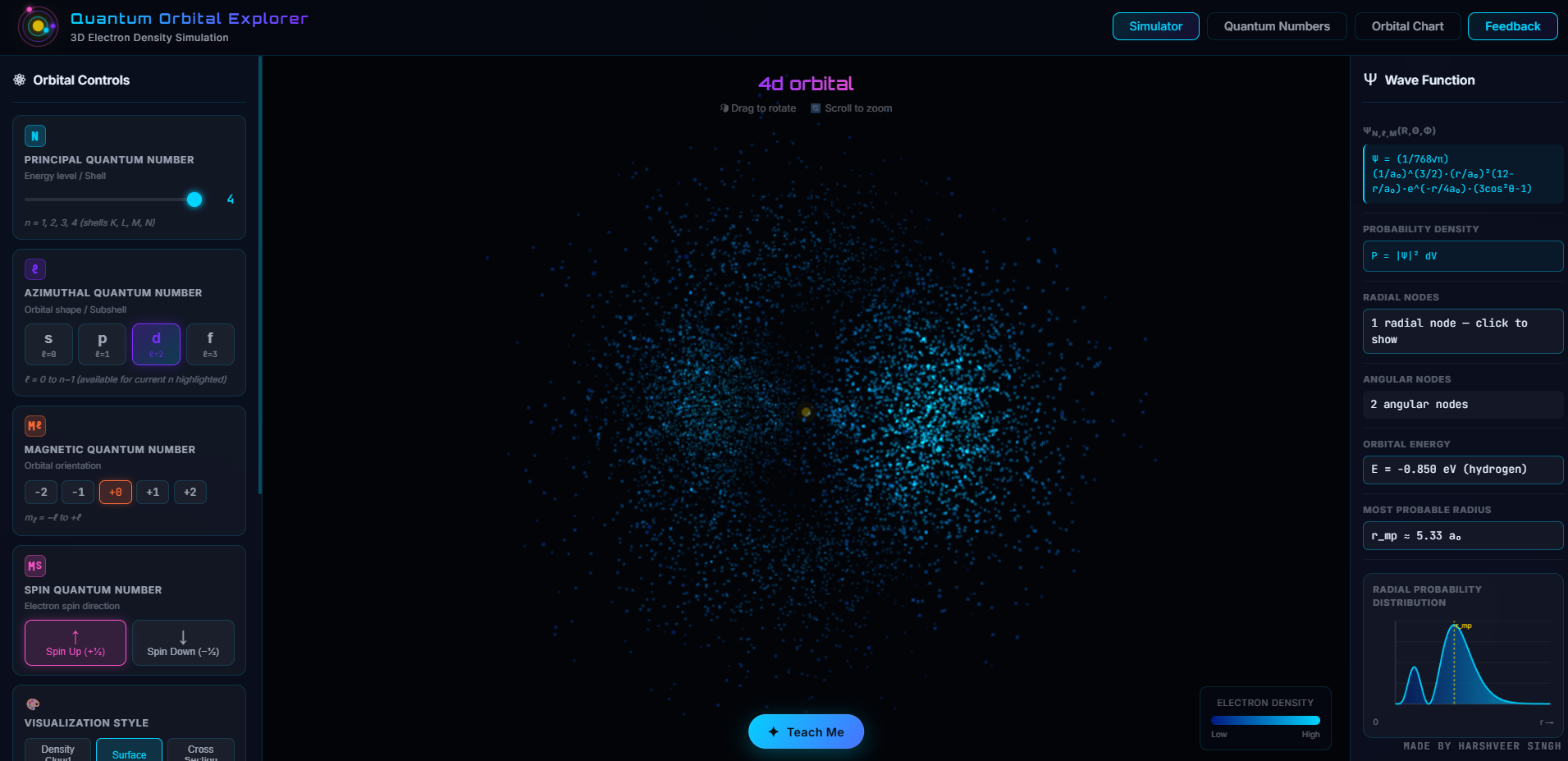
Interactive 4d orbital visualization demonstrating complex electron probability distributions.
-
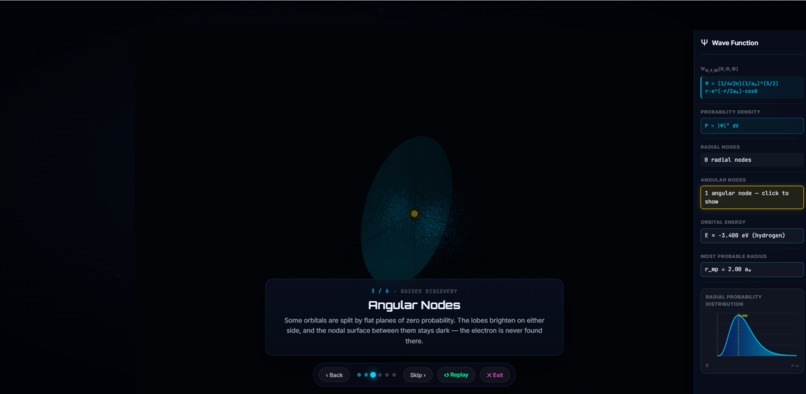
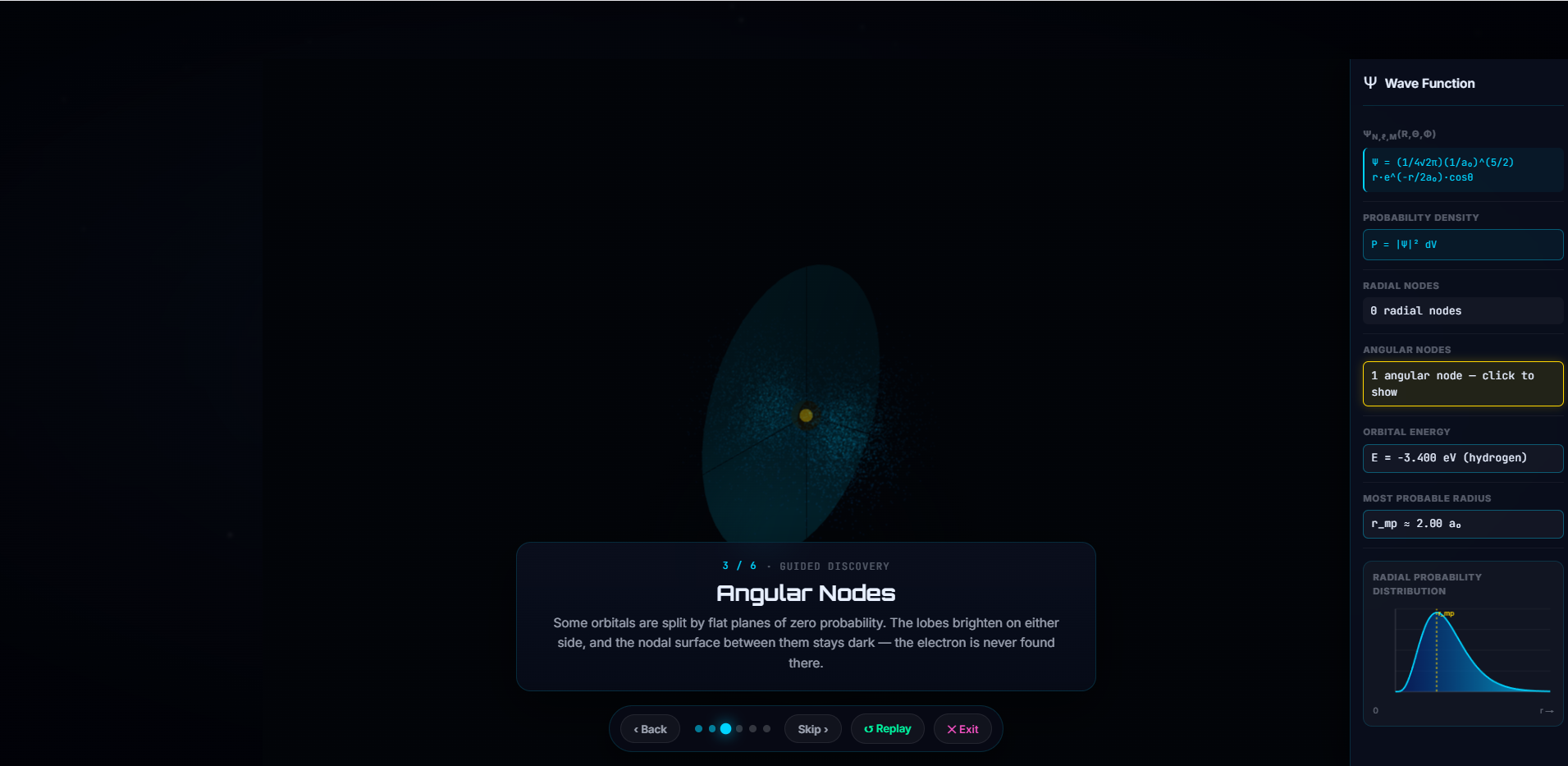
Guided Discovery Mode teaches orbital concepts through interactive, step-by-step visual explanations.
-
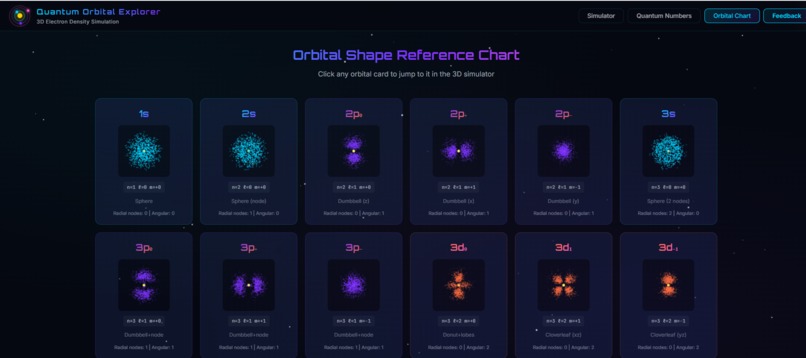
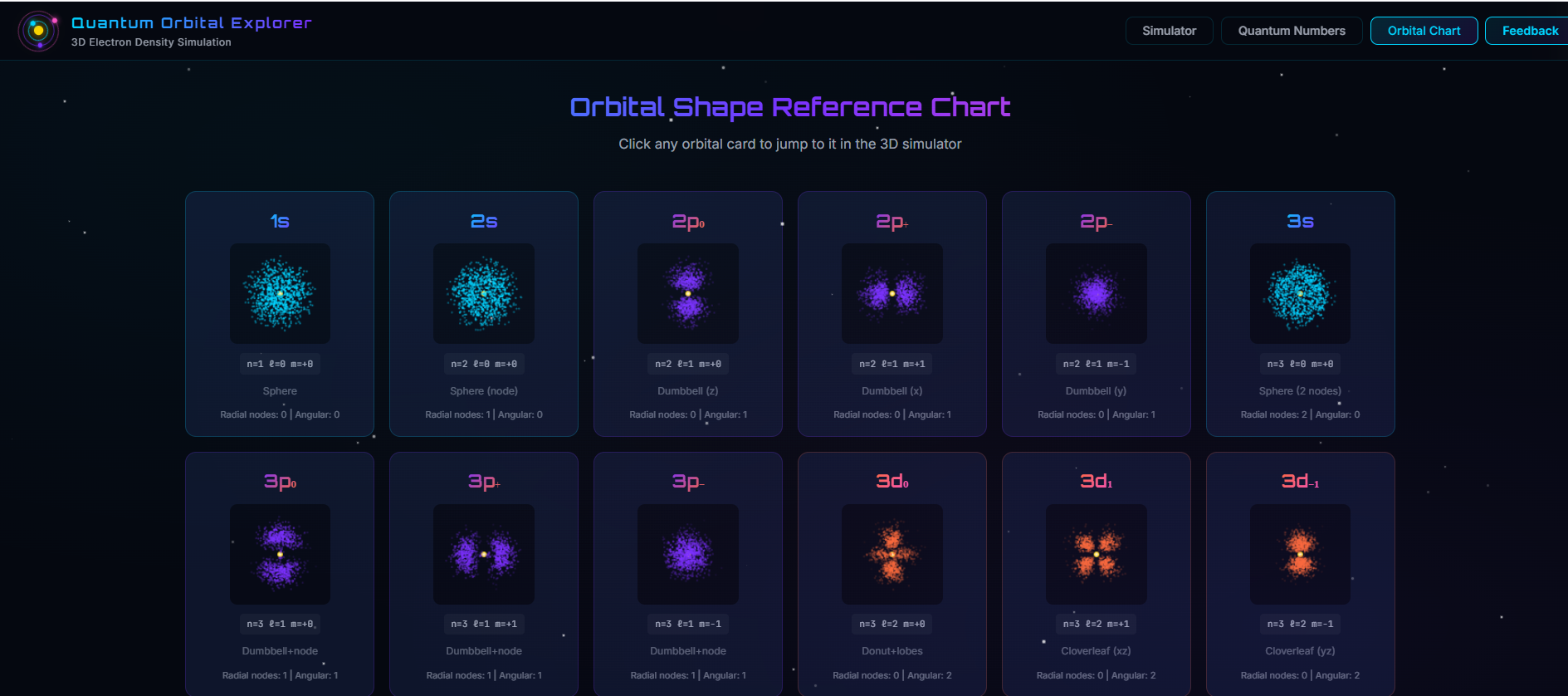
Reference library of hydrogen atomic orbitals with instant access to the interactive 3D simulator.
-
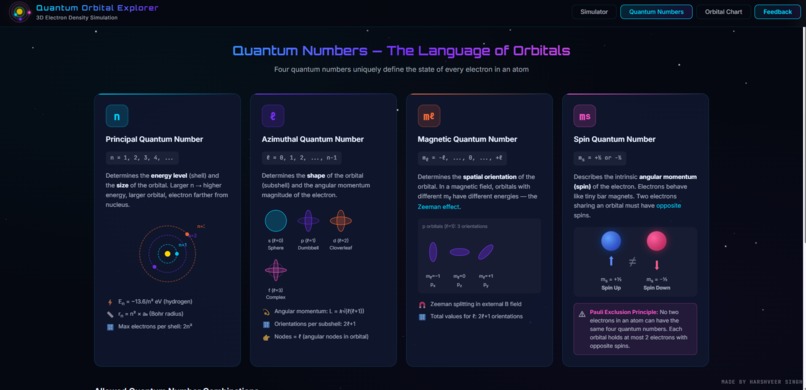
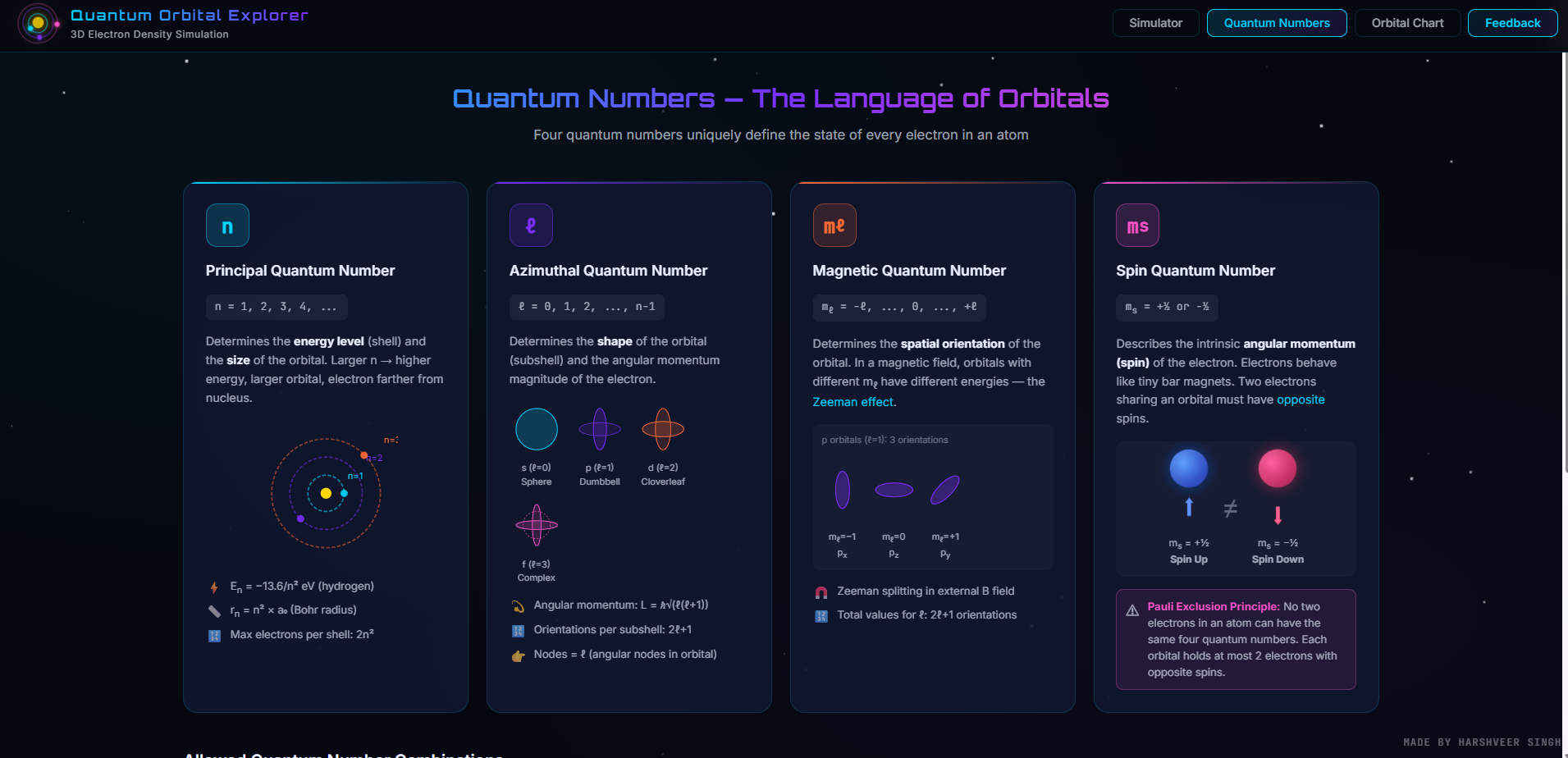
Interactive learning module explaining the four quantum numbers and their physical significance.
-
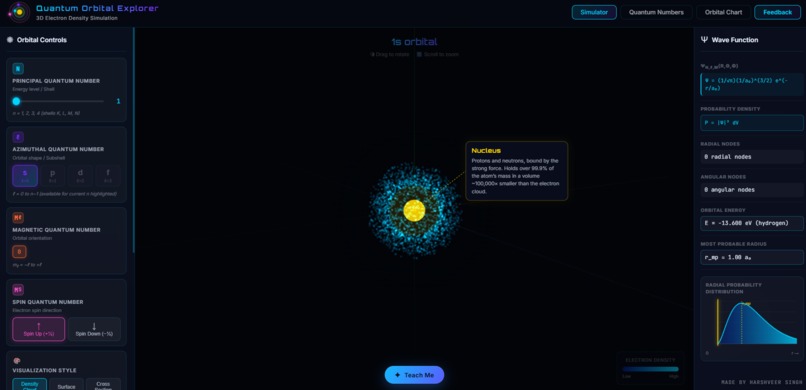
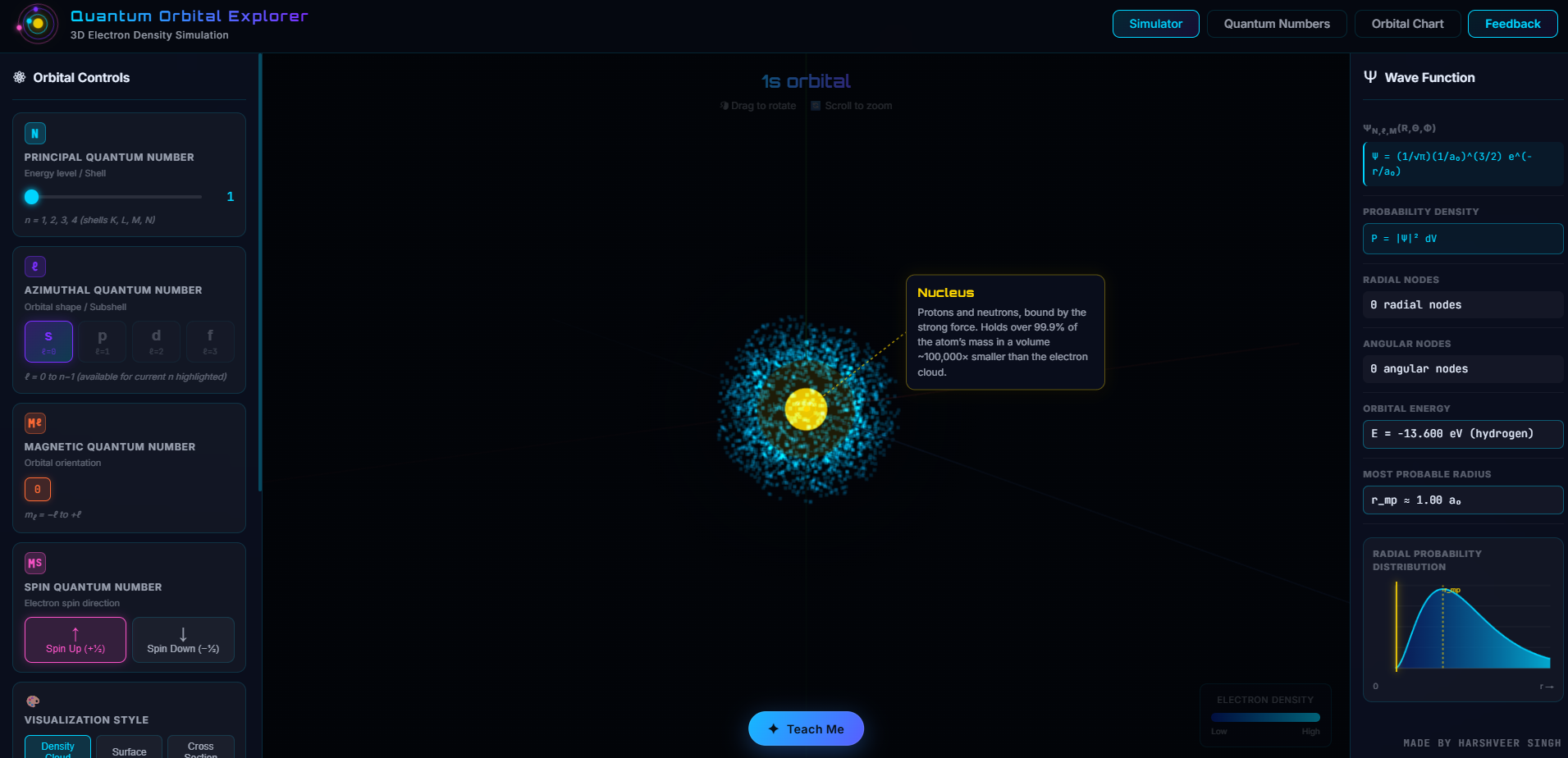
Interactive 1s orbital simulator with real-time quantum controls and probability density visualization.
Quantum Orbital Explorer
Inspiration
Quantum mechanics is one of the most fascinating subjects in science, yet it is also one of the hardest to visualize. Students are often expected to memorize orbital shapes, quantum numbers, and wavefunctions from static textbook diagrams without ever truly understanding what they represent.
We wanted to change that.
Our goal was to transform quantum mechanics from something students simply memorize into something they can actually explore, experience, and understand through interaction.
Instead of reading about orbitals, learners can navigate inside them, observe their probability distributions, and follow a guided lesson that explains each concept step by step.
What it does
Quantum Orbital Explorer is an interactive educational platform for visualizing hydrogen atomic orbitals using real quantum mechanical wavefunctions.
The application allows users to:
- Explore hydrogen orbitals in fully interactive 3D
- Visualize electron probability density
- Experiment with all four quantum numbers
- Observe radial probability distributions
- View orbital energies and wavefunctions
- Understand radial and angular nodes
- Learn through a cinematic guided "Teach Me" mode
Unlike traditional orbital visualizers, the application actively teaches each orbital through synchronized camera movement, animations, visual highlights, and contextual explanations.
How we built it
The application was built entirely as a web application using modern browser technologies.
Technologies
- HTML5
- CSS3
- JavaScript (Vanilla)
- Three.js
- Firebase Hosting
The orbital geometry is generated mathematically using the analytical hydrogen atom wavefunctions instead of pre-made 3D models.
Electron density is produced through Monte Carlo sampling of the probability density function, allowing every orbital to emerge naturally from quantum mechanics.
The guided discovery system combines camera choreography, animations, synchronized UI updates, and educational overlays to create an interactive learning experience.
Challenges we ran into
One of the biggest challenges was balancing scientific accuracy with usability.
Displaying the mathematics correctly was only half the problem.
The harder challenge was explaining abstract quantum concepts in a way that students could intuitively understand without oversimplifying the underlying physics.
Designing the guided teaching mode required coordinating camera movement, animations, educational content, and user interaction while maintaining a smooth and responsive experience.
Accomplishments that we're proud of
- Real hydrogen wavefunction implementation
- Interactive 3D orbital visualization
- Guided Discovery learning mode
- Cinematic educational camera system
- Responsive interface across desktop, tablet, and mobile devices
- Interactive radial probability graphs
- Educational visualization of nodes, probability density, and orbital energy
Most importantly, we transformed a traditionally static topic into an interactive educational experience.
What we learned
This project taught us that great educational software is not just about displaying information.
It's about guiding curiosity.
We learned how thoughtful interaction design, animation, and visualization can make complex scientific concepts significantly easier to understand.
What's next for Quantum Orbital Explorer
Our long-term vision is to build a complete interactive quantum learning platform.
Future plans include:
- Multi-electron atoms
- Molecular orbital visualization
- Hybridization explorer
- Chemical bonding simulation
- AR/VR classroom experiences
- Interactive quizzes and assessments
- AI-powered tutoring
- Classroom integration for teachers and students


Log in or sign up for Devpost to join the conversation.