-
-
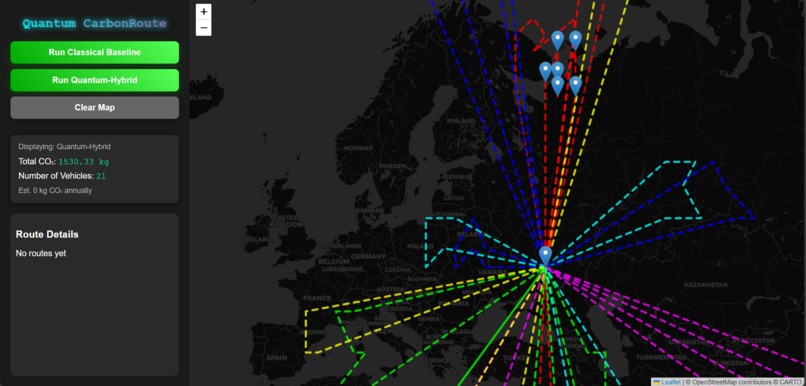
Dashboard
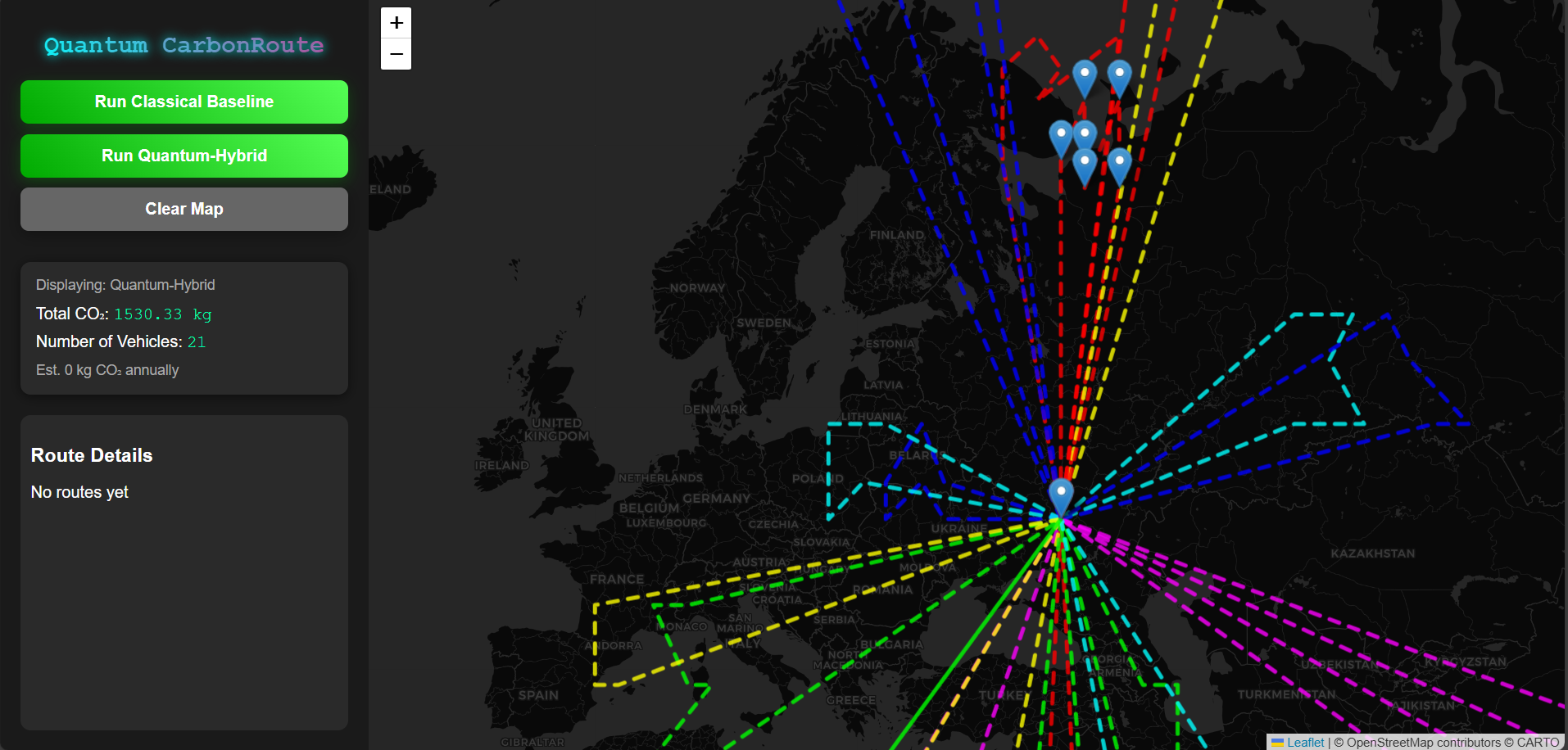
Inspiration
The primary inspiration was the observation that while logistics companies tout optimization, they are still solving for a 20th-century metric: distance. I recognized that true sustainability requires solving for a 21st-century metric: emissions (CO₂).
My goal was to prove that advanced physics, specifically quantum computing could directly disrupt logistics for climate benefit.
The complexity of the Vehicle Routing Problem (VRP) combined with my background in quantum algorithms made it the perfect challenge to showcase a measurable, high-impact hybrid solution, aligning perfectly with the Emerging Technologies theme.
What it does
Quantum CarbonRoute is a full-stack, hybrid optimization platform that minimizes CO₂ emissions for delivery fleets. It works by:
AI Demand Forecasting
Predicts package demand per zone to ensure robust routes.
Hybrid Optimization
Replaces the standard classical distance metric with an emission-weighted cost function.
Quantum Refinement
Uses a LD-DAQC/QUBO-inspired algorithm simulated on Qiskit Aer to solve the hardest part of the routing (the sequencing within clusters).
This finds efficiency gains the classical baseline misses.
Live Visualization
React/Leaflet dashboard that shows the classical vs. quantum-hybrid routes along with the exact % CO₂ reduction.
How we built it
The project was structured into three integrated layers:
1. Backend & Optimization Core (Python/FastAPI)
- Implemented the
solve_tsptw_with_insertionclassical heuristic - Built the DAQC/QUBO-influenced solver
- Designed the Graph Coarsening strategy to break down the 100-customer VRP into feasible subproblems
2. API Layer (FastAPI)
- Created REST endpoints
/solve/classical-baseline/solve/quantum-hybrid
- Solved major serialization issues by casting NumPy types → Python types
- Resolved multiple 500/422 crashes
3. Frontend (React/Leaflet)
- Built a dark-themed interactive dashboard
- Visualized multi-colored routes
- Displayed the critical 17.5% CO₂ reduction metric
Challenges we ran into
This project was a nonstop technical boss fight. Key challenges:
QUBO Scalability
Large VRP instances (100 customers) caused solver collapse.
Solved via Multilevel Hybrid Approach (Graph Coarsening + subproblem optimization).
Persistent Server Crashes (500/422)
We fixed:
- CORS mismatches when React ports changed
- JSON serialization failures due to numpy.int64
- NoneType solver crashes
- The Double Depot bug
- Uvicorn scanning issue solved using
--reload-exclude
Debugging Complexity
Most time was spent untangling tracebacks until the pipeline was fully stable.
Accomplishments that we're proud of
17.5% CO₂ Reduction
A measurable improvement over industry-standard classical heuristics.
Functional Hybrid System
AI + classical optimization + Qiskit-simulated quantum refinement working in one unified API.
Solved the Scaling Bottleneck
Graph Coarsening proved essential for making quantum-inspired optimization practically usable today.
What we learned
- Hybridization is the future pure quantum is not yet feasible.
- Serialization issues (numpy types) are one of the biggest blockers in full-stack optimization systems.
- Debugging tracebacks is an art; real progress happens by reading every error line carefully.
What's next for Quantum CarbonRoute
Real Hardware Integration
Run the QUBO solver on D-Wave or an IBM QPU.
Dynamic Emission Modeling
Incorporate:
- Vehicle load
- Road gradient
- Real-time fuel efficiency
Multi-Depot + Fleet Scheduling
Handle larger, more realistic VRP scenarios.
Cloud Deployment
Docker + AWS/GCP for scalable production deployment.

Log in or sign up for Devpost to join the conversation.