-
Live Demo with Agent
Inspiration
Modern businesses rely on optimization to make high-stakes decisions, but many real-world problems—like pricing and bundling—quickly become too complex to solve intuitively. At the same time, quantum computing is often presented as futuristic, abstract, and disconnected from real applications.
We wanted to bridge that gap by building something that feels like a real product, not just a research experiment: a tool that shows how quantum-inspired methods can meaningfully contribute to business decision-making today.
What it does
Our project is an interactive dashboard that compares classical optimization, QAOA (Quantum Approximate Optimization Algorithm), and DQI (Decoder-based Quantum-inspired approach) on an insurance bundle recommendation problem.
Users can:
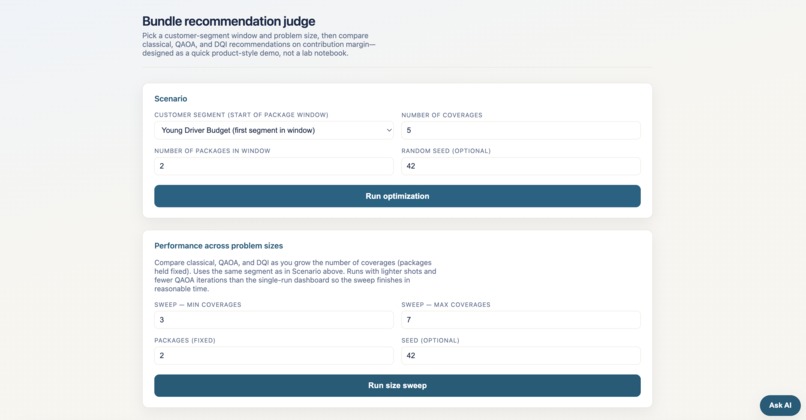
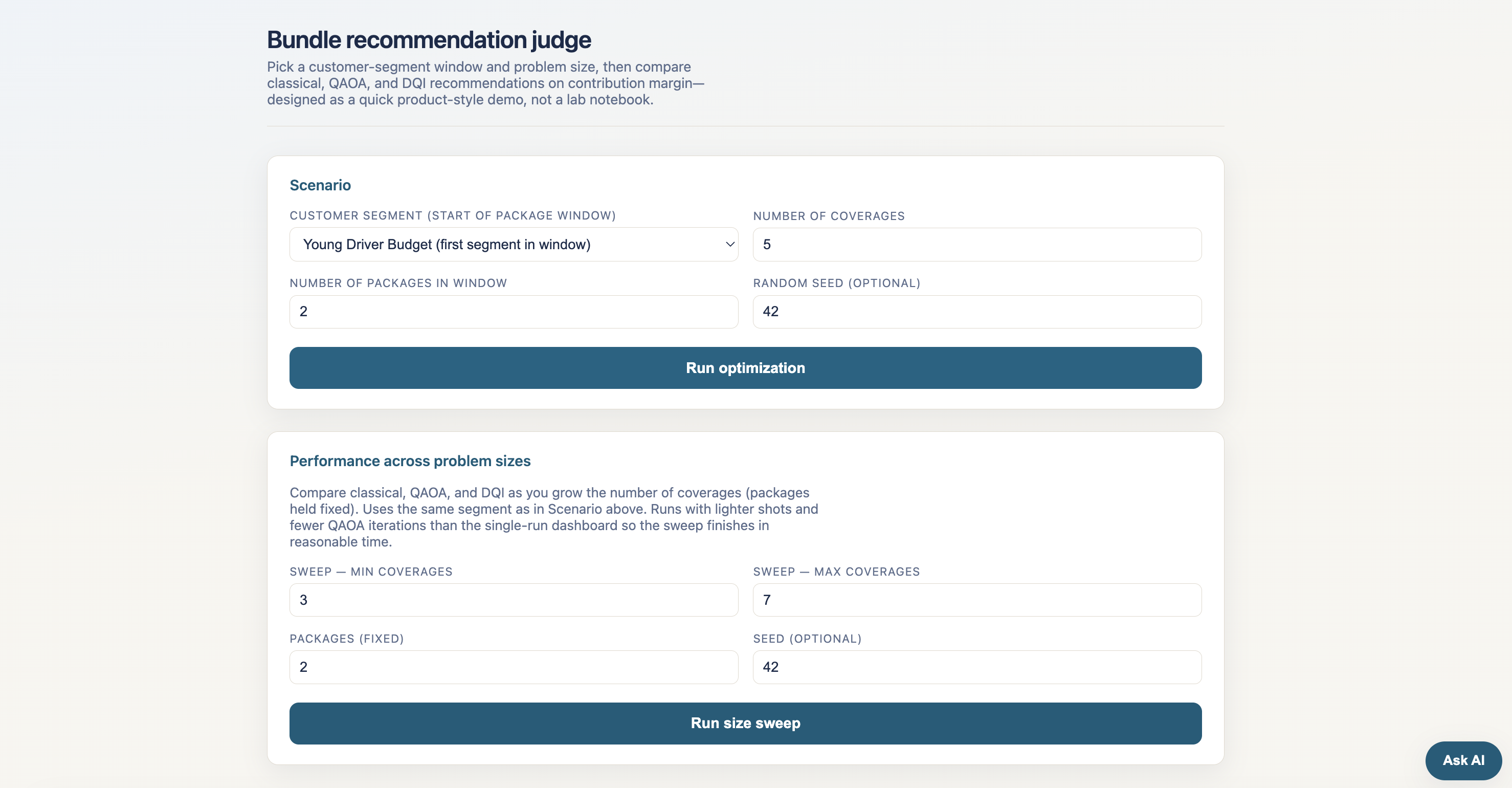
Select customer segments and bundle sizes Run optimization in real time Compare outcomes across methods Visualize performance through charts and scaling analysis
The system outputs:
Best bundle recommendations Contribution margins (objective values) Feasibility and reliability metrics Performance trends as problem size increases How we built it
We combined optimization, quantum simulation, and web engineering into a unified system:
Backend (Python + FastAPI) Classical optimization via ILP QAOA simulation using Qiskit-style circuits DQI decoding for feasible solution extraction Benchmarking pipeline for comparing methods Frontend (HTML/CSS + Chart.js) Interactive dashboard UI Real-time charts (bar + line graphs) Scenario controls for experimentation Visualization layer Objective comparison across methods Convergence plots for QAOA Scaling analysis across problem sizes Challenges we ran into
One of the biggest challenges was making quantum methods comparable to classical optimization in a fair and interpretable way.
QAOA produces many infeasible solutions → we had to track feasibility rates DQI required careful decoding to ensure valid bundles Visualization needed to clearly communicate small differences in large objective values Performance tuning was critical to keep the app responsive
We also had to translate technical outputs into clear, product-style insights, not just raw numbers.
What we learned
We learned that quantum methods are not just about beating classical solutions—they are powerful tools for exploration and approximation.
Classical optimization still provides the ground truth QAOA explores the solution space but struggles with feasibility DQI acts as a stabilizer, consistently producing usable solutions
Most importantly, we learned how to turn advanced algorithms into something intuitive, interactive, and decision-focused.
What's next
We plan to extend this system by:
Scaling to larger, real-world datasets Integrating real quantum hardware Improving hybrid classical-quantum workflows Expanding to other industries beyond insurance
Our goal is to build tools that make quantum computing practical, interpretable, and accessible for real decision-makers.

Log in or sign up for Devpost to join the conversation.