-
-
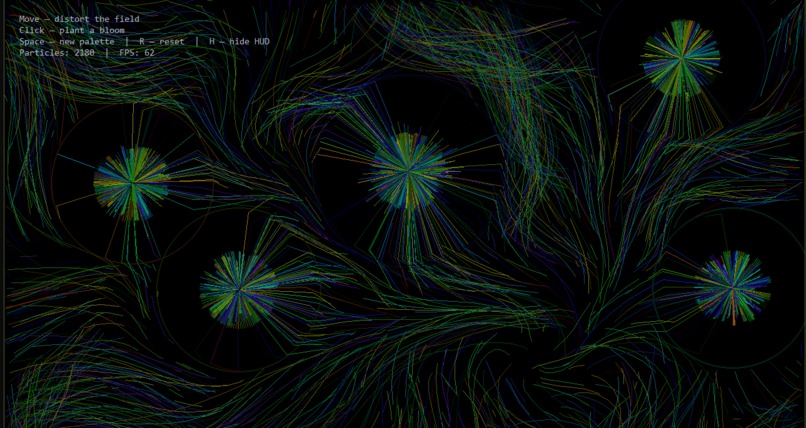
A photographic demo of the art made with tech
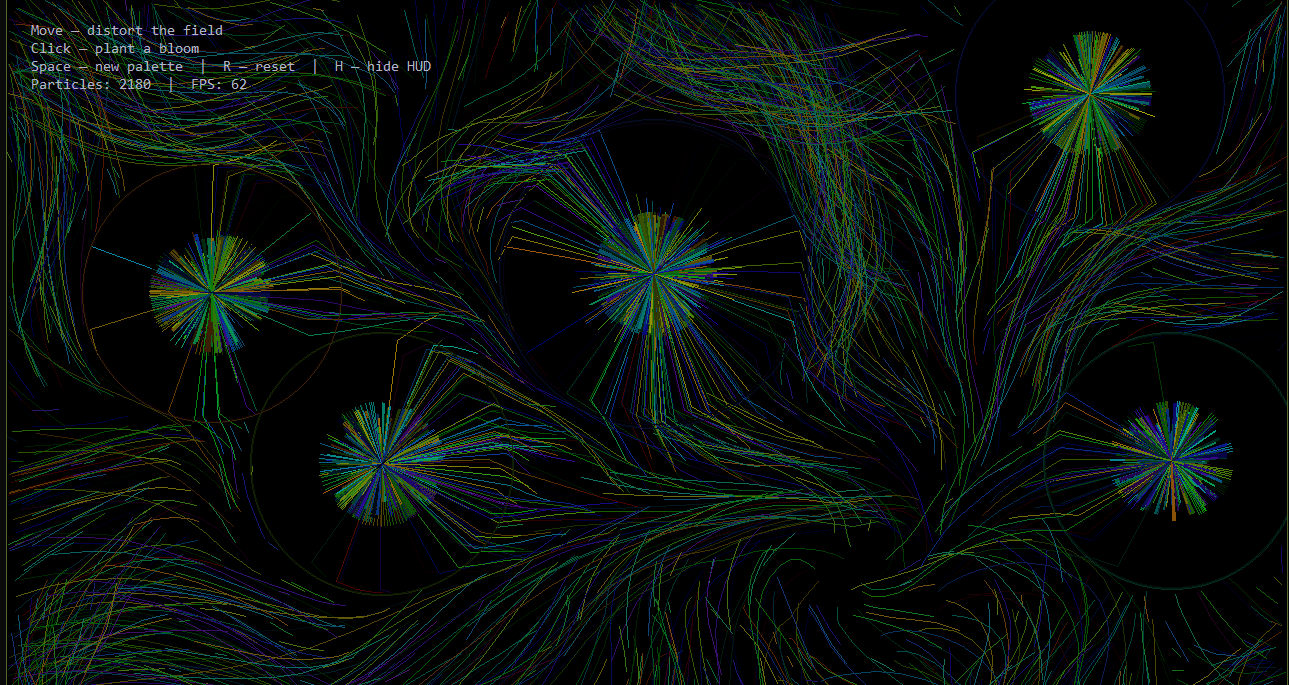
Inspiration
Art has always been shaped by its tools — from charcoal to cameras. We asked: what can art do when the tool is code itself? We wanted to build something that isn't a static image or a video, but a living system — art that evolves, responds, and surprises even the person running it.
What it does
Quantum Bloom is an interactive generative art piece written in Python. Thousands of particles flow through an evolving noise-driven vector field, leaving painterly trails across the canvas. Move your mouse to warp the field around your cursor. Click anywhere to plant a bloom — a gravitational seed that pulls particles into spiraling, galaxy-like patterns. Colors shift procedurally based on particle speed and time. No frame is pre-rendered; every visual is computed live at 60 FPS.
How we built it
We built the project in Python using:
- NumPy for particle physics and noise-based flow fields
- Pillow for high-performance pixel-buffer rendering
- Tkinter for the interactive window and input handling
Accomplishments that we're proud of Built a fully interactive art system from scratch during the hackathon Created emergent visuals (spirals, auroras, ripples) that aren't hardcoded — they arise from physics Made it zero-setup friendly: only two pip dependencies, runs on any machine with Python Every interaction produces unique output — the piece never looks the same twice
What we learned Generative art is a collaboration between the algorithm and the audience. The most interesting moments happen when user input meets simulation — a click becomes a gravitational event, a mouse movement becomes a distortion in space. We learned that interactivity turns computation into expression.
What's next for Quantum Bloom Audio reactivity — blooms triggered by sound/music Save and share snapshots or timelapse recordings Multiple interaction modes (repulsion, vortex, symmetry) Web version with WebGL for broader access VR/exhibition mode for immersive installations
The core systems:
- A value noise flow field that continuously morphs over time
- A particle engine with motion trails and inverse-square bloom forces
- A generative HSV palette that drifts and evolves on its own
Challenges we ran into Getting smooth performance with 2,000+ particles and trail rendering was tricky — we moved from a canvas-draw approach to a NumPy pixel buffer for faster updates. We also hit compatibility issues with pygame on Python 3.14, so we pivoted to tkinter + Pillow, which kept the project lightweight and easy to run

Log in or sign up for Devpost to join the conversation.