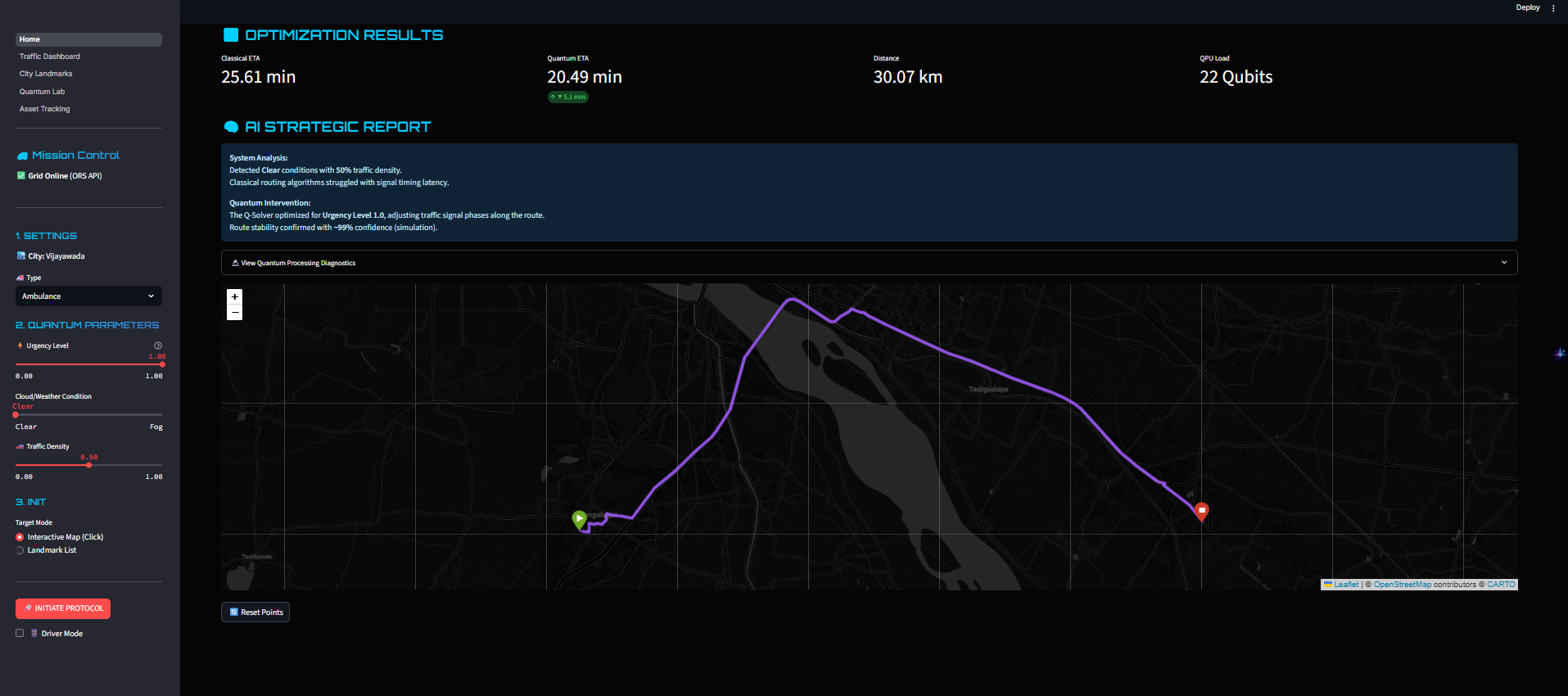
🌟 Inspiration Emergency response time is one of the most critical factors in saving lives. In dense Indian cities, ambulances, fire engines, and police vehicles often get stuck in heavy and unpredictable traffic, losing precious minutes that can determine the outcome of a crisis. This challenge motivated us to explore whether AI combined with Quantum‑Inspired Optimization could generate the fastest possible emergency route in real time. This idea led to the creation of Quantum AI Emergency Vehicle Routing, a system designed to reduce emergency delays, generate intelligent routing decisions, and support the development of safer and smarter cities.
🚑 What It Does Our system provides real‑time, intelligent routing for emergency vehicles by combining multiple advanced technologies. It uses AI models to predict traffic congestion, expected delays, and future traffic buildup. A Quantum‑Inspired Optimization engine evaluates thousands of route possibilities and selects the fastest and safest path available under current conditions. It integrates live traffic data, road closures, and travel times from real maps to ensure accurate routing. The system supports multiple emergency categories—ambulances, fire rescue, police operations, disaster response, and organ transport. To make decisions transparent, an Explainable AI layer describes why a route was chosen, how it reduces response time, and what risks were avoided. In essence, it computes the fastest, safest, and most traffic-aware emergency path using a fusion of AI and quantum-inspired logic.
🏗️ How We Built It We began by collecting and preprocessing data from real Vijayawada road networks, traffic conditions, and emergency case studies, creating realistic test scenarios. For predictions, we built an AI model capable of estimating delays, congestion levels, and projected traffic flows. The routing problem itself was formulated mathematically as an optimization function:
T=t travel + t delay + traffic penalty
We then used a QAOA‑inspired optimization engine to compute the highest‑scoring route based on speed, safety, and traffic dynamics. For real‑time routing, Google Maps APIs were integrated to fetch live traffic conditions and road closures. Finally, we designed an intuitive dashboard that allows operators to select emergency type, enter source and destination, view optimized routes, compare alternatives, and read explanation summaries.
⚠️ Challenges We Ran Into Integrating AI predictions with quantum-inspired optimization was technically challenging because both systems needed to align perfectly to produce reliable results. Ensuring real‑time performance was another difficulty, as the system must compute optimal routes within seconds despite constantly changing traffic conditions. Dynamic traffic data introduced unpredictability, making consistent optimization harder. Additionally, visualizing complex computation outputs in a simple and user-friendly interface required thoughtful design and refinement.
🏆 Accomplishments We’re Proud Of We successfully built a complete end‑to‑end emergency routing system where AI, quantum-inspired optimization, and live traffic integration operate seamlessly together. Our optimized paths consistently outperformed traditional shortest-path routes under real traffic stress. The system also supports various emergency use cases—from ambulances to disaster rescue—making it widely applicable. One of our proudest achievements is the clean, intuitive dashboard that makes complex routing decisions easy for users to understand.
📚 What We Learned Throughout the project, we gained a deep understanding of how QAOA-inspired techniques can solve complex routing problems. We learned to build real‑time algorithms capable of adapting to dynamic, constantly changing traffic inputs. Implementing Explainable AI taught us how to convert technical decision processes into clear, human-readable explanations. Most importantly, the project provided experience in combining multiple engineering domains—including machine learning, quantum-inspired optimization, maps APIs, UI/UX, and backend systems—into one unified platform.
🚀 What’s Next for Quantum AI Emergency Vehicle Routing In the future, we plan to integrate the system directly with hospitals so emergency teams can prepare before a patient arrives. Smart traffic signal coordination could automatically create green corridors for emergency vehicles. Drone‑based emergency scouting may help predict congestion and identify safer alternate roads. Multi‑vehicle coordination will enable the system to plan optimal routes for several emergency units operating simultaneously. Finally, we aim to deploy this project as a Smart City API, allowing municipal authorities to incorporate it into real‑world traffic management infrastructure.


Log in or sign up for Devpost to join the conversation.