-
-
Benchmark
\section*{Inspiration}
The rapid development of quantum hardware from companies such as IBM, IonQ, and Rigetti has created an urgent need for efficient software infrastructure that can fully utilize these systems. However, many existing quantum frameworks are either high-level research tools or tightly coupled to specific ecosystems.
Quantum Accelerate was inspired by the need for a high-performance, hardware-native quantum runtime that enables researchers and developers to design, optimize, and execute quantum algorithms efficiently across heterogeneous quantum hardware.
Our goal was to create a unified platform that bridges the gap between quantum algorithm design and real-world quantum hardware execution.
\section*{What it does}
Quantum Accelerate is a hardware-native quantum execution engine that allows developers to build, transpile, and run quantum circuits across multiple quantum platforms.
The system supports:
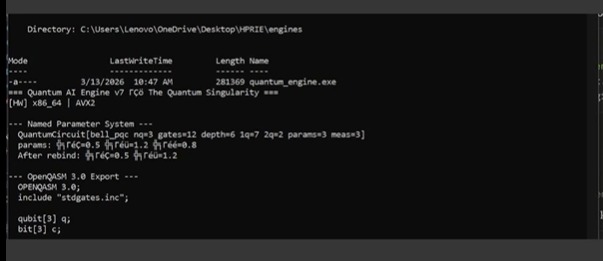
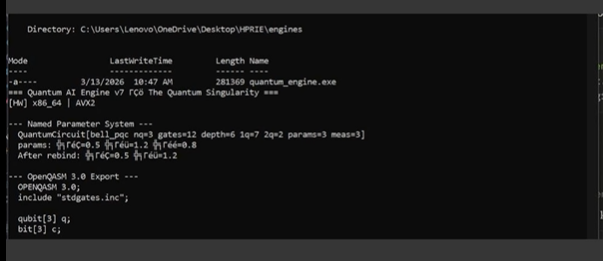
\begin{itemize} \item Variational quantum algorithms such as VQE, QAOA, QNN, and QSVM \item Hardware-aware circuit transpilation \item Multi-backend execution (IBM, IonQ, Rigetti, and local simulators) \item OpenQASM 3.0, OpenQASM 2.0, QIR, and IonQ JSON export \item High-performance statevector simulation with AVX-512 optimization \item Parameterized quantum circuits for hybrid quantum-classical workflows \end{itemize}
The engine enables researchers to prototype quantum algorithms locally and seamlessly deploy them on real quantum hardware.
\section*{How we built it}
Quantum Accelerate was implemented in modern C++20 with a modular architecture designed for performance and portability.
The core system consists of several major components:
\begin{itemize} \item \textbf{QuantumCircuit Builder} for constructing parameterized quantum circuits \item \textbf{ParameterRegistry} for managing named circuit parameters \item \textbf{Transpiler Pipeline} for gate decomposition and qubit mapping \item \textbf{Multi-format Exporters} supporting OpenQASM 3, QASM 2, QIR, and IonQ formats \item \textbf{Job Scheduler} for asynchronous execution and batching \item \textbf{Execution Engine} supporting both quantum hardware backends and high-performance simulators \end{itemize}
The simulator backend was optimized using vectorized operations (AVX-512) and OpenMP parallelism to efficiently simulate large quantum circuits.
\section*{Challenges we ran into}
One of the biggest challenges was designing a flexible architecture that could support multiple quantum hardware backends with different gate sets and execution models.
Another challenge involved implementing efficient quantum state simulation while maintaining numerical stability and scalability.
Managing parameterized circuits and enabling fast parameter binding for variational algorithms also required careful design of the parameter registry and circuit representation.
\section*{Accomplishments that we're proud of}
We successfully built a full-stack quantum execution engine capable of compiling circuits for multiple quantum hardware platforms.
Key achievements include:
\begin{itemize} \item Implementing a hardware-native quantum runtime from scratch \item Supporting multiple industry-standard quantum formats \item Developing a high-performance simulator with advanced CPU vectorization \item Designing a modular architecture capable of scaling to distributed quantum simulation \end{itemize}
The project demonstrates that modern systems programming can be used to build powerful infrastructure for the emerging quantum computing ecosystem.
\section*{What we learned}
Throughout this project we gained valuable experience in quantum software architecture, high-performance computing, and hybrid quantum-classical algorithm design.
We also learned the importance of designing flexible abstractions when working with rapidly evolving quantum hardware platforms.
This project deepened our understanding of quantum algorithms, compiler pipelines, and the engineering challenges involved in bridging theoretical quantum computing with practical hardware.
\section*{What's next for Quantum Accelerate}
Future development will focus on expanding the capabilities of the engine and improving hardware integration.
Planned improvements include:
\begin{itemize} \item Distributed quantum simulation for larger circuits \item Advanced transpiler optimizations \item Noise-aware circuit optimization \item Integration with cloud quantum platforms \item Support for additional quantum hardware architectures \end{itemize}
Our long-term vision is to transform Quantum Accelerate into a next-generation quantum computing runtime that enables scalable, efficient quantum algorithm development across the global quantum ecosystem.
Built With
- avx-512
- c++20
- openmp
- openqasm
- qir
- stl

Log in or sign up for Devpost to join the conversation.