-
-
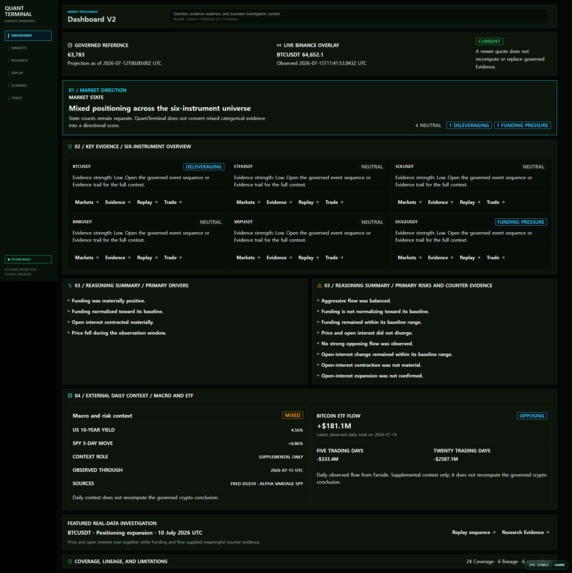
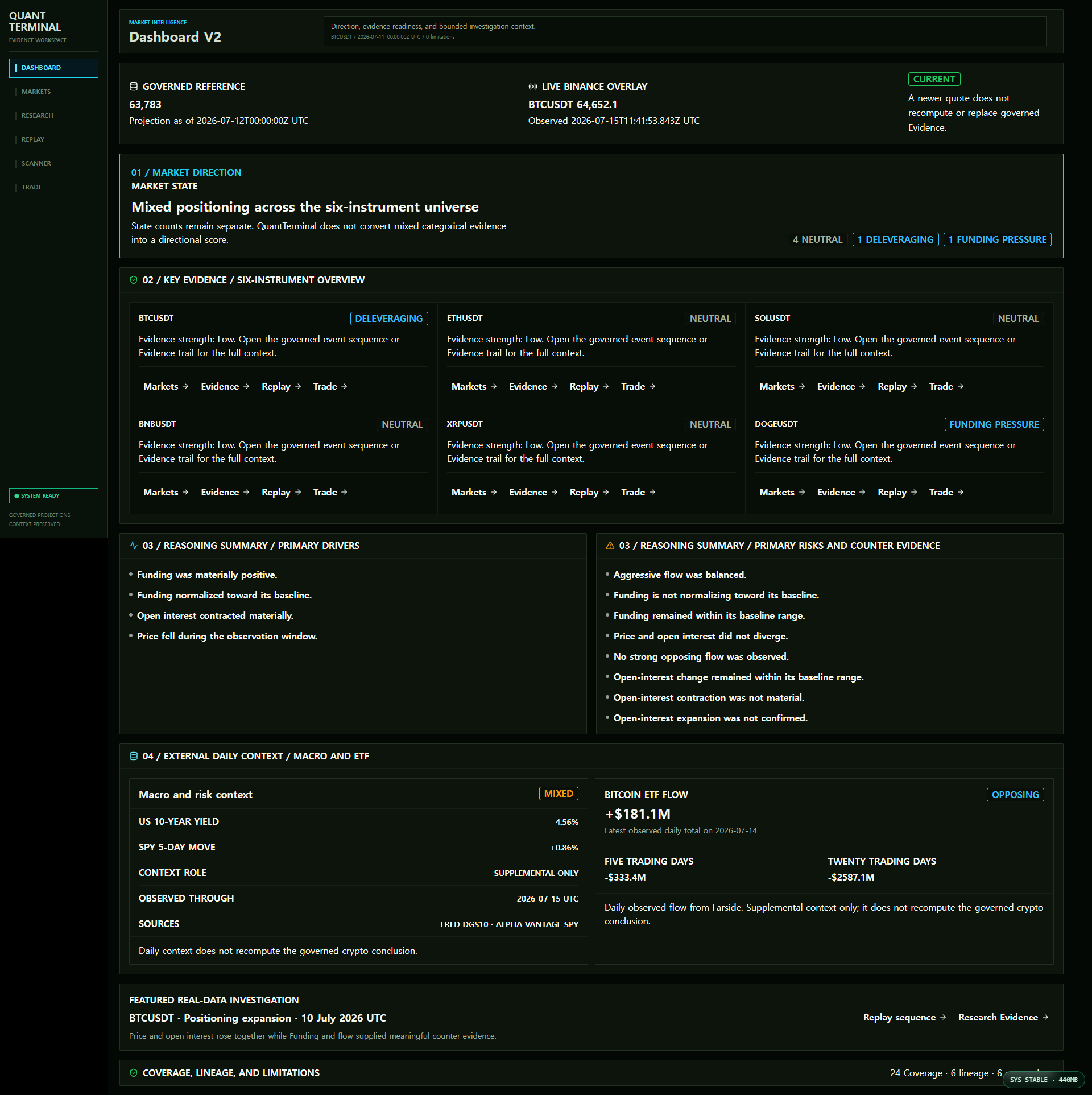
Dashboard
-
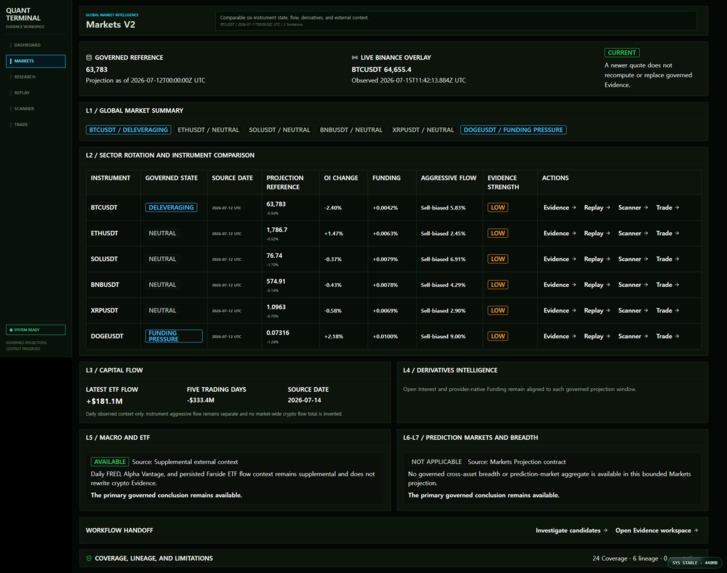
Markets
-
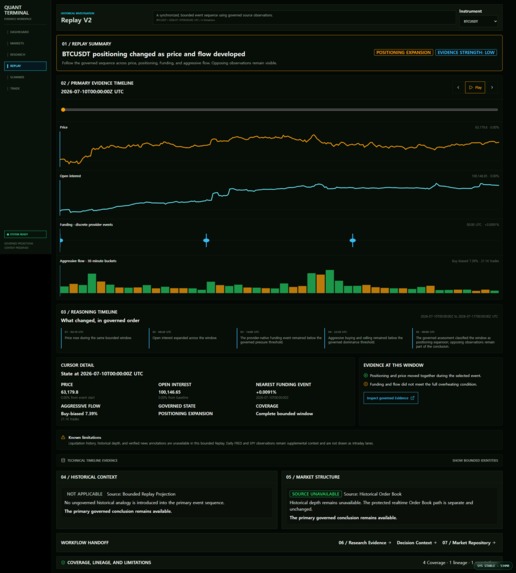
Replay
-
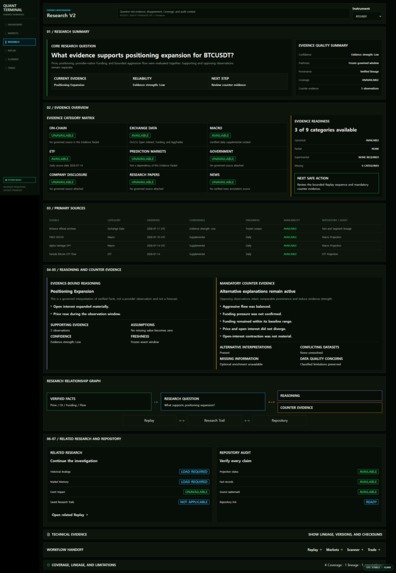
Research
-
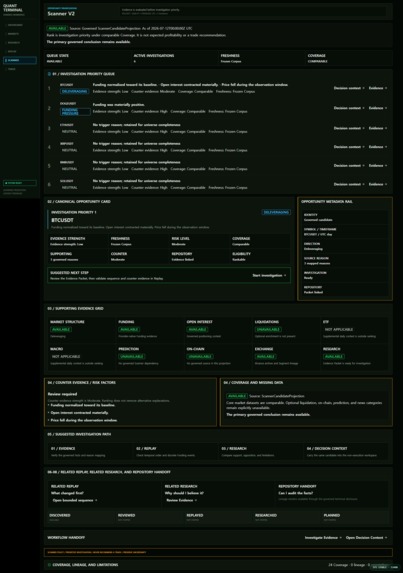
Scanner
-
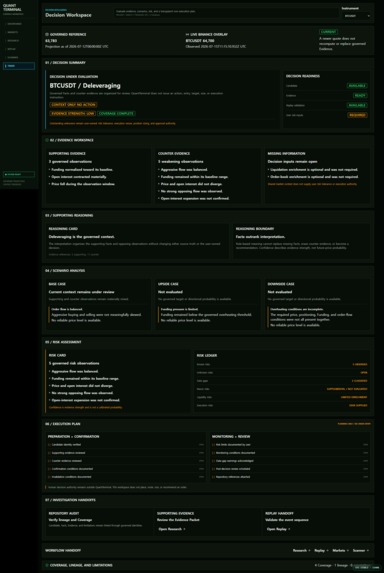
Trade
-
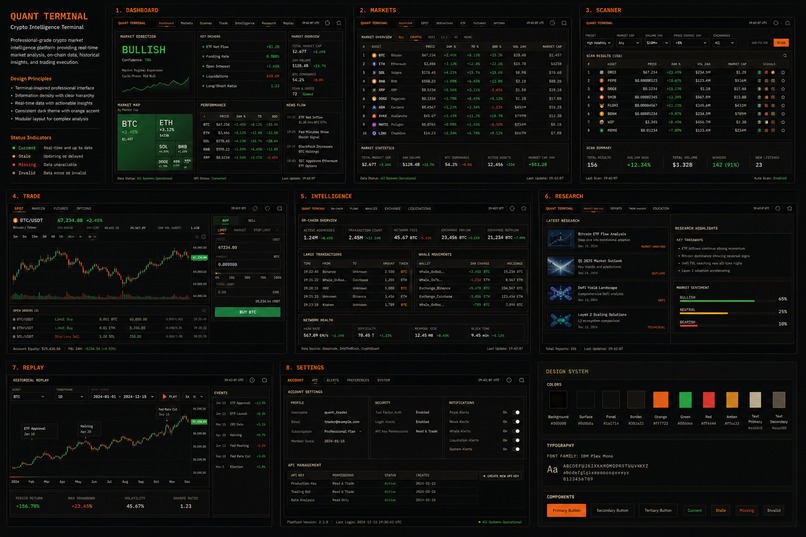
Figma
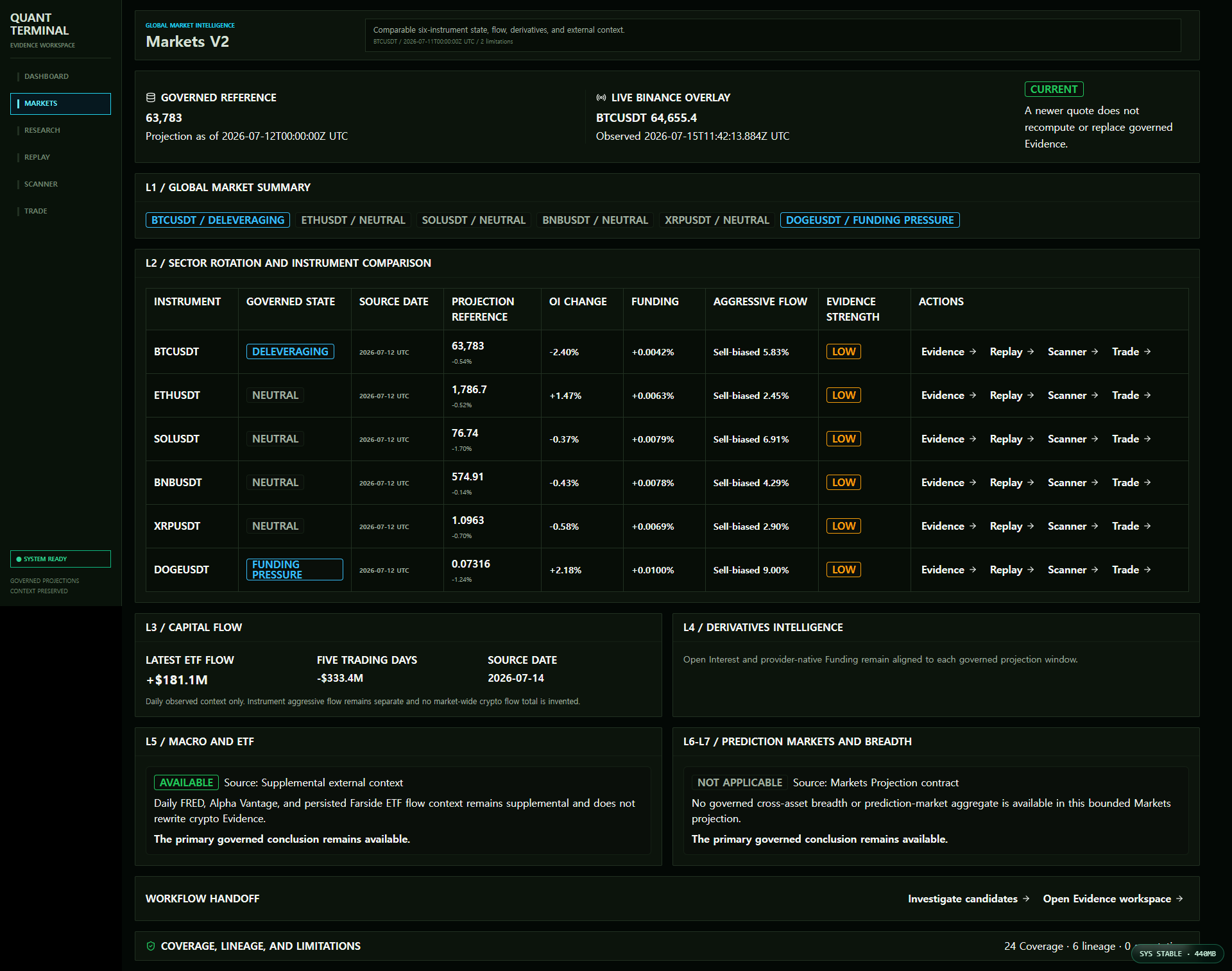
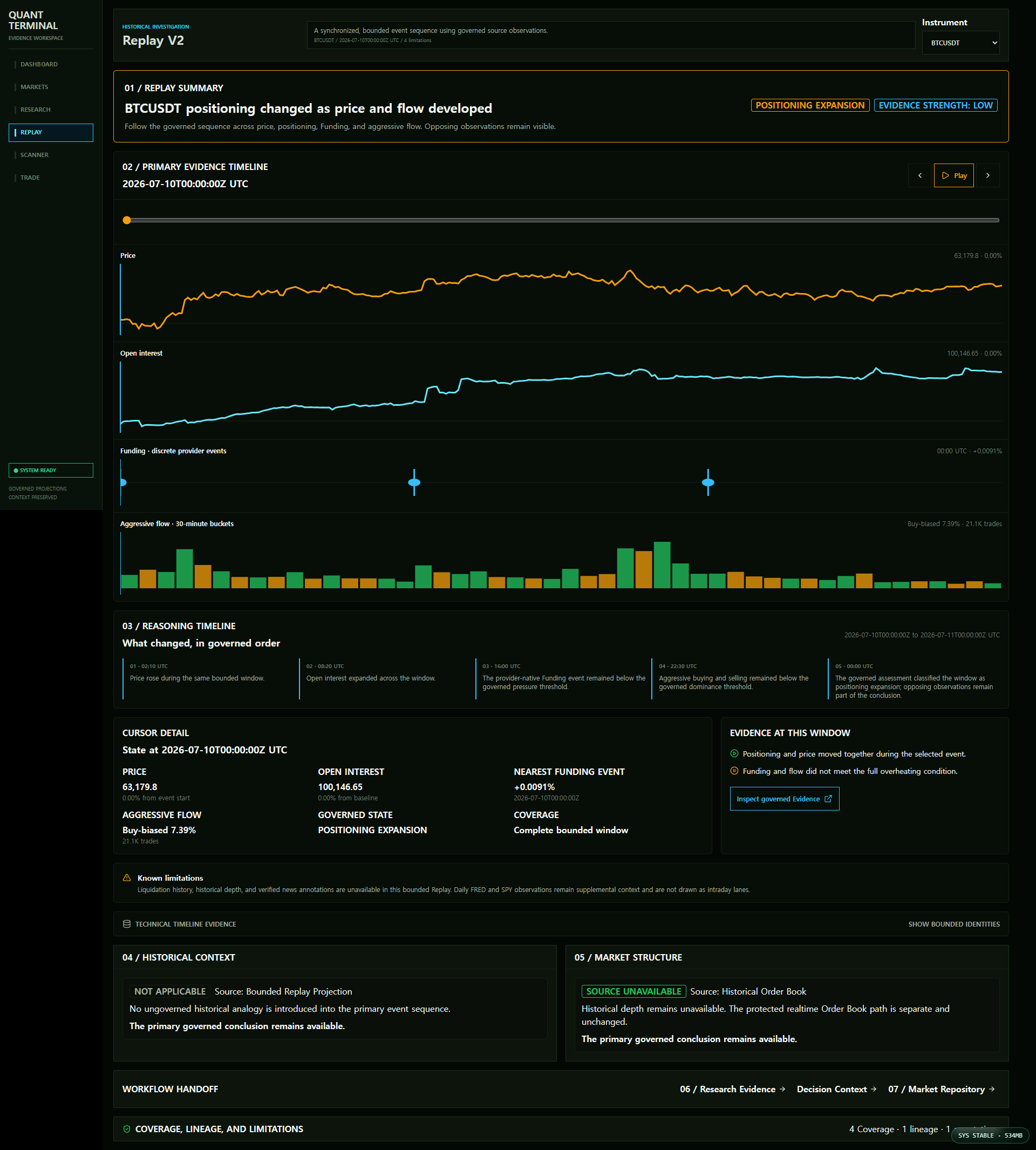
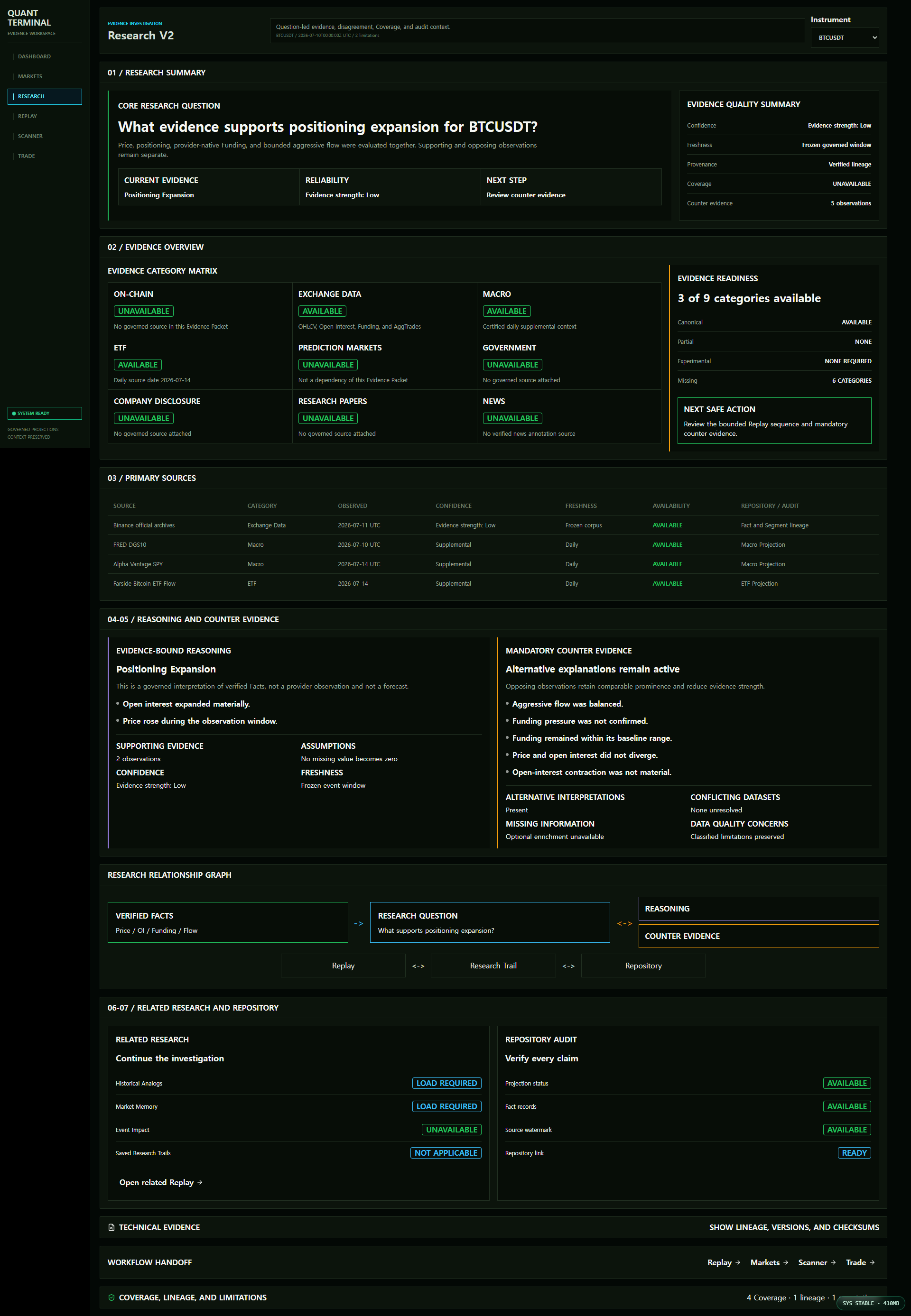
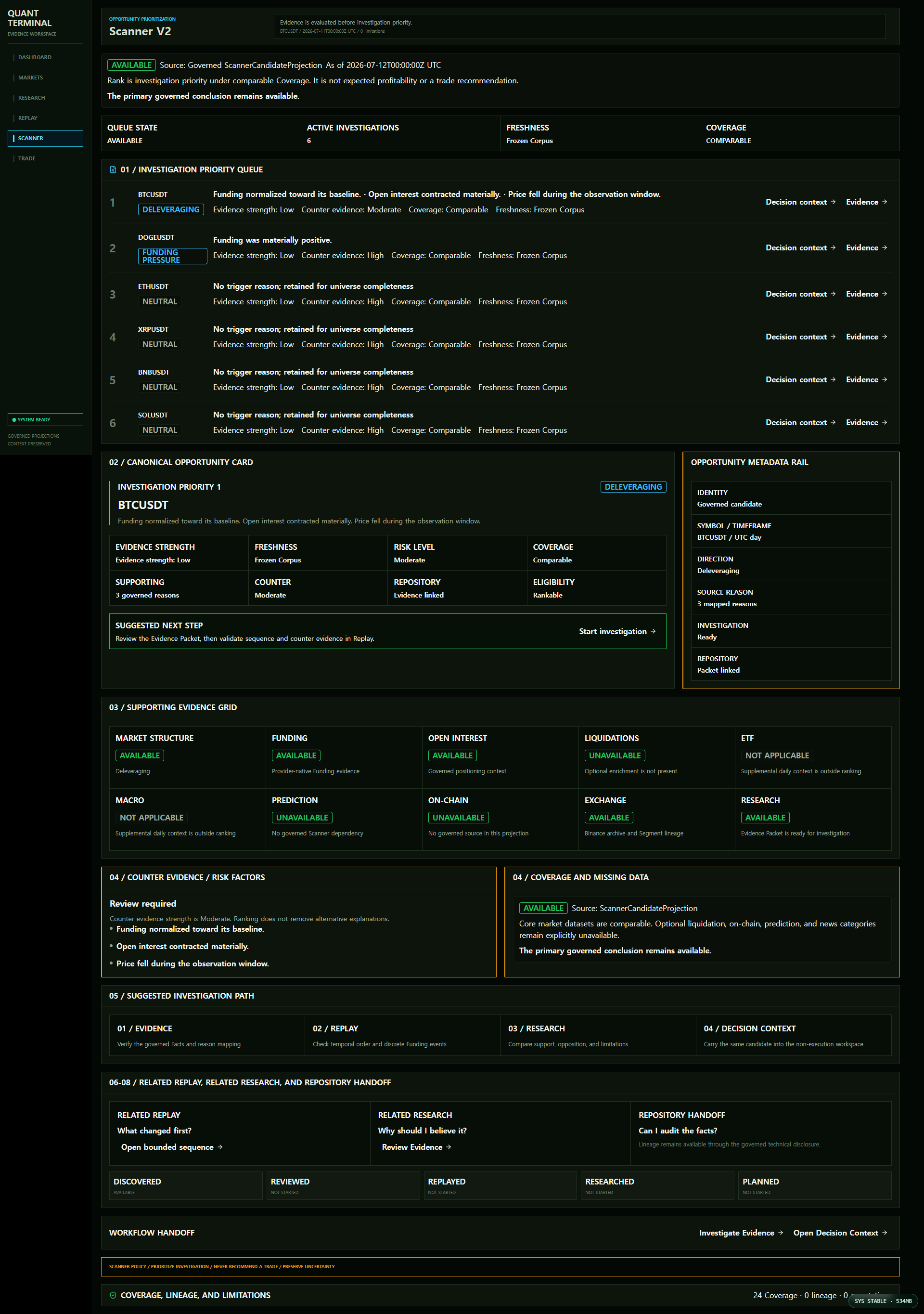
Inspiration
Crypto markets generate an overwhelming amount of information: price movements, open interest, funding rates, liquidations, order books, on-chain activity, news, and macroeconomic data.
The problem is not simply finding more data. The real problem is understanding which claims are supported by evidence, which are only interpretations, and what information is still missing.
Most market tools either present disconnected charts or produce confident AI summaries without showing how the conclusion was reached. I built QuantTerminal: Market Evidence Copilot to make AI-assisted market research more transparent, traceable, and honest about uncertainty.
What it does
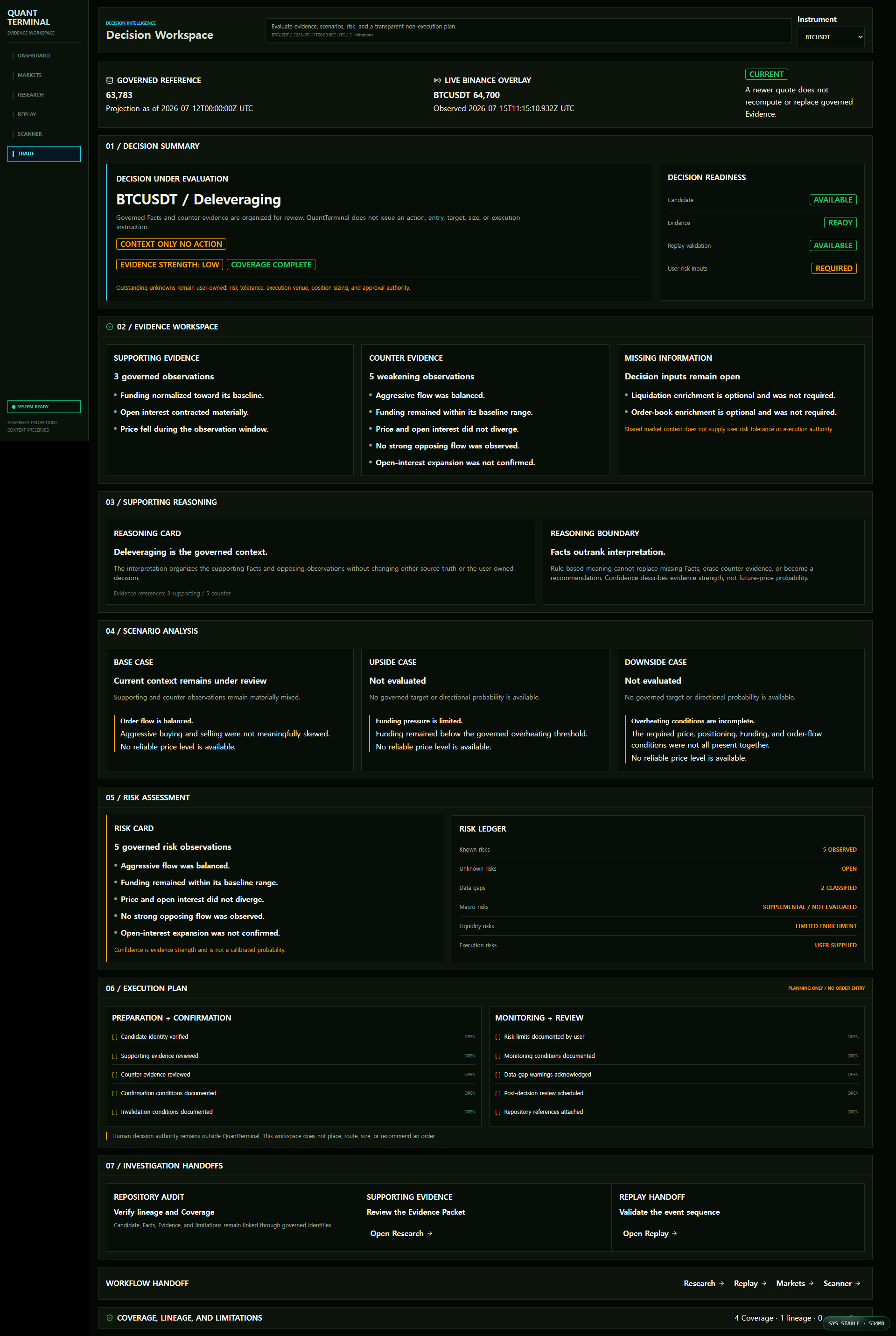
QuantTerminal transforms fragmented market information into a structured evidence brief.
For a selected asset or market event, it organizes the analysis into:
- What changed: observable market facts and measurable changes
- Why it may matter: evidence-linked interpretations generated with GPT-5.6
- Supporting evidence: the data behind each explanation
- Counter-evidence: facts that weaken or contradict the main interpretation
- Unknowns: unavailable, stale, or insufficient data
- Source lineage: where the information came from and when it was observed
Instead of producing a simple buy or sell signal, the system helps traders and researchers understand the evidence behind a market narrative.
The interface follows a simple hierarchy:
Conclusion → Reason → Evidence → Uncertainty
This allows users to understand the market situation quickly while still being able to inspect the underlying information.
Build Week contribution
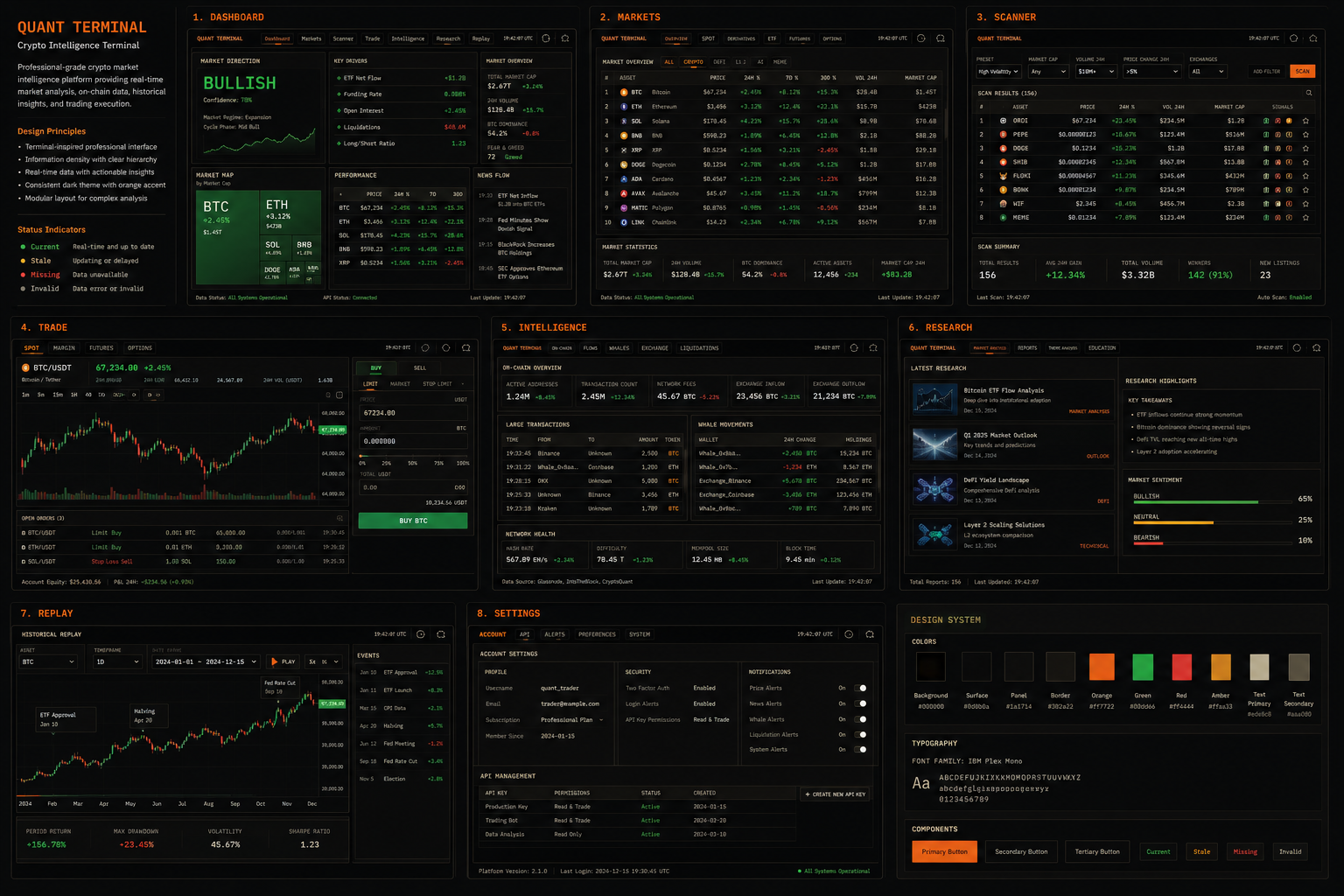
QuantTerminal existed before OpenAI Build Week as a broader crypto market intelligence platform.
This submission focuses specifically on the new Market Evidence Copilot extension developed during Build Week.
The new work includes:
- A structured market evidence model
- GPT-5.6-powered evidence interpretation
- Separation of facts, interpretations, counter-evidence, and unknowns
- Source-aware and timestamp-aware outputs
- A dedicated evidence copilot interface
- Validation, testing, and documentation for the new workflow
The pre-existing QuantTerminal dashboard, data infrastructure, and research pages are used only as the foundation for this extension and are not presented as work created during Build Week.
How I built it
The application is built with Next.js, React, TypeScript, Node.js, and PostgreSQL.
Market observations are first normalized into a structured evidence bundle. Each item can contain its value, timestamp, source, availability state, and relevant metadata.
GPT-5.6 receives this structured evidence rather than an unrestricted natural-language request. It then produces an organized response that distinguishes:
- Directly observed facts
- Evidence-supported interpretations
- Alternative explanations
- Missing or uncertain information
The result is displayed in a research-focused interface where users can move from a high-level conclusion to the underlying evidence.
How I used Codex
Codex served as my primary engineering partner during Build Week.
I used Codex to:
- Analyze the existing QuantTerminal architecture
- Design the evidence contracts and structured output format
- Implement changes across the API, application, and UI layers
- Review cross-file architectural consistency
- Generate and improve tests
- Diagnose implementation failures
- Document technical and product decisions
Instead of using Codex only to generate isolated code snippets, I used it as an iterative engineering agent across planning, implementation, testing, review, and documentation.
Challenges I ran into
The largest challenge was preventing the AI from turning incomplete evidence into an overly confident market explanation.
A plausible explanation is not necessarily a proven explanation.
To address this, the system treats missing data and contradictory evidence as first-class outputs. When sufficient evidence is unavailable, the interface should clearly display that limitation instead of inventing an answer.
Another challenge was connecting multiple types of market evidence without losing timestamps, source identity, or data lineage.
Accomplishments that I'm proud of
I am most proud that the project does not treat AI confidence as evidence.
The copilot is designed to expose the reasoning structure behind an interpretation and make uncertainty visible to the user.
I am also proud of creating a workflow that combines an existing market-data foundation with GPT-5.6 while preserving clear boundaries between facts and generated analysis.
What I learned
I learned that reliable AI market analysis requires more than a strong model.
The surrounding system must control what evidence the model receives, preserve its source and timestamp, validate the output structure, and make uncertainty visible in the product experience.
Codex was particularly useful for managing changes that crossed multiple architectural layers and for repeatedly reviewing whether the implementation still matched the original product constraints.
What's next for QuantTerminal
The next steps are:
- Add more macroeconomic, on-chain, and public-data sources
- Compare competing explanations for the same market event
- Connect evidence briefs to historical market replay
- Add reusable research reports and alerts
- Expand beyond crypto into tokenized assets and 24-hour financial markets
- Introduce expert review and multi-agent verification workflows
The long-term goal is to build an evidence-based market intelligence platform that reduces information asymmetry rather than another signal or news-summary product.
Built With
- api
- codex
- crypto
- data
- docker
- git
- github
- gpt-5.6
- market
- next.js
- node.js
- on-chain
- openai
- postgresql
- react
- rest
- typescript
- websockets

Log in or sign up for Devpost to join the conversation.