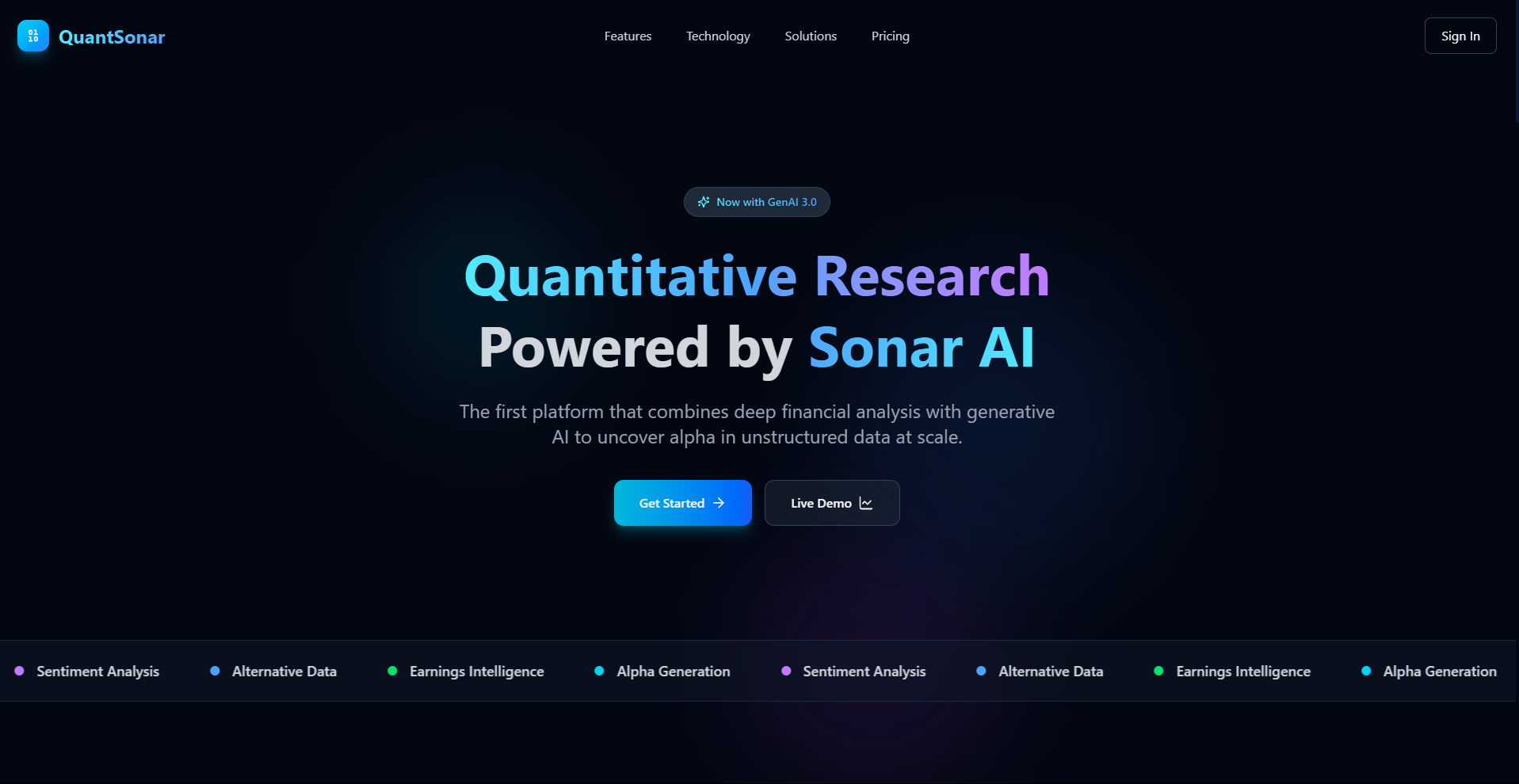
🚀 About the Project: QuantSonar 🎯 Inspiration Institutional investors operate in a world flooded with data but starved for clarity. From dense earnings calls to real-time social sentiment, making sense of noisy, fragmented sources can be overwhelming—and costly.
I wanted to build something that not only synthesized this chaos but offered trustworthy, actionable insights that could move real portfolios. The idea for QuantSonar was born:
An AI-powered quantitative research assistant that delivers alpha, manages risk, and ensures compliance—faster and smarter than ever before.
🧠 What I Learned AI is only as good as its reasoning: Transparent, chain-of-thought explanations were essential to earn trust from financial users.
Institutional needs are deep and specific: Surface-level summaries weren’t enough—our tools had to be data-rich, citation-backed, and audit-friendly.
UX matters for trust: Visualizing insights clearly, and allowing data traceability, significantly improved credibility and usability.
🛠️ How I Built It Frontend: A responsive, React-based web dashboard that displays research briefs, trade signals, backtest results, and risk visualizations.
Backend + AI:
Integrated the Sonar API for deep research queries across real-time (X posts, news) and static sources (SEC filings, historical data).
Built NLP pipelines to flag contradictions, extract sentiment, and generate chain-of-thought narratives.
Used predictive modeling to forecast risks and alpha signals.
Data Sources: SEC filings, earnings call transcripts, social media sentiment, ETF flows, commodity prices, central bank policy updates, and more.
⚔️ Challenges I Faced Data Overload: Designing a system that filters signal from noise while remaining explainable was tough—especially with volatile real-time inputs.
Latency vs. Depth: Balancing fast performance with deep, citation-heavy insights required careful API chaining and caching.
Contextual Accuracy: Financial language is nuanced. Ensuring that the AI understood not just what was said, but what it implied, involved multiple iterations on our LLM prompt design.
Backtesting at Scale: Running statistical tests on alternative data sources (e.g., CEO LinkedIn activity) while ensuring significance and reproducibility pushed the limits of our modeling pipeline.
Built With
- firebase
- next.js
- sonarapi

Log in or sign up for Devpost to join the conversation.