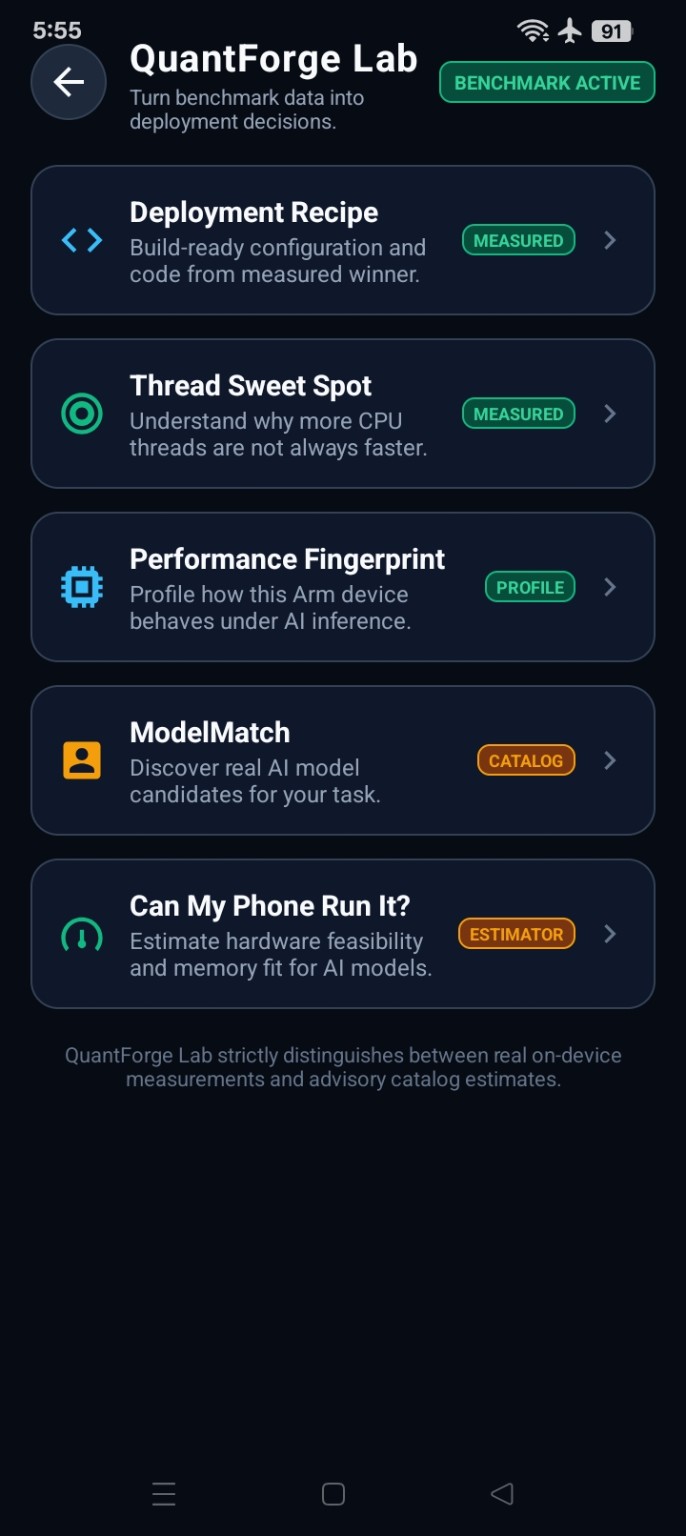
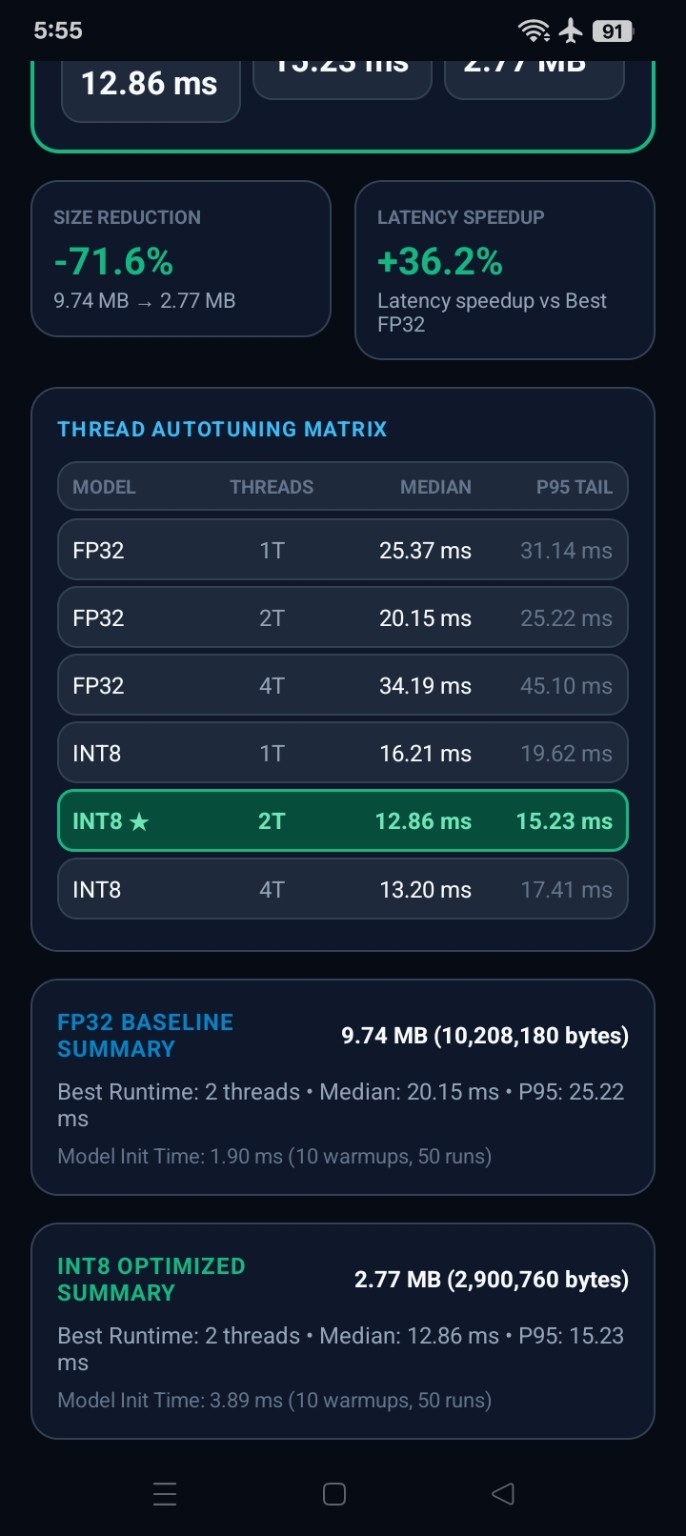
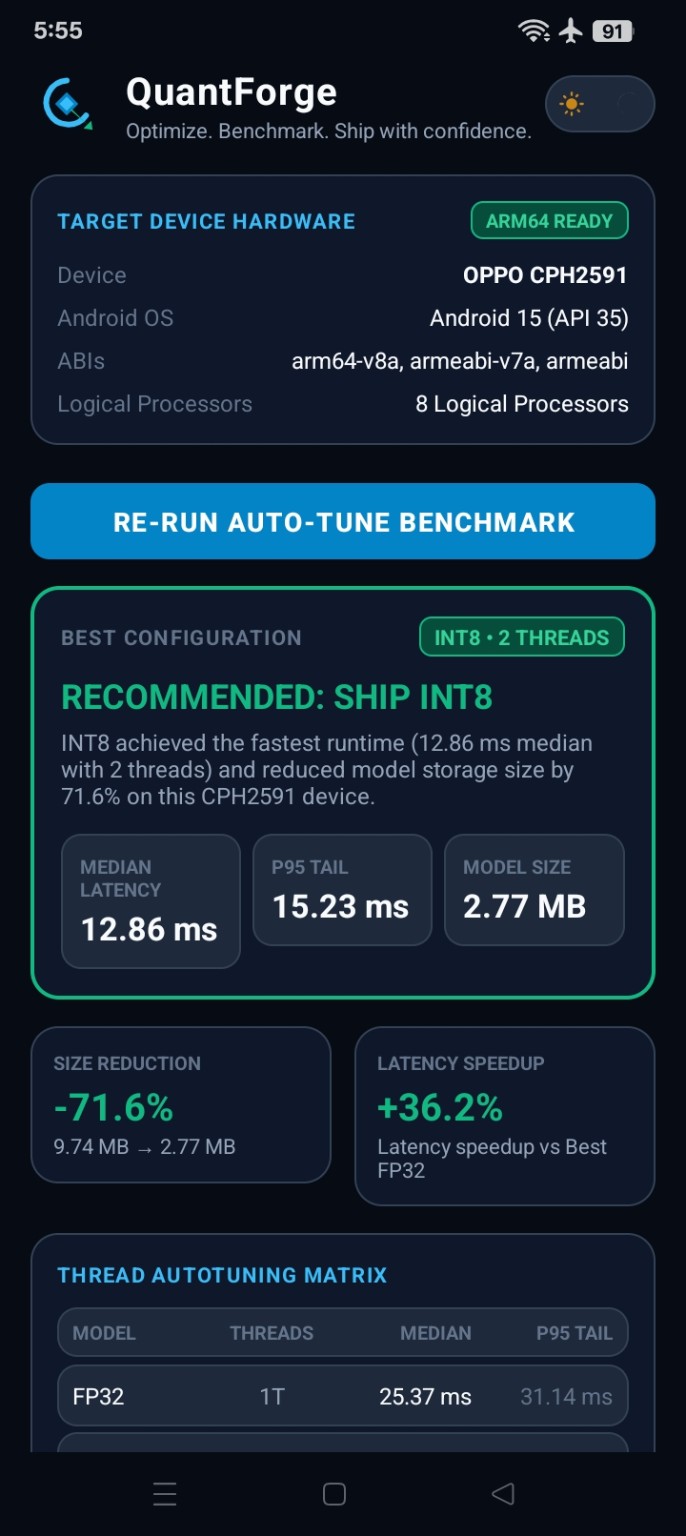
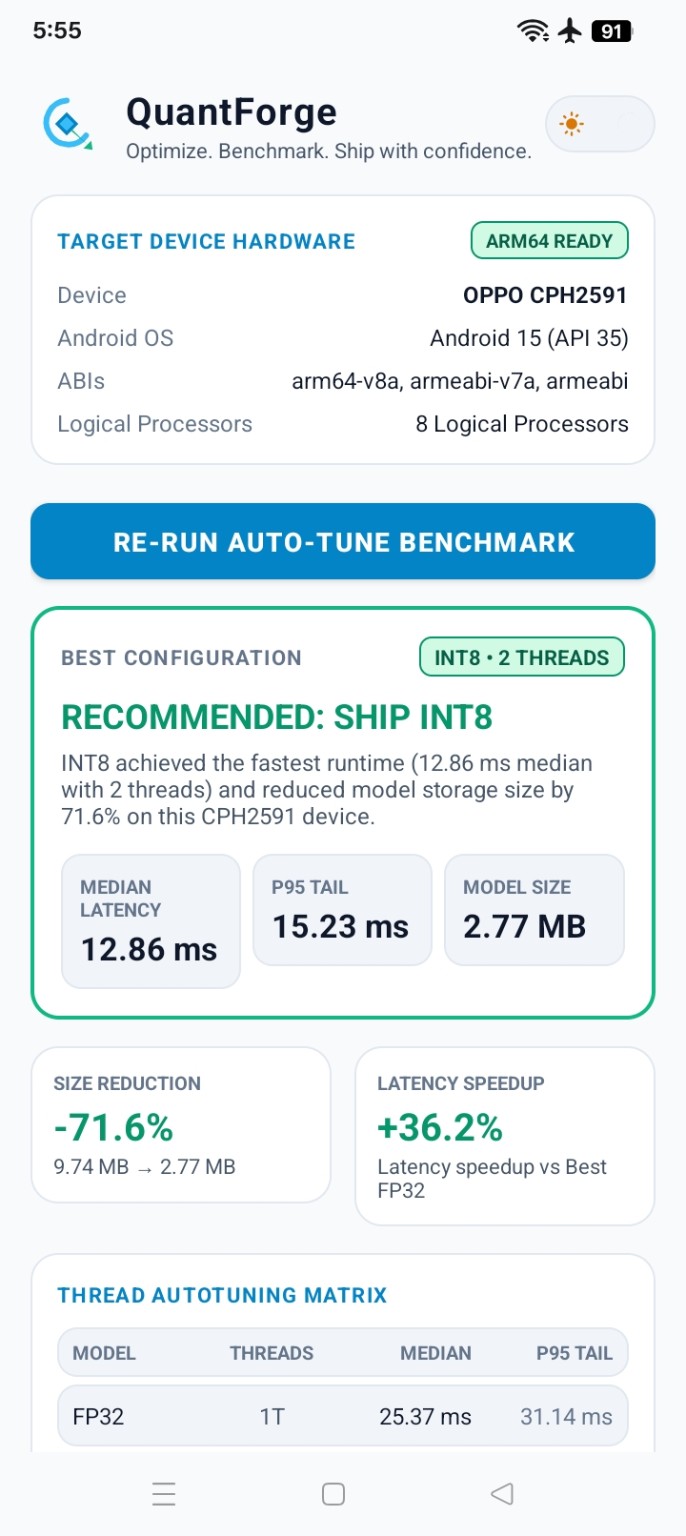
Inspiration
Running open-source AI models locally is confusing.
A developer may see a model such as Qwen, Llama, Gemma, Mistral, or DeepSeek and have no simple way to know whether their laptop or PC can actually handle it.
Model parameter count alone is not enough. RAM, VRAM, quantization, context length, inference runtime, and CPU/GPU configuration all affect whether a model will work well.
We built QuantForge to make this decision simple.
Instead of downloading a huge model, configuring a runtime, and discovering that it does not fit, users can check compatibility first and receive an actionable deployment recommendation.
What It Does
QuantForge helps users answer:
“Can my computer run this AI model?”
Users select or enter an open-source AI model and provide their device specifications.
QuantForge analyzes:
Model parameter count Estimated model memory FP16/BF16 requirements Quantized model sizes System RAM GPU VRAM CPU/GPU availability Runtime overhead Context-size considerations Local inference feasibility
It then produces:
A 0–100 compatibility score Compatibility status Recommended quantization Recommended inference method RAM/VRAM estimates Suggested context configuration CPU/GPU recommendation Plain-language explanation Smaller alternative models when the selected model is too demanding
For example, if someone with 8 GB RAM chooses a very large 70B model, QuantForge does not simply say “No.”
It explains why the model is impractical and recommends smaller models and quantized configurations that better match the user's hardware.
New for Pixel Forge AI Hackathon 2026
For Pixel Forge 2026, we expanded QuantForge with the new:
Model Compatibility Advisor
This new system allows users to search for an open-source model and determine whether it can realistically run on their hardware.
The new functionality includes:
Model compatibility analysis Hardware-based recommendations Quantization recommendations Compatibility scoring Model memory estimation AI-assisted explanations Alternative-model suggestions Model search and metadata support
The underlying compatibility decision is calculated using deterministic hardware and model analysis.
AI is used to turn those technical results into understandable recommendations rather than inventing the compatibility result itself.
How We Built It
QuantForge combines model metadata, hardware information, deterministic compatibility calculations, and AI-assisted explanations.
The system evaluates the approximate memory required by a model at different precision levels and compares those requirements with the user's available hardware.
Quantization estimates allow QuantForge to evaluate whether variants such as Q8, Q6, Q5, or Q4 are more suitable.
The compatibility engine considers factors including:
model parameters precision quantization RAM VRAM GPU availability runtime overhead context requirements
The calculated result is then presented through a developer-focused interface.
An AI explanation layer converts the compatibility analysis into simple recommendations such as which quantization to choose, whether to use CPU or GPU inference, and whether a smaller model would provide a better experience.
Why AI Matters
QuantForge is not simply a hardware calculator.
The compatibility engine generates structured technical analysis, while the AI Advisor interprets those results for the user.
It can explain:
why a model is difficult to run which quantization is appropriate what trade-offs the user should expect whether CPU or GPU inference is preferable what smaller model would work better what hardware bottleneck is limiting the model
This turns complex local-AI deployment information into actionable guidance.
Challenges We Ran Into
One major challenge was that model compatibility cannot be determined from parameter count alone.
Two similarly sized models may behave differently depending on precision, context length, runtime overhead, quantization format, and hardware configuration.
Another challenge was preventing the AI layer from hallucinating technical compatibility information.
To solve this, QuantForge separates the system into two layers:
A deterministic compatibility engine performs the technical calculations. AI explains the calculated result in understandable language.
This keeps the recommendations useful while making the core decision more reliable.
Accomplishments We're Proud Of
We are especially proud that QuantForge turns a complicated local-AI deployment problem into a simple user experience.
Instead of requiring users to understand model memory formulas, quantization formats, VRAM requirements, and inference runtimes, QuantForge produces one clear compatibility assessment.
We are also proud of separating deterministic analysis from AI-generated explanations, allowing AI to improve usability without becoming the source of truth for hardware compatibility.
What We Learned
Building QuantForge showed us how many factors affect local AI inference beyond simply looking at model parameter count.
We learned more about:
model quantization local inference model memory estimation VRAM limitations CPU/GPU inference context-memory trade-offs model metadata designing AI systems around deterministic tools
Most importantly, we learned that AI is most useful when combined with reliable computation instead of replacing it.
What's Next for QuantForge
Next, we want to expand QuantForge into a complete local-AI deployment intelligence platform.
Future features could include:
Automatic Hugging Face model discovery More accurate model-specific memory calculations Real-world benchmark crowdsourcing Tokens-per-second estimates Multi-GPU analysis Apple Silicon optimization Automatic Ollama and llama.cpp command generation Model-vs-model comparisons Hardware upgrade recommendations One-click optimized deployment configurations
Our long-term goal is simple:
Before downloading an AI model, developers should be able to ask QuantForge whether it will actually work on their machine.
Technologies Used
Python JavaScript / TypeScript React HTML CSS AI/LLM API Hugging Face model metadata REST APIs GitHub Vercel / Render / your actual hosting provider Built With Tags
Use whichever Devpost lets you select:
artificial-intelligence, machine-learning, developer-tools, open-source, llm, generative-ai, web, model-optimization, local-ai
Demo Video Description
QuantForge — AI Model Compatibility Advisor | Pixel Forge AI Hackathon 2026
QuantForge helps developers determine whether an open-source AI model can run on their hardware before downloading or deploying it.
The demo shows model selection, hardware configuration, compatibility scoring, quantization recommendations, memory estimates, and AI-assisted deployment guidance.
Repository
Paste your public GitHub repository URL.
Try It Out
Paste your live hosted project URL.
License
MIT License
Make sure LICENSE actually exists in the root of the GitHub repository.
Built With
- actual
- ai/llm
- api
- apis
- built
- css
- face
- github
- hosting
- html
- javascript
- metadata
- model
- provider
- python
- react
- render
- rest
- typescript
- vercel
- with

Log in or sign up for Devpost to join the conversation.