Inspiration
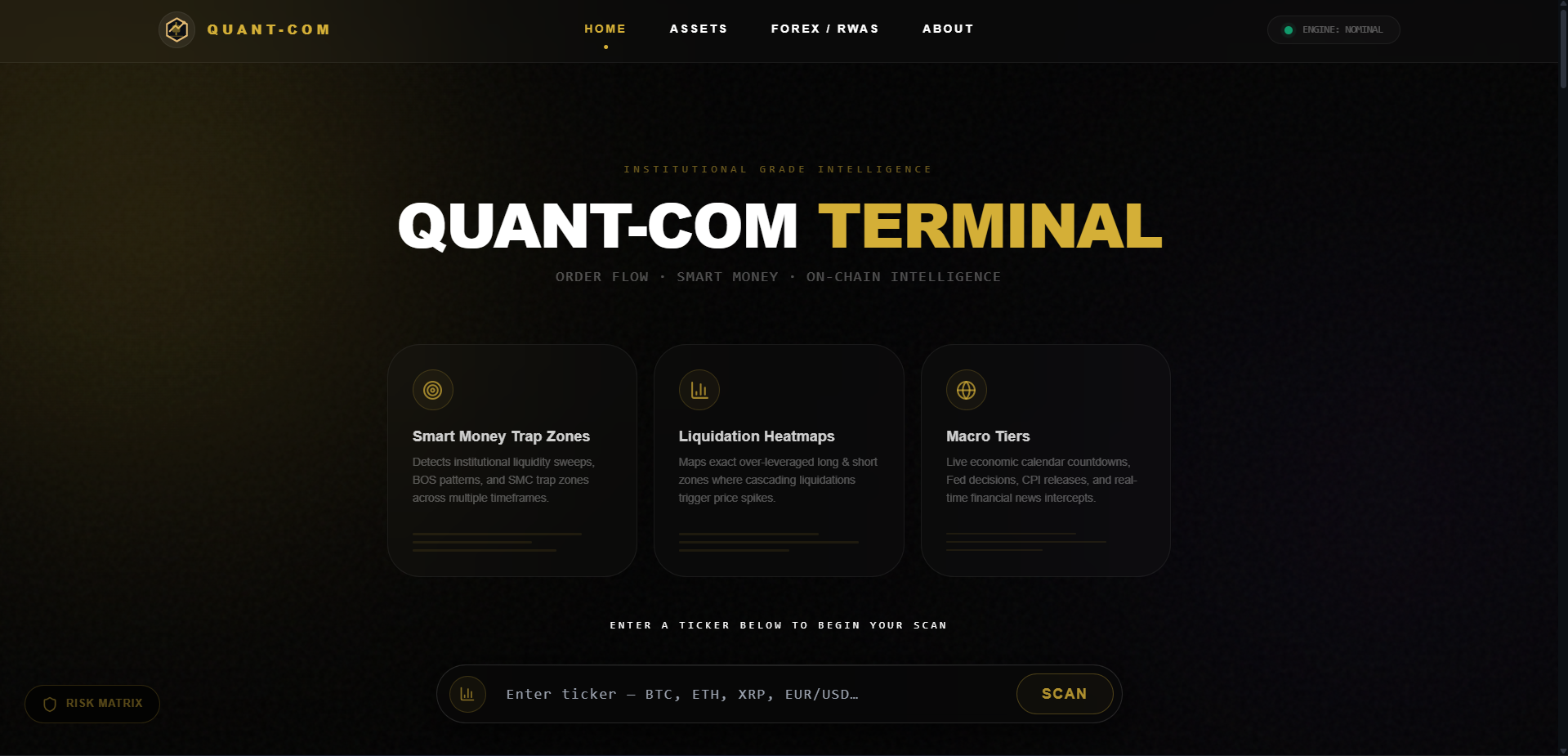
Retail traders are constantly trading blind, getting hunted by institutional "Smart Money" algorithms. While hedge funds leverage advanced multi-exchange aggregators, real-time RWA tracking, and on-chain liquidity depth to map retail stop-loss clusters, everyday traders rely on lagging indicators. We wanted to build an institutional-grade market intelligence terminal that levels the playing field—giving retail traders clear visibility into global liquidity blocks, asset flows, and algorithmic traps.
What it does
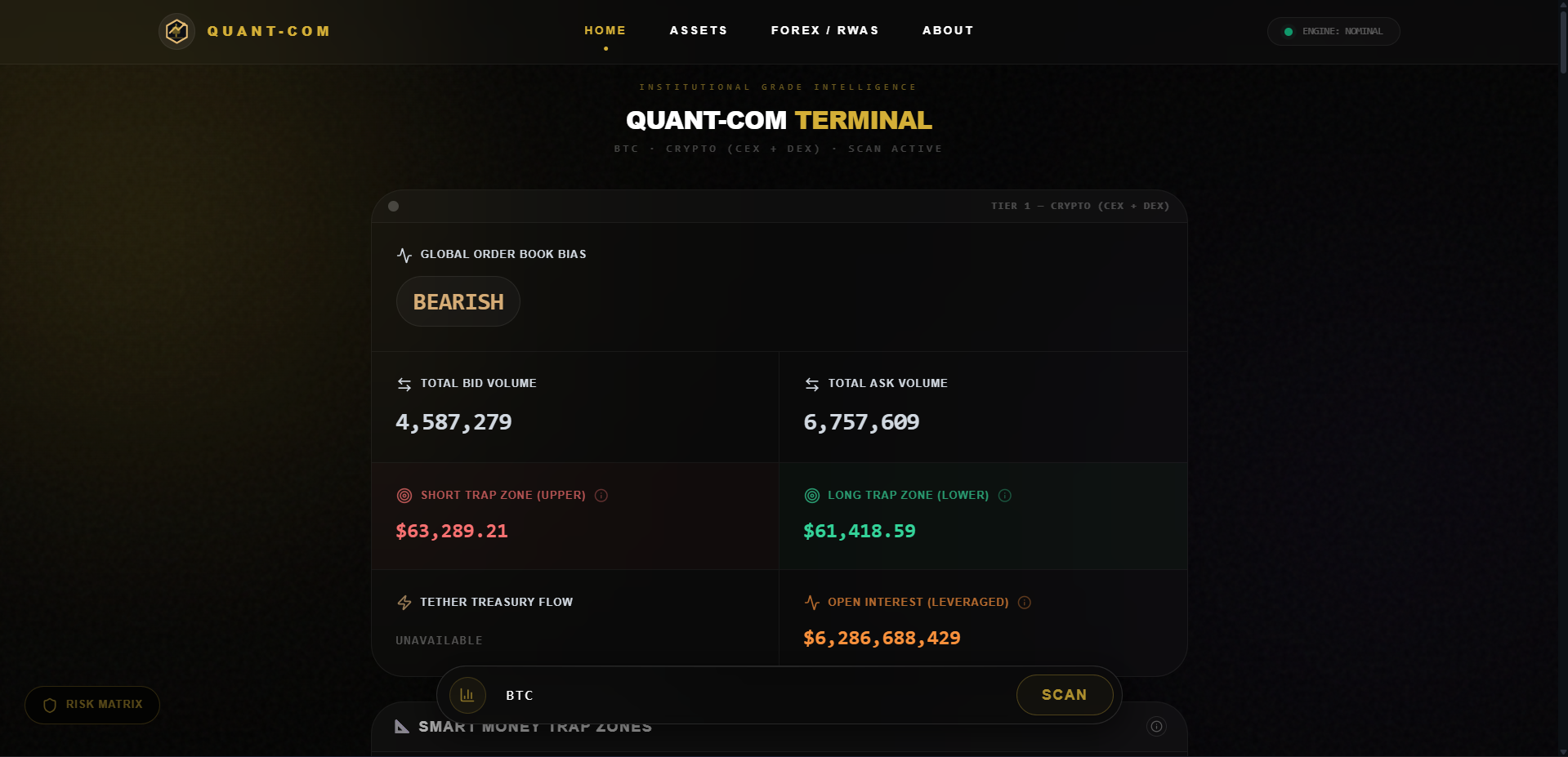
QuantCom is a sleek, glassmorphic trading intelligence terminal that cuts through market noise to reveal exactly where smart money is positioned. It delivers core features through a unified dashboard: Consolidated Order Book (COB): Aggregates global bid/ask arrays from multiple major exchanges simultaneously to calculate overall global liquidity depth. XRPL & RWA Flow Trackers: Monitors deep XRPL on-chain liquidity sweeps and tracks BlackRock’s BUIDL RWA token vault on Ethereum in real-time for large-scale mint and burn events. Liquidation Heatmaps: Parses raw order book data to locate dense clusters of retail stop-losses, rendering glowing, high-fidelity trap zones via a visual heatmap. Prop-Firm Risk Matrix: An integrated algorithmic calculator that uses custom account parameters to enforce strict mathematical risk management.
How we built it
We built QuantCom using a modular, highly responsive architecture:
Frontend: Crafted with raw HTML, CSS, and vanilla JavaScript to avoid bloated framework overhead. It utilizes custom glassmorphism styles with neon pulsing states, skeleton loaders, and Odometer.js to animate streaming volume numbers smoothly. The visual liquidation spots are rendered using a highly optimized implementation of Chart.js.
Backend: Powered by Python (omni_matrix.py and api_bridge.py), handling multi-exchange WebSocket connections and multi-threaded data scraping. It queries the Blockchair API to track specific smart contract addresses like BlackRock's tokenized fund.
Cloud Infrastructure: Fully deployed onto an Azure dedicated cloud server configuration to eradicate cold starts and ensure sub-second data propagation.
Challenges we ran into
Integrating live bid/ask arrays across completely different exchange APIs concurrently resulted in immense race conditions. Our Consolidated Order Book initially suffered from data desynchronization. We overcame this by refactoring our API aggregator into an asynchronous, non-blocking pipeline in Python that normalizes and flushes incoming books to the client at fixed intervals.
Another major challenge was optimizing the Liquidation Zone Processor. Sifting through millions of data rows to find dense retail stops caused massive latency spikes on the frontend chart rendering, which we resolved by implementing spatial binning algorithms on the server to pass pre-aggregated cluster coordinates.
Accomplishments that we're proud of
Successfully processing global multi-exchange data feeds into a single unified liquidity value on-the-fly.
Engineering a gorgeous, custom UI with high-performance animations that look and feel like premium terminal software.
Building a reliable, zero-latency pipeline that catches high-value token burns and mints instantly, feeding them back to a custom alerts system.
What we learned
We learned that building low-latency financial tech requires meticulous optimization at the data processing layer. We also mastered handling WebSockets efficiently, implementing custom data structures for the order books, and structuring clean, event-driven pipelines. On the financial side, we deepened our knowledge of how market makers engineer traps, capture liquidity, and optimize risk parameters via strict formulas.
What's next for QuantCom
The immediate next phase for QuantCom is turning it into an execution engine. We plan to build out an automated Web3 Prop Firm layer natively using Circle's stablecoin infrastructure and the Arc Agent Stack. This layer will deploy programmable AI Agent Wallets that monitor these risk matrices on-chain, enabling retail users to pass decentralized trading challenges and gain access to liquidity pools that execute trades instantly via USDC nanopayments.
Built With
- azure
- fastapi
- python
- react
- websockets
- xrpl

Log in or sign up for Devpost to join the conversation.