Gemini 3 Integration
QuantaVibe leverages Gemini 3 as the Sentinel Architect, a central kernel orchestrator that moves beyond standard chat interfaces into active agentic control.
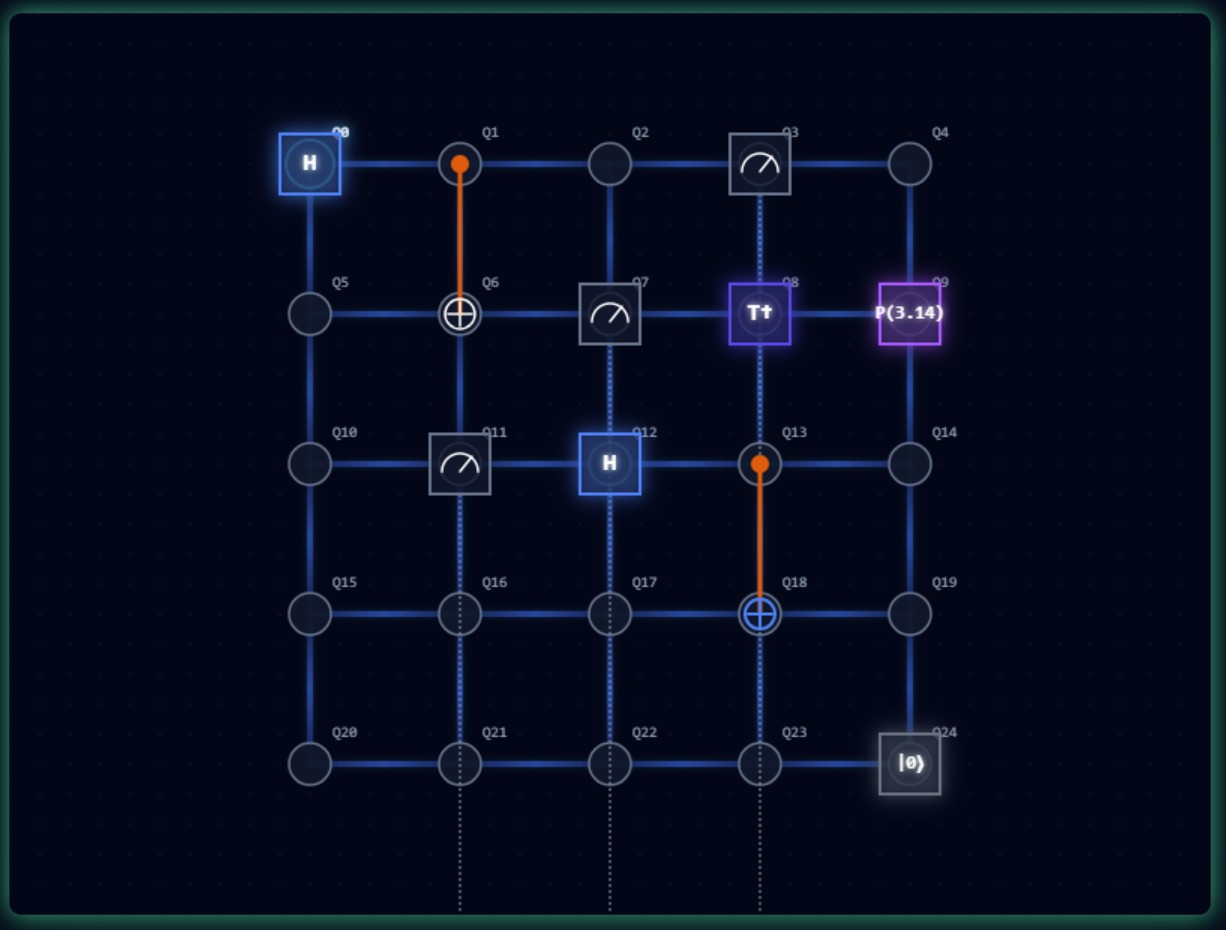
Agentic Hardware Synthesis: Gemini 3 acts as the system’s hardware engineer. Utilizing its advanced reasoning, the model translates natural language into high-fidelity "Digital Twins" of industry-leading processors like Google Willow and IBM Heron. It autonomously manages 110+ qubit registers and optimizes complex Heavy-Hex topologies, ensuring the AI understands physical hardware constraints.
Dynamic Plugin Injection: Central to the "Self-Evolving IDE" is Gemini 3’s ability to engineer and deploy functional software modules. Users can instruct the Architect to build new diagnostic tools, some of which can use the model to write, compile, and inject into the workstation in real-time. Plugins can also be modified or upgraded using Gemini 3.
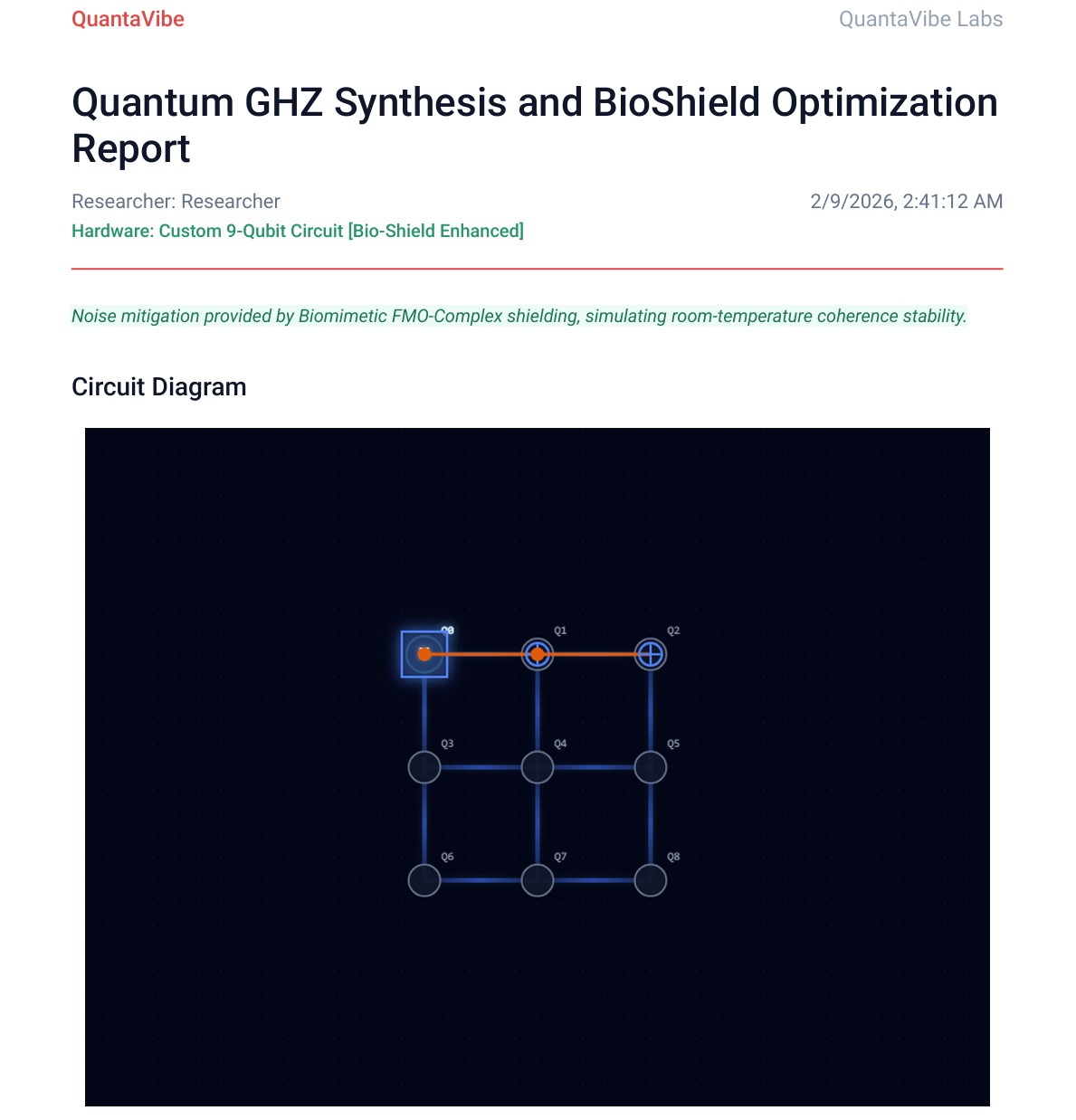
Scientific Data Orchestration: Gemini 3 automates the entire research lifecycle by synthesizing transient simulation data into immutable, peer-review-ready PDF Research Reports. It reasons through the biomimetic "BioShield" logic to explain 50% noise reduction metrics in academic terms, providing the necessary "Paper Trail" for professional research.
By bridging the gap between human intent and quantum physics, Gemini 3 transforms QuantaVibe from a passive simulator into an autonomous scientific collaborator capable of streamlining quantum application development.
Inspiration
The "Quantum Decade" is here, yet the barrier to entry remains sky-high. Most quantum IDEs are either overly academic or too simplistic. QuantaVibe was inspired by the idea of a "Sentinel Architect"—an agent powered by Gemini 3 that doesn't just help you write code but understands the physical constraints of a 156-qubit Heron processor and can architect a professional research workflow around it. The goal was to bridge the gap between theoretical models and real-world hardware deployment.
What it does
QuantaVibe is an agentic research station that streamlines the quantum development lifecycle through natural language. Using the Sentinel Architect, users can:
Architect Hardware Circuits: Create custom quantum hardware layouts for high-fidelity simulations with a single prompt.
Scan circuits through a webcam or import images of circuits and Gemini 3 will automatically construct the circuit.
Self-Evolving Tools: Instruct the AI to engineer and inject custom plugins and tools into the IDE in real-time to aid specific research needs.
BioShield Noise Reduction: Simulate and develop novel noise reduction methods, specifically the BioShield protocol—a biomimetic defense inspired by photosynthesis to stabilize qubits.
Automated Documentation: Generate detailed PDF Research Reports that include circuit analysis, state tomography, and scientific abstracts.
Production-Ready Export: Automatically output accurate Q#, Qiskit, and Cirq code that reflects the designed hardware's native gate sets and topology.
How we built it
The foundation of QuantaVibe was built through an iterative "Agent-to-Agent" workflow. Rather than manual coding, the system was developed by using complex prompts from Gemini 3 to instruct automated IDEs—primarily Gemini 3 Pro in Antigravity. This process involved a rigorous cycle of trial and error, where Gemini 3 provided the architectural blueprints and surgical fixes for the physics engine. Supplemental logic debugging and specialized code modules were refined with help from Claude Opus 4.6. This human-AI collaboration allowed for the rapid assembly of 110+ qubit simulators and a persistence layer capable of generating immutable scientific records.
Challenges we ran into
The primary hurdle was managing the "Visual vs. Performance" trade-off. Initial attempts at 3D rendering for 156-qubit digital twins throttled the browser's performance and hampered the AI's reasoning capabilities. This required a critical pivot to a leaner, document-centric architecture. Additionally, enforcing realistic hardware constraints—like the sparse connectivity of the Heavy-Hex layout—required engineering sophisticated routing logic to handle the SWAP-gate overhead necessary for long-distance qubit entanglement.
Accomplishments that we're proud of
The Plugin Injection system is a major milestone; seeing the AI write, compile, and deploy a functional tool into the sidebar in seconds feels like a glimpse into the future of development. We are also incredibly proud of the BioShield results. Successfully simulating a 50% noise reduction in a 110-qubit register by mimicking biological energy-transfer patterns provides a unique, high-impact solution to the problem of quantum decoherence.
What we learned
We learned that Agentic AI is the ultimate abstraction layer for hardware engineering. Building a true "Digital Twin" requires the AI to respect physical limitations like nearest-neighbor connectivity and native gate sets. This journey proved that combining nature’s efficiency with silicon computing can solve deep-tech problems that were previously inaccessible to individual developers.
What's next for QuantaVibe
While the submissions for this hackathon cannot be changed after the deadline, the vision for QuantaVibe continues to expand:
The Sentinel Network: Building a community-driven marketplace where researchers can share AI-generated BioShield profiles and hardware plugins.
Hybrid Cloud Handshakes: Integrating direct API links to IBM Quantum and Google Vertex AI to send "Bio-Shielded" circuits to real processors for execution.
Quantum-Bio Research: Collaborating with academic labs to refine our biomimetic noise models using real data from biological light-harvesting complexes.
Advanced Error Correction: Implementing automated surface code generation for 1,000+ qubit systems to prepare for the era of fault-tolerant quantum computing.
Built With
- antigravity
- claude
- css
- gemini3
- html
- javascript
- opus


Log in or sign up for Devpost to join the conversation.