Inspiration
As a quantitative trading enthusiast familiar with funded accounts and order flow, I noticed a massive gap in retail trading tools. Most retail traders only look at basic candlestick charts, while institutions use order book depth, whale interception metrics, and on-chain accumulation data. I wanted to build Quant-Com: an institutional-grade quantitative terminal that brings premium order flow intelligence to retail, while specifically highlighting the power of Tokenized Real-World Assets (RWAs) and native tokens on the XRP Ledger (XRPL).
What it does
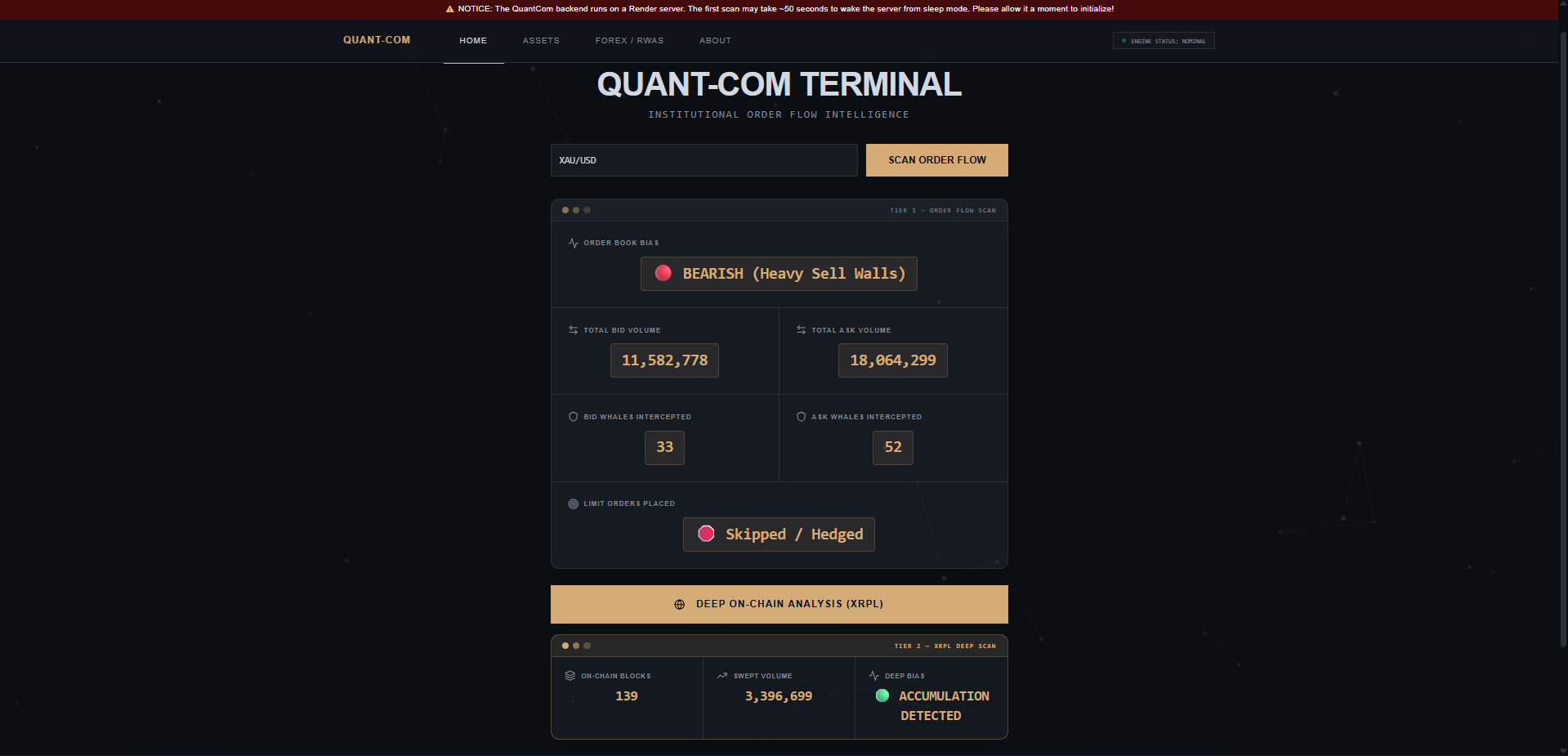
Quant-Com is a dual-tier quantitative intelligence terminal:
Tier 1 (Order Flow Scan): Analyzes real-time order book depth, calculates bid/ask whale interceptions, and determines market bias (Bullish/Bearish/Neutral) for major cryptocurrencies and Forex pairs.
Tier 2 (XRPL Deep Scan): A conditional scanner that unlocks specifically for assets native to the Ripple Ledger (like XRP, SOLO, RLUSD, and tokenized XAU/USD) to detect hidden on-chain accumulation and swept volume.
How we built it
Frontend: Developed entirely with MeDo AI. We utilized MeDo to instantly scaffold a highly complex layout isolating separate terminal views (Home, Assets, Forex) into fluid UI components.
Backend: Powered by a multi-threaded Python engine (omni_matrix.py) using FastAPI and Baidu AI API.
The Bridge: We built a custom "Liquidity Router" that dynamically pulls real API depth for crypto assets while generating simulated institutional liquidity pools for Forex/RWAs, feeding everything seamlessly to the frontend interface.
Challenges we ran into
The biggest challenge was the full-stack architecture and multi-protocol environment bridging. Routing Web2 API requests (like Binance) alongside Web3/XRPL assets required complex conditional logic and custom error handling so the real-time calculating engine wouldn't crash when switching to traditional Forex pairs.
Accomplishments that we're proud of
I am incredibly proud of executing an exceptionally user-friendly web application. MeDo AI did an outstanding job generating the Conditional Deep Scanning Layout Engine—a feature where the UI dynamically expands and morphs to reveal the complex Tier-2 ledger panels only when an XRPL asset is detected. Beyond the logic, the terminal genuinely looks and feels like a premium institutional software suite.
What we learned
This hackathon was a masterclass in full-stack debugging. I learned how strict TypeScript interfaces dictate state rendering across complex dashboard components, and how to build asynchronous Python routers that can handle high-frequency quantitative requests without blocking the main thread.
What's next for Quant-Com
The immediate next step is transitioning from prototype to production. I plan to deploy and host the Python engine on a dedicated 24/7 cloud server. Feature-wise, I want to integrate live institutional broker APIs (like OANDA) for real-time Forex data and connect directly to XRPL WebSocket nodes for millisecond-precise on-chain tracking.
Built With
- ai
- api
- medo
- python

Log in or sign up for Devpost to join the conversation.